-
-
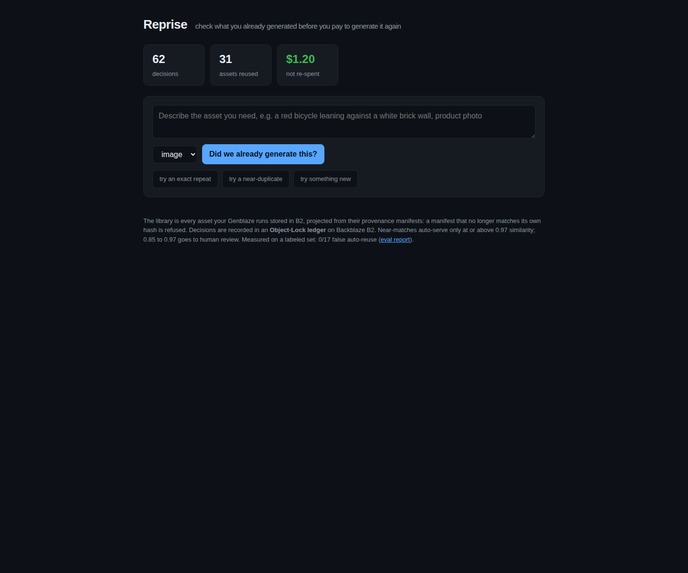
Every total on the scoreboard is folded from Object Lock records in B2, not from a counter the app can edit.
-
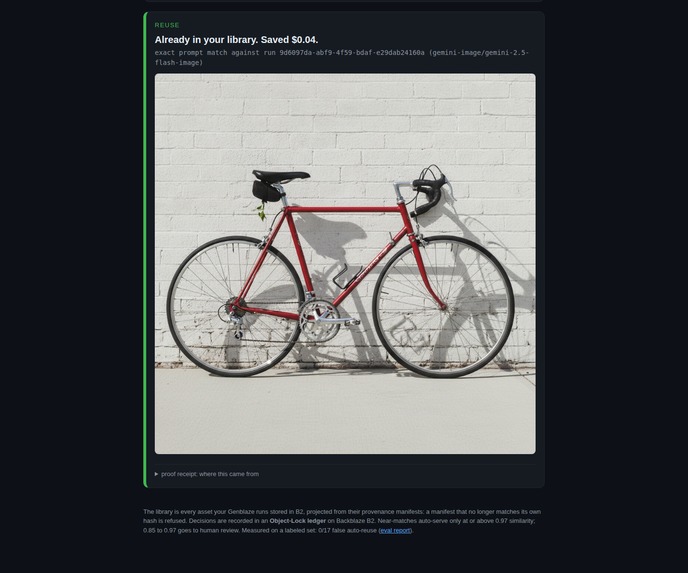
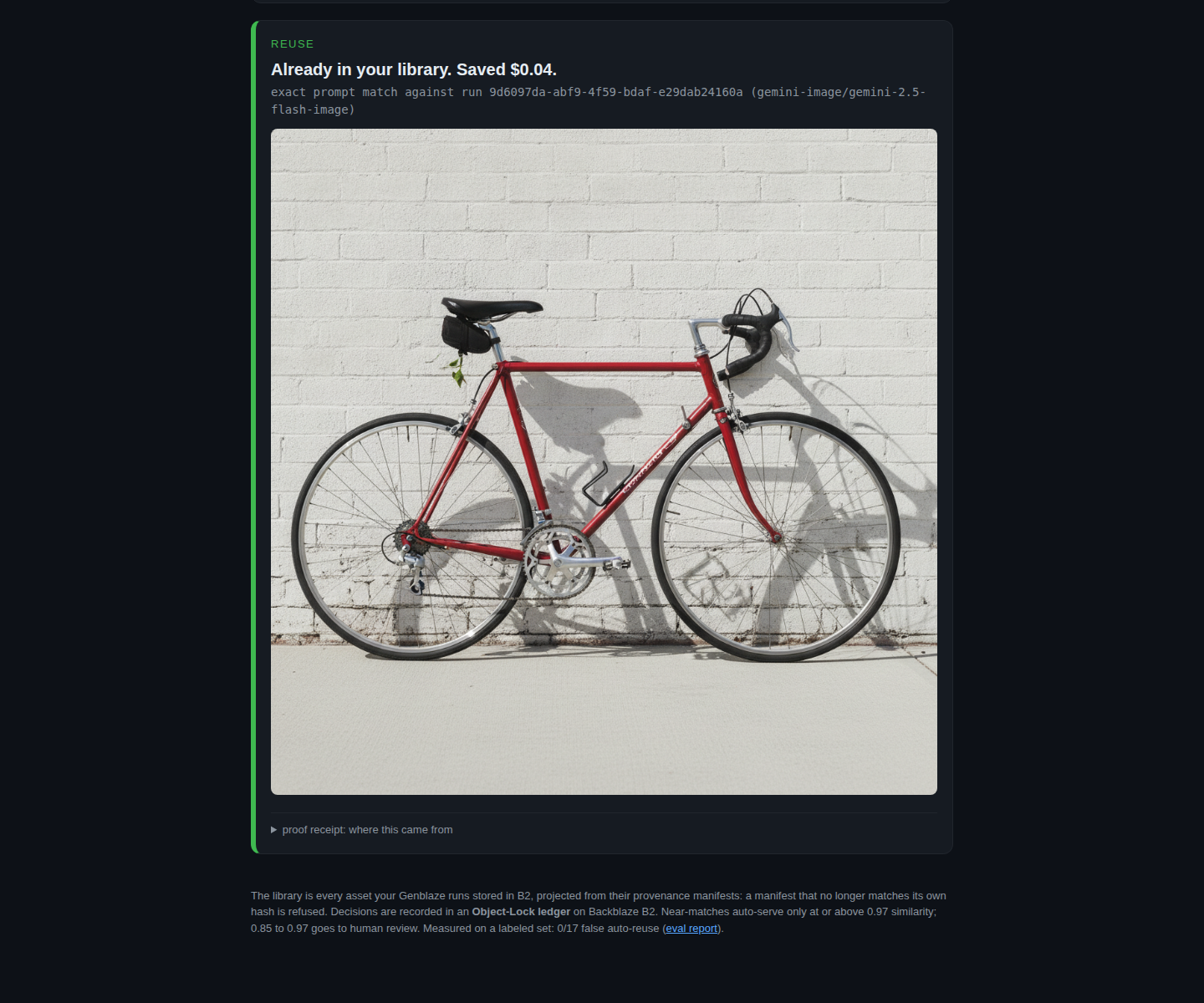
An exact repeat is answered from the library before any model is called, and the money not spent is booked as a saving.
-
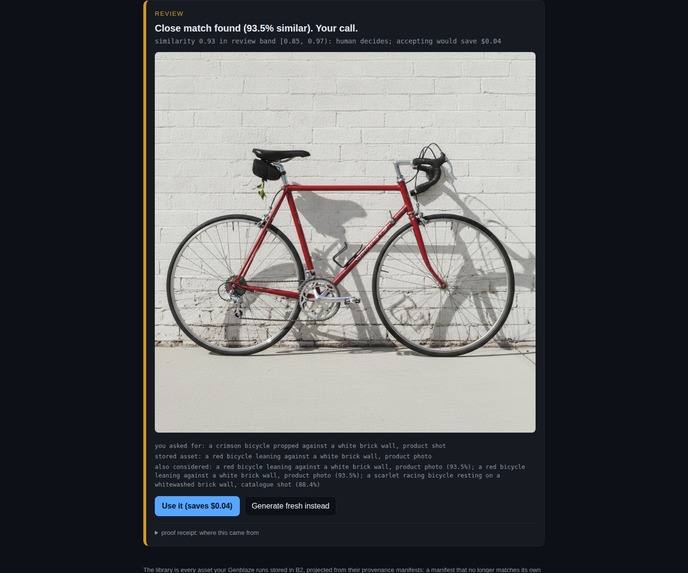
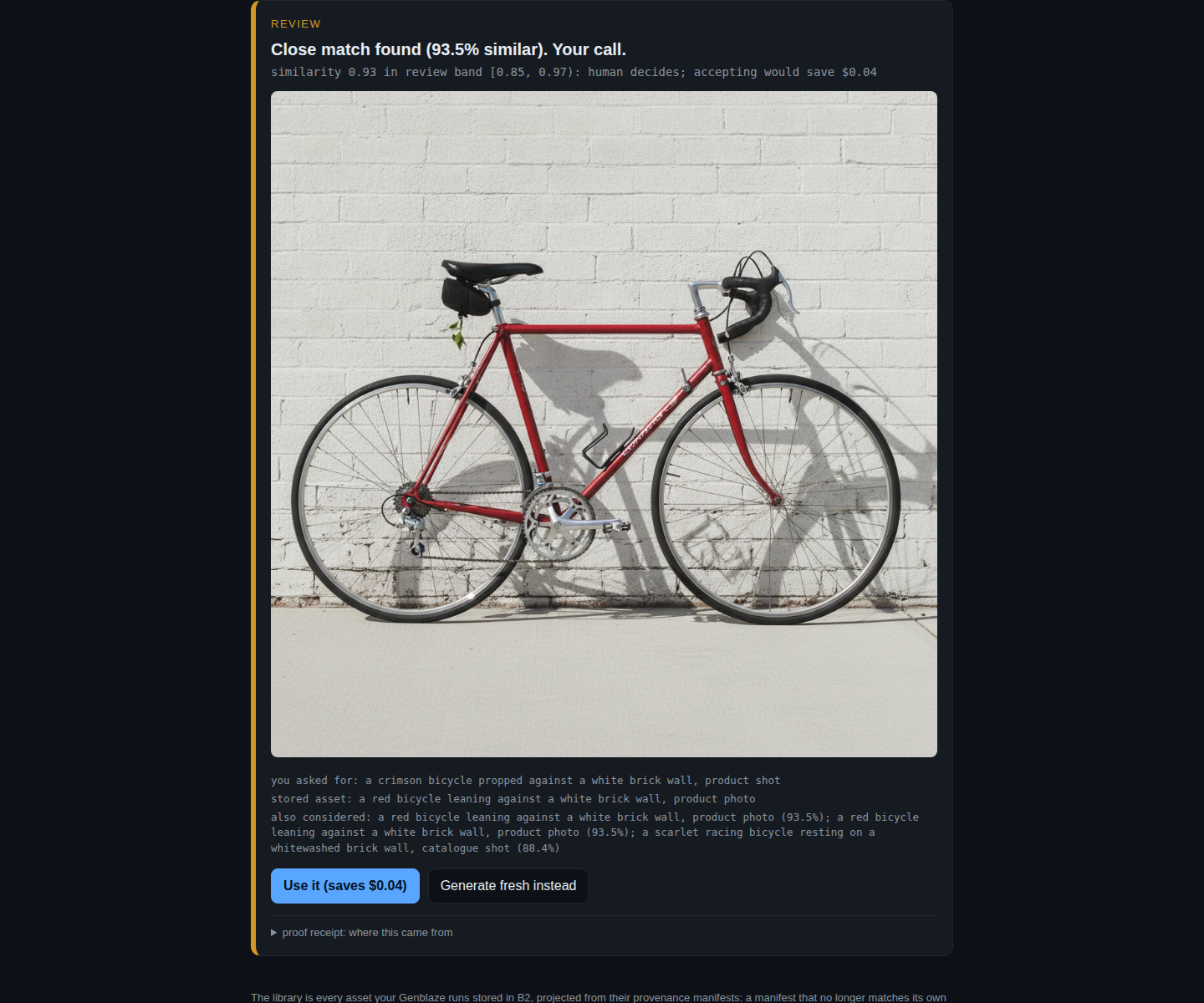
Between 0.85 and 0.97 similarity a human decides. The request, the stored prompt and the runner-up candidates are all shown side by side.
-
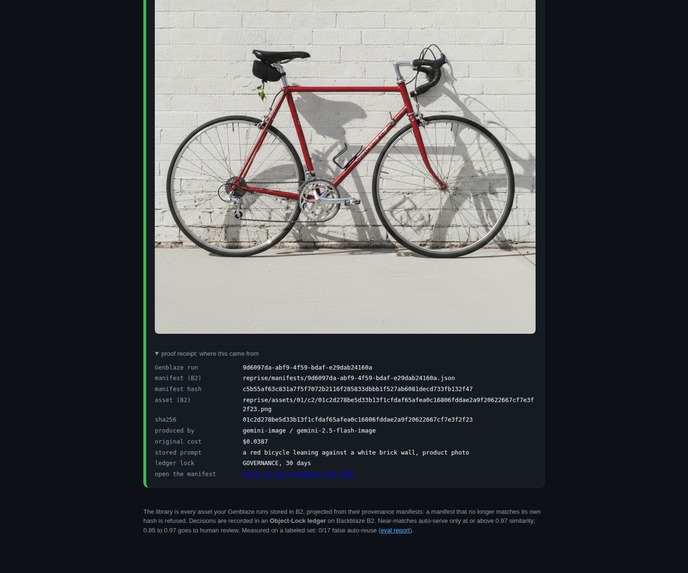
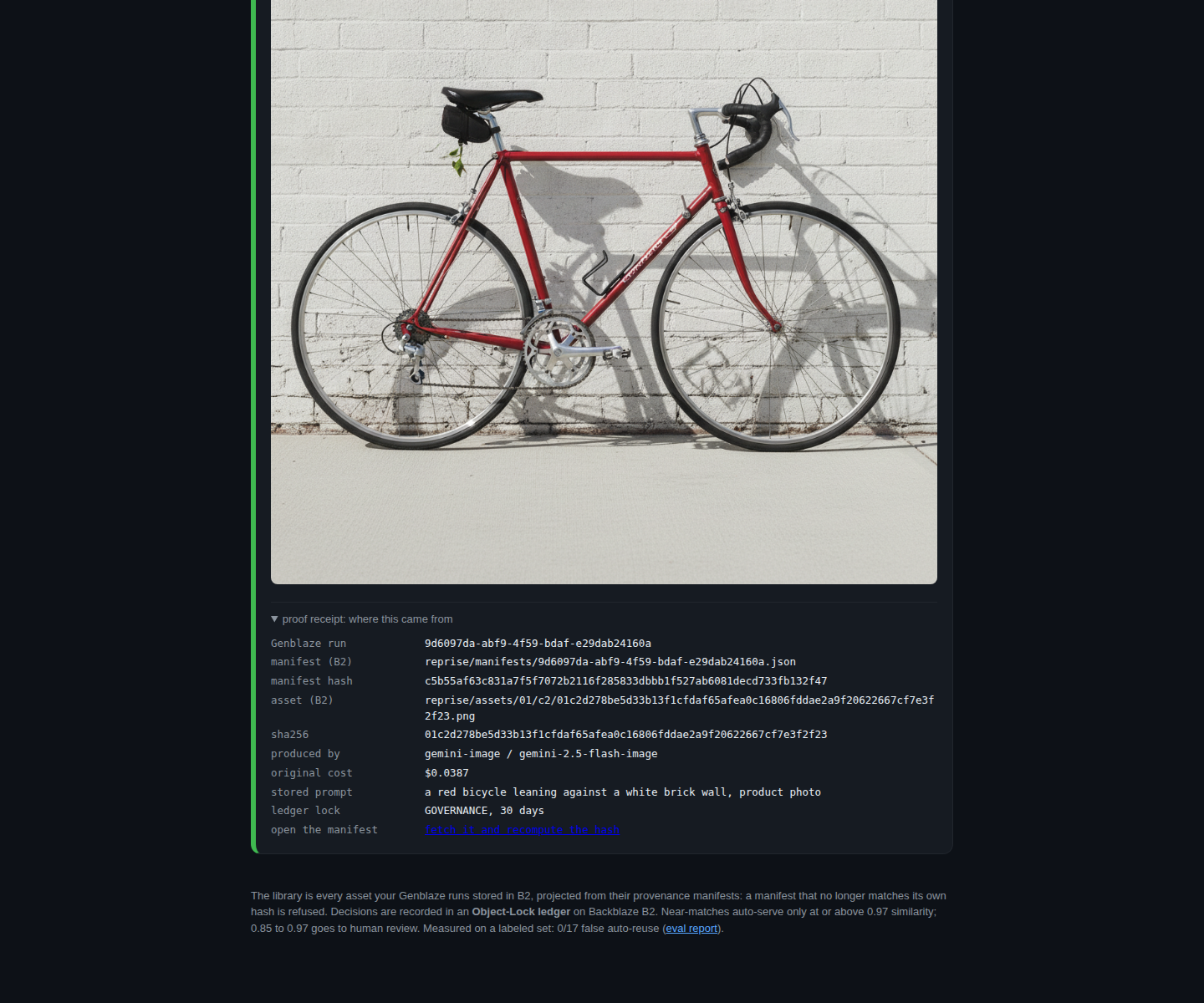
The receipt names the run, model, stored key and manifest hash, and links the manifest so a reader can recompute the hash.
-
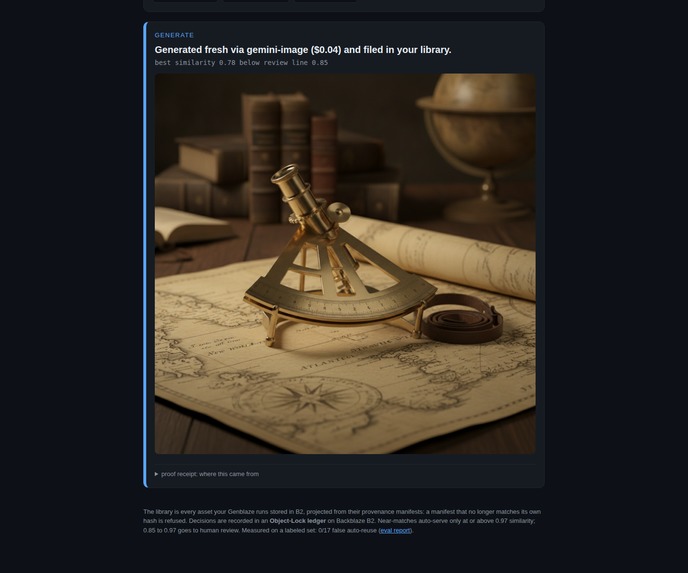
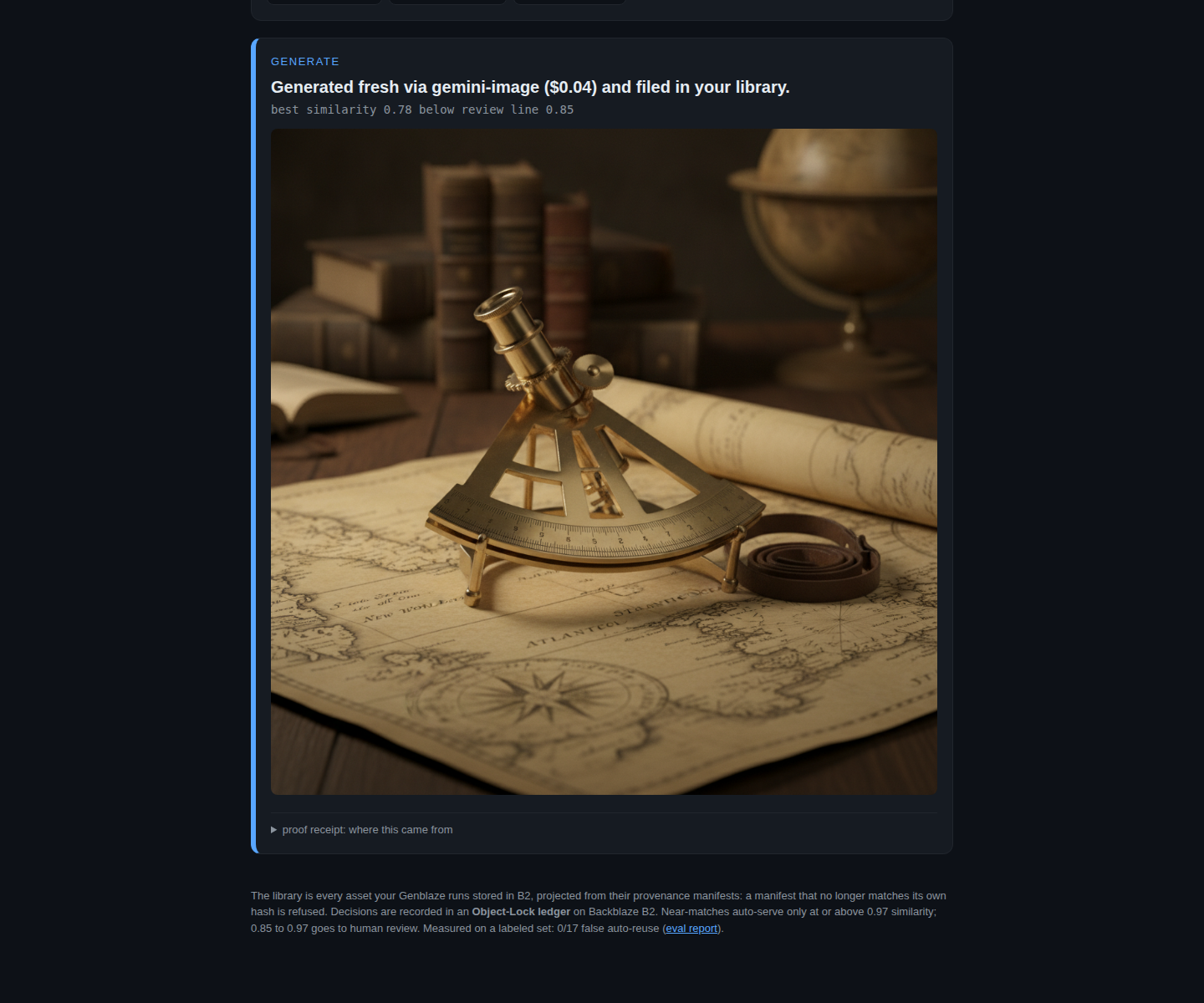
Below 0.85 it generates for real, files the asset and its provenance manifest into B2, and the next identical request is free.
-
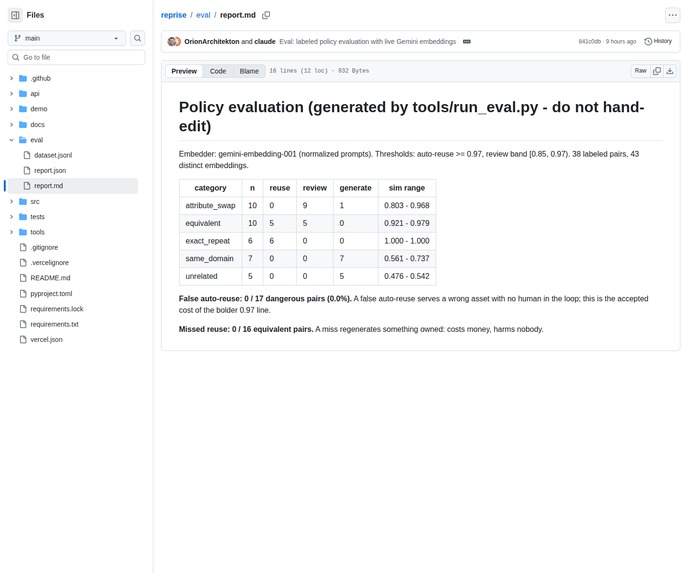
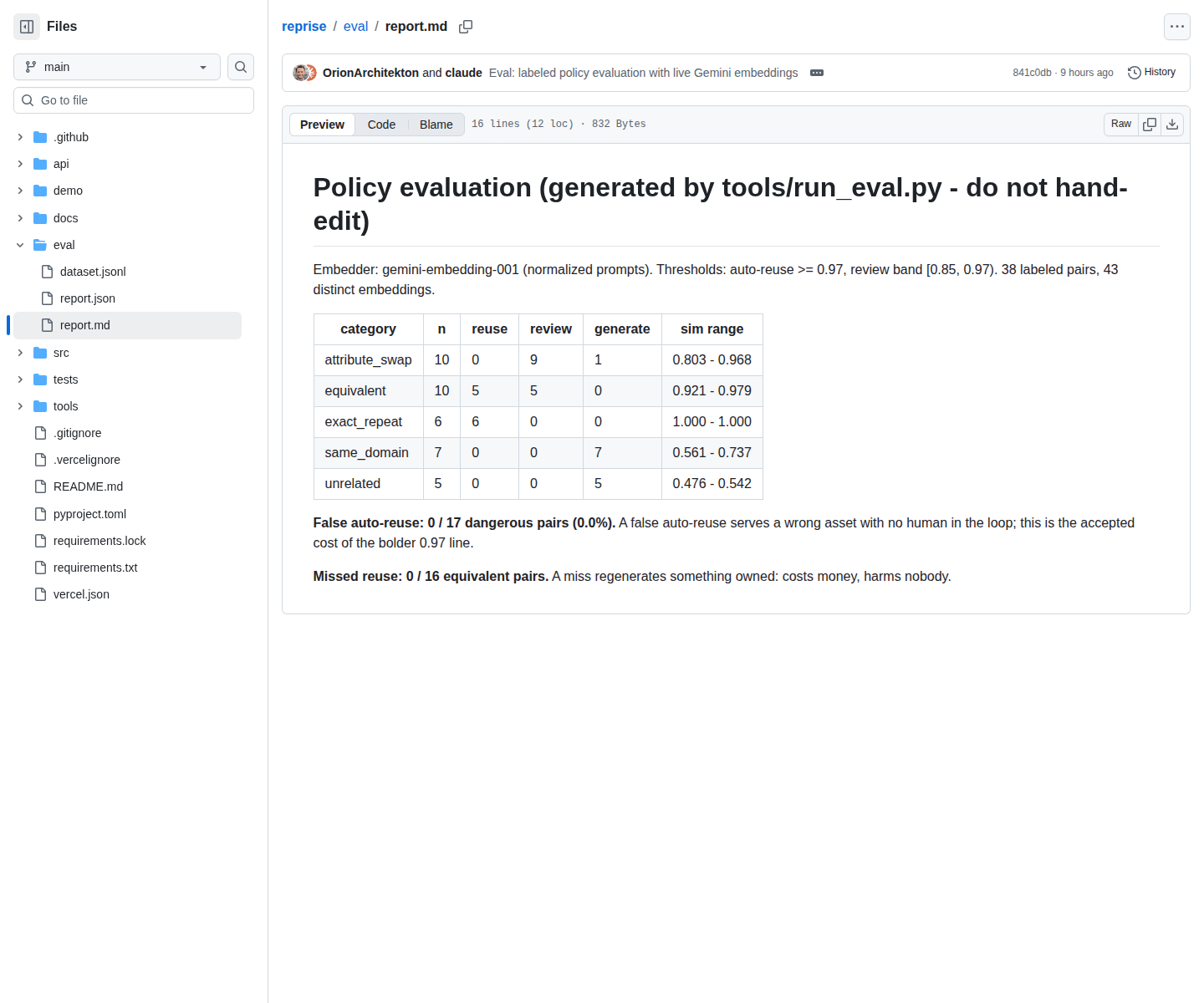
38 labeled pairs: nothing dangerous auto-reused, nothing equivalent regenerated. The published numbers are pinned to this data in CI.
Inspiration
Every generative media team quietly pays for the same asset twice. The same product shot, the same jingle, the same hero image, weeks apart, requested by different people who had no way to know it already existed. The bucket holding those assets is usually treated as an archive: somewhere finished work goes to sit. We wanted to treat it as the opposite, an asset that appreciates, and put it in the request path so that owning something is checked before paying for it again.
The framing that stuck with us: your storage bill is not the cost. Regenerating what is already in storage is the cost.
What it does
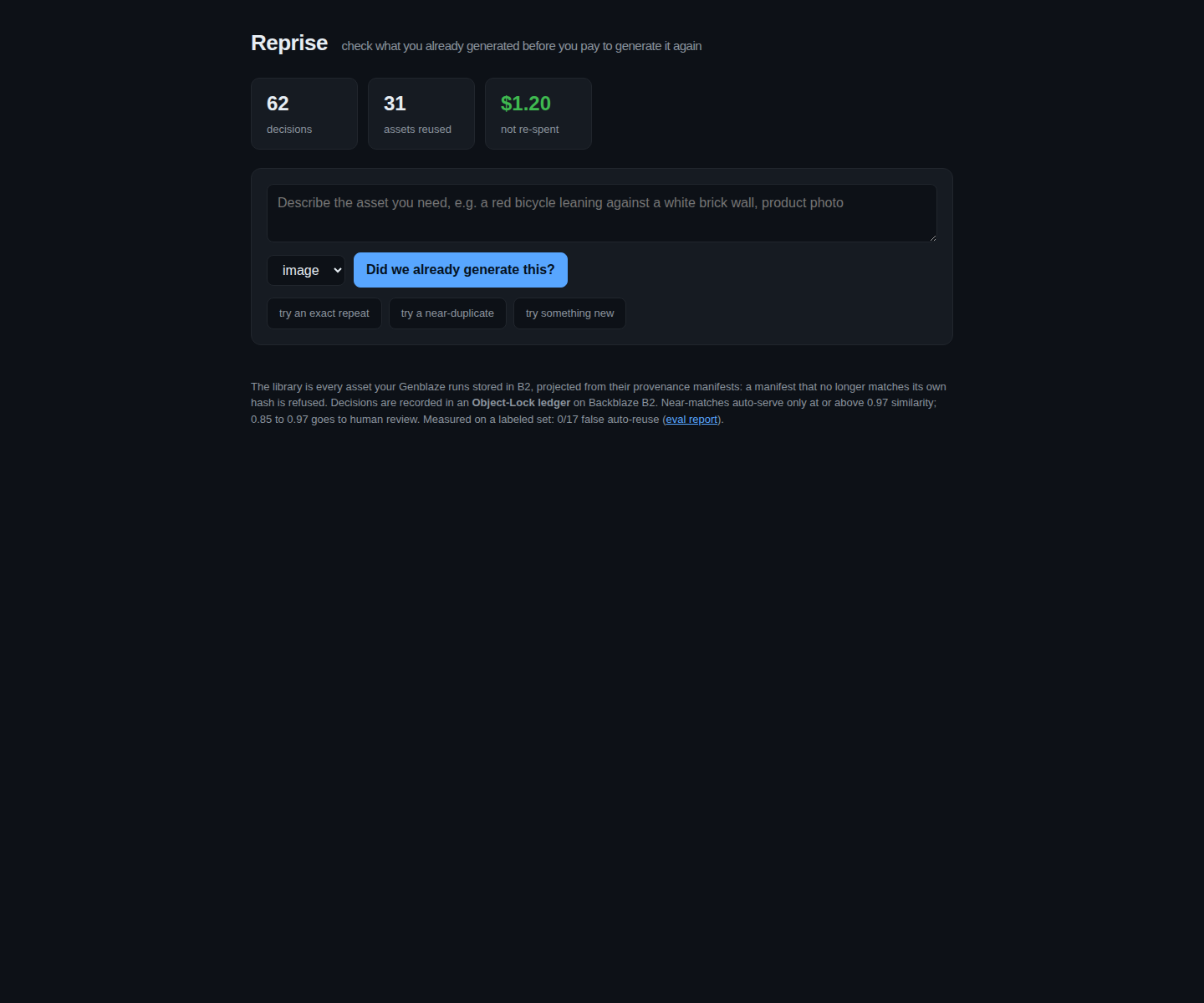
Reprise sits in front of a Genblaze pipeline and answers one question per request: did we already generate this?
- Exact match returns the stored asset from Backblaze B2 behind a short lived presigned URL. Nothing is generated, and the money not re-spent is booked as a saving.
- Near match at or above 0.97 similarity auto-serves the same way.
- Between 0.85 and 0.97 stops in front of a human, who accepts or rejects. Accepting requires a signed capability token minted with that specific card, so a saving cannot be forged into the ledger by anyone who can reach the API.
- Below 0.85 generates for real, through Genblaze, and files the result in the library with its provenance manifest so the next person gets it free.
Every decision, reuse or spend, is written as an Object Lock record in B2 under GOVERNANCE retention. The savings scoreboard on the page is recomputed from those records, not from an application counter that anyone can edit.
How we built it
- Genblaze does the orchestration. Generations run as a
PipelinewithObjectStorageSink(raise_on_failure=True), so nothing enters the library without a sha256 bound, verifiable manifest. The library itself is a projection of those manifests, which means there is no second database to drift out of sync with what B2 actually holds. - Backblaze B2 is the product's memory. Assets are content addressed via
KeyStrategy.CONTENT_ADDRESSABLE, so identical bytes dedupe by construction. Manifests sit beside assets. Embedding sidecars are keyed by normalized prompt hash, so a library prompt is embedded once no matter how many runs reference it. The decision ledger is written with Object Lock. - Similarity is cosine distance over
gemini-embedding-001prompt embeddings, with modality, aspect ratio and style held as hard constraints rather than scored, because those are substitutability requirements and not matters of degree. - Image generation runs through a custom Genblaze
SyncProviderwe wrote for Gemini native image models, plus the stock ElevenLabs provider for audio. - Provenance is checkable, not asserted. Admission is gated on
Manifest.verify_hash(), and every result carries a proof receipt: run id, manifest key and canonical hash, content addressed asset key, sha256, producing model, and the retention actually in force. Those are coordinates you can re-derive from the bucket yourself. - FastAPI and server rendered Jinja for the app, deployed on Vercel, secrets in Doppler, 105 tests, mypy strict, and a CI check that pins the numbers in the README to the eval report that produced them.
AI providers and models used
| Model | Provider | What it does here |
|---|---|---|
gemini-2.5-flash-image |
Google Gemini, via a custom Genblaze SyncProvider we wrote |
Image generation. Falls back down a chain and the manifest records the model that actually produced the bytes |
gemini-3.1-flash-image |
Google Gemini, same provider | First choice in the fallback chain |
gemini-embedding-001 |
Google Gemini | Prompt embeddings (3072 dims) for near-match scoring |
eleven_flash_v2_5 |
ElevenLabs, via the stock Genblaze provider | Audio generation in the app |
eleven_multilingual_v2 |
ElevenLabs | Narration in the demo video only, not in the product |
Storage is Backblaze B2 throughout, via genblaze-s3. Nothing else is called
at runtime. Reading the source you will also find an OpenAIEmbedder
(text-embedding-3-small): it implements the same contract for anyone
deploying with an OpenAI key, and the deployed app does not construct it.
Challenges we ran into
Every Imagen tier refuses newly created API keys. The Google connector's
only image family matches ^imagen-, and on a key created this month every one
of those slugs answers 404 "no longer available to new users". Worse, the SDK's
liveness probe calls models.get, which returns 200 for those same slugs,
because catalog membership and entitlement are different facts. Preflight passed
and the run died at call time. We wrote our own SyncProvider against
generateContent, which returns inline image bytes, and filed both findings
upstream (genblaze issues #205 and #206).
Backblaze shipped both. A Genblaze maintainer implemented the Gemini-native image provider and the Imagen entitlement probe in PR #220, which merged on 2026-07-28 and closed both issues. We reported the findings and supplied the reproductions; the upstream fix is theirs, not ours. The workaround we built to get unblocked is now redundant with the SDK itself, which is the outcome a feedback report is supposed to have.
A spend cap that counted the wrong thing. Our first daily cap counted ledger records written after a generation completed. Under any concurrency the cap failed open: the spend happened, then the record it was counted by. We rewrote it to reserve before spending, and treat an unwritable reservation as an exhausted cap. That is a fail closed default, and the regression test asserts the reservation exists before the provider is ever called.
The accept button was an unauthenticated write. Anything that can POST to the API could have written savings into an object locked ledger, which is the one place in the system where a wrong number is permanent. Acceptance now requires an HMAC capability token bound to the asset, the prompt and an expiry, issued only in the review response that offered it.
Saying what we actually proved about Object Lock. Our first probe asserted that a delete should fail, saw it succeed, and reported that the lock had not bound. The probe was wrong, not the control: on a versioned bucket an unversioned delete writes a delete marker. The lock binds at the version. We corrected the probe, kept the correction in the evidence file, and now say precisely what holds: a delete can hide a record, it cannot destroy the version while retention holds.
Accomplishments that we're proud of
- The thresholds are measured, not asserted. 38 labeled prompt pairs across five categories, scored with live embeddings: 0 of 17 dangerous pairs auto reused, 0 of 10 non exact equivalents regenerated. The published caveat is the interesting number: the highest attribute swap similarity measured 0.968, just under the 0.97 auto line, which is exactly why the review band exists.
- CI will not let those numbers go stale. A check recomputes every verdict from the stored similarities and fails the build if the README, the report, or the test count drifts from the data. We proved the check fires by tampering with each claim and watching it exit non zero.
- The honest limitations are in the product, not just the README. Prompt similarity measures how alike two prompts read, not how alike two images look. That is why attribute swaps land in front of a person instead of silently on a customer.
What we learned
- A model appearing in a provider's catalog listing is not an entitlement. Probe the endpoint you will actually call.
- A spend cap that counts records written after the spend fails open. Reserve first, and treat the reservation store being unavailable as exhausted.
- When a claim outruns its checker, strengthen the checker rather than softening the claim, then prove it fires. A green gate whose failure you have never observed is indistinguishable from a no op.
- Provenance is only as good as what you refuse to admit. Failed steps and URL only assets never enter the library, because a manifest that cannot verify is worth less than no manifest at all.
- A health check that touches nothing cannot see an outage of everything. Ours stayed green while every page that read storage was down. The smoke check now walks the ladder a visitor walks.
- The sharpest lesson came from an outage we caused ourselves. Backblaze's daily transaction cap tripped because every request re-read the whole ledger and the whole library, so the cost grew with the data. Reads are now bounded to what can still change. But the worse defect was what the outage revealed: with manifests unreadable, the library looked EMPTY, and a reuse-first product cheerfully paid to generate an asset it already owned. Absence of evidence had been coded as evidence of absence. It now refuses instead, and says why.
- A defect with a shape has siblings. Rather than call the outage closed, we priced what a request actually costs and found both bugs again one call deeper, in the embedding cache: reads that grew with the library, and a 403 from the exhausted cap being read as "no vector was ever made", which is the condition for buying one. Vectors are content addressed, so they are remembered now, and only a typed not-found counts as absence.
What's next for Reprise
- Harden multi-writer publication of the library index: versioned or compare-and-swap writes plus a manifest-set watermark, so two instances publishing at once cannot lose an update. The index itself shipped; what is left is making concurrent publication safe rather than last-write-wins.
- Make generation claims atomic per prompt fingerprint. Two identical requests arriving together can still each pay, because the library check is read-then-act. Bounding that is the honest next step, not a solved property.
- Ledger reads are already bounded (day partitions plus a
snapshot of completed days), but a cold instance still scans the library once;
Genblaze's
ParquetSinktables are the natural seed for persisting it. - Add an image embedding signal alongside the prompt signal, so the review band can narrow honestly rather than by moving a number.
- Team scoped libraries with per project budgets, and a webhook so an existing pipeline can consult Reprise without changing its own code.
- Land the two upstream issues as pull requests against genblaze-google.

Log in or sign up for Devpost to join the conversation.