-
-
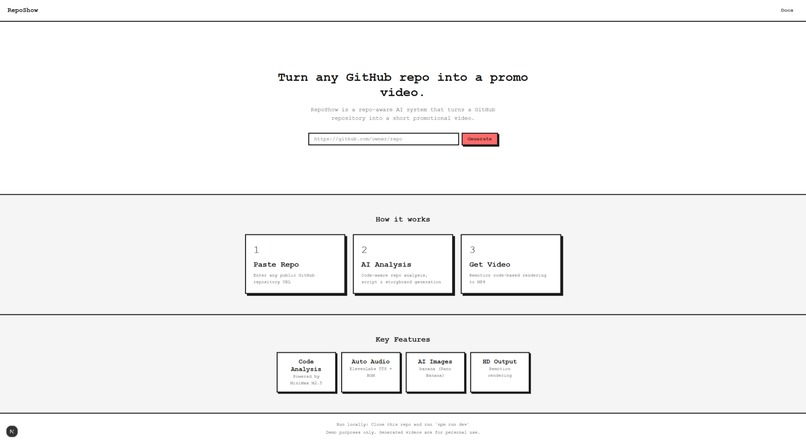
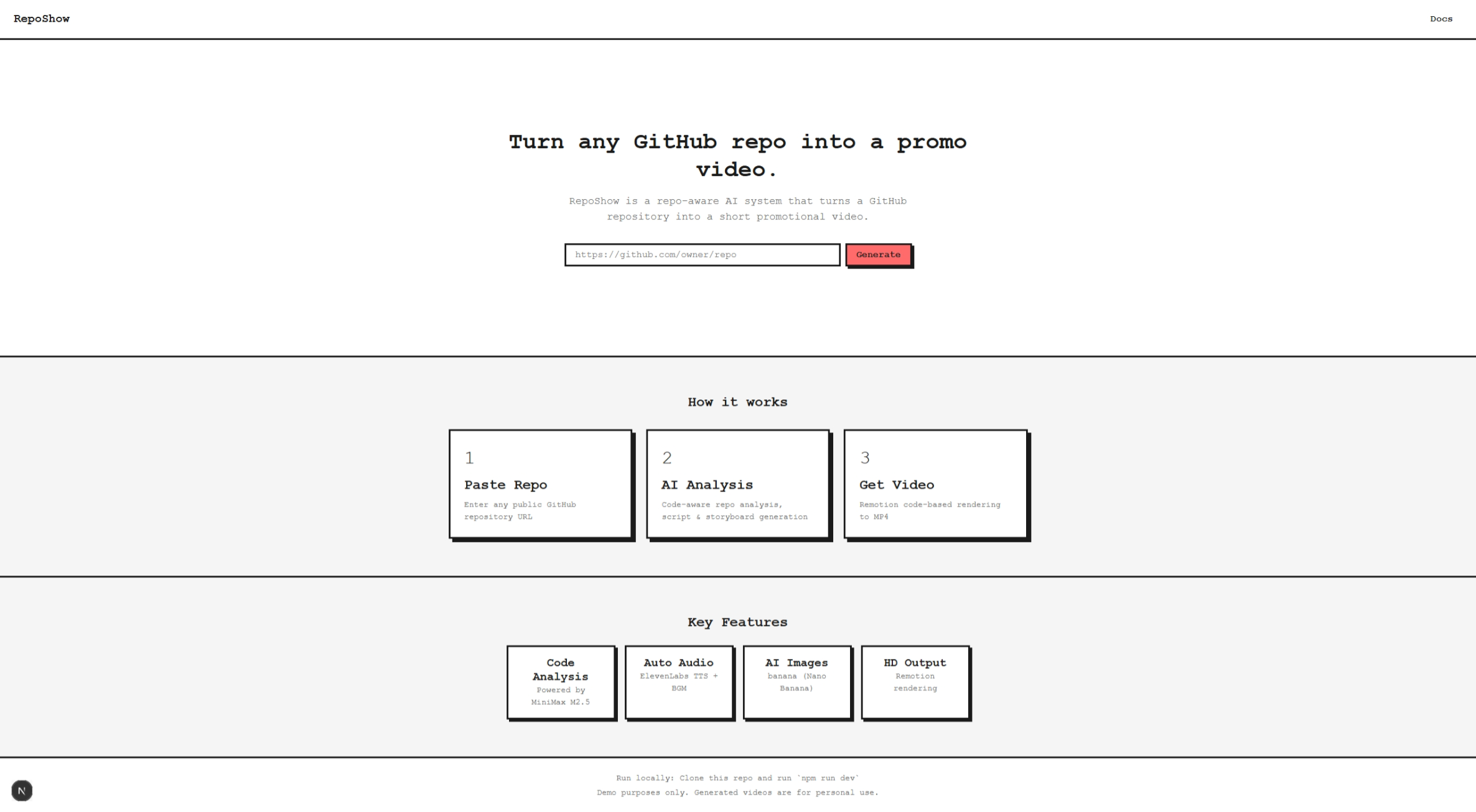
landing_page
-
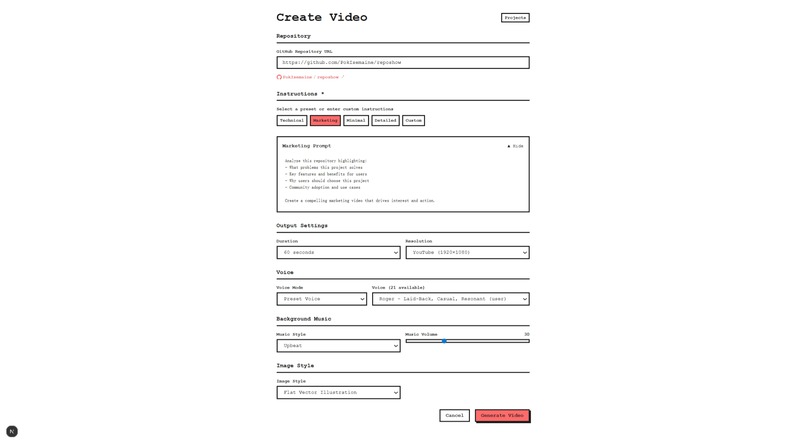
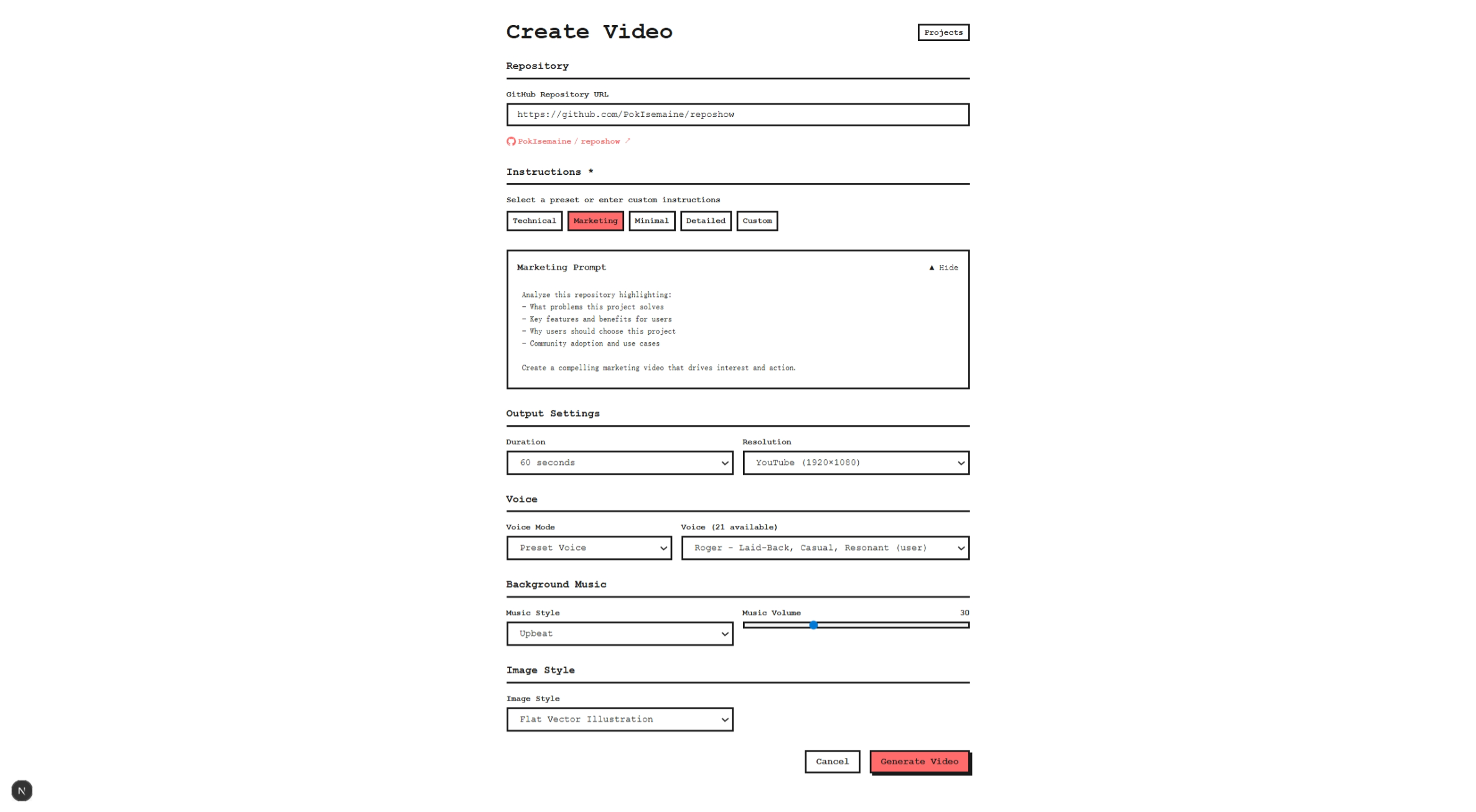
create
-
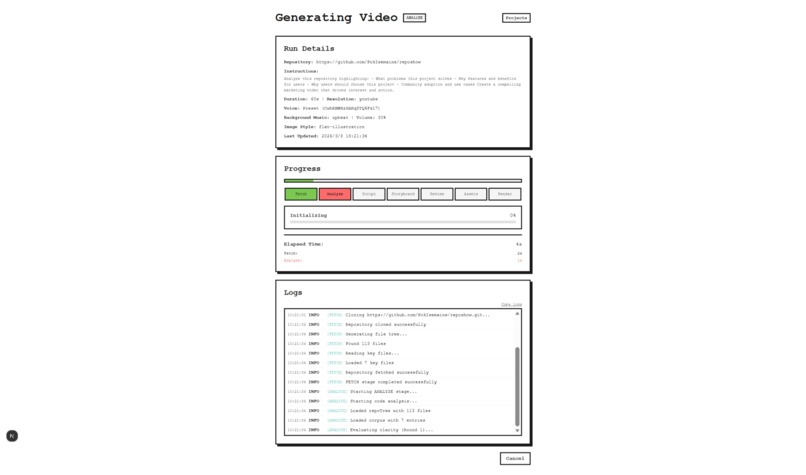
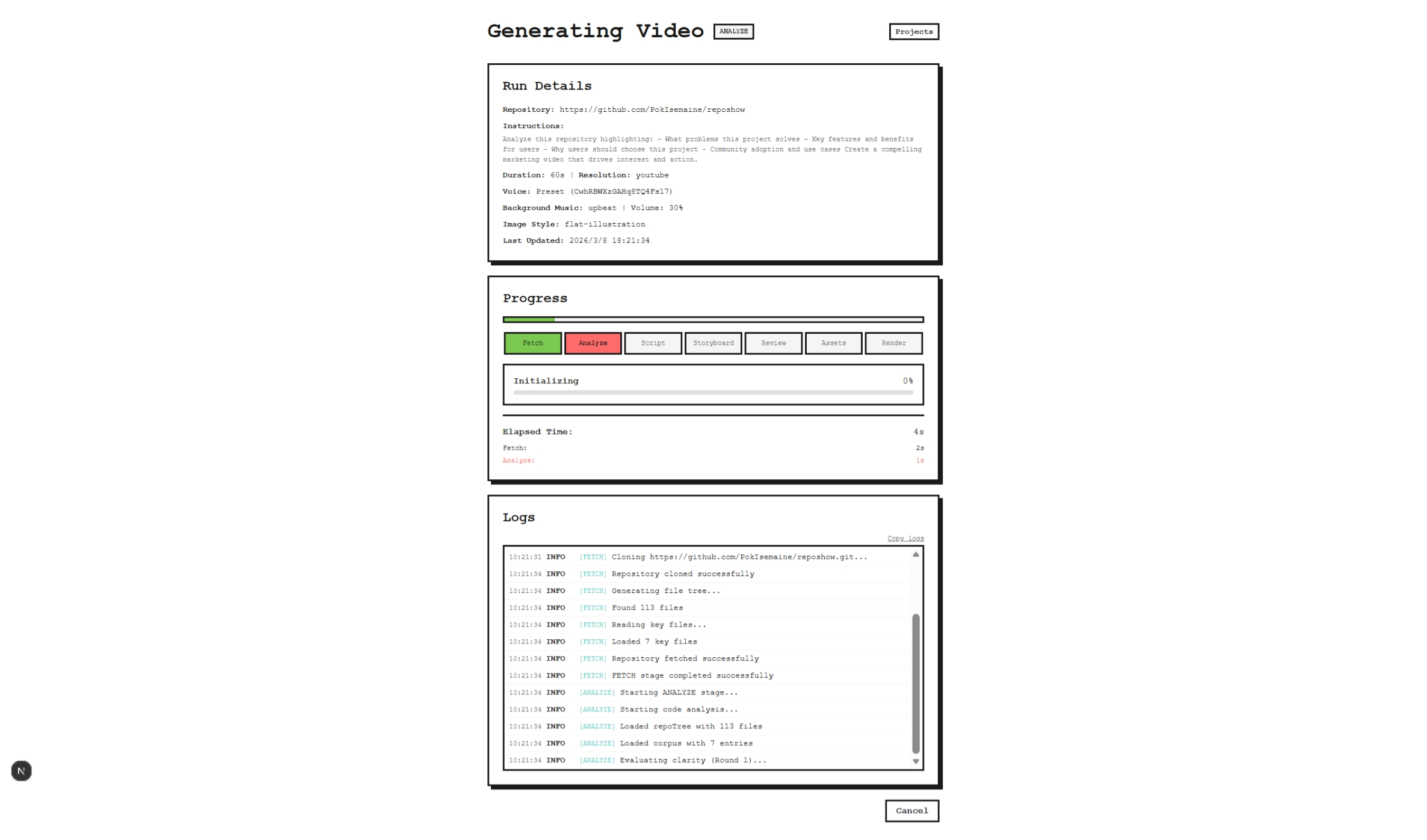
progress
-
-
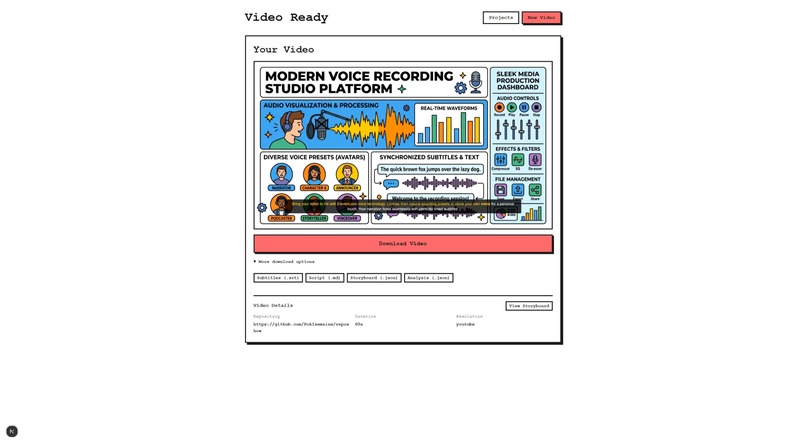
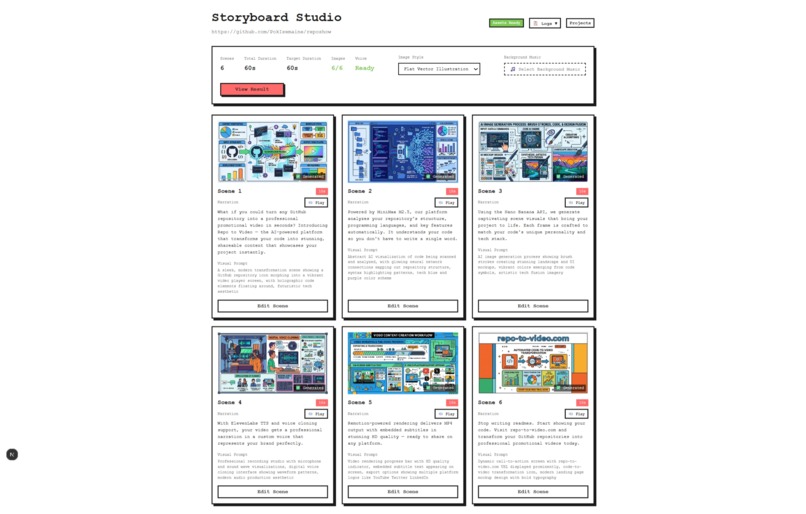
result
RepoShow
Inspiration
Great open-source projects often die in silence.
Developers spend most of their time building, but turning a GitHub repository into a polished demo video still takes a surprising amount of manual work. You have to decide what to highlight, write a script, plan visuals, generate assets, sync narration, and edit everything into a coherent story.
At the same time, AI has made video generation much easier, but technical projects such as code repositories still present a unique challenge. A video can look polished without really reflecting what the project is about. For developer-facing products, the hard part is not just generating visuals — it is understanding the project well enough to tell a story that feels relevant and grounded.
That was the starting point for RepoShow.
We wanted to explore whether a GitHub repository could be turned into a short promotional video automatically — one that is visually compelling, but still connected to the project’s actual purpose, flow, and value.
What it does
RepoShow is a repo-aware AI system that turns a GitHub repository into a short promotional video.
Given a repository URL, it can:
- understand the repository context,
- identify the most important product or project ideas,
- write a concise narrative and voiceover script,
- plan visuals scene by scene,
- generate supporting media assets,
- and render the final video programmatically.
Rather than treating the result as a generic AI montage, RepoShow tries to ground the output in the repository itself, so the final video feels closer to a real project story than a template.
How we built it
We built RepoShow as a multi-stage pipeline that connects repository understanding with automated media generation.
1. Repository ingestion
The system starts from a GitHub repository URL and gathers the repository context needed to understand the project.
2. Project understanding
We use AI (MinMax 2.5) to identify what the repository is trying to do, what makes it interesting, and which parts are most worth presenting in a short video format.
3. Narrative generation
Based on that understanding, RepoShow generates a short storyline and voiceover script focused on the project’s value and flow.
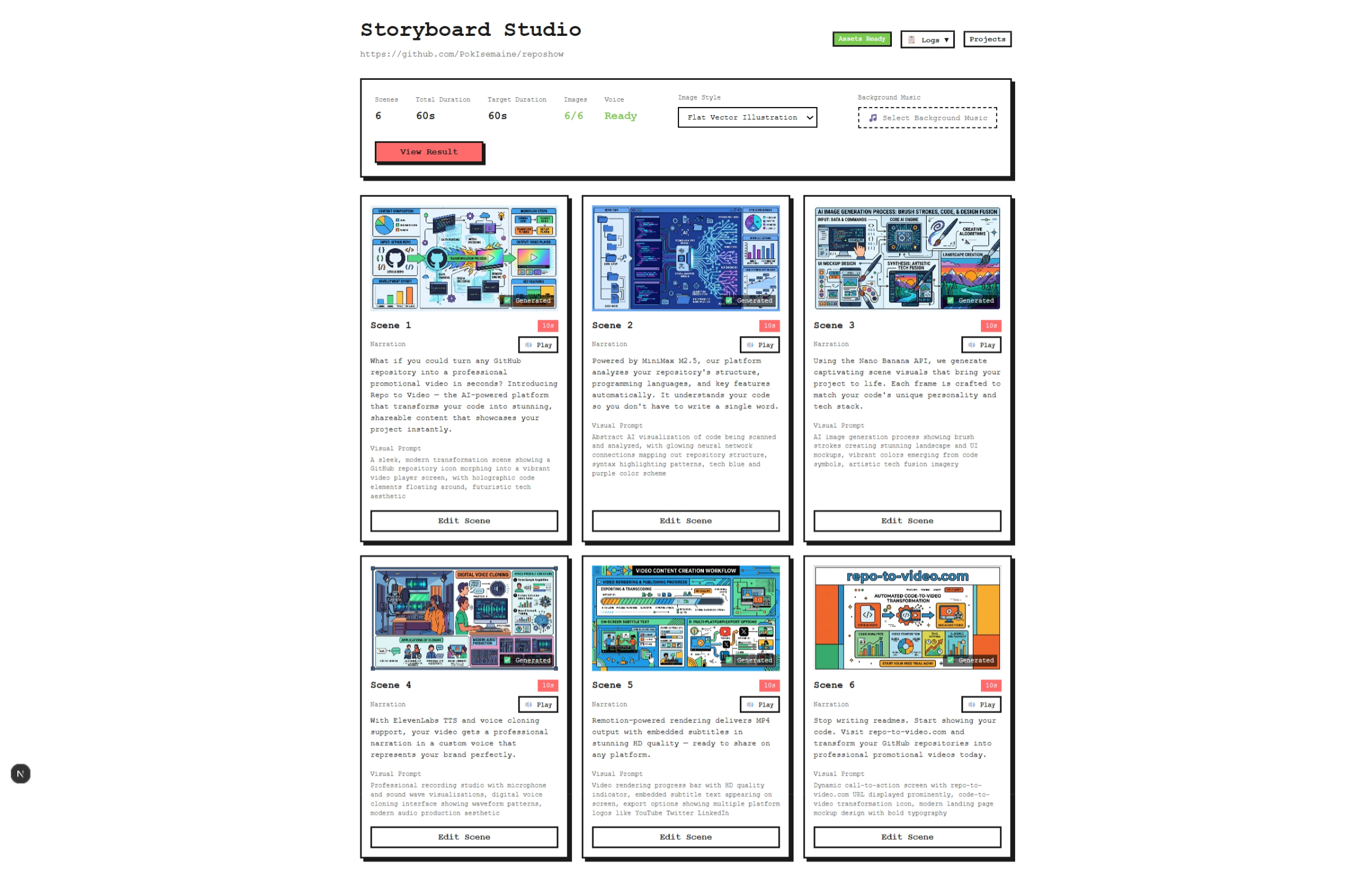
4. Storyboard planning
The script is then broken into scene-level visual plans, so each section of the video has a specific role instead of relying on generic filler content.
5. Asset generation
We generate the supporting visual ((Nano Banana) and audio (ElevenLabs) assets needed for the final piece, aligned with the tone and pacing of the story.
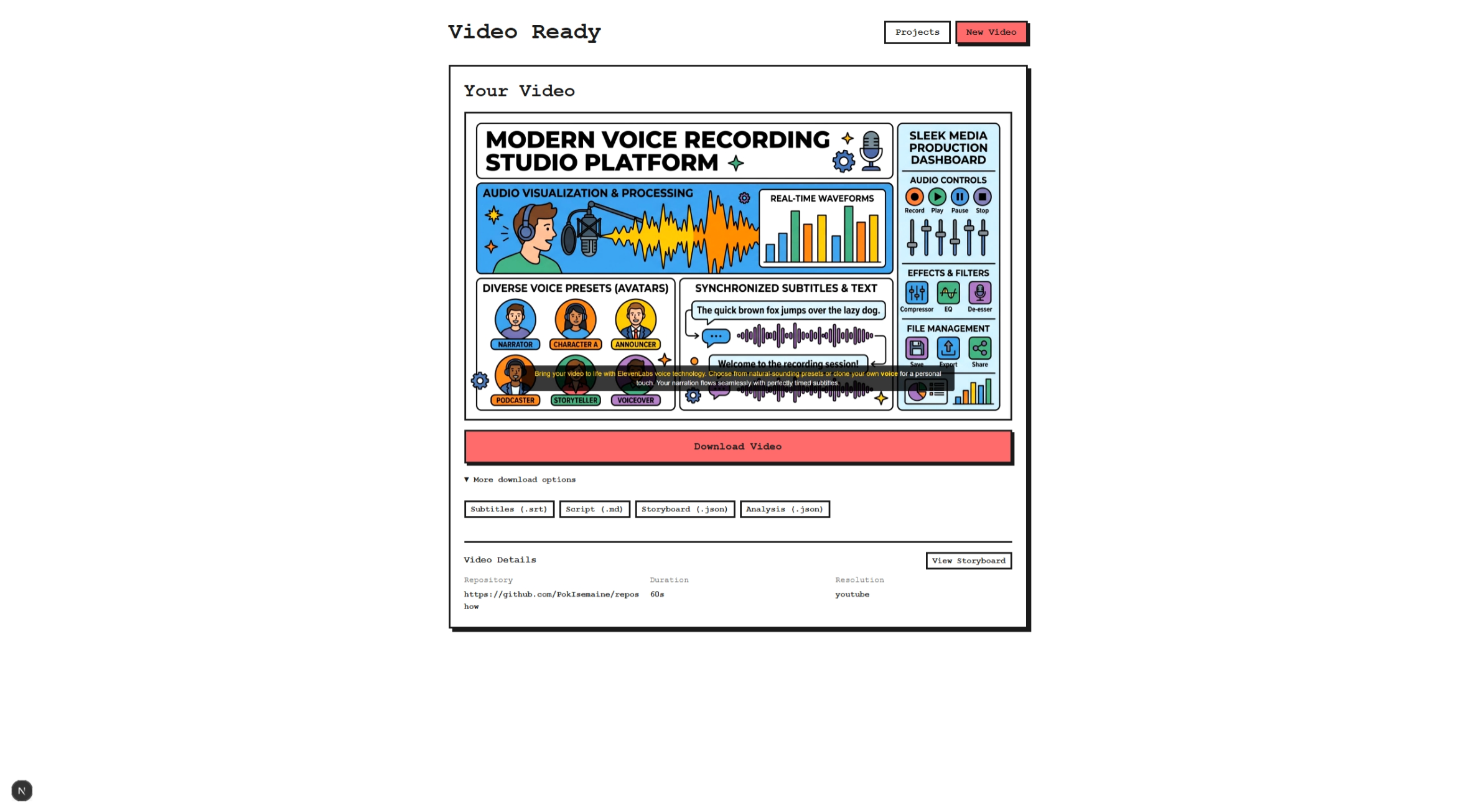
6. Programmatic rendering
Finally, everything is assembled and rendered with Remotion, which lets us treat video composition as a programmable process with precise timing and structure.
This pipeline helped us move from “AI-generated clips” toward something more deliberate: repository context turned into narrative, visuals, and timing.
Challenges we ran into
Finding the real story
A repository contains a lot of information, but not all of it is equally important for storytelling. One of the hardest parts was deciding what the video should emphasize. README files can be incomplete, overly technical, or simply not written with promotion in mind, so extracting a strong narrative required more than simple summarization.
Keeping the output grounded
It was easy for the system to drift toward generic AI-video aesthetics. We had to keep pushing the pipeline toward outputs that reflected the project itself, rather than relying on familiar but shallow “tech” visuals.
Synchronizing everything
Script, visuals, audio, subtitles, and timing all come from different stages of the pipeline. Once those pieces are generated separately, combining them into a coherent final video becomes a real systems challenge. Using programmatic rendering helped us make that process much more controlled and repeatable.
Accomplishments that we're proud of
What we are most proud of is that we turned the idea into a working end-to-end prototype.
RepoShow does not stop at understanding a repository. It carries that context through a full creative pipeline: script, storyboard, assets, audio, and final rendering. Seeing a project that originally lived as code and documentation become a short, watchable video made the concept feel much more tangible.
We are also proud that the result feels tied to the repository itself, rather than looking like a generic AI-generated montage.
What we learned
This project taught us that, in this kind of workflow, AI is most useful not simply as a generator, but as an organizer.
The interesting part is not just creating images or narration. It is deciding what matters, what should come first, and how different media components can work together to communicate a project clearly.
We also learned that Remotion is a very natural bridge between structured logic and media output. Once the video becomes programmable, it becomes much easier to combine generated assets into something coherent and editable.
More broadly, this project made us excited about the idea that repositories could become more expressive artifacts. In the future, we would love to keep exploring ways to help developers present their work in forms that are easier to watch, share, and understand.
What's next for RepoShow
We see this hackathon version as the beginning of a broader creative workflow for developer storytelling.
One next step is making distribution easier. Right now, RepoShow focuses on turning a repository into a finished video; in the future, we want to support sharing directly to social media platforms so creators can publish and distribute their videos more easily.
We also want to make the system more flexible by supporting multiple LLM providers. Different models have different strengths in reasoning, summarization, and creative generation, and adding provider flexibility would make RepoShow more adaptable to different projects and user preferences.
Another important direction is cloud deployment. A cloud-based version would make the pipeline easier to access, easier to scale, and much more practical for teams who want to generate videos without setting up the full environment locally.
More broadly, we want to keep improving how RepoShow turns repository context into something that is easier to watch, share, and understand.
Built With
- elevenlabs
- github
- minimax
- nano-banana
- next.js
- react
- remotion
- typescript


Log in or sign up for Devpost to join the conversation.