
Inspiration
Solo founders often move fast, build alone, and ship under uncertainty. One of the hardest questions is not how to build, but how to judge whether a project is actually ready. A repository may look functional, but it can still be just a prototype with missing documentation, weak structure, or poor handoff readiness.
RepoReadinessAgent was inspired by that problem. We wanted to create an autonomous agent that reviews a GitHub repository and helps founders understand whether their project is still a Prototype, already an MVP, or truly ready for handoff—and most importantly, what they should fix next.
What it does
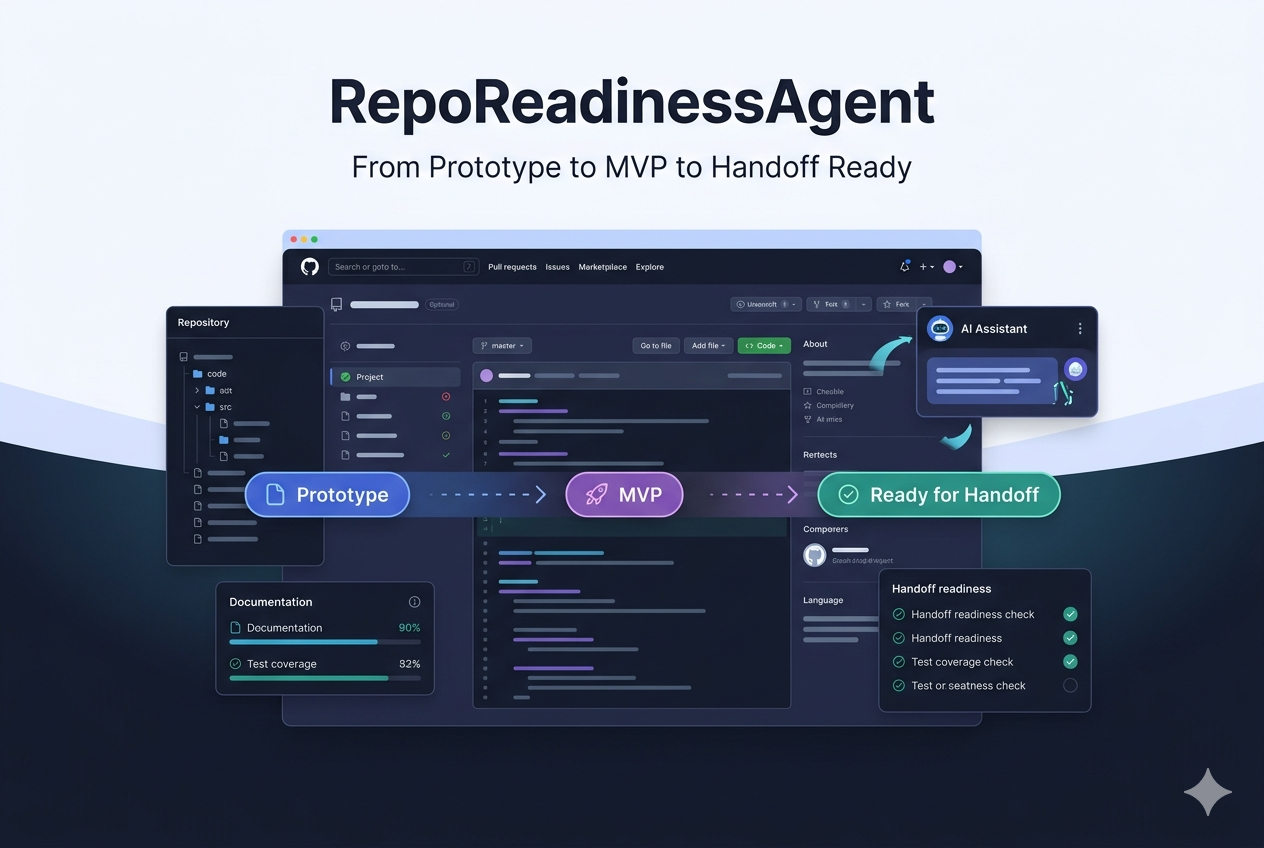
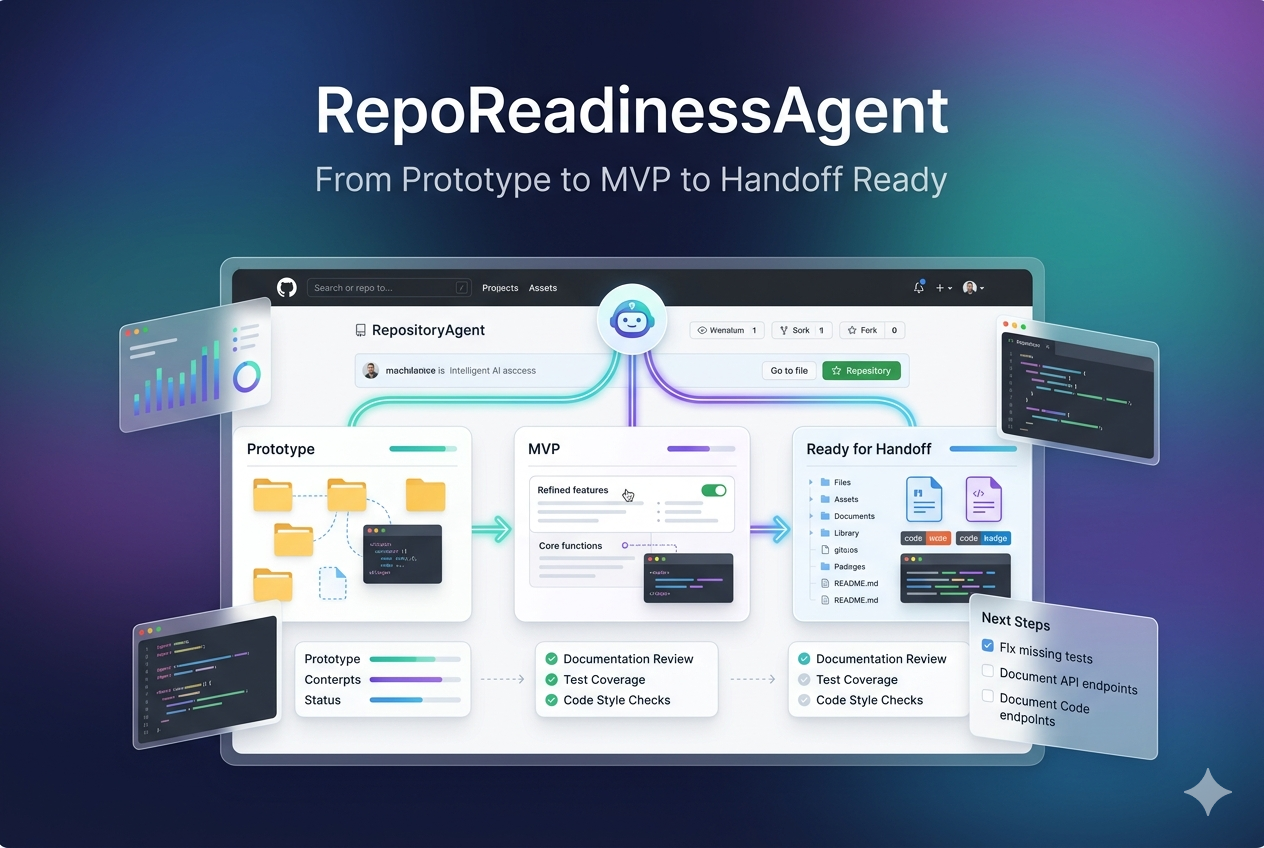
RepoReadinessAgent analyzes a GitHub repository and classifies it into one of three stages:
- Prototype
- MVP
- Ready for Handoff
The agent reviews repository signals such as project structure, documentation, maintainability, setup clarity, and overall development maturity. It does not just return a label—it also explains the reasoning behind the classification and provides actionable recommendations for improvement.
This helps solo founders answer practical questions like:
- Is this project ready to launch?
- Is the codebase mature enough to share with a contractor or teammate?
- What is missing before this can be handed off or scaled further?
How we built it
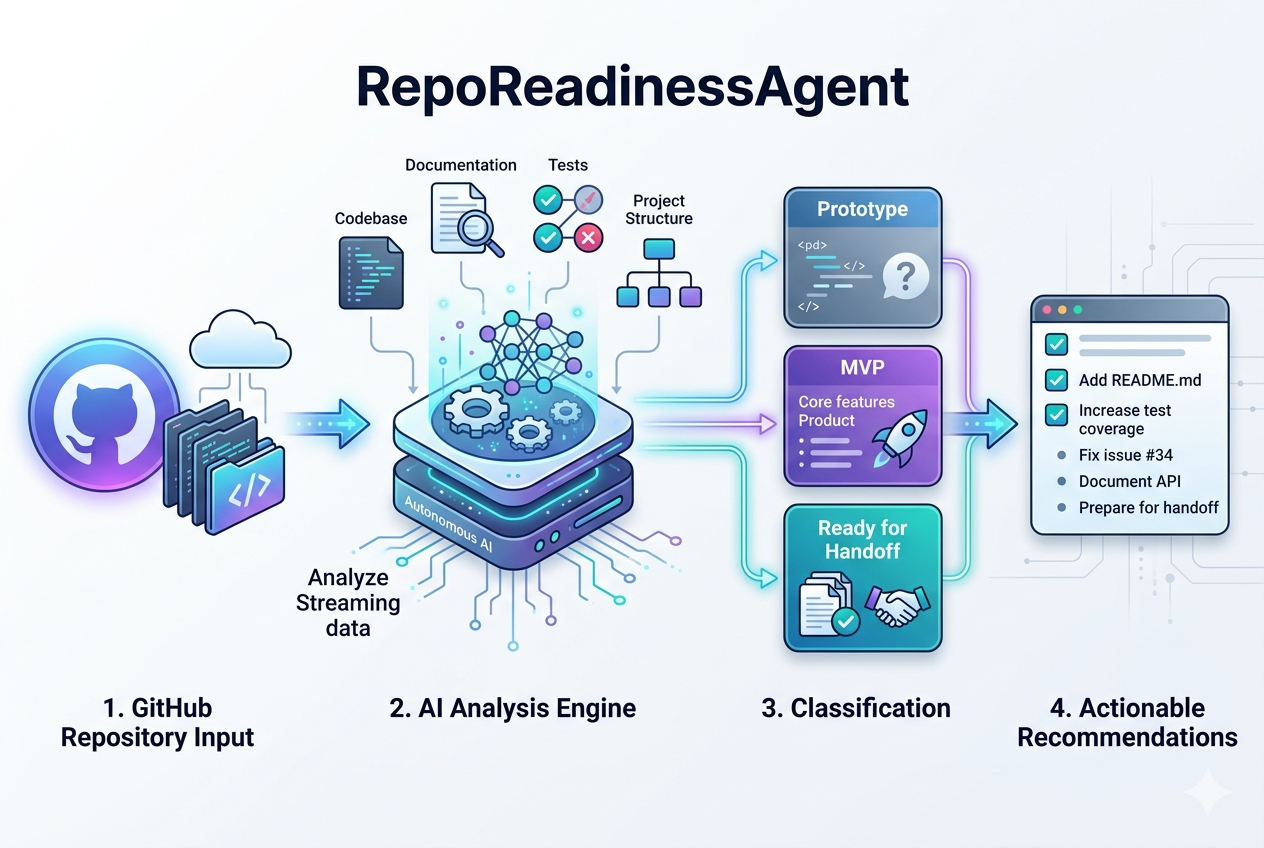
We built RepoReadinessAgent as an autonomous repository review workflow powered by AI and repository-level heuristics.
The system works by:
Reading a GitHub repository
- Inspecting the file structure
- Looking at key files such as
README, configs, dependency files, and source folders
Evaluating readiness indicators
- Documentation completeness
- Codebase organization
- Setup and deployment clarity
- Maintainability signals
- Testing and handoff readiness
Classifying the repository
- Mapping the findings into Prototype, MVP, or Ready for Handoff
Generating next-step recommendations
- Highlighting what is missing
- Suggesting the most important fixes
- Turning repo analysis into a practical action plan
Our focus was to make the output useful for founders, not just technical for engineers.
Challenges we ran into
One of the biggest challenges was that repository readiness is not binary. A project can be functional but still not handoff-ready. It can also have strong code but weak documentation, or a polished README but poor maintainability.
Other challenges included:
- Defining meaningful criteria for Prototype vs MVP vs Handoff-ready
- Avoiding shallow judgments based only on file presence
- Balancing technical accuracy with simple, founder-friendly explanations
- Turning repository signals into recommendations that are actually actionable
We had to think beyond code quality and consider developer experience, onboarding, and project continuity.
Accomplishments that we're proud of
We are proud that RepoReadinessAgent turns a vague and subjective question into a structured evaluation:
“What stage is this repo really in, and what should I do next?”
We are also proud that the project is highly practical for solo founders, who often lack time, team feedback, or engineering review support. Instead of only analyzing repositories, the agent helps users make decisions.
What we learned
We learned that repository maturity is a mix of:
- technical quality,
- documentation,
- maintainability,
- and transferability.
We also learned that AI tools become much more useful when they are focused on a narrow, high-value workflow. In this case, the value is not just “analyzing code,” but helping someone understand project readiness with clear next steps.
Most importantly, we learned that good feedback must be both accurateable
