-
-
-
home page
Inspiration
In large international sport events like the FIFA World Cup, a stadium transforms from a sports facility into a highly volatile micro-city. For example, a single broken turnstile at a gate or a minor failure in transit signaling can halt the movement of a crowd, propagating massive crowd-surge risks backward down the line.
Modern monitoring tools are excellent at logging these exceptions, but they depend heavily on worn out human dispatchers to manually cross reference manifests, look up asset positions and compute alternate paths. It’s this disconnect between raw data telemetry and real-time operational response that inspired VenueIQ.” I wanted to build a command network that heals itself, and doesn't just look at problems, but actually arranges solutions the moment they arise.
What it does
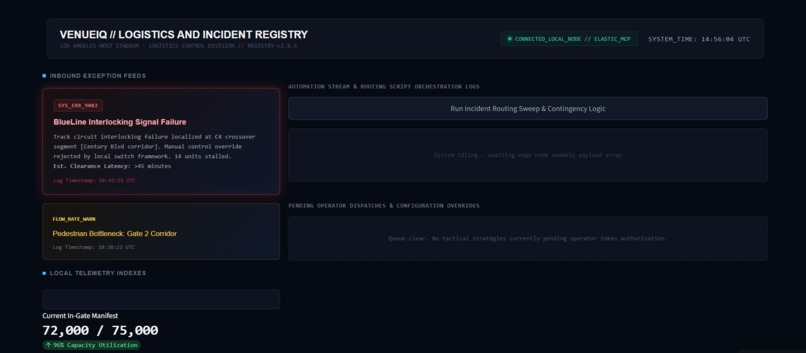
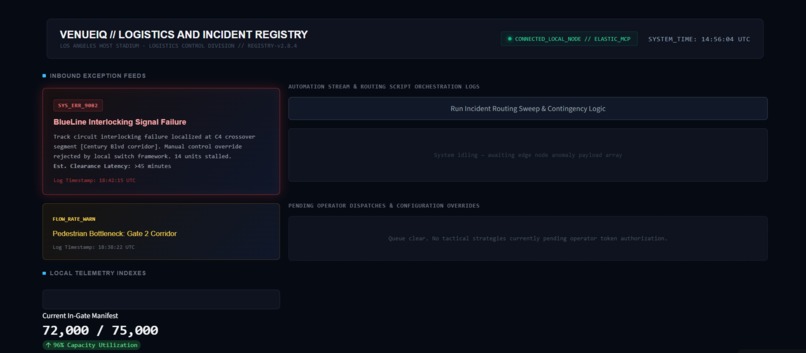
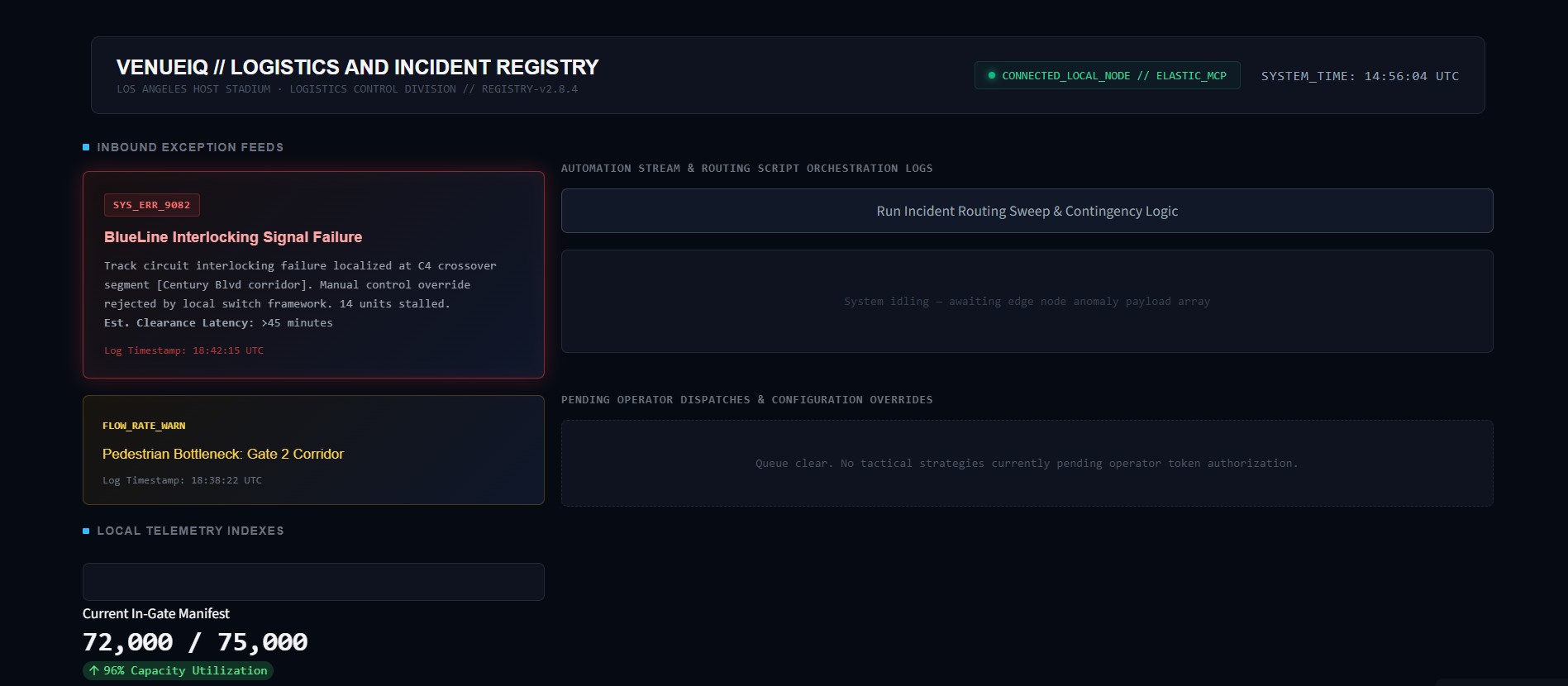
VenueIQ is a closed-loop incident management and logistics command center that combines local database tracking with real-time cloud intelligence.
When an infrastructure anomaly occurs (e.g. gate bottleneck or interlocking signal failure) the operator launches a Neural Sweep. Our background engine sends the emergency telemetry to Gemini 2.0 Flash, who is our automated incident commander. Gemini doesn’t generate a canned text response, it runs real tool logic on our live database, looking at live venue capacity manifests and finding the closest idle transport units.
How we built it
The Intelligence Layer: Fully powered by the Google Gemini API (gemini-2.0-flash) with the new modernized, native google-genai SDK to provide fast, asynchronous tool execution.
Local Storage Fabric: Operational records, such as venue registers, active incident logs, and transit manifests, are indexed and stored locally in a distributed Elasticsearch (v8.11+) cluster.
The Gateway Pipeline We needed to securely link our cloud-hosted application layer to our local cluster, without exposing infrastructural ports to the open web. To do this, we set up a ngrok reverse-proxy tunnel.
The Interface Deck: Developed using Streamlit (v1.35+) and styled dynamically using custom Tailwind CSS, resulting in a high-visibility, dark-mode cyber-security dashboard.
Challenges we ran into
- Eliminate Legacy Enterprise Auth Overhead The project was initially configured around complex Google OAuth 2.0 client credential loop (oauth-credentials.json)
The Solution: We did a complete refactor of the initialization framework to support the native google-genai client, eliminating the old google-auth bloat.
- Controlling AI Hallucinations in Crisis Matrix Calculations AI cannot speculate or invent assets or provide generic advice in crisis logistics. If the model hallucinated an empty transport shuttle that wasn’t in the physical fleet index, then the whole dispatch system would break.
The Solution: We put a firm leash on Gemini with an execution sandbox built via Function Calling (Tool Use). Rather than letting the model answer freely, it needs to format a structured query back over our Elasticsearch index via the local Model Context Protocol (MCP) transport layer.
Accomplishments that we're proud of
End-to-end mutating state loop: Building a pipe that goes both ways, successfully using tool reasoning to mutate records in a local firewalled database with a cloud LLM.
Deterministic Execution: Achieve true zero-hallucination execution loop for Gemini by constraining its parameters completely to live database states.
UI Responsiveness: Custom native CSS configurations added to override Streamlit defaults for a responsive real-time telemetry stream display that looks clean and premium.
What we learned
Building VenueIQ required us to go far beyond typical chatbot development and get deep into production network topology. We learned about the importance of Human-in-the-Loop systems, showing that the best role for AI in critical environments is to take on cognitive friction, not to make structural changes without supervision.
This project also provided us a lot of hands-on experience with local developer environment management, troubleshooting secure network tunnels with ngrok host-header rewrites, and distributed lookups in Elasticsearch indices.
What's next for VenueIQ
Multi-Agent Coordination: Decomposing the architecture into a multi-agent system with sub-agents responsible for different sectors of the venue (e.g. one agent for crowd routing, one for security dispatch, one for transit optimization).
Predictive Threat Modeling: Using historical event data to train a predictive model that predicts gate bottlenecks before they happen, allowing Gemini to proactively adjust shuttle distribution maps.
Offline Fallback Sync: Creating a decentralized architecture so that local command nodes can still run routing logic with local tinyLLMs if the primary internet gateway fails during an incident.
Built With
- css
- elasticsearch
- ngrok
- python
- streamlit


Log in or sign up for Devpost to join the conversation.