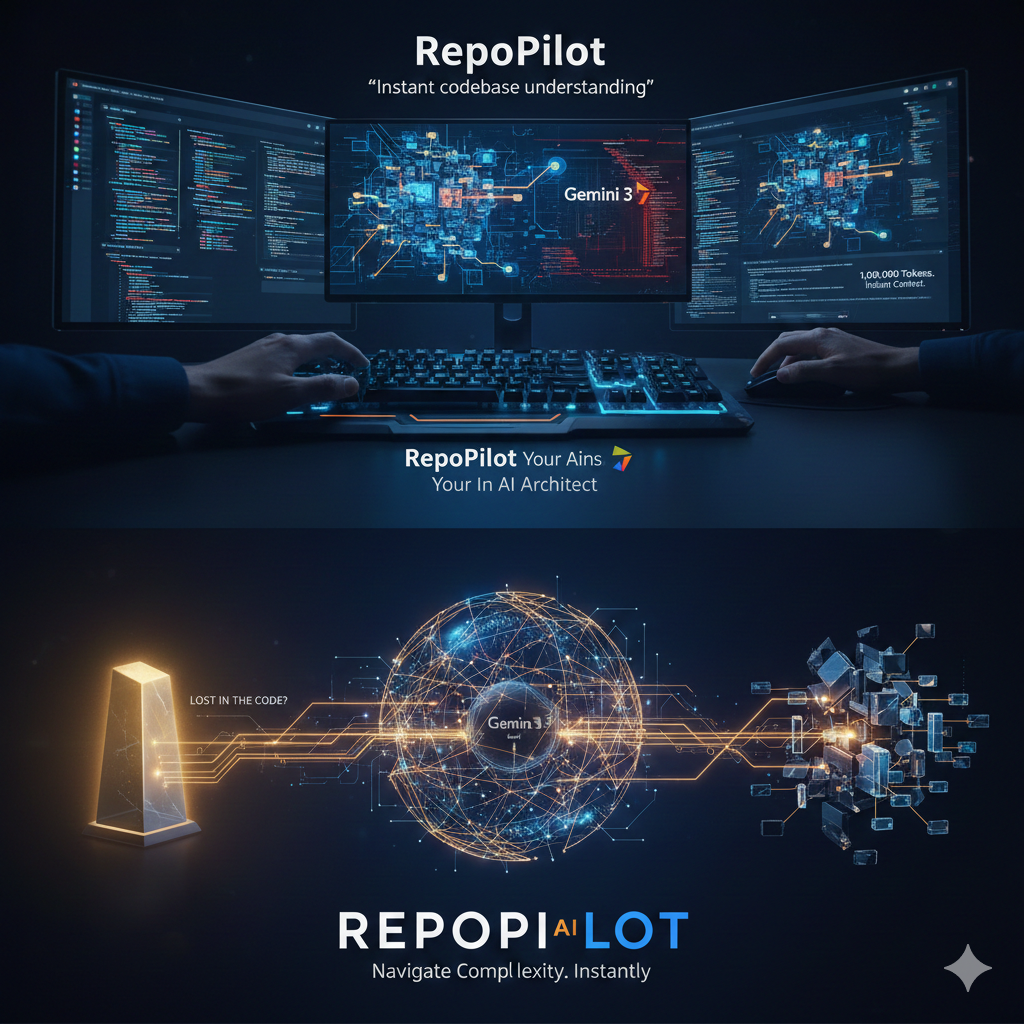
Inspiration Every developer has felt the "Day 1 Dread"—staring at a massive, undocumented 10,000-file repository and having no idea where the data starts or where the logic ends. Traditional onboarding takes days of manual tracing. We built RepoPilot to act as an AI Senior Architect that instantly maps the "big picture," turning weeks of codebase frustration into a 10-second conversation.
What it does RepoPilot is an intelligent repository navigation engine that ingests entire GitHub projects and provides high-level architectural oversight. Key features include:
Instant Mapping: Clones and strips "noise" (like lock files and binaries) to create a high-density Code Map.
Architectural Reasoning: Uses a "Senior Dev" persona to explain complex logic and design patterns.
Live Visualization: Automatically generates Mermaid.js diagrams to show data flow and dependency graphs.
Impact Analysis: Predicts which files will break if you change a specific code snippet.
Logic Verification: Leverages a code execution sandbox to verify its architectural theories in real-time.
How we built it The technical backbone of RepoPilot is a high-performance Python stack:
The Ingestion Pipeline: Built with GitPython and a custom "Cleanshelf" script to intelligently filter repository noise.
The Brain: Powered by the Gemini 3 "Thinking" Backend via the google-genai library. We utilized System Instructions to enforce a Senior Architect persona.
Context Management: We implemented Implicit Context Caching to handle Gemini’s 1-million-token window efficiently, ensuring responses are fast and cost-effective.
Frontend/Backend: A FastAPI backend serves the logic, while a Streamlit UI provides a clean, interactive dashboard for developers.
Challenges we ran into One of the biggest hurdles was managing "token noise." Simply dumping 10,000 files into an LLM causes hallucinations and hits limits quickly. We had to develop a sophisticated metadata wrapping system so the AI could understand directory hierarchies without getting lost. Additionally, ensuring that Mermaid.js syntax rendered correctly across different repository structures required rigorous prompt engineering and error-handling logic.
Accomplishments that we're proud of Zero-Lag Architecture: Successfully implemented context caching so the model "remembers" the codebase without re-processing it for every question.
Visual Integration: Seeing the AI move from text descriptions to rendering live, accurate architectural diagrams was a major "aha!" moment.
Thought Signatures: Enabling the "Thinking" mode allows the AI to reason through the architecture before responding, leading to significantly higher technical accuracy.
What we learned We learned that when dealing with massive codebases, context is king. The way code is pre-processed and "cleaned" is just as important as the model used to analyze it. We also discovered the immense power of Gemini's long-context window, which allowed us to keep the entire project structure "in mind" rather than relying on fragmented RAG (Retrieval-Augmented Generation) which can often lose the "big picture."
What's next for RepoPilot The future of RepoPilot is about moving from "understanding" to "executing." We plan to:
PR Reviews: Automatically analyze pull requests for architectural violations.
Auto-Documentation: Generate and commit READMEs or Docstrings directly back to the repo.
IDE Integration: Move RepoPilot from a standalone web app into a VS Code Extension for an even tighter developer loop.

Log in or sign up for Devpost to join the conversation.