-
-
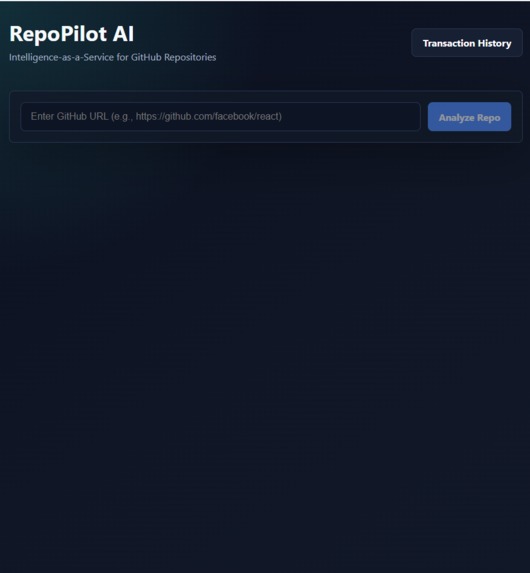
dashboard
-
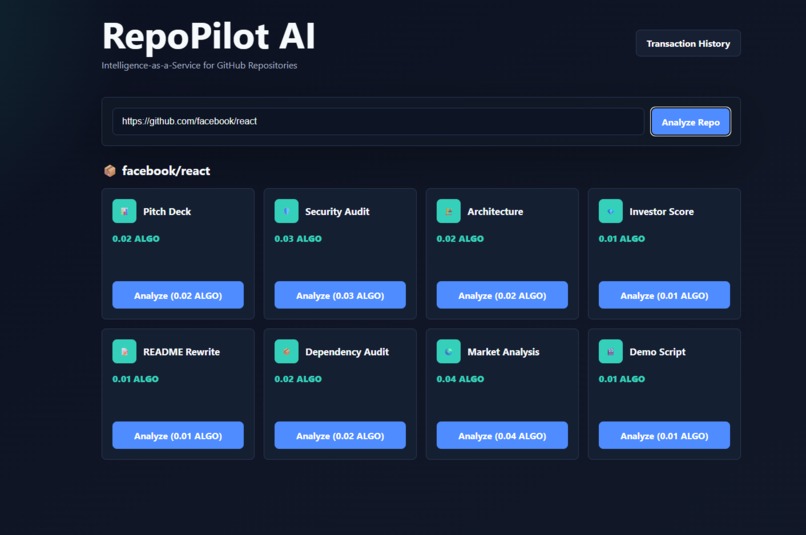
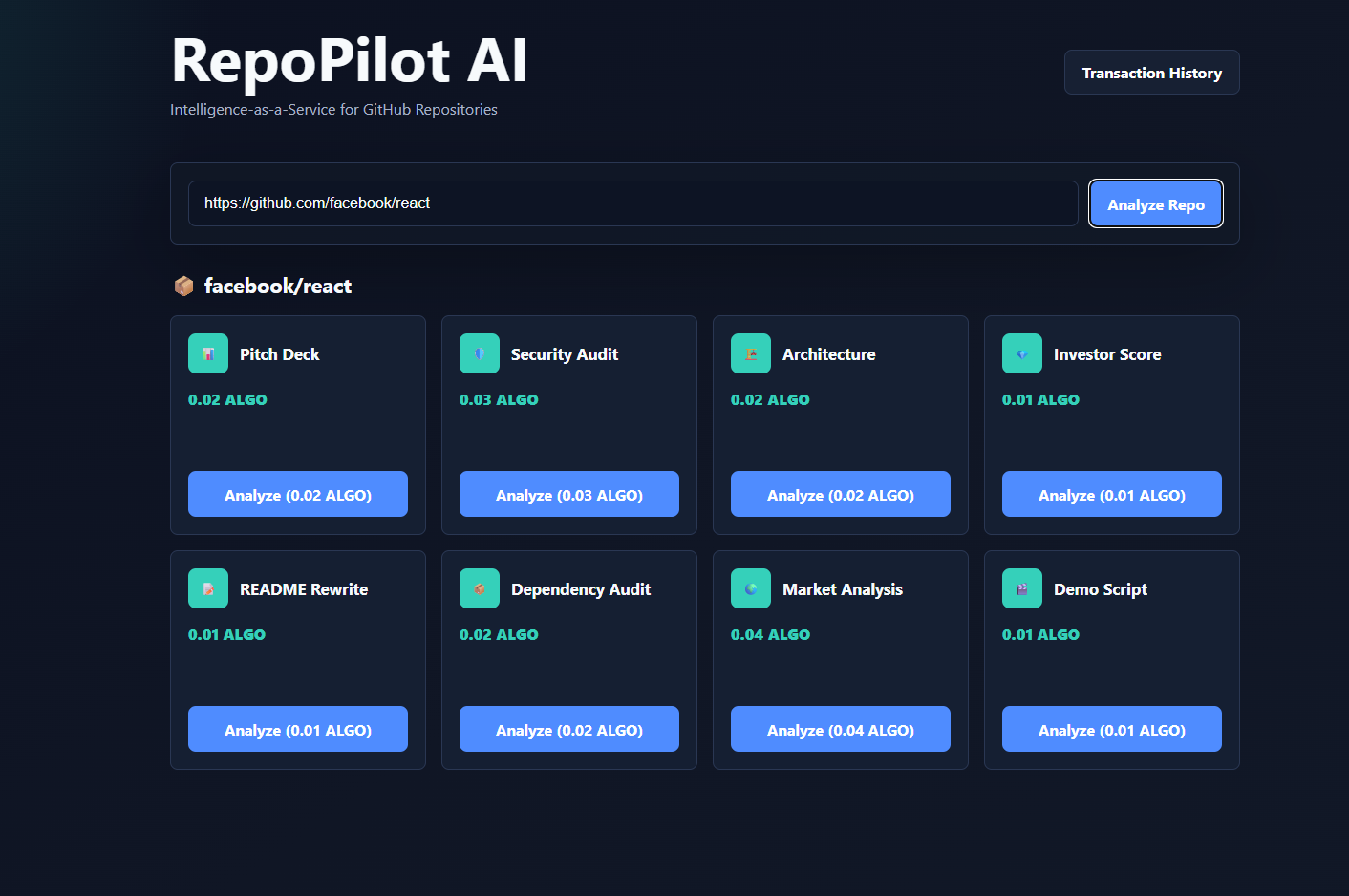
analysis dashboard
-

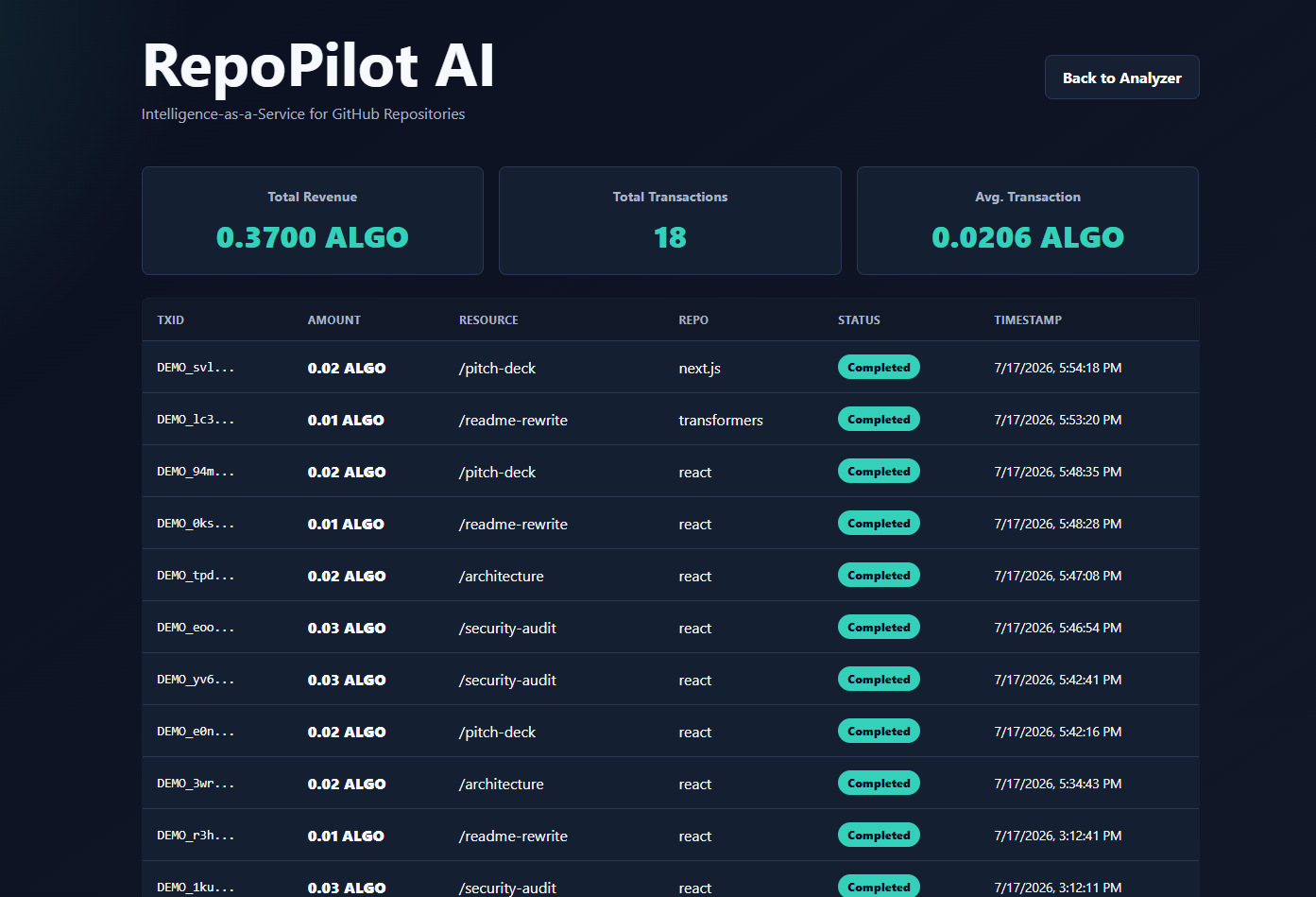
transaction history
Inspiration
Developers, VCs, and security teams spend significant time manually analyzing GitHub repositories to understand their architecture, identify risks, evaluate technical maturity, and assess business potential.
At the same time, AI agents are becoming increasingly autonomous. For these agents to interact with online services independently, they need a way to discover, access, and pay for services without requiring human intervention.
The x402 standard, combined with Algorand's fast and low-cost blockchain transactions, creates a foundation for machine-to-machine commerce over HTTP.
We built RepoPilot AI to demonstrate this concept: an AI-powered intelligence service where users and eventually autonomous AI agents can pay for repository analysis on demand using micropayments.
RepoPilot AI explores a future where AI agents can pay for intelligence exactly when they need it.
What It Does
RepoPilot AI transforms GitHub repositories into actionable intelligence through eight AI-powered analysis modules, each available through x402 micropayments on Algorand.
Intelligence Modules
| Feature | Price | Description |
|---|---|---|
| 🛡️ Security Audit | 0.03 ALGO | Identify potential vulnerabilities and recommended fixes |
| 📊 Pitch Deck | 0.02 ALGO | Generate an investor-ready pitch deck |
| 🏗️ Architecture Analysis | 0.02 ALGO | Generate architecture insights, Mermaid diagrams, and component breakdowns |
| 📈 Investor Score | 0.01 ALGO | Evaluate startup and project readiness on a 0–100 scale |
| 📝 README Rewrite | 0.01 ALGO | Transform repository documentation into professional README content |
| 📦 Dependency Audit | 0.02 ALGO | Analyze dependencies, license risks, and potential vulnerabilities |
| 🌍 Market Analysis | 0.04 ALGO | Analyze TAM, SAM, competitors, and market positioning |
| 🎤 Demo Script | 0.01 ALGO | Generate a structured five-minute investor demo script |
Total cost to run all eight analyses: 0.16 ALGO.
Users only pay for the intelligence modules they need.
The x402 Flow
RepoPilot AI uses the x402 payment model to enable pay-per-request access to AI-powered repository intelligence.
1. Client requests an analysis
             ↓
2. Server returns HTTP 402
   Payment requirements are provided
             ↓
3. Client signs an Algorand payment
             ↓
4. Payment is verified and settled
             ↓
5. The requested analysis is executed
             ↓
6. Results and payment receipt are returned
This creates a simple model:
Request → Pay → Receive Intelligence
The same model can be used by human users, applications, and autonomous AI agents.
How We Built It
Technology Stack
| Layer | Technology |
|---|---|
| Frontend | React + TypeScript |
| Backend | Node.js + Express |
| Payments | x402 |
| Blockchain | Algorand |
| AI | OpenAI API |
| Repository Data | GitHub API |
| Database | SQLite |
Architecture
┌─────────────┐
│   Client    │
│ React + TS  │
└──────┬──────┘
       │
       │ Request analysis
       ▼
┌────────────────────┐
│   RepoPilot API    │
│   x402 Middleware   │
└──────┬─────────────┘
       │
       │ Payment required
       ▼
┌────────────────────┐
│     Algorand       │
│ Payment Verification│
└──────┬─────────────┘
       │
       │ Payment confirmed
       ▼
┌────────────────────┐
│   GitHub API       │
│ Repository Data    │
└──────┬─────────────┘
       │
       ▼
┌────────────────────┐
│      OpenAI        │
│   AI Analysis      │
└──────┬─────────────┘
       │
       ▼
┌────────────────────┐
│  Analysis Result   │
│ + Payment Receipt  │
└────────────────────┘
The backend is built with Express.js and includes a payment middleware layer that handles the x402 payment flow.
The frontend is built with React and TypeScript, providing a responsive dark-themed interface for repository analysis and transaction tracking.
SQLite stores transaction records and receipts, creating an auditable history of payments and completed analyses.
Challenges We Ran Into
Challenge 1: Understanding the x402 Payment Flow
The x402 flow Challenge → Sign → Retry → Settle was new to us. We had to understand how an HTTP 402 Payment Required response could integrate with Algorand transactions and an API request-response workflow.
Our Solution
We built a dedicated middleware layer to abstract the payment complexity from the analysis logic.
This allows the application to separate:
- Payment requirements
- Payment verification
- Repository analysis
- AI processing
- Result delivery
The goal was to make the experience seamless for both human users and future autonomous AI agents.
Challenge 2: SQLite Database Paths on Windows
During development, SQLite initially failed to open the database because the required data/ directory did not exist.
Our Solution
We created the required directories programmatically and improved the database path configuration to ensure the application could reliably locate the database across development environments.
Challenge 3: Real Algorand Verification vs. Reliable Demonstration
We wanted to demonstrate the complete payment experience during development without requiring real ALGO transactions for every test.
This created a challenge: how could we maintain the application's payment architecture while keeping development and demonstrations reliable?
Our Solution
We implemented a DEMO_MODE that simulates the payment process during development while preserving the structure of the real payment verification flow for future production integration.
This allows us to demonstrate the complete user experience while keeping the application architecture ready for real blockchain settlement.
Challenge 4: Making the Improvement Plan Actionable
We did not want RepoPilot AI to simply identify problems and assign scores.
Developers need to know:
- What should be fixed first?
- How serious is the issue?
- How long might the fix take?
- What steps should be taken?
Our Solution
We created an Improvement Plan that organizes recommendations by:
- Critical
- High
- Medium
- Low
Each recommendation includes actionable steps and estimated effort.
We also created an Auto-Fix PR interface that demonstrates how the platform could eventually generate pull requests containing automated fixes.
🏆 Accomplishments We're Proud Of
Complete x402 Payment Flow — Implemented the Challenge → Sign → Retry → Settle workflow within the application architecture.
Eight AI-Powered Analysis Modules — Created a modular intelligence system covering security, architecture, investment, documentation, dependencies, market analysis, pitch decks, and demos.
Professional User Interface — Built a responsive dark-themed dashboard for repository analysis.
Payment Receipt System — Created transaction records and receipts for completed analyses.
Transaction History Dashboard — Added visibility into transaction counts, total revenue, and average transaction value.
Actionable Improvement Plans — Added priority levels, estimated effort, and recommended next steps instead of simply displaying problems.
Modular Architecture — Designed the system so additional intelligence modules can be added without rebuilding the entire application.
Agent-Commerce Foundation — Demonstrated how AI services can be structured as independent, pay-per-request resources.
What We Learned
1. x402 Provides a Foundation for Agentic Commerce
AI agents need more than intelligence. They also need the ability to access and pay for external services.
x402 provides a protocol-level approach for enabling machine-to-machine payments over HTTP.
2. Blockchain Payments Can Support API Workflows
Traditional blockchain transactions are often associated with wallets, exchanges, and financial applications.
Our project helped us explore how blockchain payments can instead become part of a normal API request:
Request → Payment → Verification → Resource
3. Micropayments Enable Alternative Business Models
Many AI services rely on subscriptions.
However, not every user needs a service frequently enough to justify a monthly subscription.
Pay-per-request pricing provides an alternative:
Use the service → Pay for the request → Receive the result.
4. Reliable Demonstrations Matter
Hackathon projects need to demonstrate a concept reliably.
A development mode allows the application to be tested and demonstrated without depending on real-value transactions during every development cycle, while keeping the production payment architecture in mind.
5. Recommendations Are More Valuable Than Scores
A score alone does not tell a developer what to do next.
An effective intelligence system should provide:
- The problem
- Its priority
- Why it matters
- Recommended actions
- Estimated effort
This is why RepoPilot AI focuses on actionable intelligence, not just analysis.
6. Receipts Build Trust
When an autonomous agent pays for a service, it needs evidence that the transaction occurred.
Payment receipts and transaction records provide a foundation for:
- Auditing
- Accounting
- Agent verification
- Service transparency
What's Next for RepoPilot AI?
1. Real Algorand Payment Integration
Move from development/demo payment mode to complete production-ready ALGO transactions with wallet integrations such as Pera Wallet.
2. Automated Pull Request Generation
Enable RepoPilot AI to create real pull requests containing fixes for identified vulnerabilities, dependency issues, and other code problems.
3. Multi-Chain Support
Explore x402 payments across additional supported blockchain networks where appropriate.
4. GitHub App Integration
Launch RepoPilot AI as a GitHub App for seamless repository access and collaboration workflows.
5. Agent-to-Agent Intelligence Marketplace
Allow autonomous AI agents to discover, select, and pay for repository intelligence services independently.
6. More Intelligence Modules
Potential future analyses include:
- Code Quality Score
- Security Patch Suggestions
- Documentation Generation
- Test Coverage Analysis
- Performance Analysis
- Technical Debt Assessment
7. Custom AI Models
Explore specialized models and fine-tuned systems designed specifically for software repository analysis.
8. Enterprise Features
Add:
- Bulk analysis pricing
- Private repository support
- Team workspaces
- Organization-level analytics
- Dedicated support
9. Open Source SDK
Create an SDK that allows developers to build their own x402-powered intelligence services.
10. Advanced Analytics
Expand the analytics dashboard with:
- Most popular analyses
- Transaction trends
- Revenue forecasting
- User retention
- Agent usage patterns
- Analysis demand trends
Our Vision
RepoPilot AI is more than an AI code analysis tool.
We believe the future of AI services will be increasingly modular and autonomous.
Instead of subscribing to a large platform, an AI agent could:
- Discover a service.
- Request a price.
- Pay automatically.
- Receive the result.
- Continue its task.
RepoPilot AI is our exploration of that future — where AI intelligence becomes an on-demand, machine-payable resource.
RepoPilot AI — Turning GitHub repositories into actionable intelligence, one paid analysis at a time.
Built With
- ai
- algorand
- api
- blockchain
- css
- express.js
- git
- github
- micropayments
- node.js
- openai
- react
- typescript
- web3
- x402


Log in or sign up for Devpost to join the conversation.