RepoMind
Turn any GitHub repository into a living engineering intelligence system.
Inspiration
Modern AI coding assistants have transformed how developers write code, but software repositories themselves remain surprisingly passive.
Git remembers what changed, yet it rarely explains why those decisions were made, how different parts of the system are connected, or what risks a new change might introduce.
Every engineering team eventually experiences the same problem:
- Senior engineers leave, taking years of architectural knowledge with them.
- Documentation becomes outdated.
- Pull request discussions disappear into history.
- Developers repeatedly ask the same questions:
- Why was Redis introduced?
- What happens if I modify authentication?
- Which services will be affected by this change?
Existing developer tools help generate code.
We wanted to build something different.
What if a repository could actually understand itself?
That idea became RepoMind.
Instead of treating Git as a collection of files, RepoMind treats every repository as a living engineering knowledge system.
What it does
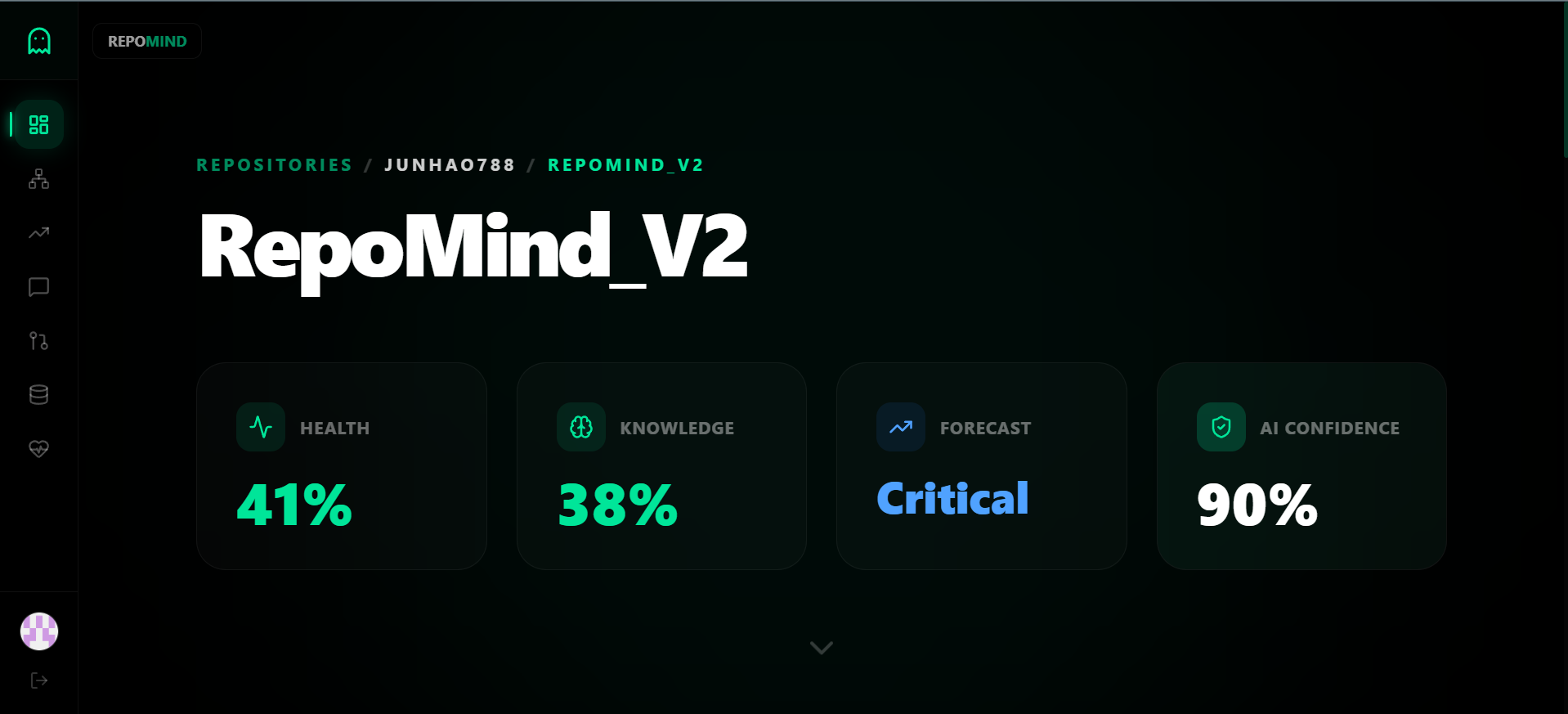
RepoMind continuously transforms a GitHub repository into an Engineering Intelligence Platform.
After importing a repository, RepoMind performs a complete engineering analysis and constructs a persistent knowledge layer.
It generates:
- Repository DNA
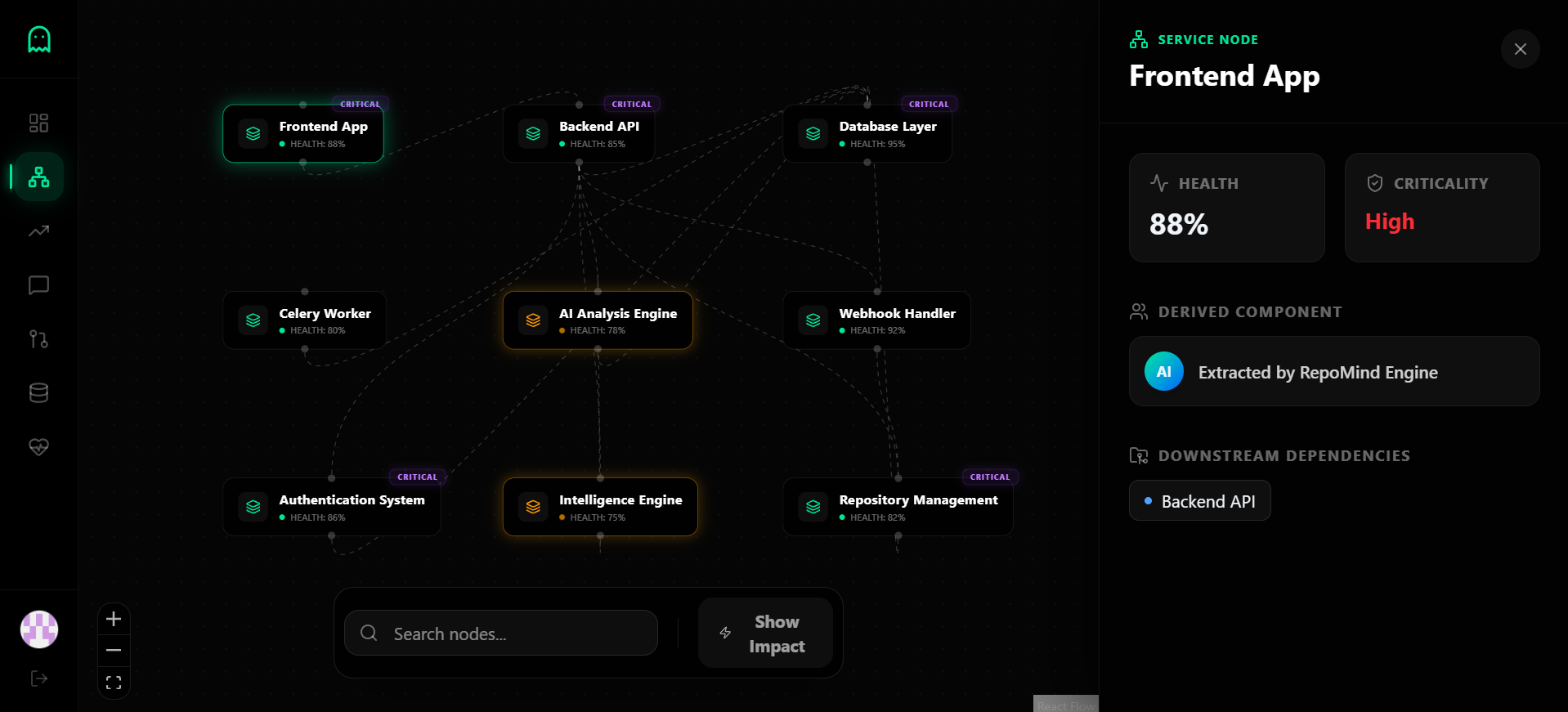
- Knowledge Graph
- Engineering Health
- Repository Evolution
- Semantic Pull Request Analysis
- Impact Analysis
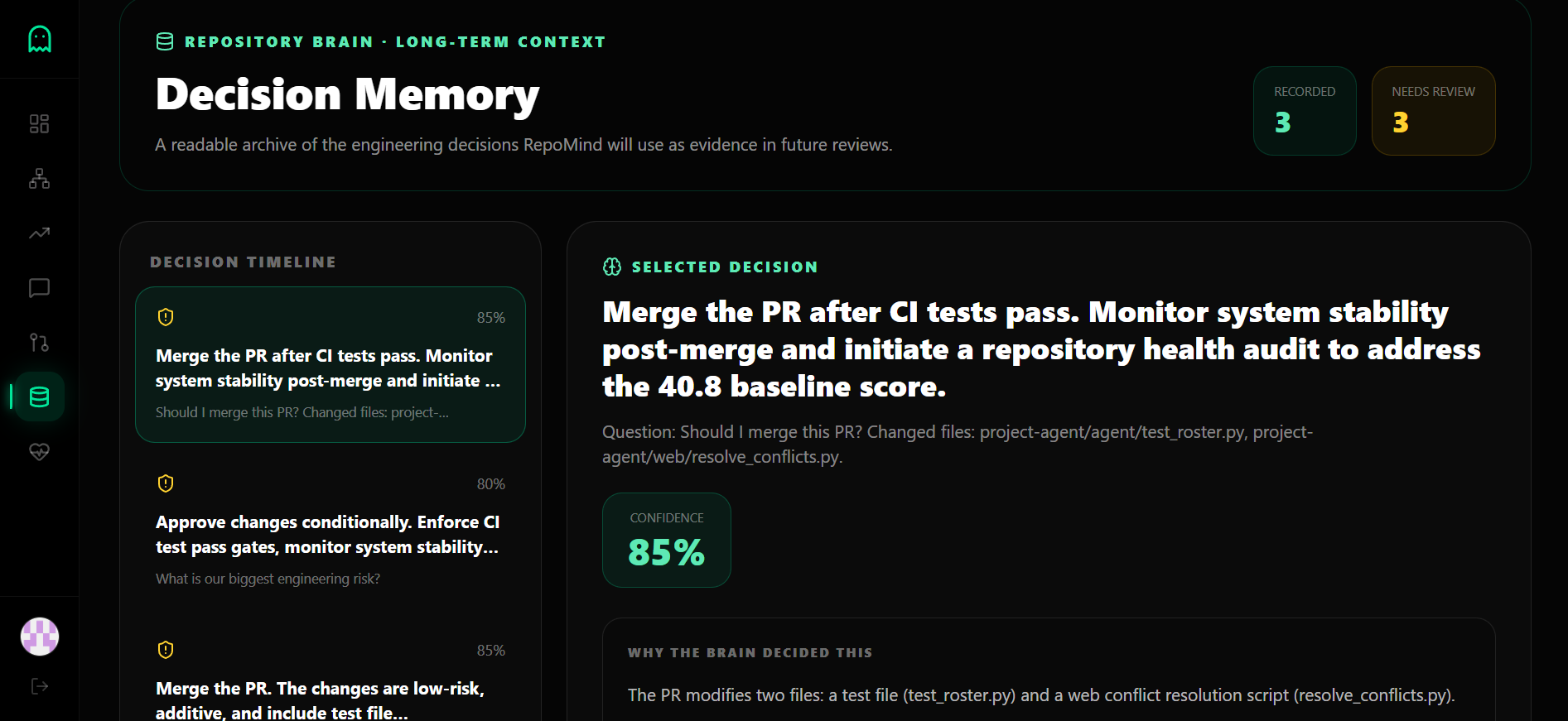
- Decision Memory
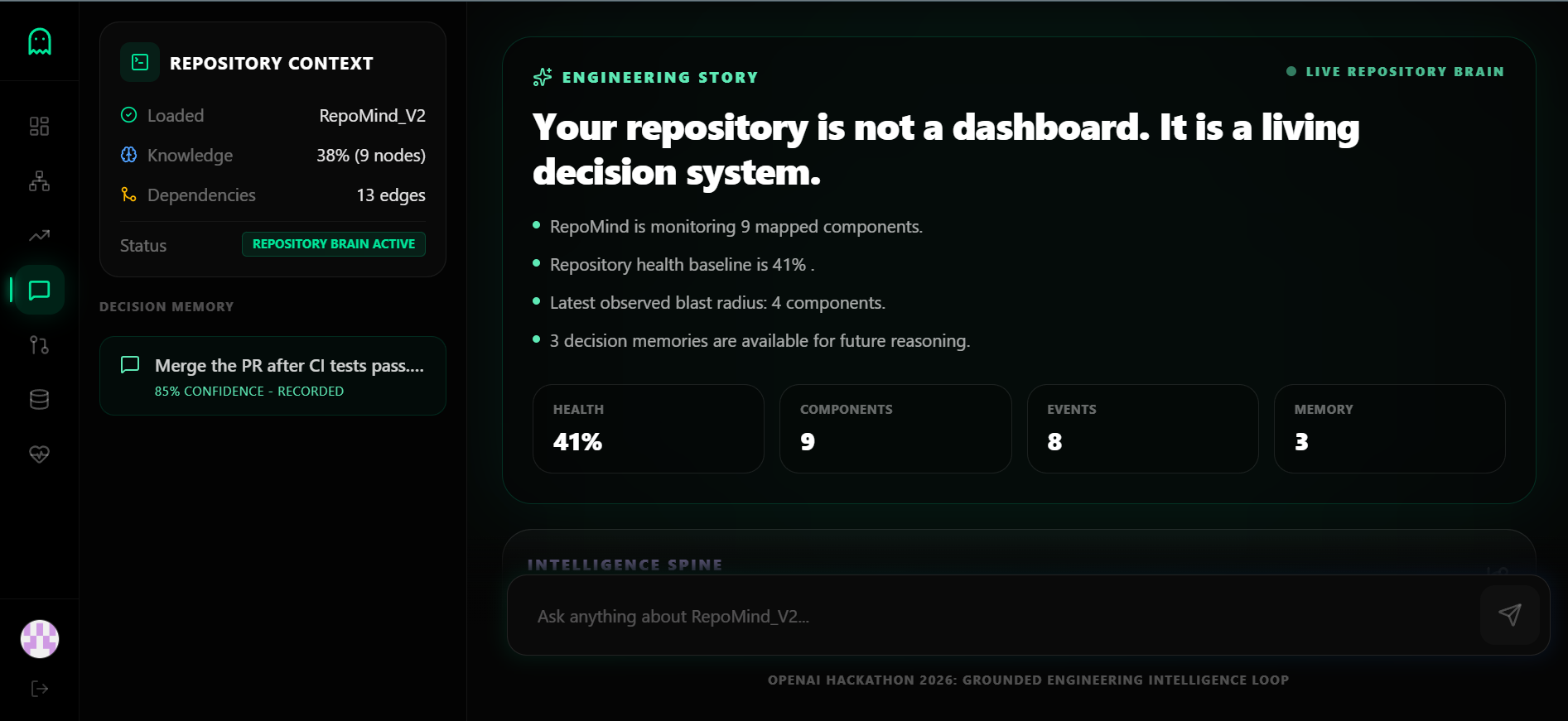
- AI Workspace
Unlike traditional repository dashboards, RepoMind doesn't simply visualize Git history.
It builds an understanding of how software evolves.
Developers can ask engineering questions in natural language, inspect architectural decisions, visualize dependency relationships, understand the business impact of changes, and review pull requests through structured AI reasoning instead of raw code diffs.
How we built it
RepoMind is built around what we call the Intelligence Spine.
Instead of sending repository data directly to a language model, every repository passes through a structured engineering pipeline:
GitHub Repository
        ↓
Repository Analysis
        ↓
Repository DNA
        ↓
Knowledge Graph
        ↓
Semantic Diff
        ↓
Impact Analysis
        ↓
Decision Memory
        ↓
Evolution Timeline
        ↓
AI Workspace
This architecture allows every AI response to be grounded in real repository evidence rather than relying solely on model reasoning.
Our backend performs repository cloning, Git history extraction, dependency analysis, component discovery, semantic diff generation, engineering health evaluation, and knowledge graph construction before the AI layer is invoked.
The Workspace, PR Auditor, Evolution Timeline, and Knowledge Graph all share the same intelligence backbone.
Challenges we ran into
One of our biggest technical challenges was making every feature operate on the same source of truth.
Initially, different modules were generating their own interpretations of the repository, which caused inconsistencies between the Knowledge Graph, PR analysis, and Workspace.
To solve this, we redesigned the backend around a centralized Intelligence Spine where Repository DNA, Knowledge Graph, Evolution, Semantic Diff, and Decision Memory all originate from the same analysis pipeline.
Another challenge involved infrastructure.
Our repository analysis worker cloned repositories into its own isolated container, preventing other services from accessing the analyzed source code.
We introduced a shared repository volume so every backend service could reference the exact same repository snapshot.
We also replaced unstable parsing logic with a more reliable structural analysis pipeline, allowing Repository DNA and Knowledge Graph generation to remain consistent across projects.
What we learned
Building RepoMind changed how we think about software engineering.
Repositories are more than source code.
They contain architecture, engineering decisions, historical context, trade-offs, and organizational knowledge.
We also learned that AI becomes significantly more useful when reasoning is grounded in structured engineering data rather than raw source files alone.
Instead of asking a model to "guess," we first build understanding.
Only then do we ask AI to reason.
What's next for RepoMind
Our long-term vision is to evolve RepoMind into an Engineering Operating System.
Future versions will introduce:
- Multi-Agent Engineering Council
- Repository Simulation ("What happens if I change this?")
- Continuous Architecture Monitoring
- Engineering Forecasting
- Organization-wide Knowledge Graphs
- Autonomous Repository Memory
Ultimately, we believe software repositories should not only store code.
They should understand it, remember it, explain it, and help engineering teams make better decisions.

Log in or sign up for Devpost to join the conversation.