-
-
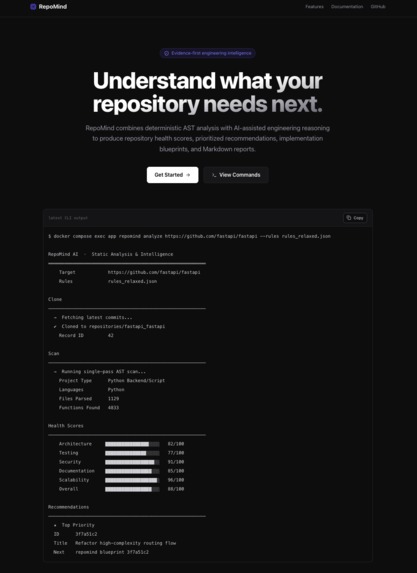
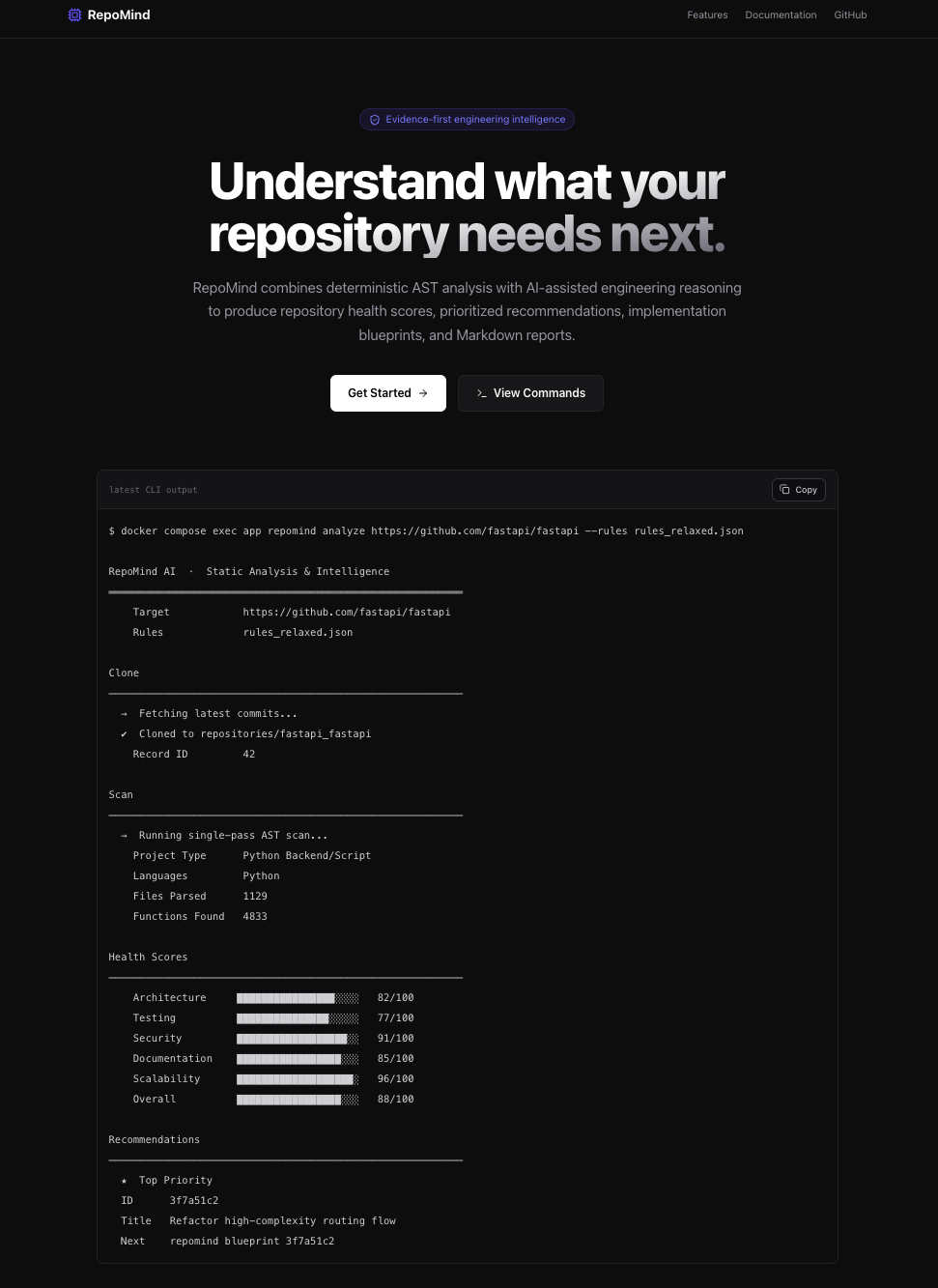
RepoMind documentation homepage showcasing its architecture, workflow, features, and developer-first experience
-
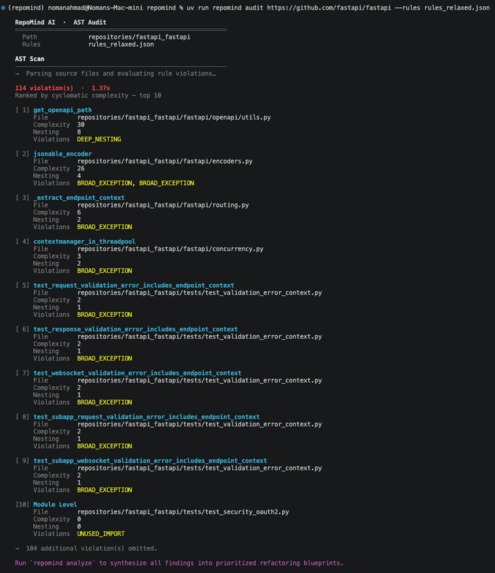
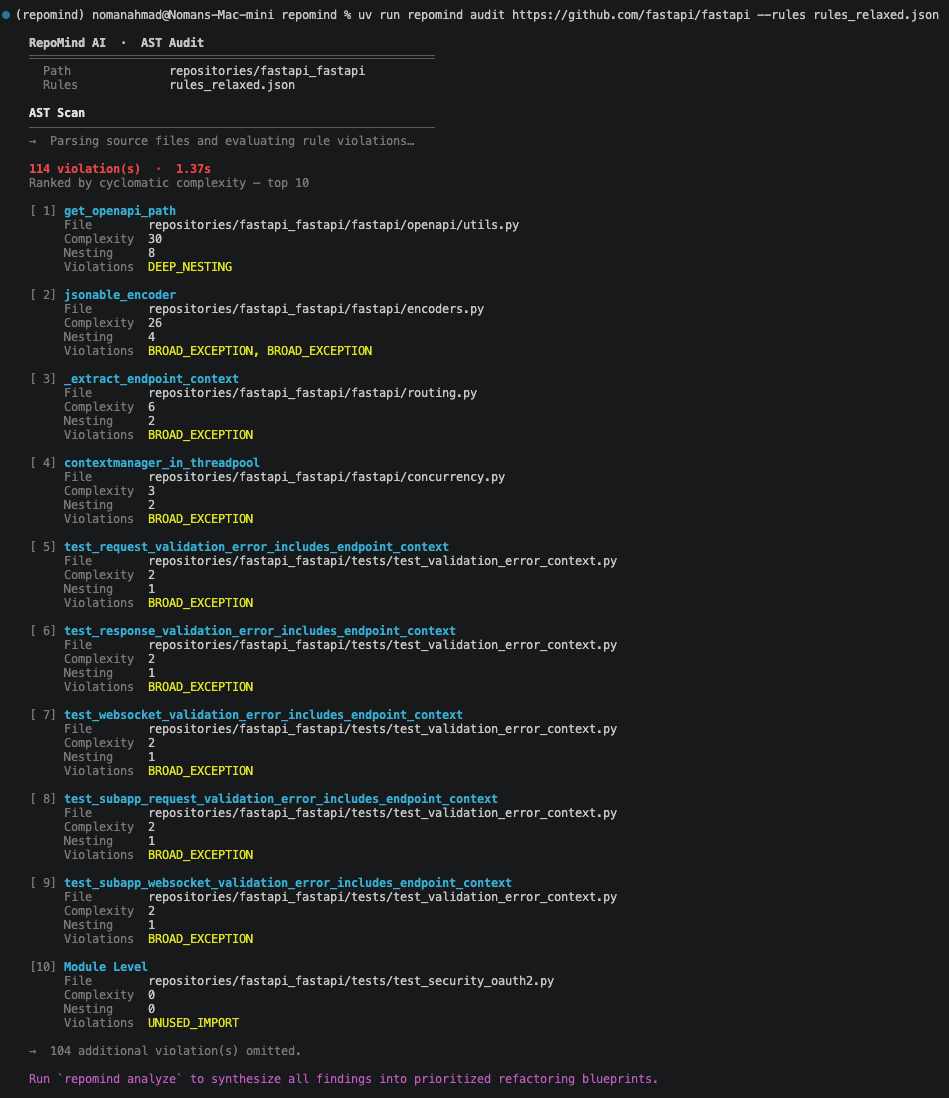
AST Audit: Deterministic AST audit that detects engineering violations, ranks findings by complexity, and surfaces maintainability issues.
-
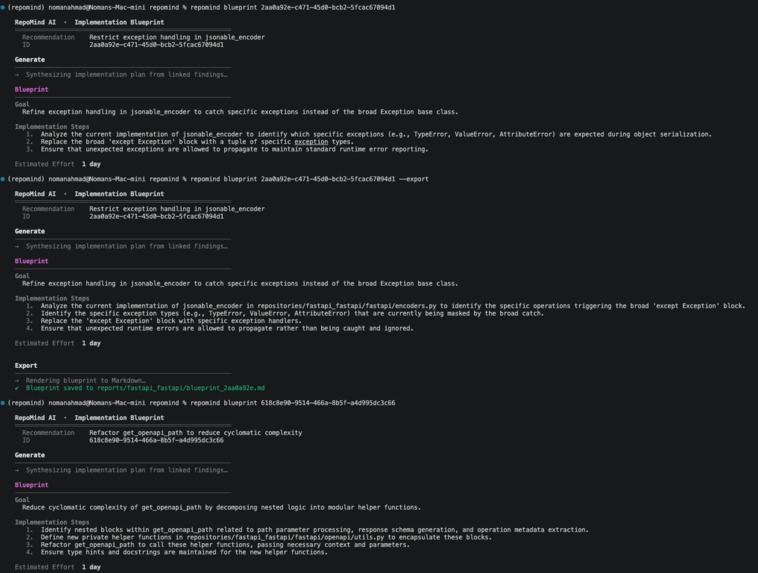
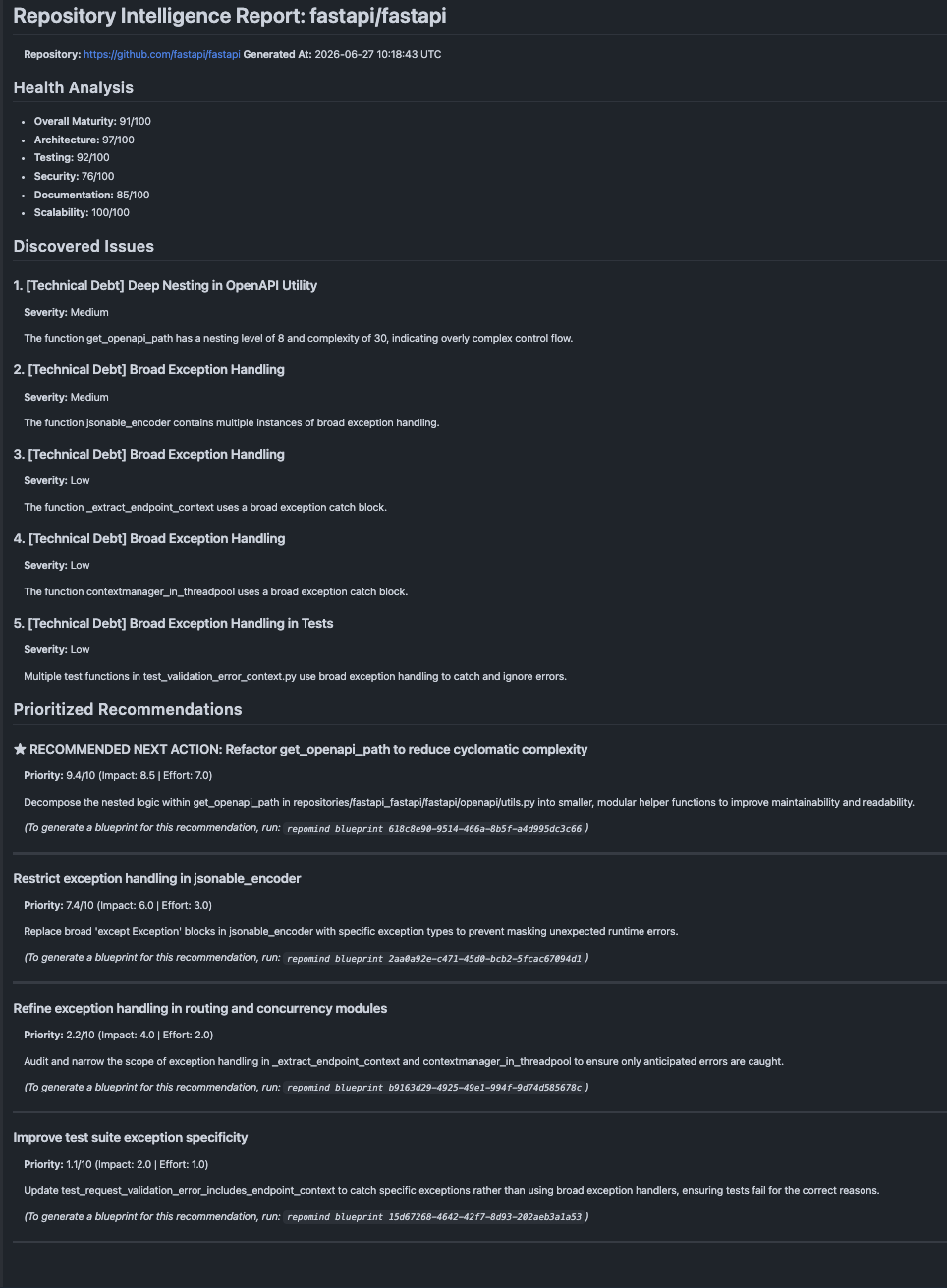
Repository Intelligence Report: Exportable Markdown report with repository health, prioritized issues, and evidence-based recommendations.
-
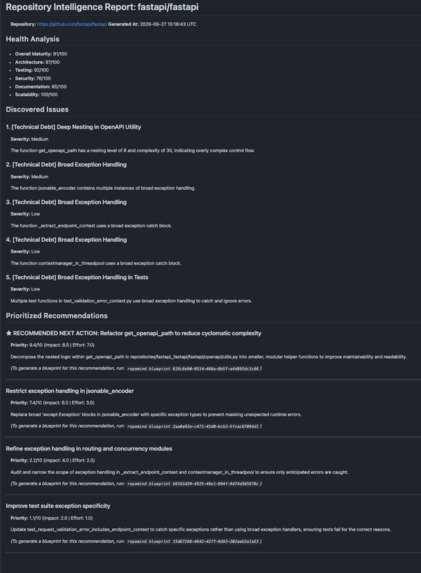
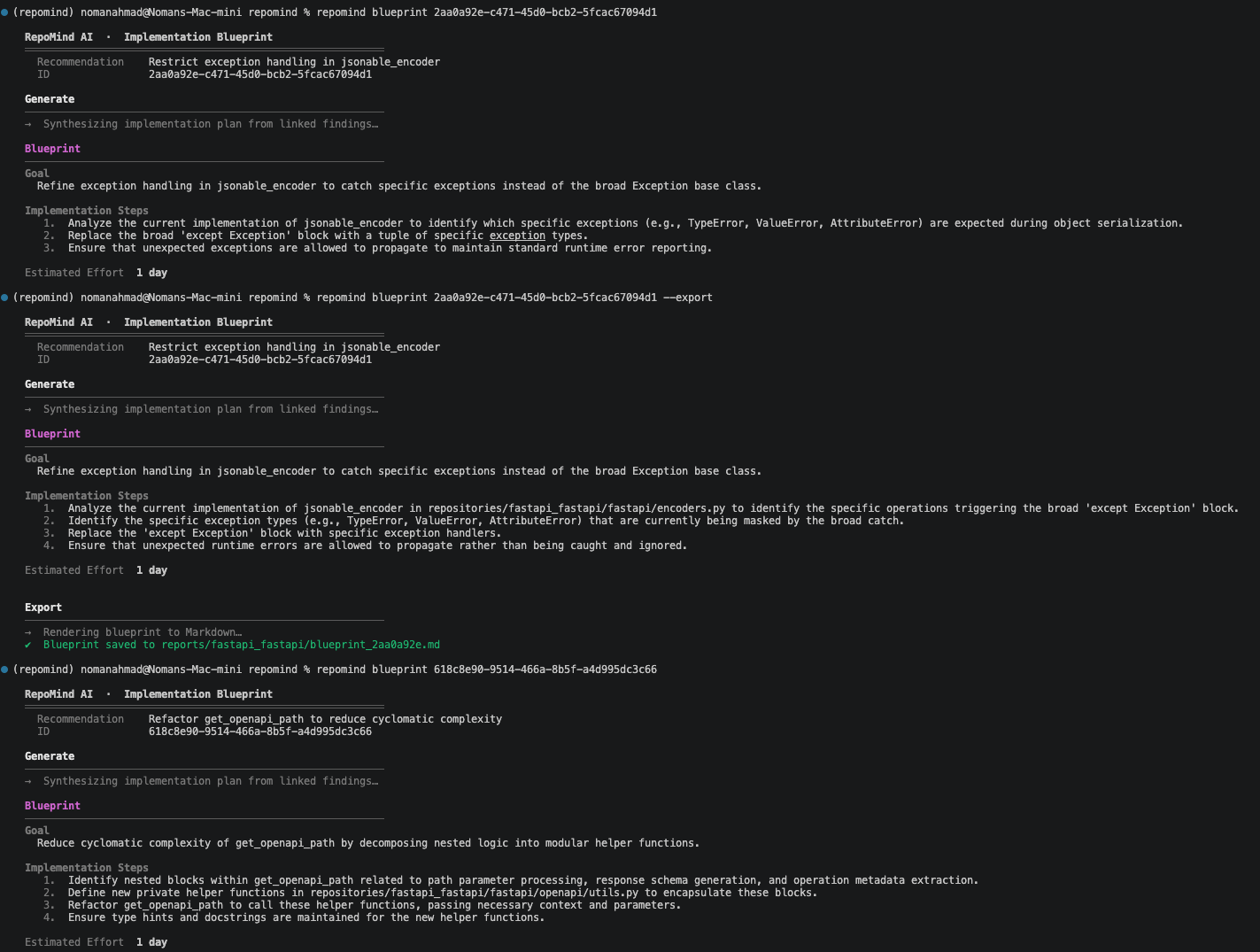
Implementation Blueprint: Actionable plan that transform detected issues into step-by-step engineering plans with estimated effort.
-
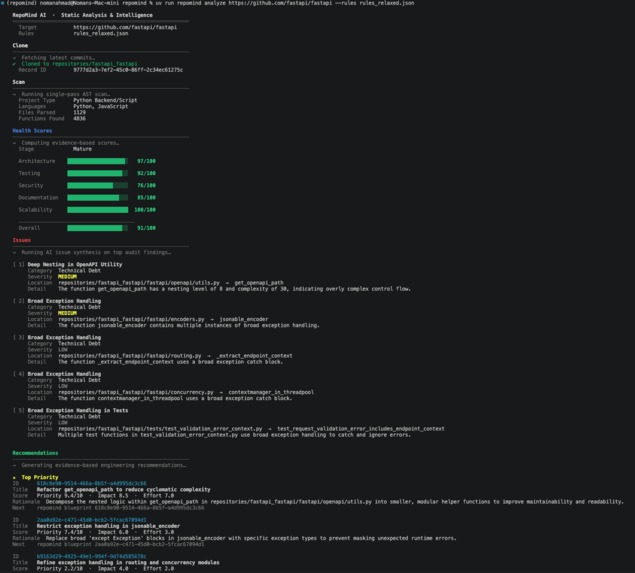
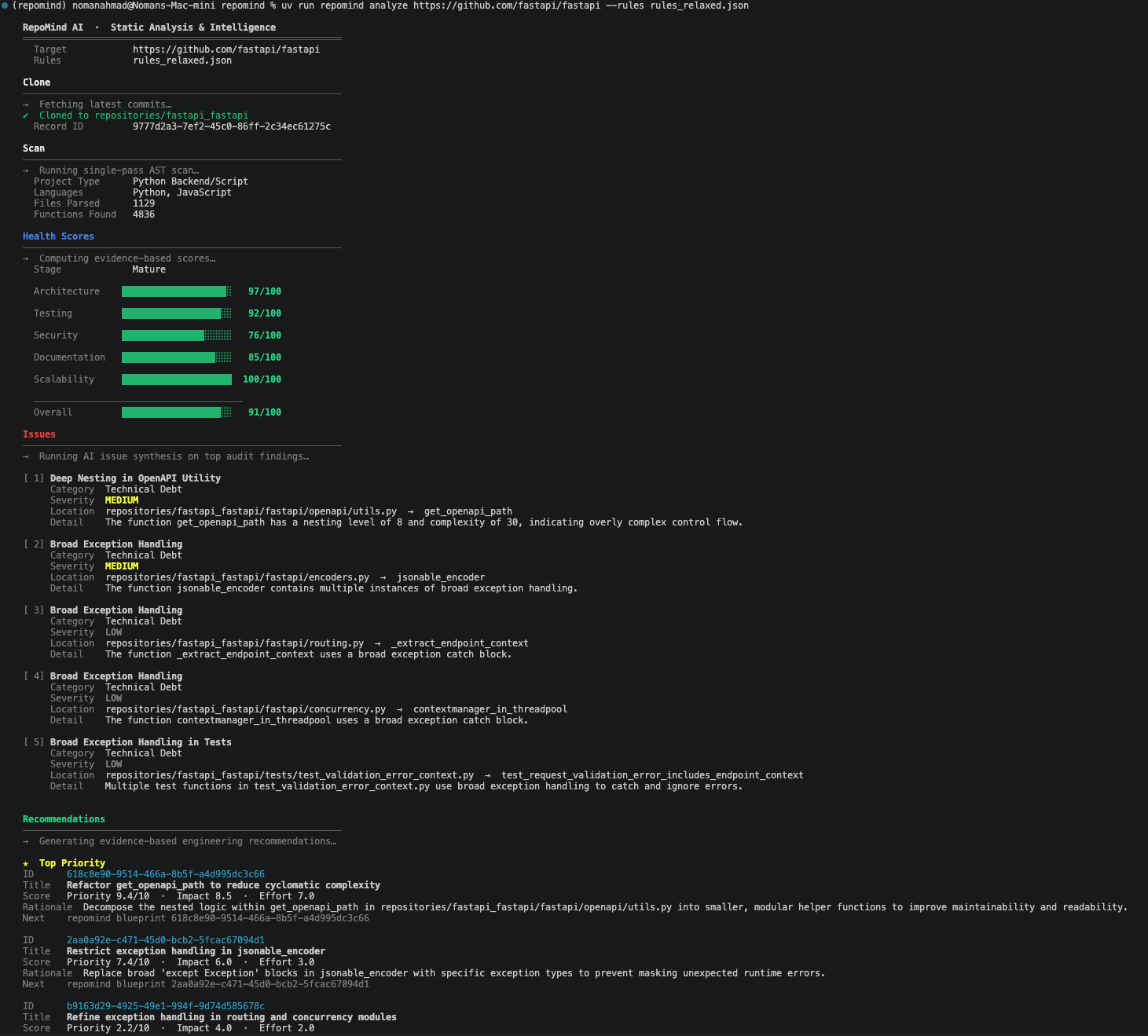
Repository Analysis: Evidence-driven repository analysis with health scoring, issue detection, and AI-powered engineering recommendations.
Inspiration
While building my own projects, I realized I could build MVPs quickly, but I often got stuck once they started growing. As the codebase became larger, it became difficult to identify what should be improved next, where technical debt was accumulating, which parts of the architecture needed refactoring, and whether the project was truly becoming production-ready.
Testing presented a similar challenge. Even with tests in place, it wasn't always clear whether they were sufficient, which areas of the codebase were under-tested, or what engineering work should be prioritized next.
Existing tools typically focused on isolated metrics, linting, or AI-generated suggestions that weren't always grounded in the actual repository. They rarely connected deterministic code analysis with practical engineering guidance.
I wanted a tool that could answer questions like:
- How healthy is my repository?
- What should I improve next?
- Where is the highest-impact technical debt?
- What is preventing this project from becoming production-ready?
- What concrete implementation steps should I take?
That challenge inspired me to build RepoMind—an evidence-driven repository intelligence platform that combines deterministic static analysis with AI to transform repository data into actionable engineering recommendations and implementation blueprints.
What it does
RepoMind is an evidence-driven repository intelligence platform that helps developers understand the engineering health of their codebases and identify the highest-impact improvements.
It clones a repository, performs deterministic static analysis, detects maintainability and code quality issues, and calculates repository health scores across Architecture, Testing, Security, Documentation, and Scalability.
Instead of allowing an LLM to analyze a repository directly, RepoMind first gathers verified engineering evidence. These deterministic findings are then used by AI to generate repository-specific recommendations, prioritize technical debt, and create implementation blueprints with actionable next steps.
RepoMind also exports Markdown reports, making it easy to share findings with engineering teams or use them as a roadmap for improving a project toward production readiness.
How we built it
RepoMind started as an AI-powered repository analysis tool that used semantic embeddings to provide repository context to the LLM. While this approach worked for understanding high-level repository semantics, it often lacked precise engineering context. This occasionally led to unsupported recommendations, such as suggesting TypeScript files for Python repositories or proposing changes that didn't exist in the analyzed codebase.
To address this, we redesigned the architecture around an evidence-first pipeline.
Instead of relying primarily on embeddings, RepoMind now begins with deterministic static analysis. The repository is cloned and analyzed using Python AST (with Tree-sitter support for future multi-language expansion) to extract verified engineering metrics, detect rule violations, and calculate repository health scores across Architecture, Testing, Security, Documentation, and Scalability.
Only after deterministic analysis is complete are the verified findings passed to Google Gemini. Rather than reasoning directly over the repository, the AI synthesizes verified evidence into engineering recommendations and implementation blueprints. This significantly reduced unsupported recommendations and produced outputs that are grounded in the actual repository.
RepoMind is built in Python as a CLI application using Typer, with PostgreSQL and pgvector for persistent repository intelligence, Docker Compose for reproducible local development, GitHub Actions for automation, configurable engineering rule profiles, and a Next.js documentation website.
Challenges we ran into
One of our biggest challenges was making AI-generated recommendations reliable. Our initial prototype relied primarily on semantic embeddings to provide repository context to the LLM. While it understood repositories at a high level, it sometimes produced unsupported recommendations—for example, suggesting TypeScript files for a Python project or referencing code that didn't exist.
Rather than trying to improve the prompts alone, we redesigned the architecture. We introduced a deterministic static analysis engine that extracts verified engineering metrics, rule violations, and repository health information before AI is involved. The LLM now reasons only over validated evidence instead of the raw repository, which significantly improved the consistency and relevance of the recommendations.
Another challenge was designing repository health scores that reflected measurable engineering characteristics rather than subjective AI judgments. We developed a deterministic scoring system based on static analysis metrics to make the results more transparent and repeatable.
Finally, we focused on developer experience by optimizing analysis performance, improving CLI output, and making the generated recommendations and implementation blueprints easy to understand and act upon.
Accomplishments that we're proud of
We're proud of transforming RepoMind from an AI-first prototype into an evidence-first engineering intelligence platform. By redesigning the pipeline around deterministic static analysis, we significantly improved the reliability and relevance of AI-generated recommendations.
Some of our key accomplishments include:
- Building a deterministic static analysis engine that detects engineering issues and calculates repository health across multiple dimensions.
- Designing configurable rule profiles for balanced and strict repository analysis.
- Developing an AI pipeline that reasons only over verified repository evidence instead of raw source code.
- Creating implementation blueprints that convert identified issues into actionable engineering plans.
- Building a polished CLI with repository analysis, auditing, report generation, and blueprint export.
- Packaging the project with Docker Compose, GitHub Actions, comprehensive documentation, and Markdown reporting.
Most importantly, we're proud that RepoMind doesn't just identify problems—it helps developers understand what to improve next and why, making it a practical tool for moving projects closer to production readiness.
What we learned
Building RepoMind taught us that combining deterministic software engineering with AI produces far more reliable results than relying on an LLM alone. While AI is effective at reasoning and prioritization, it performs much better when grounded in verified repository evidence instead of raw source code or semantic embeddings.
We also learned that engineering metrics become significantly more valuable when they're connected to actionable guidance. Detecting technical debt is only part of the problem—developers also need to understand what to fix first, why it matters, and how to implement the solution.
From a technical perspective, we gained hands-on experience building static analysis pipelines, designing configurable rule engines, improving prompt engineering, optimizing CLI developer experience, and integrating PostgreSQL, pgvector, Docker, and GitHub Actions into a cohesive developer tool.
Perhaps our biggest takeaway is that production readiness isn't determined by a single metric. It comes from understanding architecture, testing, security, documentation, maintainability, and scalability together—and using that evidence to make informed engineering decisions.
What's next for RepoMind
RepoMind is evolving from a repository analysis tool into a comprehensive engineering intelligence platform.
Our next focus is expanding deterministic analysis with additional engineering rules, deeper repository insights, and broader language support. We also plan to improve repository health scoring with more granular metrics and historical comparisons.
On the AI side, we want to move beyond recommendations into agentic engineering workflows. Instead of only identifying issues and generating implementation blueprints, RepoMind will be able to generate code changes for approved recommendations, assist with refactoring, and help automate engineering tasks while keeping deterministic analysis as the source of truth.
Other planned improvements include:
- Multi-language repository analysis using Tree-sitter.
- Incremental analysis for faster re-analysis of large repositories.
- GitHub integration for pull request reviews and continuous repository health monitoring.
- Semantic repository search and engineering knowledge retrieval.
- VS Code integration for in-editor repository intelligence.
- Additional report formats and richer engineering dashboards.
Our long-term vision is for RepoMind to become an engineering companion that not only helps developers understand the current state of a repository, but also guides them toward building more maintainable, scalable, and production-ready software.
Built With
- docker
- gitpython
- google-gemini
- next.js
- pgvector
- postgresql
- pytest
- python
- sqlalchemy
- tree-sitter
- typer
- typescript
- uv

Log in or sign up for Devpost to join the conversation.