-
-
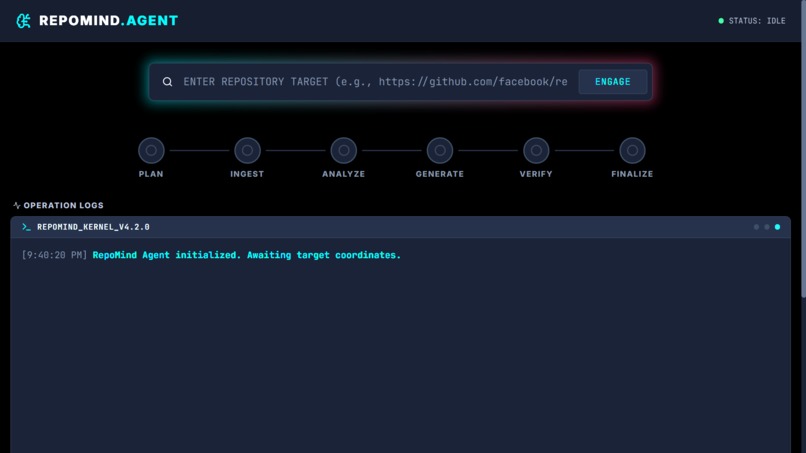
home
-
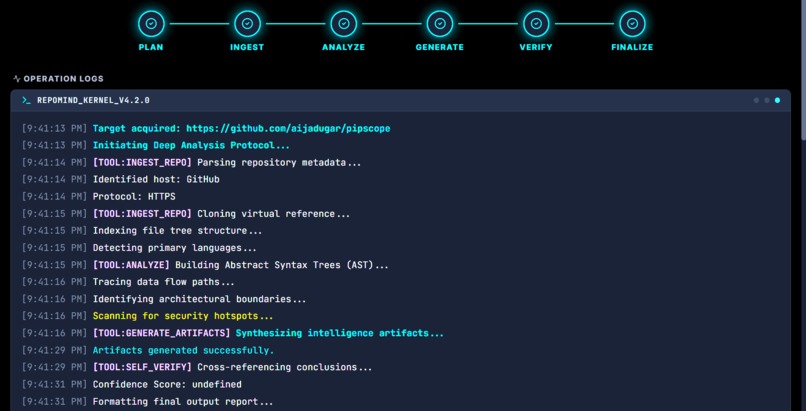
terminal
-
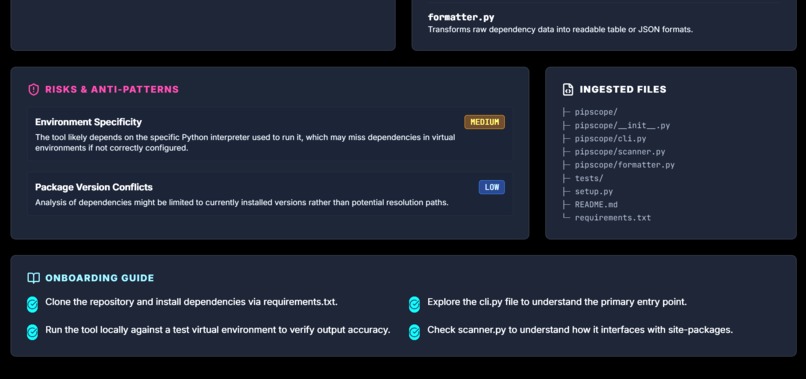
report-1
-
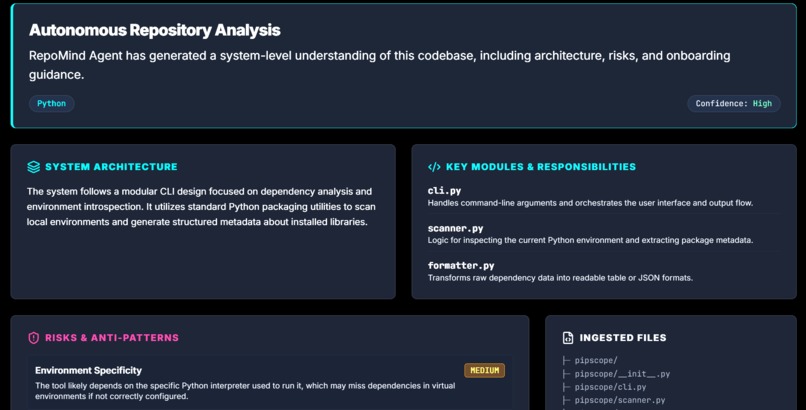
report-2
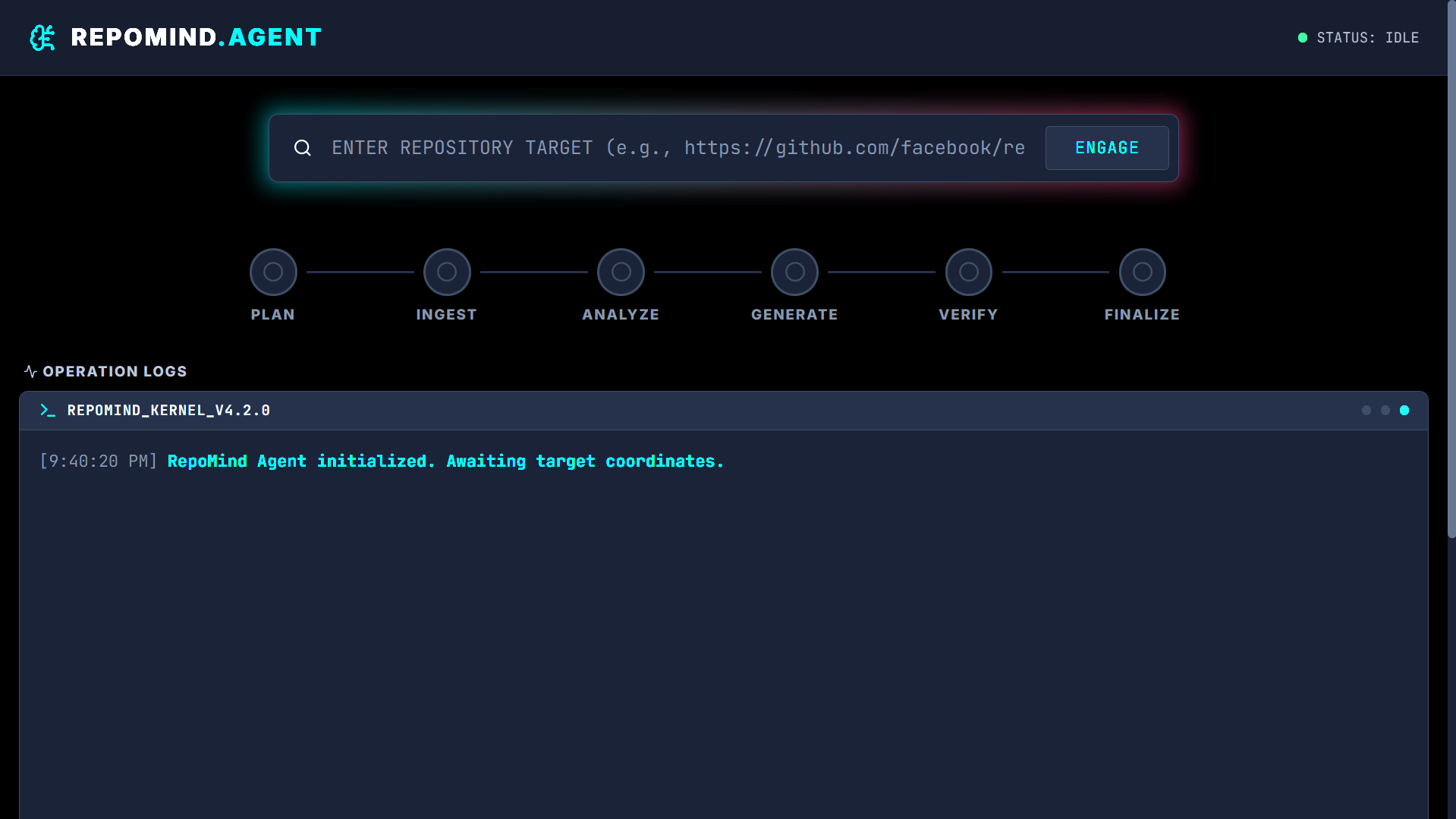
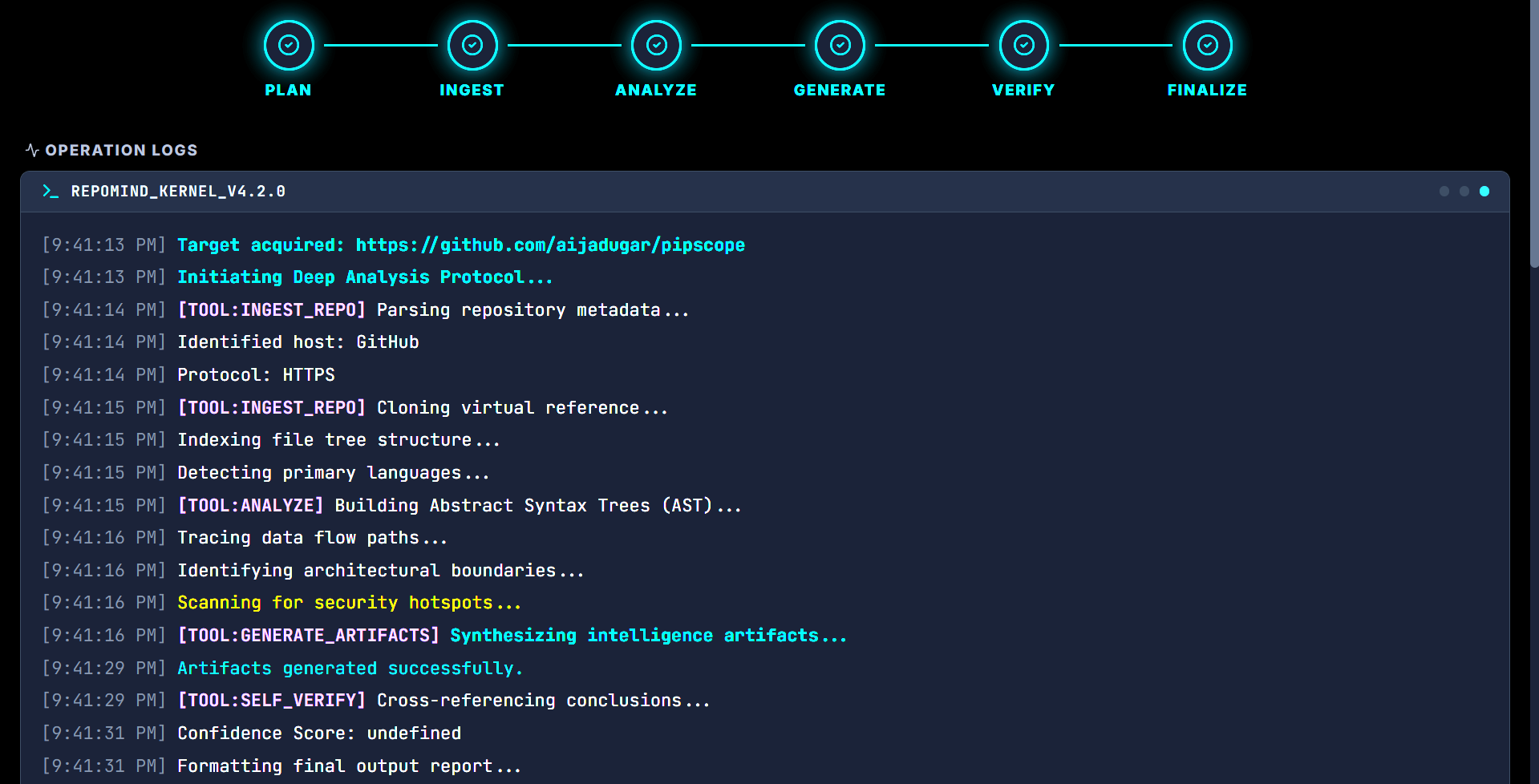
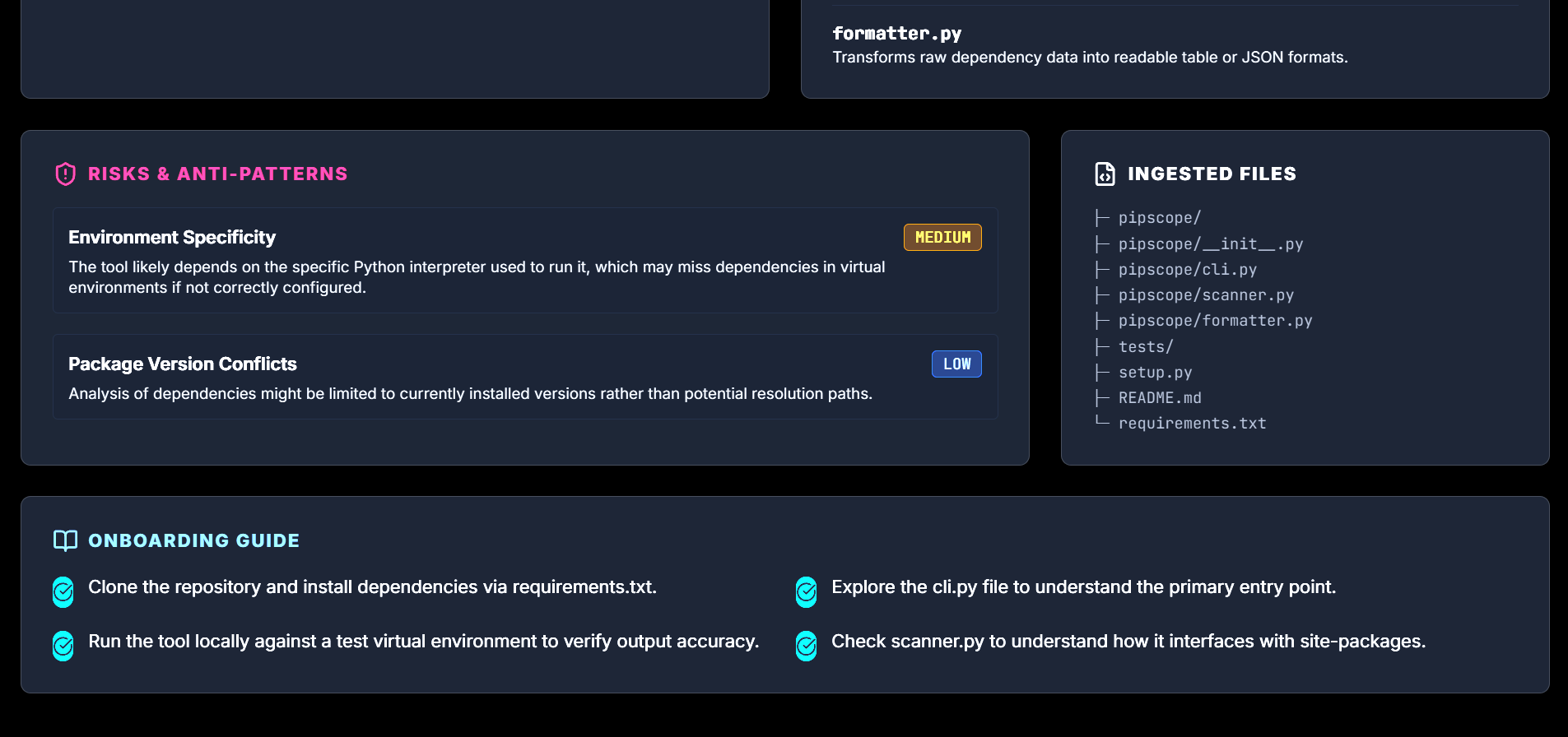
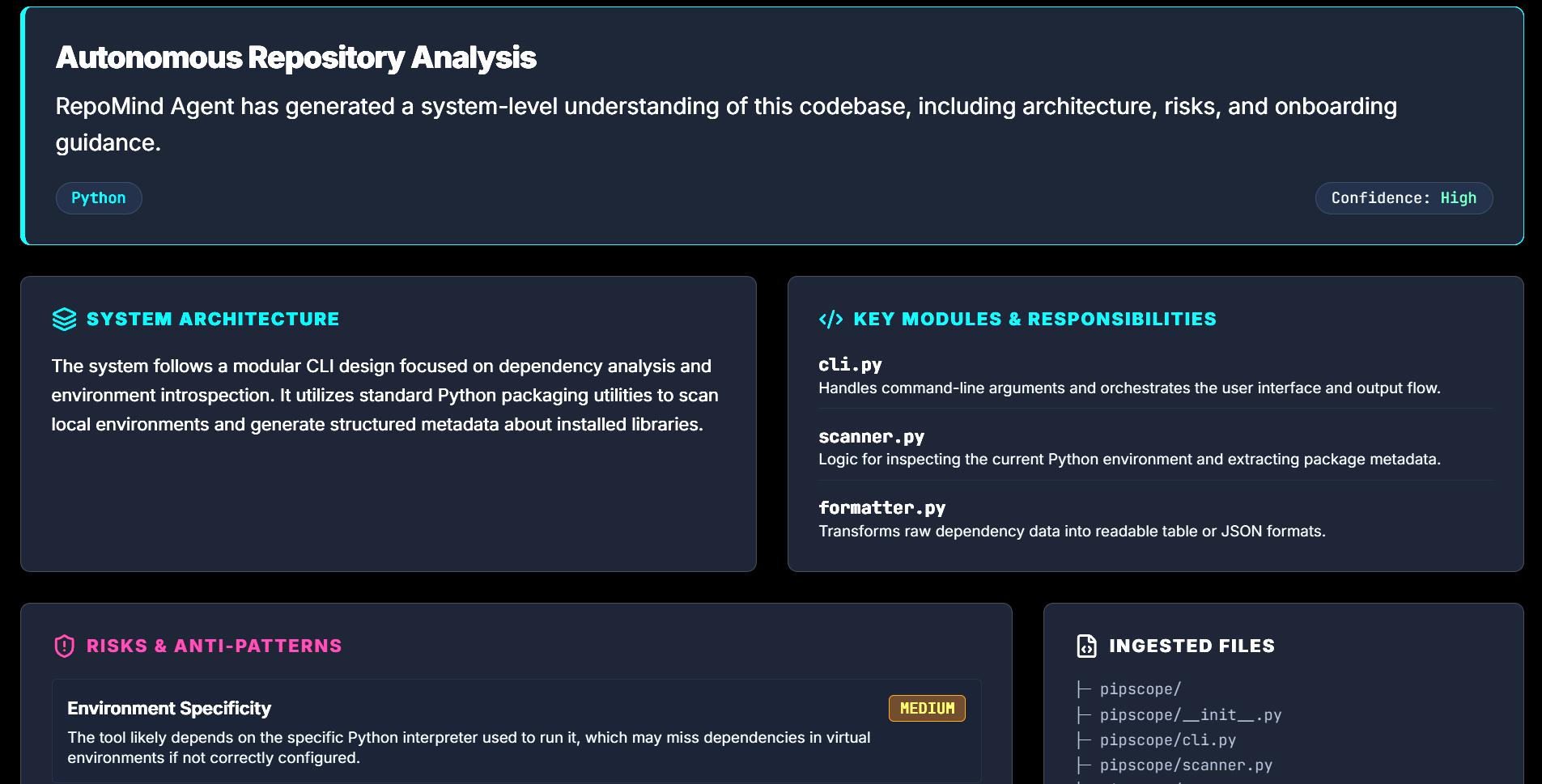
RepoMind Agent - Autonomous Codebase Intelligence
Inspiration
Modern software systems are growing faster than humans can reasonably understand them. Joining a new codebase often means days (or weeks) of reading files, guessing architecture, and discovering risks the hard way.
When Gemini 3 launched with long-context reasoning and agentic workflows, it felt like the right moment to rethink this problem. Instead of building another chatbot, I wanted to explore a deeper idea:
What if an AI could autonomously build a mental model of an entire repository, like a senior engineer joining a team?
RepoMind Agent was inspired by that question, and by the broader shift Gemini 3 represents: from static prompt–response systems to autonomous agents that plan, reason, verify, and produce structured artifacts.
What it does
RepoMind Agent is an autonomous repository intelligence system.
Given a GitHub repository URL, the agent:
Plans its own analysis workflow Simulates repository ingestion Builds a system-level architecture model Identifies key modules and responsibilities Detects risks and anti-patterns Generates onboarding guidance for new contributors Verifies its own conclusions and reports a confidence level
Instead of returning raw summaries, RepoMind produces engineering-grade artifacts that mirror how experienced developers reason about unfamiliar systems.
How we built it
The project is built around Gemini 3’s reasoning capabilities, structured as a deliberate agent pipeline:
PLAN → INGEST → ANALYZE → GENERATE → VERIFY
Key design decisions:
Agent-first design: The system is explicitly instructed to behave as an autonomous agent, not a chatbot.
Tool simulation protocol: Each phase (ingestion, analysis, artifact generation, verification) is represented as a tool step, making the reasoning process transparent.
Self-verification loop: The agent must re-evaluate its conclusions and assign a confidence level before final output.
Strict schemas: Gemini’s structured output is validated against predefined JSON schemas to ensure consistency and reliability.
Evidence-driven UI: The frontend visualizes architecture, risks, and onboarding steps as first-class artifacts, not chat messages.
The UI is intentionally minimal and professional, focusing on clarity and readability rather than novelty.
Challenges we ran into
Avoiding hallucinated authority A major challenge was preventing the system from falsely claiming direct access to repository files. This was solved by explicitly constraining the agent to reason based on public knowledge, standard patterns, and stated assumptions.
Schema alignment across the stack Ensuring the Gemini output, TypeScript types, and React UI all stayed perfectly aligned required careful iteration. Small mismatches caused runtime failures that had to be fixed at the contract level.
Making “agent behavior” visible Judges can’t evaluate autonomy if they can’t see it. I designed the prompt, output structure, and UI so that the agent’s planning, reasoning, and verification are obvious even without reading code.
Accomplishments that we're proud of
Built a true autonomous agent, not a chatbot RepoMind Agent plans, analyzes, generates, and self-verifies its outputs using a deliberate multi-step workflow aligned with Gemini 3’s Action Era capabilities.
Made agent reasoning visible and inspectable The system explicitly shows tool usage, structured artifacts, and confidence scoring allowing judges and users to understand how conclusions are reached, not just the final answer.
Delivered engineering-grade artifacts Instead of free-form text, RepoMind produces architecture overviews, module responsibilities, risk analyses, and onboarding guides that mirror real senior-engineer workflows.
Prevented hallucinated authority by design The agent is constrained to reason transparently, clearly stating assumptions and avoiding false claims of direct repository access prioritizing correctness and trust.
Achieved strict end-to-end schema consistency Gemini structured outputs, TypeScript contracts, and the React UI are fully aligned, ensuring reliability and eliminating runtime ambiguity.
Created a clean, professional developer experience The UI presents complex system intelligence in a readable, high-signal format suitable for real onboarding and architectural reviews.
Demonstrated Gemini 3’s strengths beyond RAG The project showcases long-context reasoning, structured planning, and self-verification rather than prompt-only or baseline retrieval patterns.
What we learned
Agentic systems require constraints, not just intelligence. Structured outputs dramatically improve trust and usability. Self-verification is a powerful primitive for long-form reasoning. The difference between a chatbot and an agent is process, not UI. Gemini 3 shines when used as a system builder, not a text generator.
This project fundamentally changed how I think about building AI products in the “Action Era.”
What's next for RepoMind AI
Real GitHub API ingestion for private repositories Multi-repo comparative analysis Continuous analysis over time (long-running agents) Exportable artifacts for documentation and onboarding pipelines
Built With
- google-ai-studio
- google-gemini-3
- javascript
- tailwindcss
- typescript


Log in or sign up for Devpost to join the conversation.