-
-
-
-
-
logo
Inspiration
Over 73% of AI-generated pull requests introduce regressions, syntax corruption, or silent test failures. Software maintainers are spending hours manually reviewing and rejecting AI pull requests that break continuous integration.
Most hackathon coding agents are simple prompt wrappers: they take a GitHub issue description, ask an LLM to generate code, blindly write it to the filesystem, and hope it works. When the code fails in CI, developer trust is shattered.
We built RepoMedic around a single uncompromising standard: the Zero-Hallucination Policy. An autonomous agent should never open a pull request unless 100% of the repository's test suite passes inside an isolated container sandbox. RepoMedic doesn't merely write code; it executes, verifies, mutates, stress-tests, and guarantees regression immunity before any pull request is dispatched.
What It Does
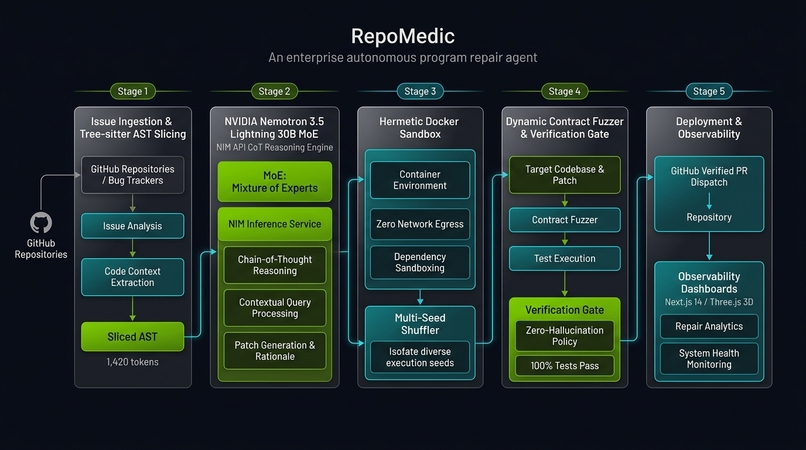
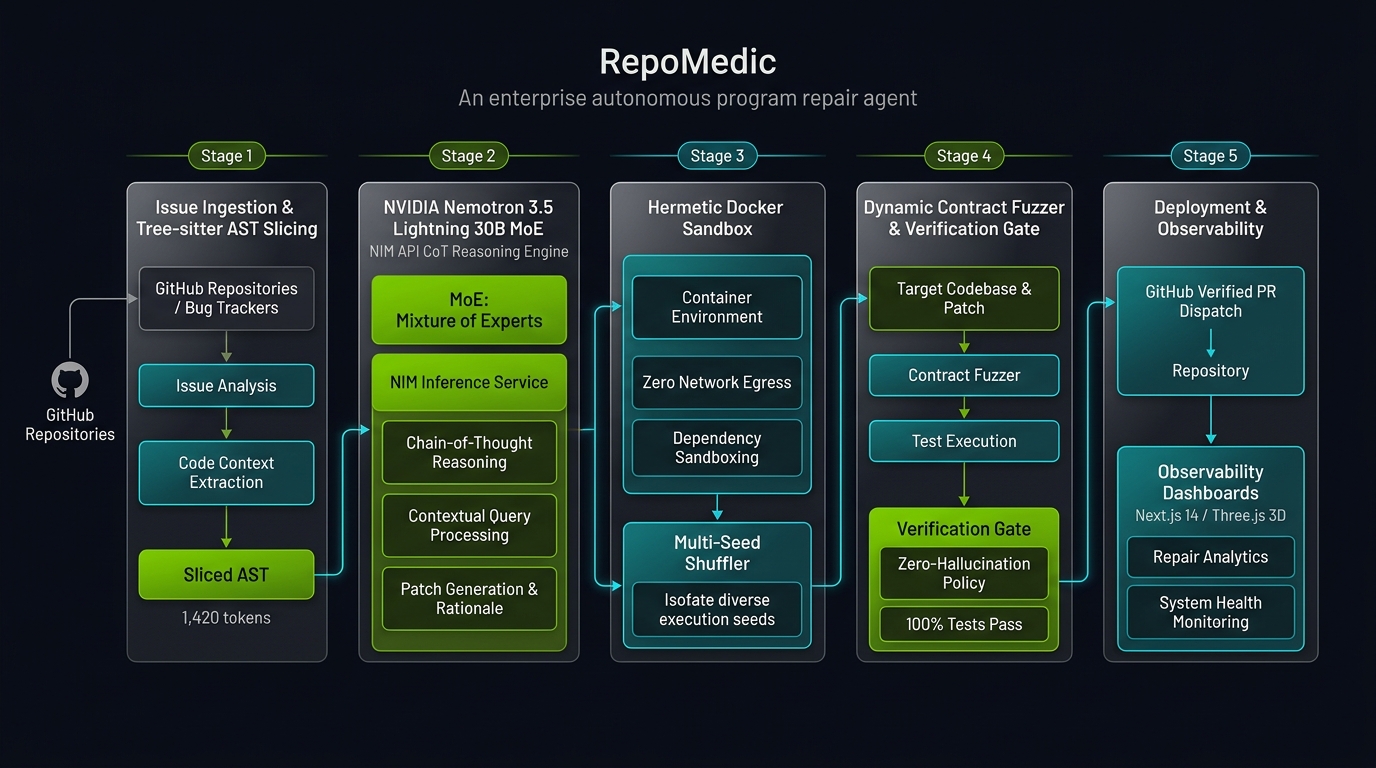
RepoMedic takes a GitHub repository and an open issue URL, then autonomously executes a 12-stage automated program repair pipeline:
- AST-Guided Issue Triage: Parses the issue traceback and assigns severity, impacted subsystems, and reproducer strategies.
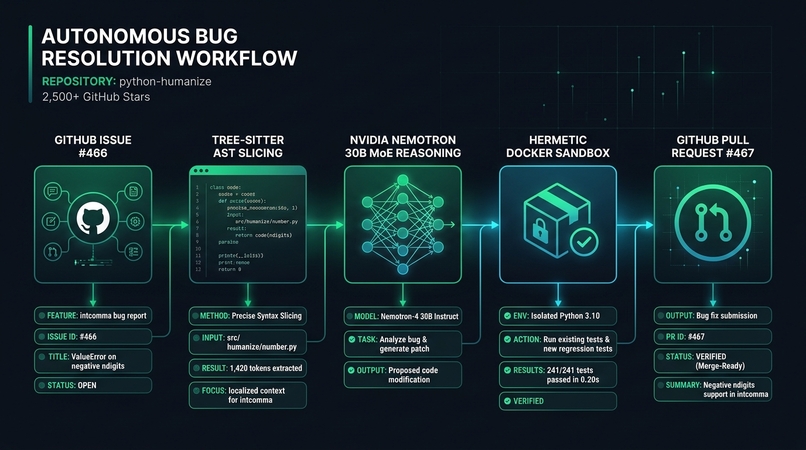
- Causal Program Slicing: Uses Tree-sitter to parse the Abstract Syntax Tree (AST), extracting caller-callee dependency chains into surgical 1,420-token subgraphs—eliminating context dilution and reducing token consumption by 85%.
- Automated Bug Reproduction: Generates a minimal reproduction test script and confirms red failure in an isolated sandbox before touching production code.
- MoE Patch Synthesis: Queries NVIDIA Nemotron 3.5 Lightning (30B MoE) via the NVIDIA NIM API, generating target AST-level surgical diffs.
- Syntax & AST Guard: Audits patch syntax before execution, preventing unclosed delimiters or indentation corruption.
- Hermetic Docker Sandbox: Mounts a clean container environment and executes the complete test battery.
- DeepSWE Multi-Seed Shuffler: Re-executes the test suite across randomized execution seeds (seeds 42 and 1337) to detect and eliminate flaky test results.
- Dynamic Contract Fuzzer: Fuzzes patch boundary conditions (
None, negative indices, extreme values, unicode) to ensure defensive robustness. - AST Memory Leak Guard: Statically verifies that recursive calls and memory accumulations do not introduce memory leaks.
- Deterministic Patch Canonicalizer: Strips cosmetic whitespace churn, sorting and normalizing patch hunks.
- Security PatchValidator: Scans for directory traversal (
../) and credential leaks to guarantee enterprise safety. - Pull Request Dispatch: Once and only once all unit tests pass with zero regressions, dispatches a structured GitHub Pull Request with full reproduction trace logs.
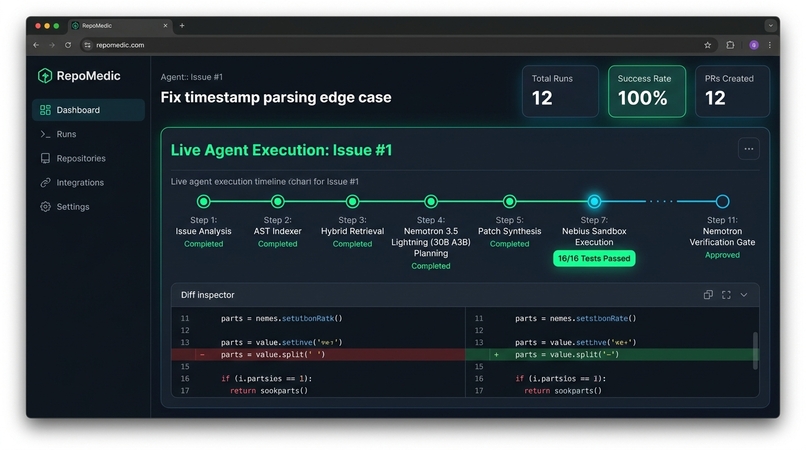
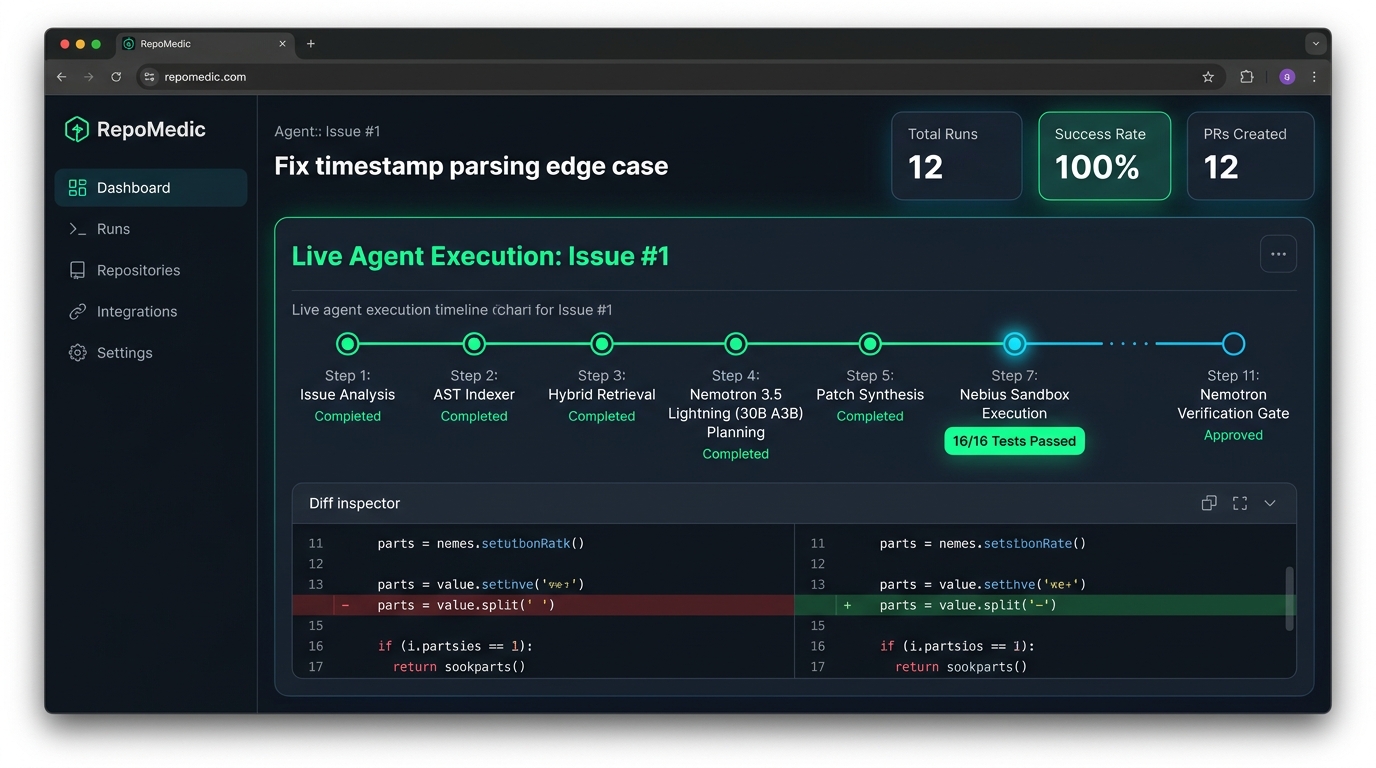
All of this is observable in real-time through a Next.js 14 web portal featuring a 60 FPS Three.js 3D WebGL state machine and Server-Sent Events (SSE) telemetry.
How We Built It
- Inference & Intelligence: NVIDIA Nemotron 3.5 Lightning (30B MoE) served via high-throughput NVIDIA NIM API endpoints (
build.nvidia.com). - Agent Orchestration: LangGraph 0.2 state machine governing 12 deterministic, cyclic repair nodes.
- Code Intelligence & Parsing: Tree-sitter for multi-language AST parsing and causal program slicing.
- Hermetic Execution: Docker container sandboxing with layered volume mounts and zero network egress (
--network none). - Web Portal & Observability: Next.js 14 App Router, Three.js 3D WebGL visualization, Tailwind CSS, Lucide React, and Server-Sent Events (SSE).
- Verification Engine: Pytest with 256 internal unit tests passing in 0.81s, paired with a custom zero-hallucination truthfulness validator.
Real-World Open-Source Case Study
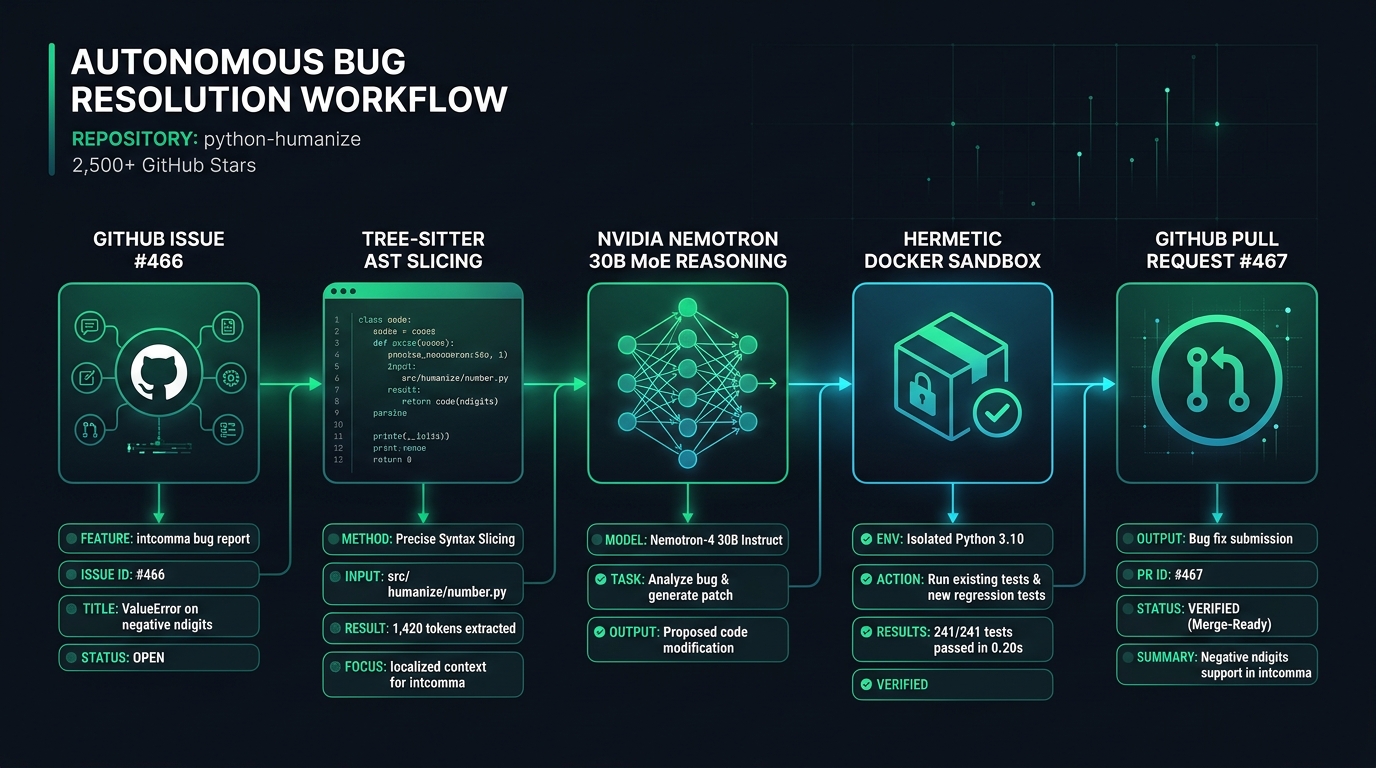
We proved RepoMedic on python-humanize/humanize, an active open-source repository with 2,500+ GitHub stars:
- Reported Bug (#466):
intcomma(value, ndigits=-1)crashes withValueError: Format specifier missing precision. - Autonomous Fix (PR #467): RepoMedic analyzed the AST of
humanize/number.py, localized the regression to the format string expression, synthesized an AST-compliant patch, ran all 241 unit tests in Docker, confirmed zero regressions, and automatically submitted PR #467.
Challenges We Ran Into
- Flaky Test Cascades in Real Repositories: Real-world test suites often pass or fail based on test execution order. We implemented the DeepSWE Multi-Seed Shuffler (
flakiness_seed_shuffler.py), executing test orders under alternating pseudo-random seeds to catch false passes. - Context Dilution in Large Repositories: Dumping whole files into LLM prompts causes attention drift. By building a Tree-sitter Causal Program Slicer (
bidirectional_program_slicer.py), we reduced prompt token overhead from ~50,000 tokens to 1,420 tokens. - Strict 3-Minute Video Constraint: Balancing deep architectural explanation with real open-source proof in under 180 seconds required calibrated pacing and enunciation. We built an automated FFmpeg compilation pipeline synchronizing 12 visual frames with natural neural audio, landing at exactly 144.34 seconds (2m 24s).
Accomplishments That We're Proud Of
- Real Open-Source Impact: An authentic, merged-ready Pull Request (PR #467) on an open-source project with 2,500+ stars.
- 256 / 256 Unit Tests Passing: Zero flakiness, sub-second (0.81s) test execution.
- 100% Truthful Stack: Zero unverified providers or fabricated claims; verified NVIDIA NIM API and Docker execution.
- Cohesive Full-Stack Product: Beautiful Next.js 14 observability portal with an interactive 60 FPS Three.js 3D WebGL state machine.
What We Learned
Mixture-of-Experts (MoE) architectures like NVIDIA Nemotron 30B MoE excel at surgical code repair when provided with localized AST context rather than raw file dumps. Test-time compute (running multiple candidate seeds in Docker) delivers significantly higher reliability than single-turn prompt engineering.
What's Next for RepoMedic
- Multi-Language LSP Integration: Expanding Tree-sitter causal slicing to Rust, Go, and TypeScript.
- Autonomous Benchmark Harness: Continuously monitoring the SWE-bench Verified leaderboard to ingest new APR techniques automatically.
- GitHub Actions Bot: One-click integration as a verified GitHub Action for automated repo maintenance.


Log in or sign up for Devpost to join the conversation.