
Inspiration
Research repositories rarely explain themselves in one place. The behavior of a project is distributed across documentation, configuration, implementation, data preparation, notebooks, and evaluation code. RepoLens makes that understanding traceable: every important claim leads back to exact repository evidence at an immutable revision.
What it does
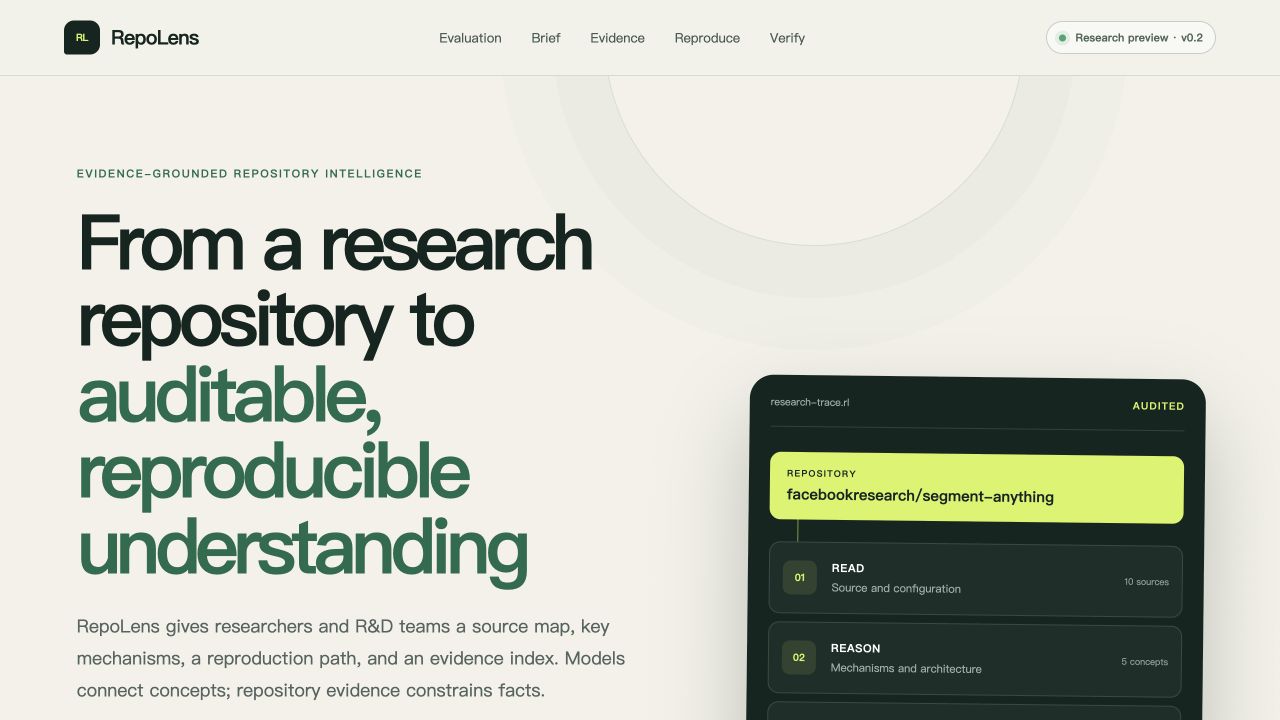
RepoLens turns a public GitHub repository into an evidence-grounded research workspace with:
- a repository map and research brief
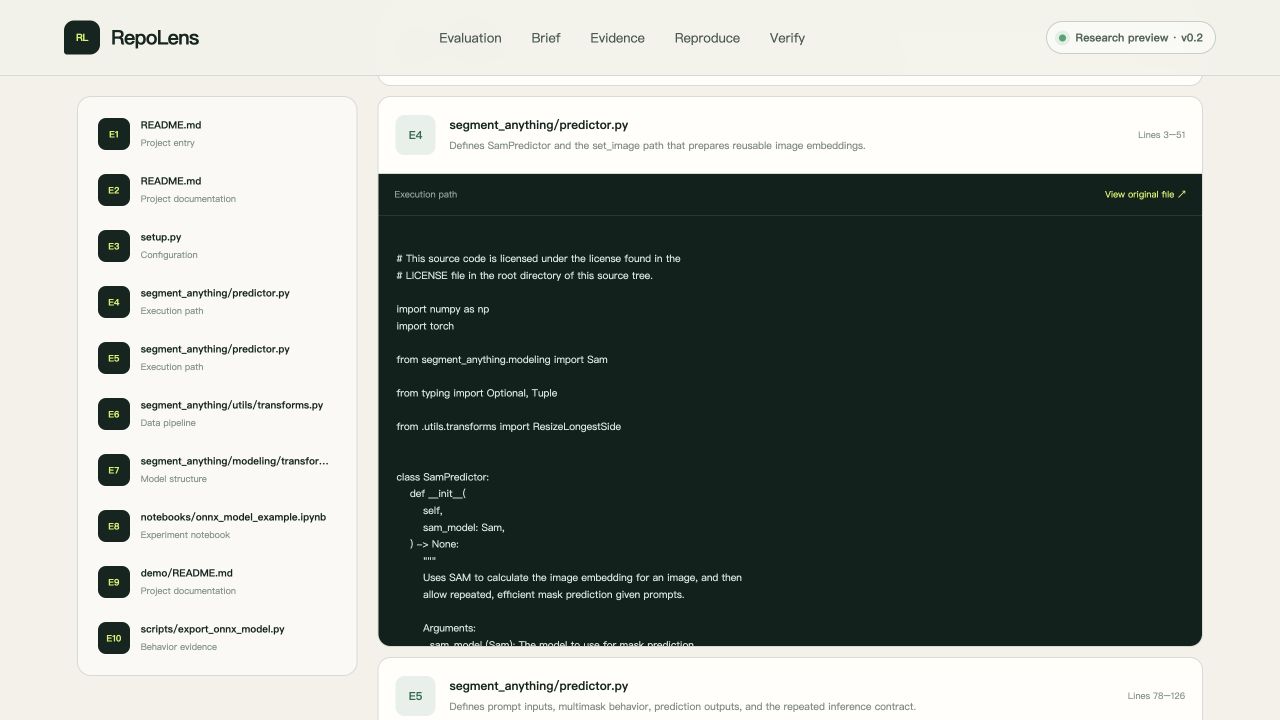
- mechanism explanations linked to source files and line ranges
- an evidence index with immutable GitHub links
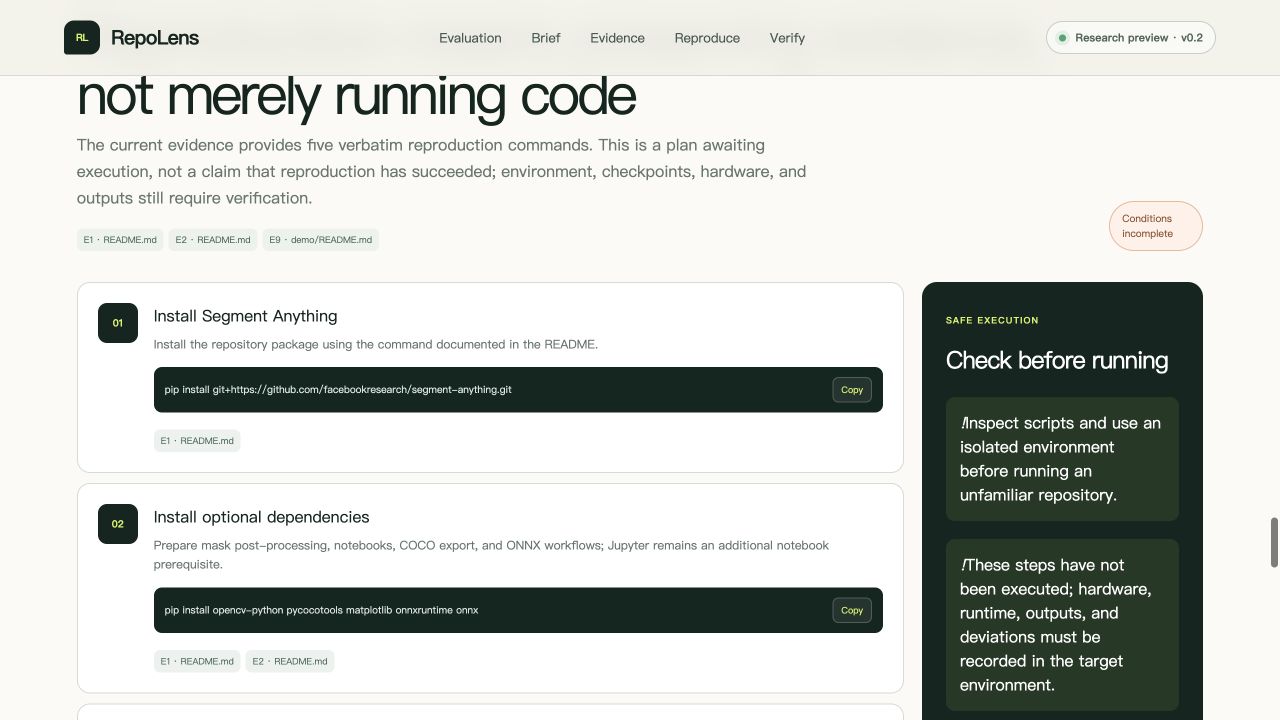
- a staged reproduction plan that preserves unknowns
- repository-specific verification questions
- Markdown export for continued research
- an optional read-only Agent for bounded evidence exploration
How it works
RepoLens is a TypeScript application built with Next.js, the GitHub REST API, and Cloudflare Workers. The server resolves a fixed commit, selects research-relevant files, extracts bounded source windows, discovers symbols and cross-file relationships, and issues stable E-series evidence identifiers.
The deterministic evidence engine provides the core report without a model key. When DeepSeek is configured, schema-constrained analysis organizes mechanisms, research paths, reproduction tasks, and verification questions. Agent exploration is limited to two rounds and may select only unread files from a server-approved candidate list. The server validates every returned path, evidence identifier, source link, and displayed command. Repository text is treated as untrusted data, and RepoLens never executes third-party code.
Evidence and evaluation
A fixed evaluation on nanoGPT, Whisper, and Segment Anything gives RepoLens a mean exact-path key-file coverage of 73.8%, compared with 35.1% for a README-only baseline. Focused evaluations on mlx-examples/lora and pytorch/examples/mnist both reach 100.0% coverage.
A paired four-repository evaluation measures bounded Agent exploration: mean exact-path coverage is 30.5% in standard mode and 63.7% with Agent exploration, with zero invalid evidence identifiers. A separate field-level review covers 73 report fields: 67 are fully supported, 6 partially supported, and none unsupported or unverifiable. All 15 displayed reproduction commands in the sample appear verbatim in cited source evidence.
These measurements evaluate retrieval and evidence support; they do not claim that third-party experiments were executed successfully.
Design challenges
The central challenge is controlling what the system is allowed to claim. Repository trees are large, common function names create ambiguous links, setup commands may appear deep inside documentation, and model output must never become an authority for source facts. RepoLens addresses these constraints through research-aware retrieval, revision locking, bounded evidence windows, server-side validation, and explicit uncertainty.
What I learned
A trustworthy research tool needs a clear boundary between model judgment and application authority. In RepoLens, the model may organize an explanation, but the repository revision and server-issued evidence determine what can be cited.
What's next
Planned work includes collaborative annotations, revision comparison, broader evaluation across research domains, and optional sandboxed execution with explicit human approval.
Built With
- api
- artificial
- cloudflare
- deepseek
- github
- github-api
- json
- node.js
- rest
- typescript
- vite
- workers

Log in or sign up for Devpost to join the conversation.