-
-

RepoLens turns research repositories into evidence-grounded, reproducible workflows.
-
RepoLens macOS application icon.
-

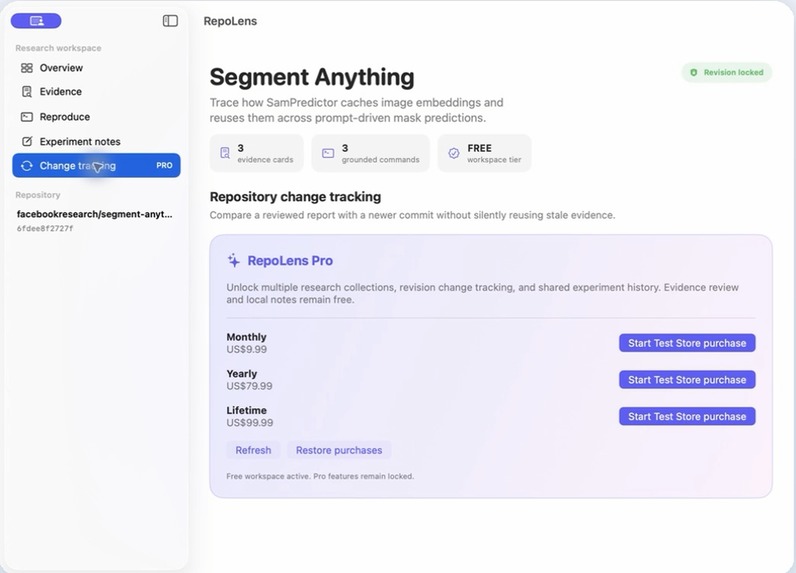
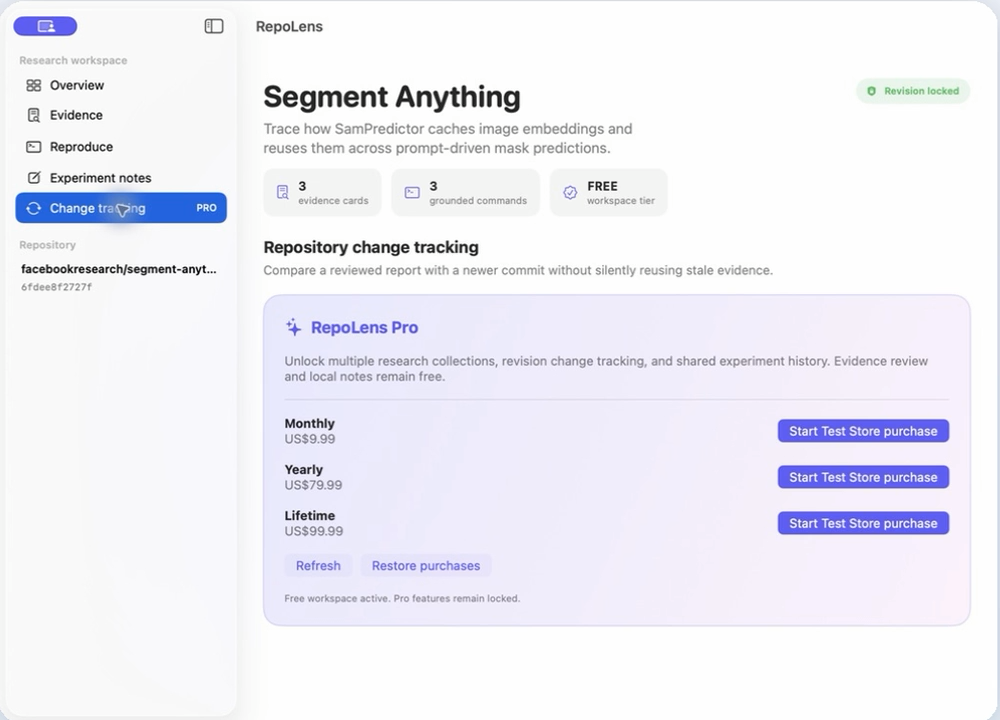
RepoLens macOS workspace with RevenueCat Test Store packages and a transparent Pro boundary.


Inspiration
Research code is often difficult to trust and reproduce. Important claims become separated from the exact files, revisions, and experiment conditions that support them. RepoLens helps researchers move from “this repository looks promising” to a source-grounded understanding of what the code does and what still needs to be verified.
What it does
RepoLens turns a public research repository into an evidence-grounded workspace. Each important claim can be traced to a fixed revision, source file, line range, excerpt, and stable evidence identifier. Researchers can:
- review an architecture brief and mechanism map
- inspect source-linked evidence cards
- follow staged research and reproduction tasks
- answer repository-specific verification questions
- export an evidence-preserving Markdown report
- record local experiment notes and deviations in the native macOS app
The core evidence workflow remains available without a paid entitlement. RepoLens Pro is designed for multi-repository collections, deeper analysis, synchronized history, and long-term repository tracking.
How I built it
The public web application uses Next.js, TypeScript, the GitHub API, and Cloudflare Workers. It resolves an immutable commit, selects research-relevant files, extracts bounded evidence windows, and validates every displayed citation and command. DeepSeek analysis and bounded Agent exploration are optional; the deterministic evidence engine provides the complete core workflow without a model key.
The native macOS application is built with SwiftUI and RevenueCat SDK 5.86.0. RevenueCat manages the repolens_pro entitlement through a default offering with monthly, yearly, and lifetime packages. The purchase interface reads the live offering, derives access from CustomerInfo, persists entitlement state across relaunches, and provides Restore Purchases.
RevenueCat verification
The full entitlement flow was verified with RevenueCat Test Store:
- fetch the current offering and packages
- simulate a package purchase
- confirm
repolens_probecomes active - relaunch the app and confirm access persists
- restore purchases and verify entitlement recovery
The demonstration uses Test Store only, so it requires no real payment method or charge.
Challenges
The central challenge is preserving trust across product layers. A concise research explanation is useful only when its source remains inspectable. Likewise, premium access must come from a verified RevenueCat entitlement rather than a local client flag. RepoLens keeps both evidence provenance and entitlement state explicit throughout the interface.
The distributable macOS application also needs to work for judges without my development environment. The release is an ad-hoc-signed universal application for Apple Silicon and Intel Macs, with setup instructions, entitlement-policy checks, no embedded private keys, and a published SHA-256 checksum.
Accomplishments
- Built a public evidence-grounded research-code workspace
- Built a native macOS evidence and experiment workspace
- Integrated RevenueCat offerings, purchases, entitlements, and restoration
- Verified purchase-to-unlock behavior end to end with Test Store
- Kept core citation review outside the paid boundary
- Published source code and a downloadable universal macOS release
What I learned
RevenueCat’s separation of products, offerings, and entitlements makes monetization easier to evolve without hard-coding business rules into the interface. Responsible AI tooling also needs a transparent product boundary: users should know both where a claim comes from and which entitlement controls a feature.
What's next
Planned work includes iOS support, secure cross-device synchronization, repository-change alerts, shared lab workspaces, and richer experiment-version tracking.
Built With
- github
- macos
- nextjs
- python
- react
- revenuecat
- swift
- swiftui
- typescript

Log in or sign up for Devpost to join the conversation.