-
-
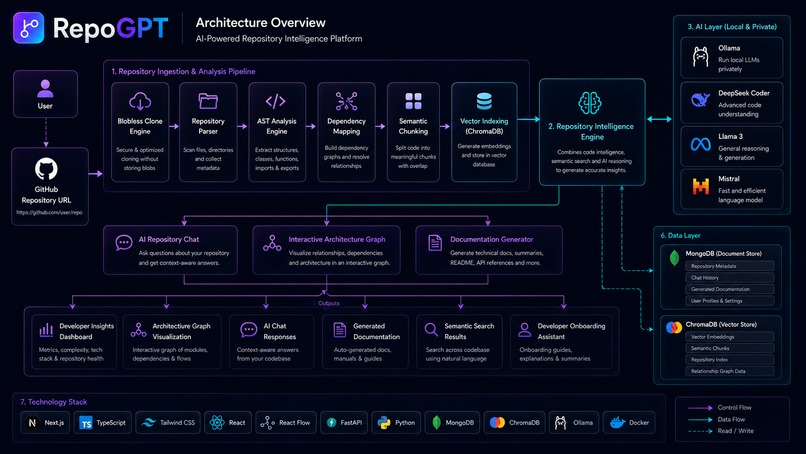
RepoGPT Architecture
-
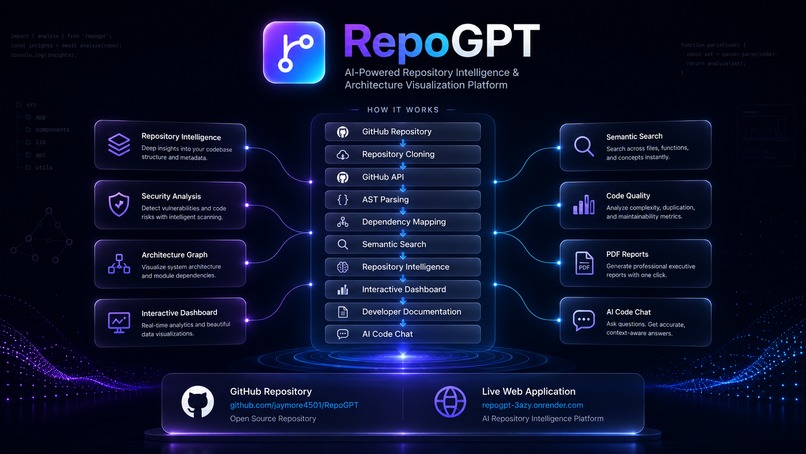
RepoGPT How It Works Diagram
-
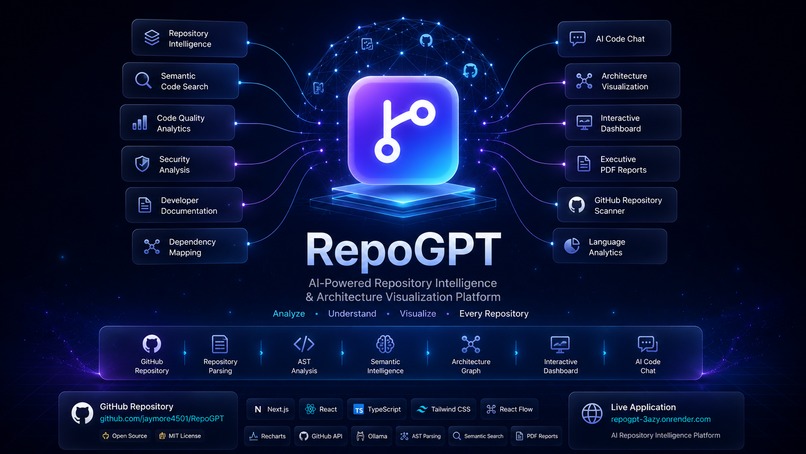
RepoGPT Comprehensive Feature Map
-
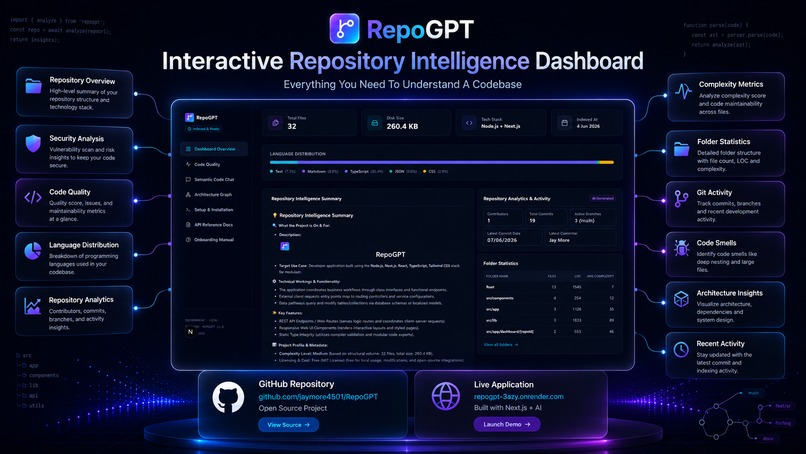
RepoGPT Dashboard Intelligence UI
-
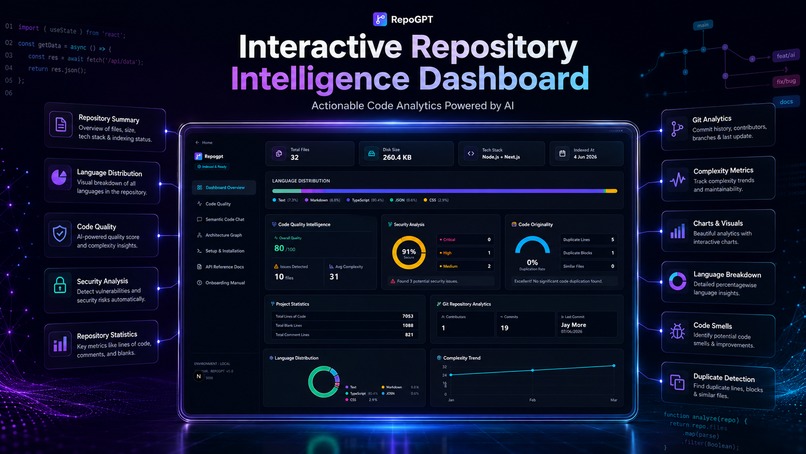
RepoGPT Code Analytics Dashboard
-
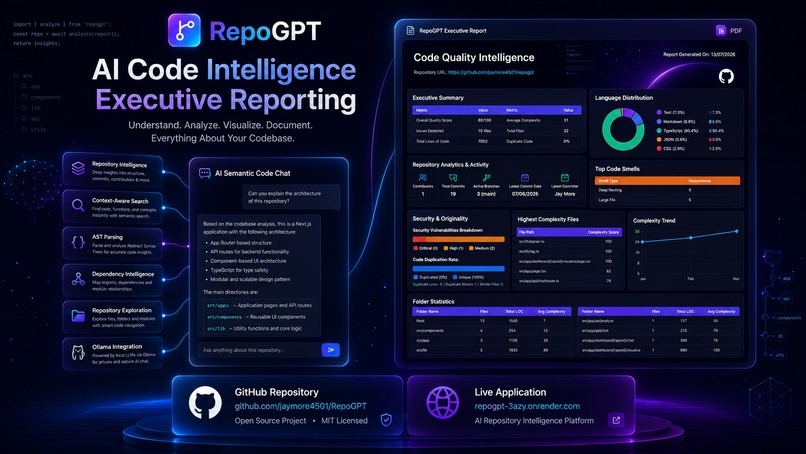
RepoGPT Executive Reports Split
-
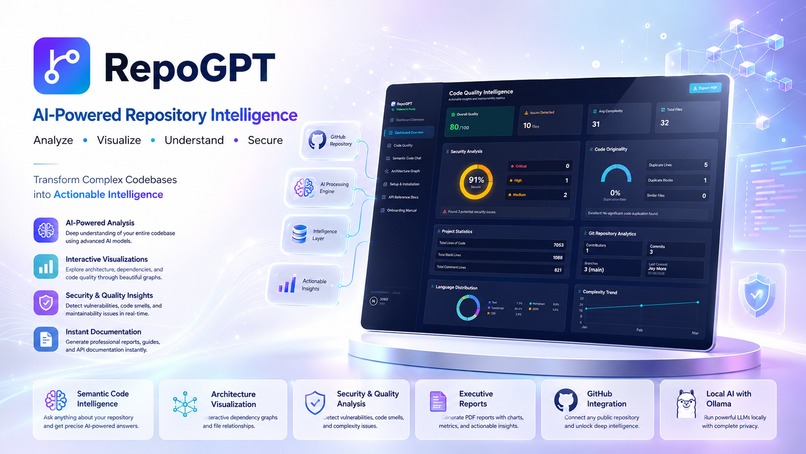
RepoGPT Product Showcase Light
-
RepoGPT Actionable Intelligence Poster
-
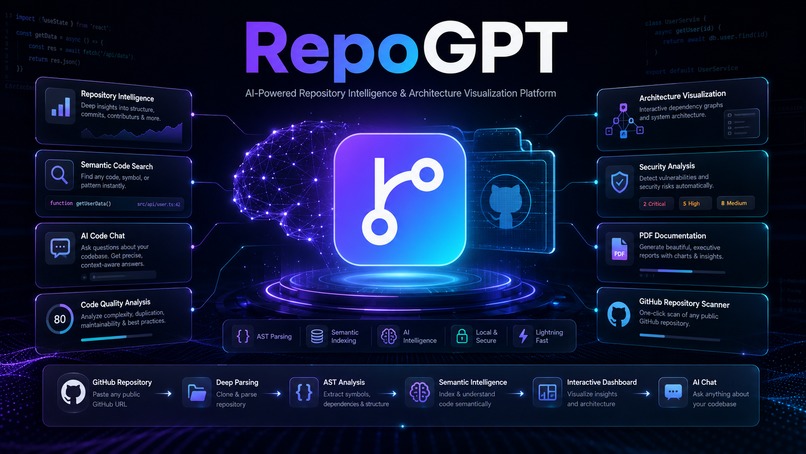
RepoGPT Intelligence Features Map
-
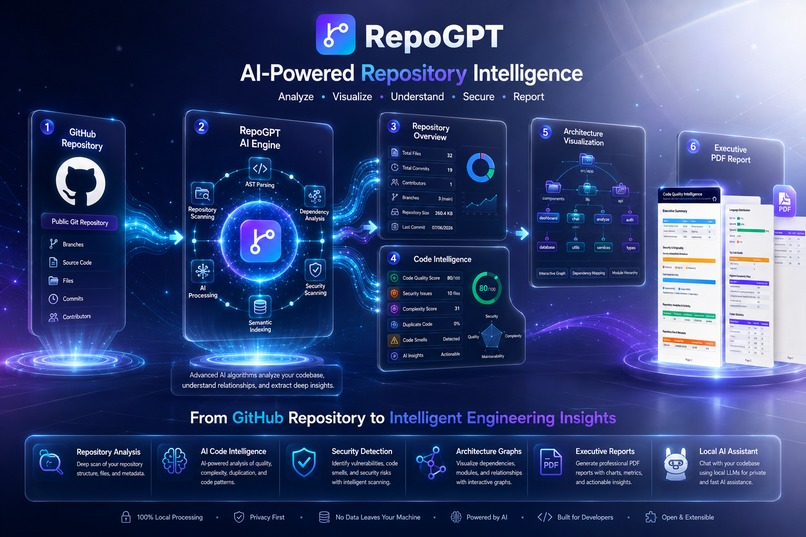
RepoGPT Data Pipeline Flow
-
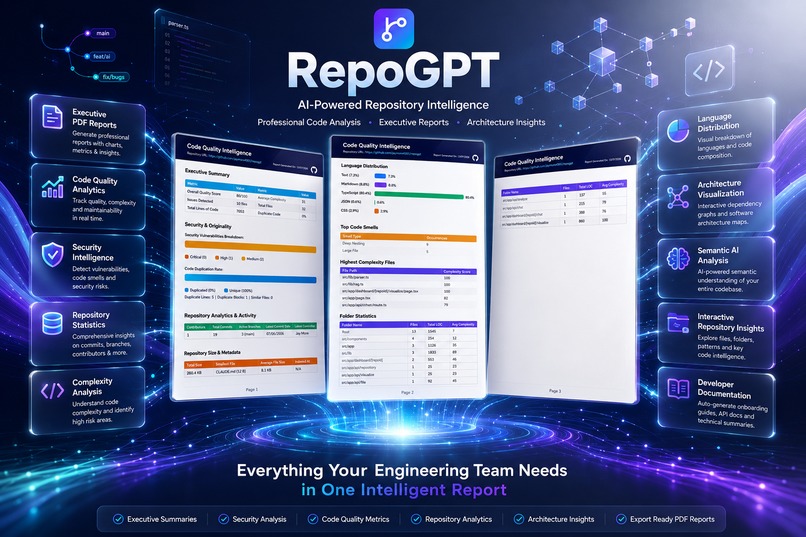
RepoGPT PDF Reports Showcase
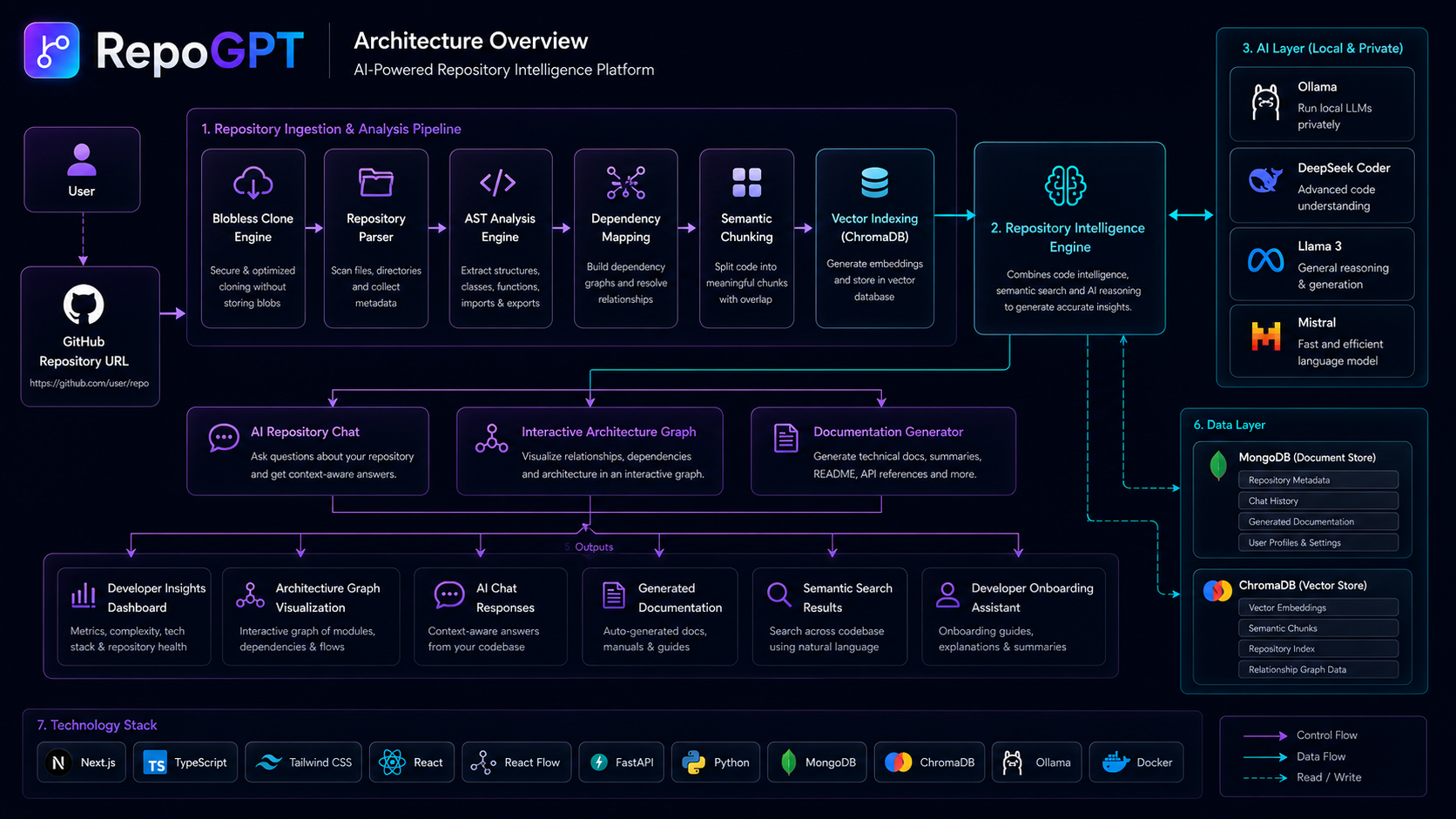
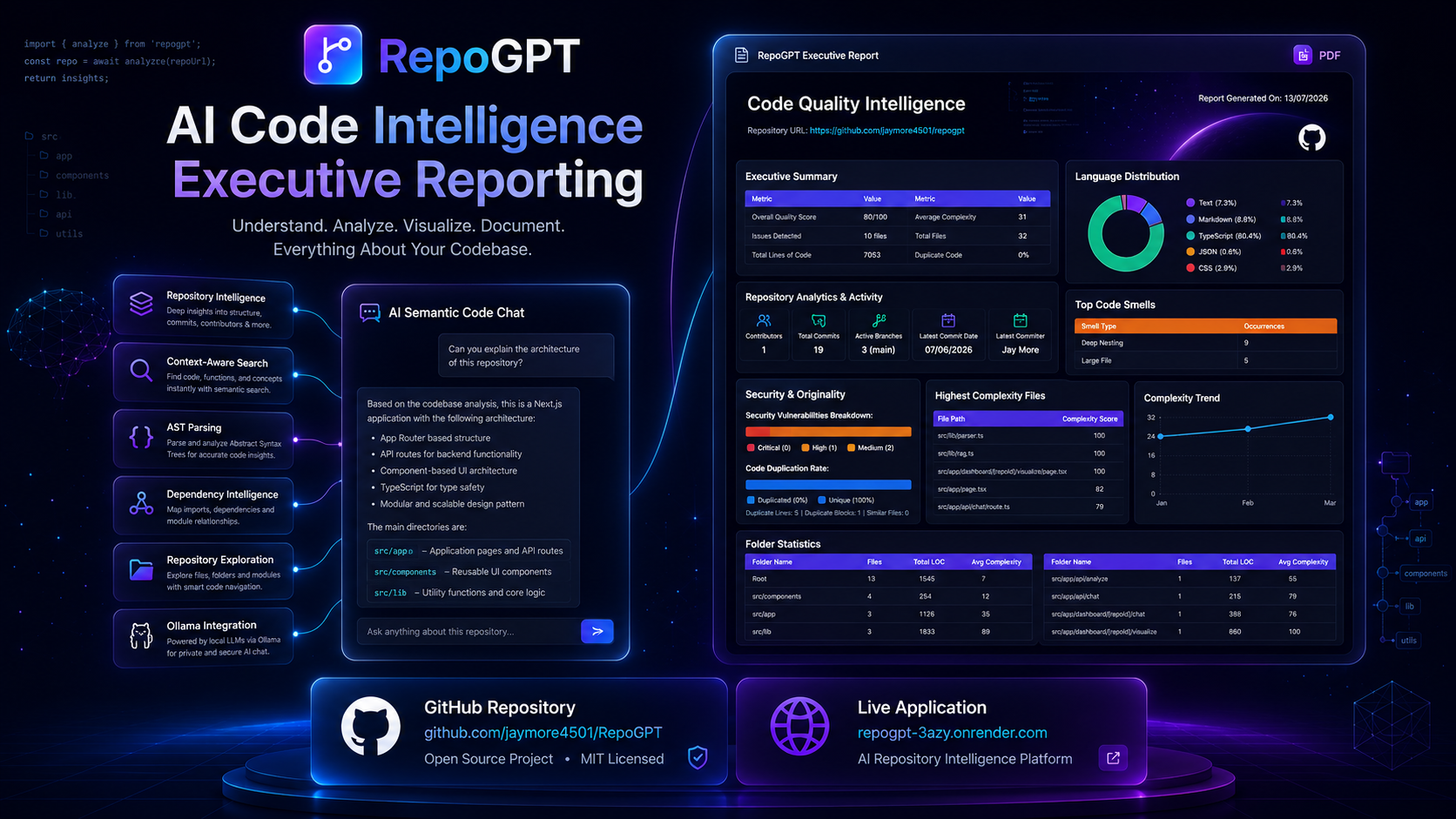
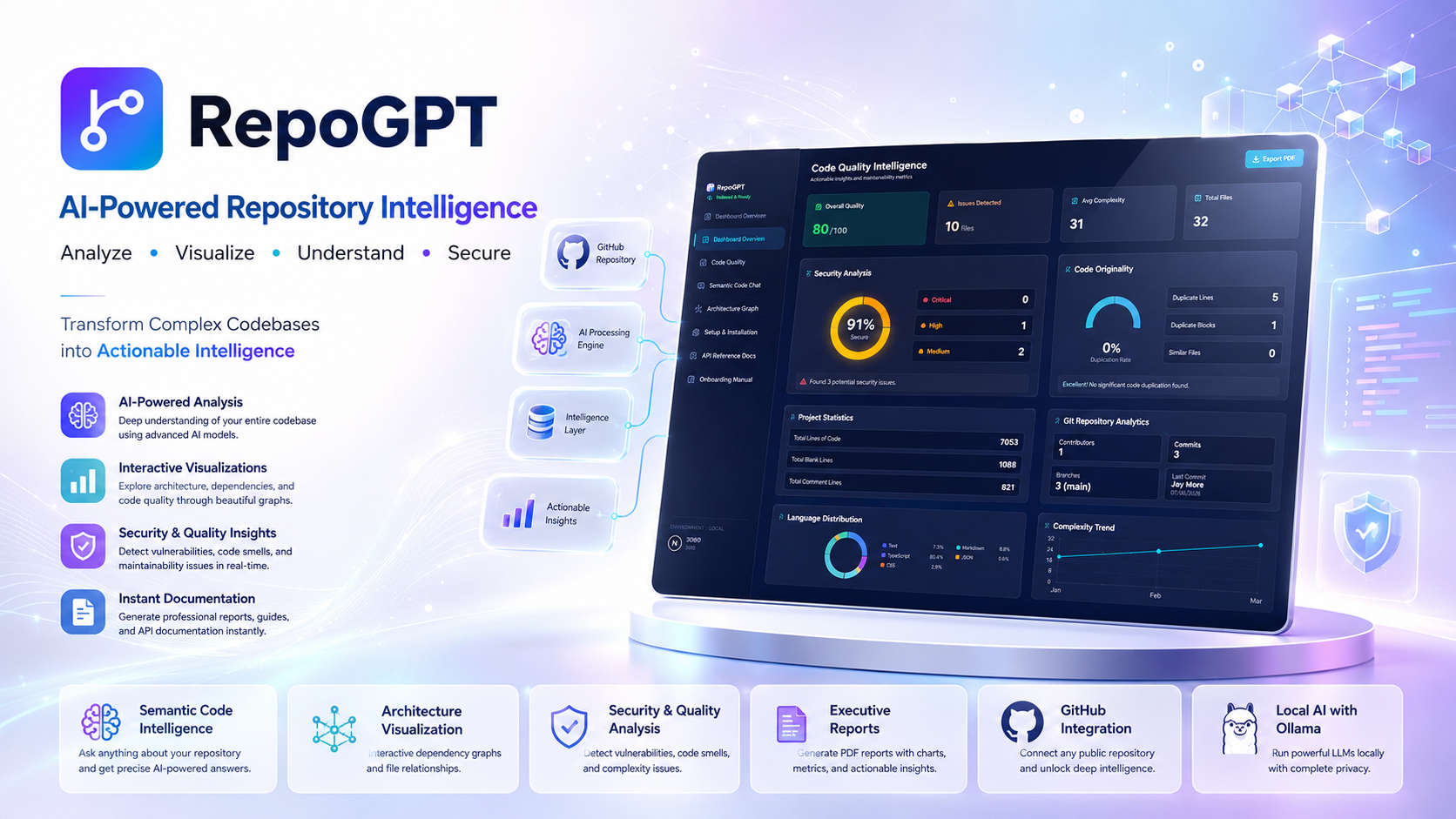
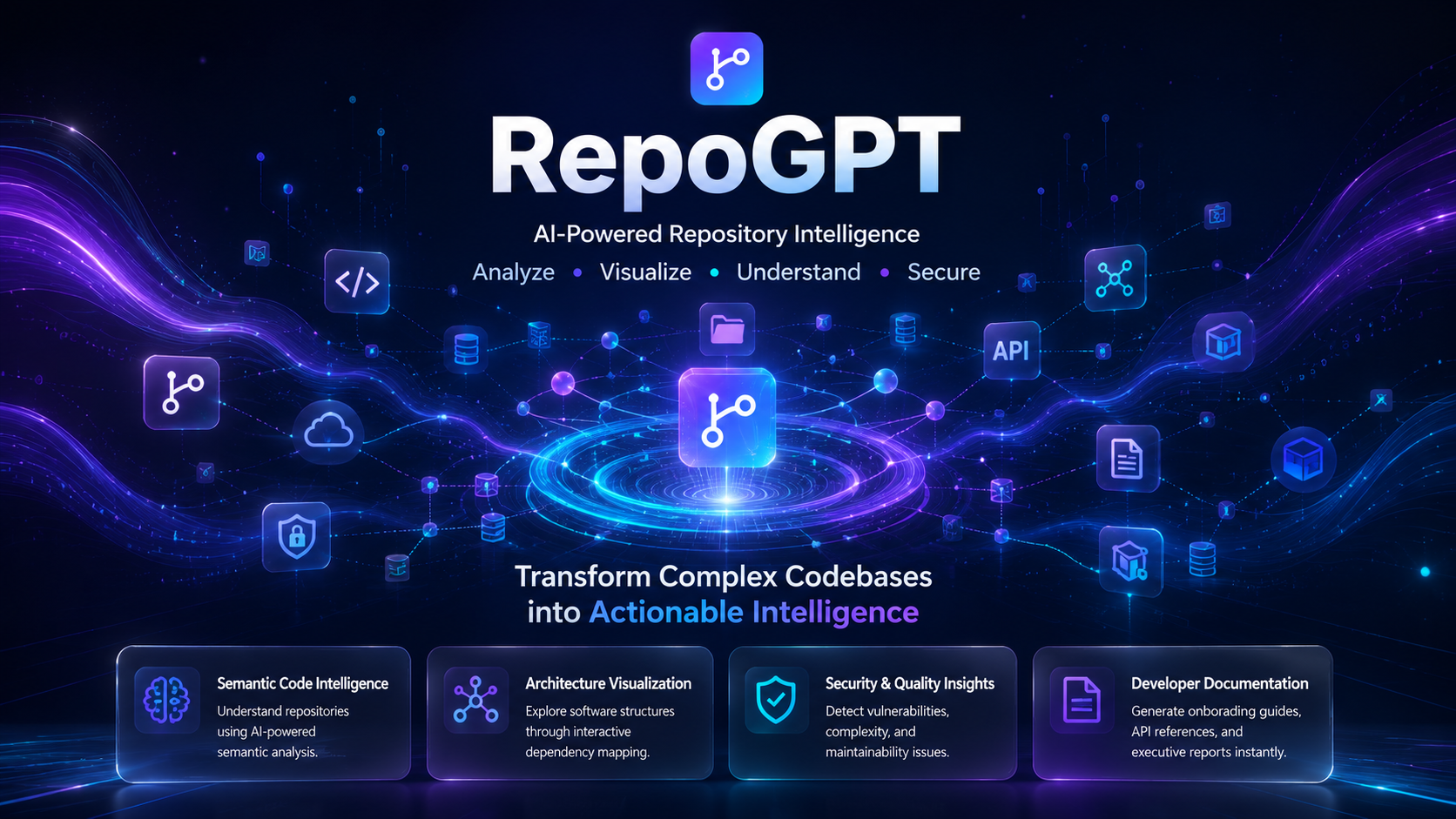
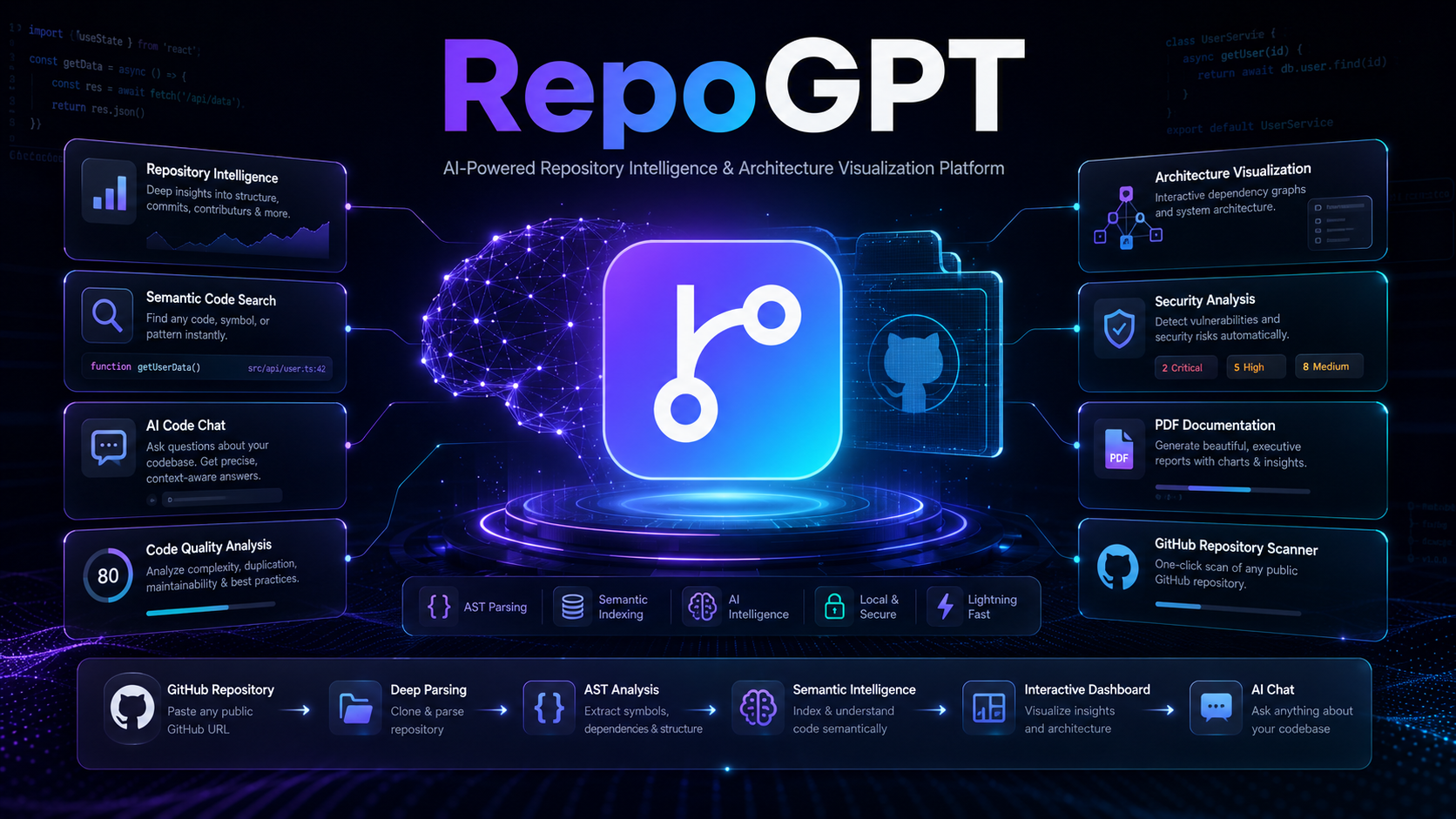
🚀 RepoGPT — AI-Powered Repository Intelligence & Architecture Visualization Platform
💡 Inspiration
Modern software projects are growing larger and more complex every day. Whether you're joining a new team, contributing to an open-source project, or reviewing an unfamiliar codebase, understanding how everything fits together often takes hours—or even days. Developers spend a significant amount of time manually exploring folders, tracing dependencies, reading documentation, and searching through files before they can confidently make changes.
We wanted to simplify that entire process.
Our goal was to build an intelligent platform that transforms any GitHub repository into an interactive, AI-powered workspace where developers can instantly understand architecture, explore relationships, analyze code quality, generate documentation, and interact with their codebase through natural language.
Instead of reading thousands of lines of code, developers can simply ask questions and visualize how the system works.
❗ The Problem
Understanding an unfamiliar repository is one of the biggest productivity bottlenecks in software development.
Developers often struggle with:
- Navigating thousands of files manually.
- Understanding project architecture and module relationships.
- Finding where specific functionality is implemented.
- Identifying security issues and code quality problems.
- Creating onboarding documentation for new contributors.
- Quickly understanding open-source projects before contributing.
Traditional documentation quickly becomes outdated, while static file explorers provide little insight into how an application actually works.
✨ Our Solution
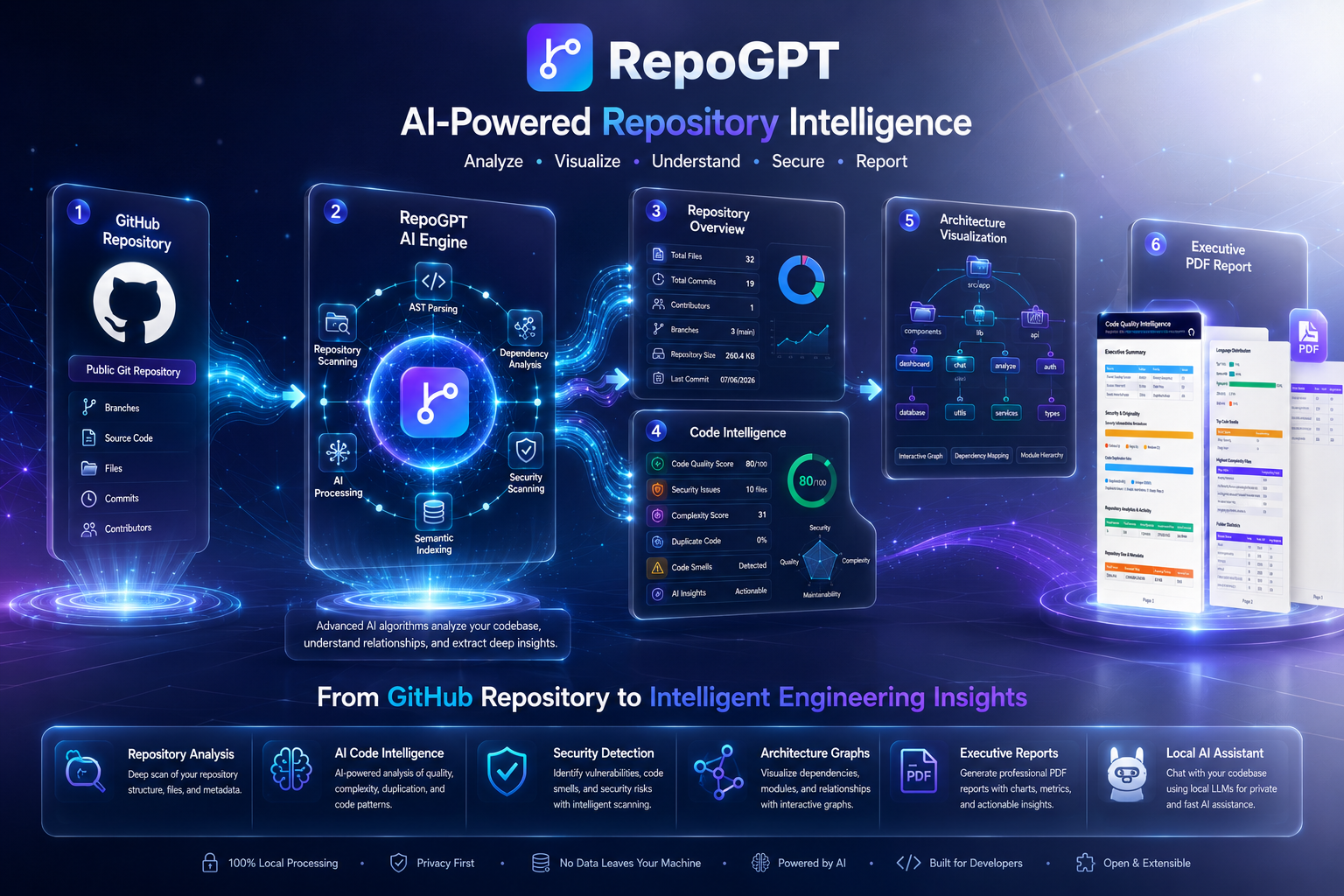
RepoGPT is an AI-powered Repository Intelligence Platform that analyzes public GitHub repositories and automatically transforms them into interactive developer workspaces.
Starting with a GitHub repository URL, RepoGPT performs deep structural analysis using Abstract Syntax Tree (AST) parsing, semantic indexing, dependency mapping, and intelligent retrieval techniques to generate meaningful insights about the entire project.
Developers can:
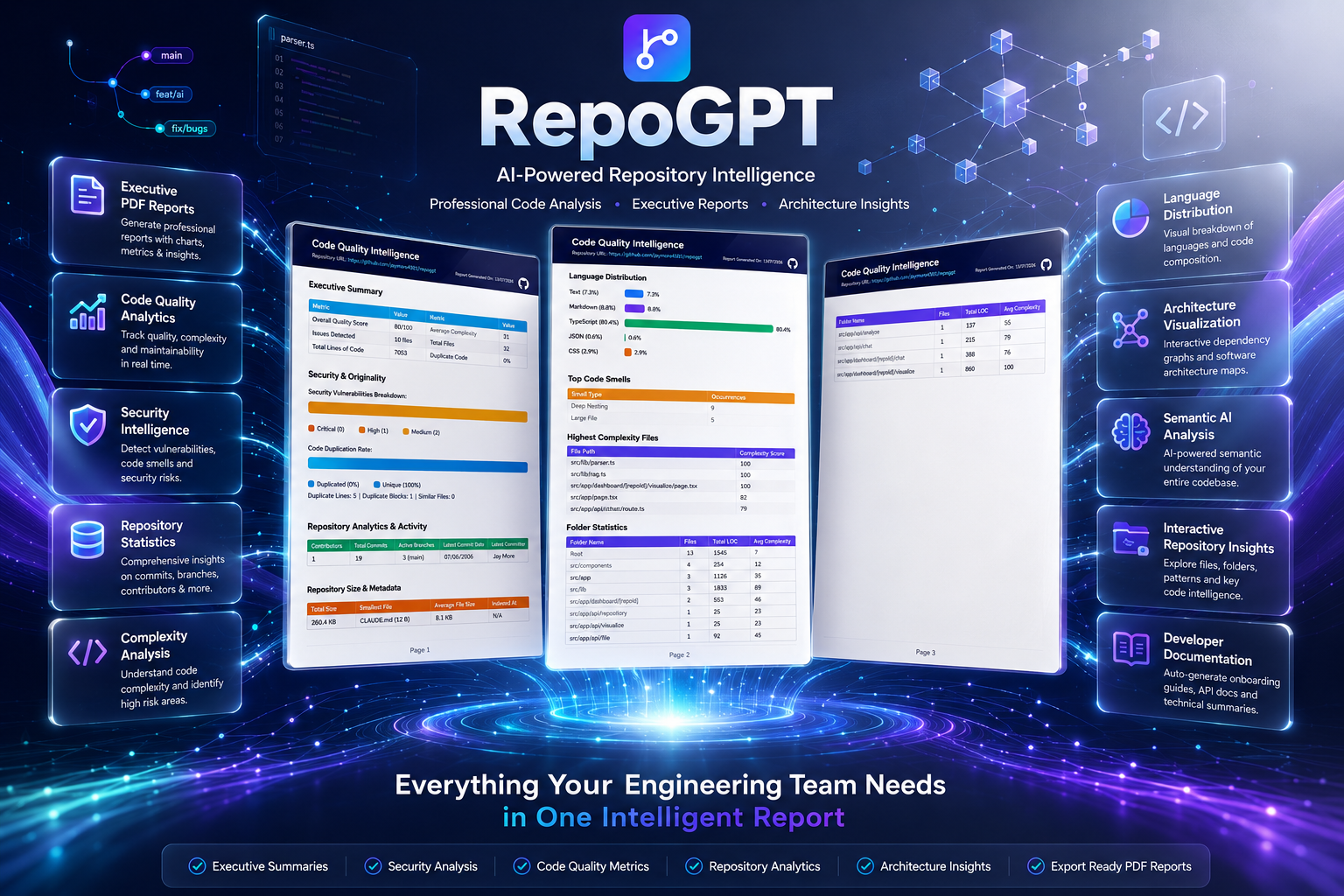
- Visualize complete software architectures.
- Chat with the repository using natural language.
- Generate developer documentation automatically.
- Explore semantic code search results.
- Analyze code quality and security.
- Export professional PDF reports.
RepoGPT dramatically reduces the time required to understand complex software systems while improving developer productivity and onboarding.
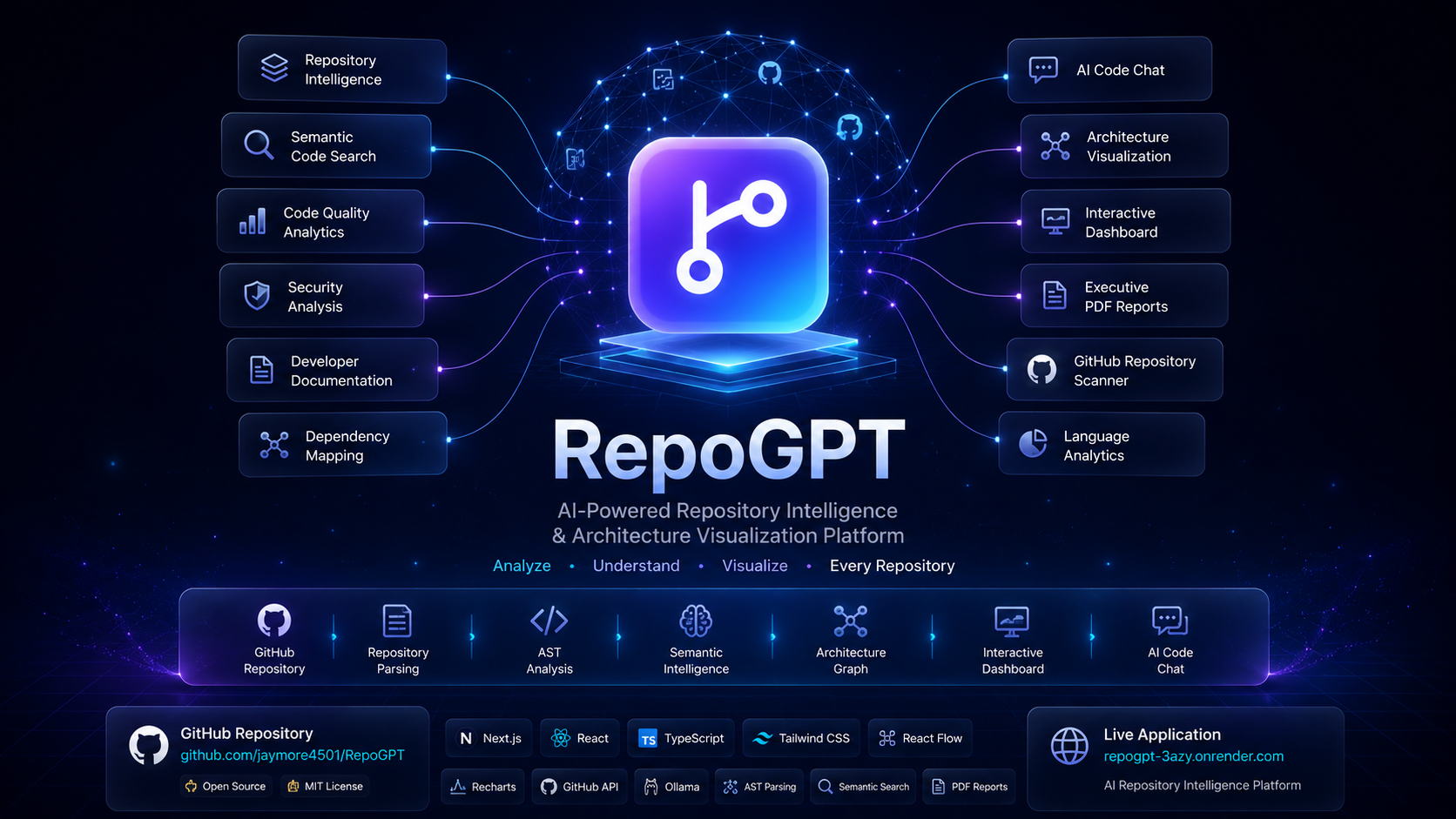
⭐ Key Features
🧠 AI Repository Intelligence
Transform repositories into searchable, AI-powered developer knowledge bases.
🏗 Interactive Architecture Visualization
Automatically generate dependency graphs and explore project structure visually.
💬 Semantic Code Chat
Ask questions about the repository using natural language and receive context-aware answers.
🔍 Semantic Code Search
Locate relevant files, functions, classes, and modules instantly.
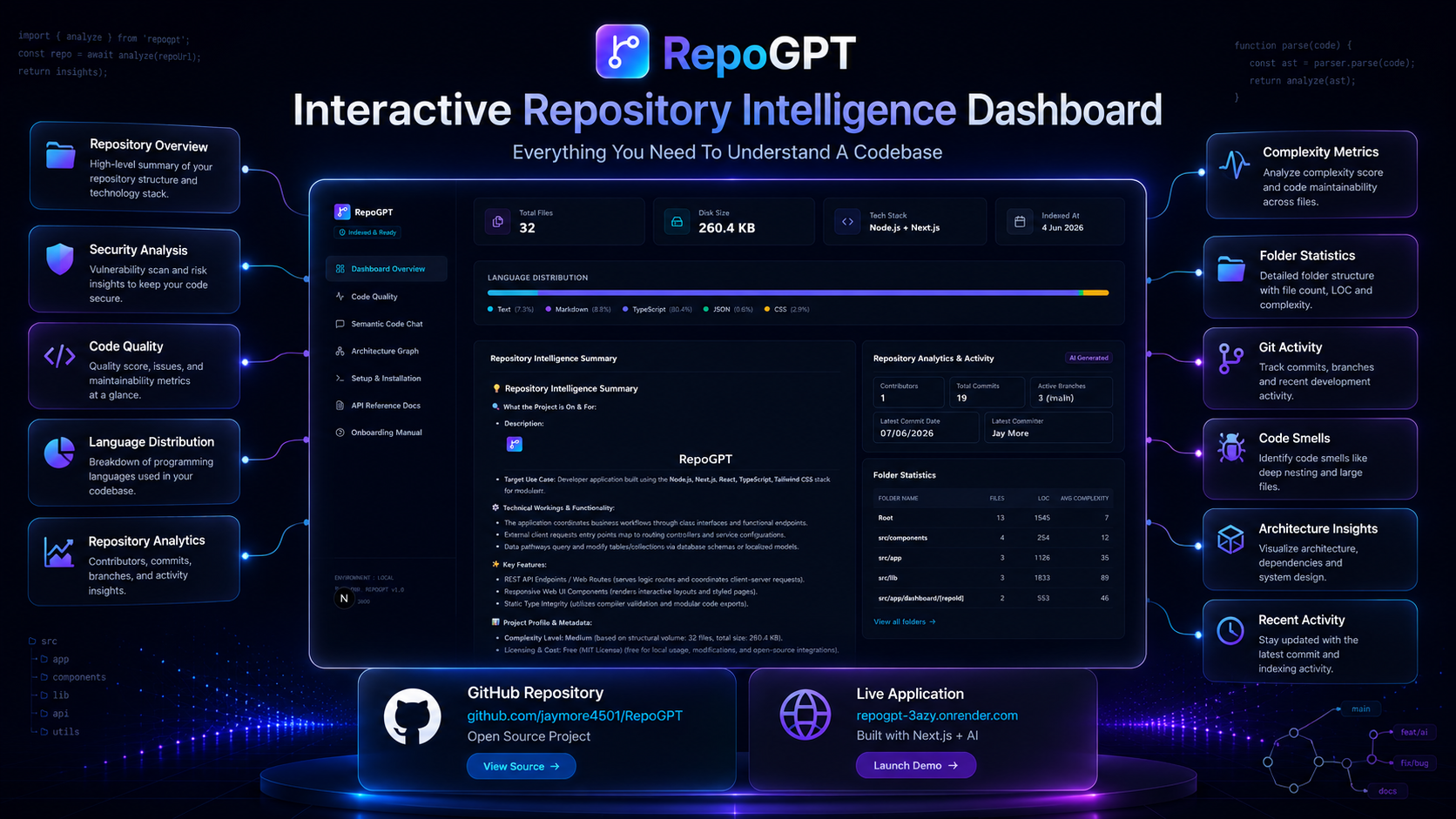
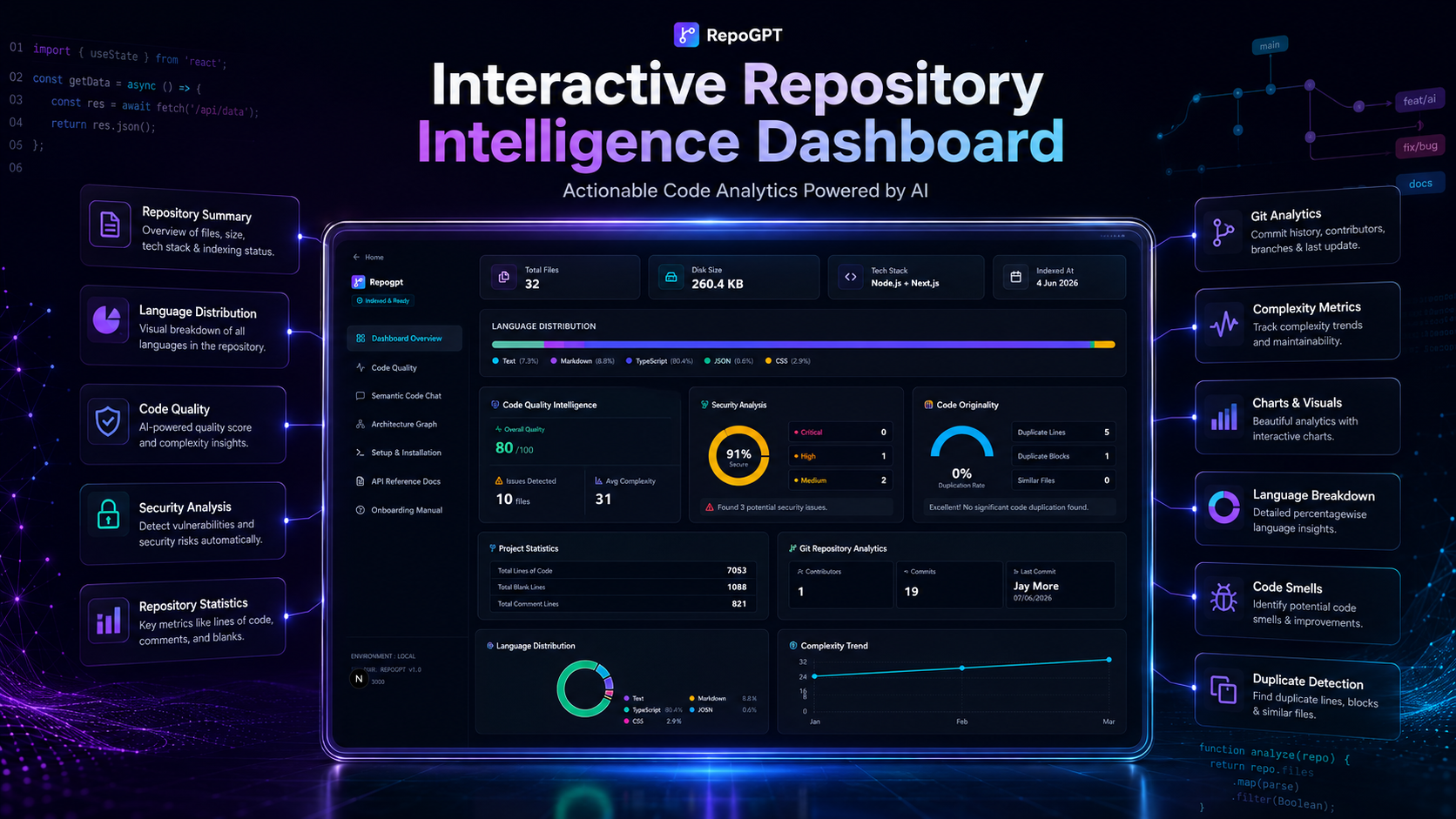
📊 Code Quality & Security Analysis
Analyze maintainability, duplicated code, language distribution, and potential security risks.
📄 Automated Documentation
Generate developer onboarding guides, project summaries, API documentation, and exportable PDF reports.
⚡ Optimized Repository Processing
Uses efficient GitHub metadata retrieval, optimized repository ingestion, AST parsing, and semantic indexing to process repositories quickly.
⚙️ How We Built It
RepoGPT combines multiple modern technologies into a unified developer platform.
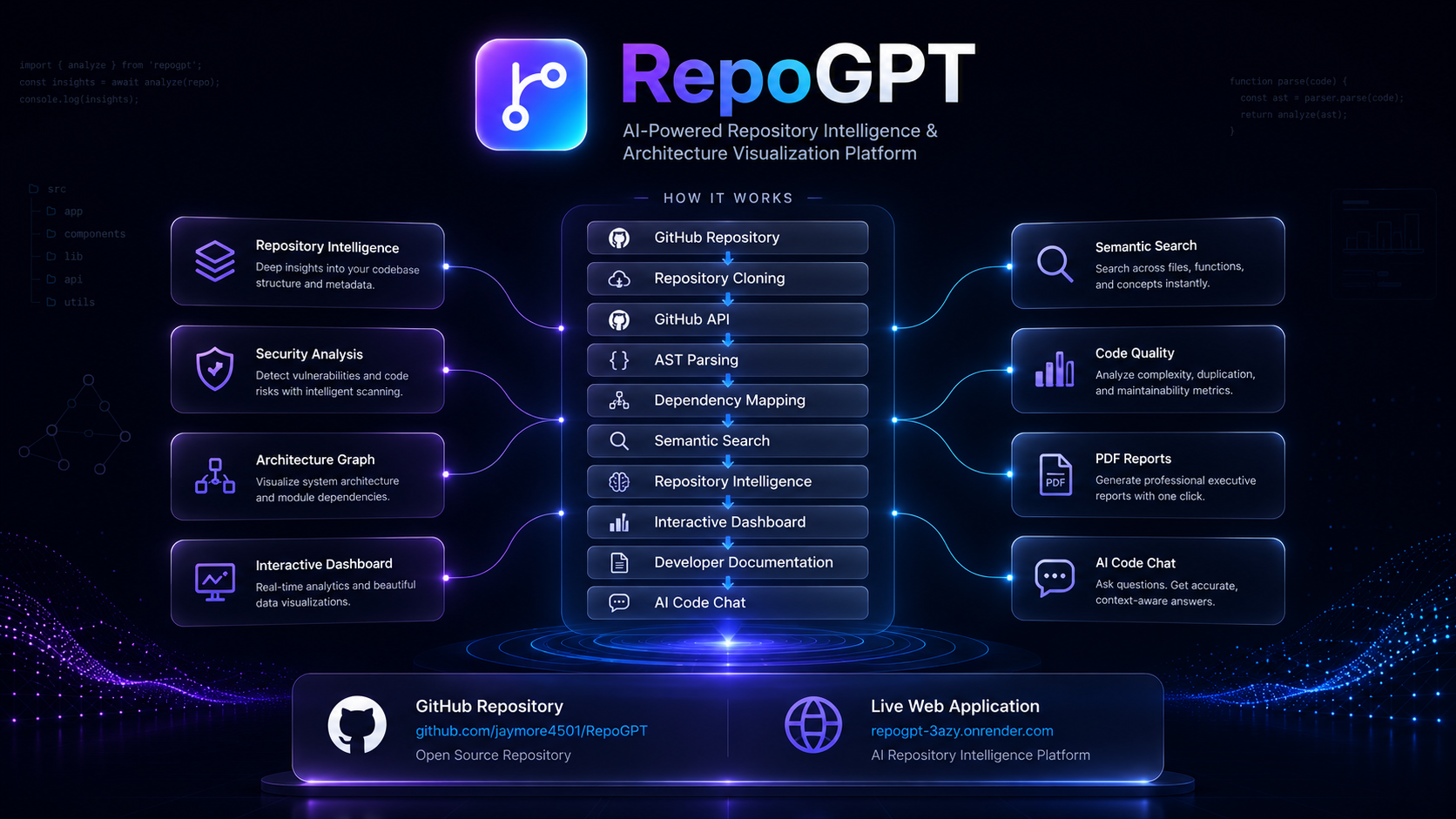
The repository analysis pipeline follows these stages:
GitHub Repository
↓
GitHub API Metadata Retrieval
↓
Optimized Repository Ingestion
↓
Abstract Syntax Tree (AST) Parsing
↓
Dependency Graph Generation
↓
Semantic Indexing
↓
Repository Intelligence Engine
↓
Interactive Dashboard
↓
AI Chat • Architecture Graph • Documentation • Security Insights • PDF Reports
The frontend was built using Next.js and React with a modern glassmorphism interface, while the backend performs repository parsing, structural analysis, semantic indexing, and intelligent retrieval. Interactive architecture visualization is powered by React Flow, analytics are rendered with Recharts, and professional reports are generated using jsPDF.
For conversational repository understanding, RepoGPT integrates with local Ollama models when available while providing a local semantic retrieval fallback to ensure the platform remains functional even without an active LLM.
🧩 Challenges We Faced
Building RepoGPT required solving several technical challenges:
- Efficiently analyzing repositories of different sizes and structures.
- Parsing multiple programming languages consistently.
- Building meaningful architecture graphs from source code.
- Designing semantic retrieval that remains useful without cloud AI services.
- Balancing performance with deep repository analysis.
- Presenting complex technical information through an intuitive interface.
Creating a seamless experience that combines visualization, documentation, analytics, and conversational AI within a single workflow was one of the most rewarding aspects of the project.
🏆 Accomplishments We're Proud Of
We're especially proud of creating a platform that combines several advanced developer tools into one cohesive experience.
Highlights include:
- AI-powered repository intelligence.
- Interactive architecture visualization.
- Semantic repository search.
- Conversational code understanding.
- Automated documentation generation.
- Code quality and security analytics.
- Executive PDF reporting.
- Modern startup-quality UI and user experience.
Rather than building isolated features, we focused on creating an end-to-end workflow that helps developers understand unfamiliar repositories significantly faster.
📚 What We Learned
Throughout this project we gained hands-on experience with:
- Repository parsing and code analysis.
- Abstract Syntax Tree (AST) traversal.
- Semantic search techniques.
- Developer tooling architecture.
- Interactive graph visualization.
- Technical documentation generation.
- Modern full-stack application development.
- Building AI-assisted developer experiences.
Most importantly, we learned that developer productivity is not just about writing code faster—it's about understanding code better.
🚀 What's Next for RepoGPT
RepoGPT has significant room for future growth.
Planned improvements include:
- Private repository authentication.
- Multi-repository workspace support.
- Pull Request review intelligence.
- CI/CD integration.
- Team collaboration features.
- AI-generated refactoring suggestions.
- Enterprise-scale architecture visualization.
- Cloud synchronization and workspace management.
Our long-term vision is to evolve RepoGPT into a comprehensive AI-powered Developer Intelligence Platform that helps engineering teams understand, maintain, and improve software systems with greater confidence.
🌍 Impact
Every software project begins with understanding the existing code.
RepoGPT helps reduce onboarding time, improves developer productivity, simplifies repository exploration, and makes complex software systems easier to understand.
Whether you're a student exploring open-source projects, a developer joining a new team, or an engineering organization maintaining large codebases, RepoGPT transforms repositories into interactive knowledge platforms—making software easier to learn, navigate, and build upon.
Built With
- ai
- api
- architecture
- ast
- code
- css
- developer
- git
- github
- intelligence
- javascript
- jspdf
- next.js
- node.js
- ollama
- quality
- rag
- react
- recharts
- repository
- semantic
- tailwind
- tools
- typescript
- visualization

Log in or sign up for Devpost to join the conversation.