🚀 RepoAgent X — Building Explainable AI Software Engineering with Paritok
Inspiration
Large Language Models have transformed software development. Today, developers can ask an AI to explain code, generate new features, fix bugs, write tests, and even review pull requests. However, while experimenting with different AI coding assistants, we repeatedly encountered the same underlying limitation.
The problem was never the intelligence of the model itself.
The problem was the context.
Modern software repositories often contain hundreds or even thousands of files. When an AI coding assistant receives a request such as "add authentication", "fix a bug", or "implement caching", it rarely needs the entire repository. Yet most AI systems either retrieve far too much information or rely on naive retrieval strategies that send excessive context to the language model.
This creates three major problems.
First, every unnecessary token increases cost.
Second, larger prompts increase latency.
Third, overwhelming the model with irrelevant context often reduces answer quality because important information becomes buried inside noise.
As we studied existing AI software engineering agents, we noticed that most projects focused on autonomous planning, code generation, or agent orchestration. Very few focused on making context optimization transparent and measurable.
Context compression usually happened silently behind the scenes.
Developers had no visibility into questions such as:
- Why was this file selected?
- Why was another file removed?
- How many tokens were actually saved?
- How much money was saved?
- What effect did compression have on quality?
- Which repository components contributed to the final answer?
This became the central question behind RepoAgent X.
What if developers could not only optimize context, but actually understand and trust the optimization process?
That idea became the foundation of our project.
Instead of building another repository chat application, we wanted to build a complete AI software engineering platform where every stage of the engineering workflow was observable, measurable, and explainable.
When we discovered the Paritok Hackathon, it perfectly aligned with this vision.
Paritok focuses on reducing unnecessary LLM context before inference.
Our idea was to make Paritok not simply another API hidden inside the backend, but the central optimization engine of an autonomous software engineering workflow.
Rather than treating context compression as an invisible implementation detail, RepoAgent X transforms it into something developers can explore, inspect, benchmark, and understand.
The Problem
As software systems continue to grow, repositories become increasingly difficult for language models to understand efficiently.
A typical enterprise repository may contain:
- hundreds of folders
- thousands of files
- multiple services
- documentation
- tests
- configuration files
- generated assets
- historical code
When an AI agent receives a task like:
"Implement JWT authentication"
only a small percentage of those files are actually relevant.
Unfortunately, many existing systems either:
- retrieve too much context,
- retrieve irrelevant context,
- repeatedly send duplicate information,
- or provide no explanation for why context was selected.
This results in several practical issues.
High Token Costs
Every unnecessary file increases prompt size.
For organizations running thousands of AI-assisted engineering tasks every day, these unnecessary tokens translate directly into higher operational costs.
Increased Latency
Larger prompts require more processing.
Developers wait longer for responses even though much of the transmitted information never contributes to the final answer.
Reduced Explainability
Most AI engineering tools behave like black boxes.
Developers receive generated code but have little understanding of:
- what repository context was used,
- why certain files were selected,
- why others were discarded,
- or how confident the system was in those decisions.
Without transparency, developers cannot fully trust autonomous engineering systems.
Lack of Measurable Optimization
Many AI coding assistants claim to be "efficient", yet provide no evidence.
Questions like these often remain unanswered:
- How many tokens were saved?
- What was the compression ratio?
- Did quality decrease?
- Was latency improved?
- Was cost actually reduced?
Without measurement, optimization becomes impossible to evaluate.
Our Vision
We wanted to build more than an AI coding assistant.
We wanted to build a platform where every engineering decision could be explained.
Every optimization could be measured.
Every repository transformation could be visualized.
And every token saved could be quantified.
Our vision was built around five principles.
1. Explainability
Developers should understand why context is selected.
Not simply accept the result.
2. Transparency
Compression should never be a black box.
The platform should clearly display:
- selected files
- removed files
- importance scores
- confidence
- reasoning
- dependency relationships
3. Measurability
Optimization should be backed by data.
The platform continuously tracks:
- token usage
- compression ratio
- estimated cost
- latency
- request history
- repository analytics
- benchmark comparisons
4. Intelligent Automation
Rather than acting as a simple chatbot, RepoAgent X behaves as an autonomous software engineering platform capable of:
- understanding repositories,
- retrieving relevant code,
- planning implementation,
- generating edits,
- validating results,
- running tests,
- and preparing GitHub workflows.
5. Human-Centered AI
The developer remains in control.
Instead of hiding AI decisions, RepoAgent X exposes them through interactive dashboards, explainable analytics, and visual workflows.
Developers can inspect every stage of the engineering pipeline instead of blindly trusting generated code.
Why Paritok
Paritok became the perfect foundation for this vision.
Its goal is not to replace language models.
Its goal is to optimize the information sent to them.
RepoAgent X extends this philosophy by placing Paritok inside a complete autonomous software engineering workflow.
Instead of simply forwarding prompts through a compression layer, the system first understands the repository, retrieves relevant code, ranks semantic importance, constructs task-specific context, and only then passes eligible context through Paritok before inference.
This allows optimization to happen after intelligent repository understanding rather than before it.
More importantly, RepoAgent X exposes every optimization through interactive dashboards.
Developers can observe how repository context changes throughout the pipeline, inspect compression decisions, compare benchmark results, and understand exactly how context optimization contributes to better AI-assisted software engineering.
Paritok therefore becomes more than a backend optimization tool.
It becomes a visible and measurable component of the overall developer experience.
The result is an AI engineering platform where repository understanding, explainable context selection, intelligent compression, and autonomous software engineering work together as one integrated system.
🏗️ How We Built RepoAgent X
Building RepoAgent X was not simply about connecting an LLM to a GitHub repository. Our objective was to design an autonomous AI software engineering platform capable of understanding repositories, making intelligent engineering decisions, optimizing context before inference, validating generated code, and exposing every stage of the workflow to the developer.
Instead of relying on a single AI model, we adopted a multi-agent architecture, where each component has a clearly defined responsibility.
Rather than asking one large prompt to solve everything, the workload is divided across specialized agents that cooperate to complete software engineering tasks.
This modular architecture makes the system easier to scale, easier to debug, and significantly more transparent.
System Architecture
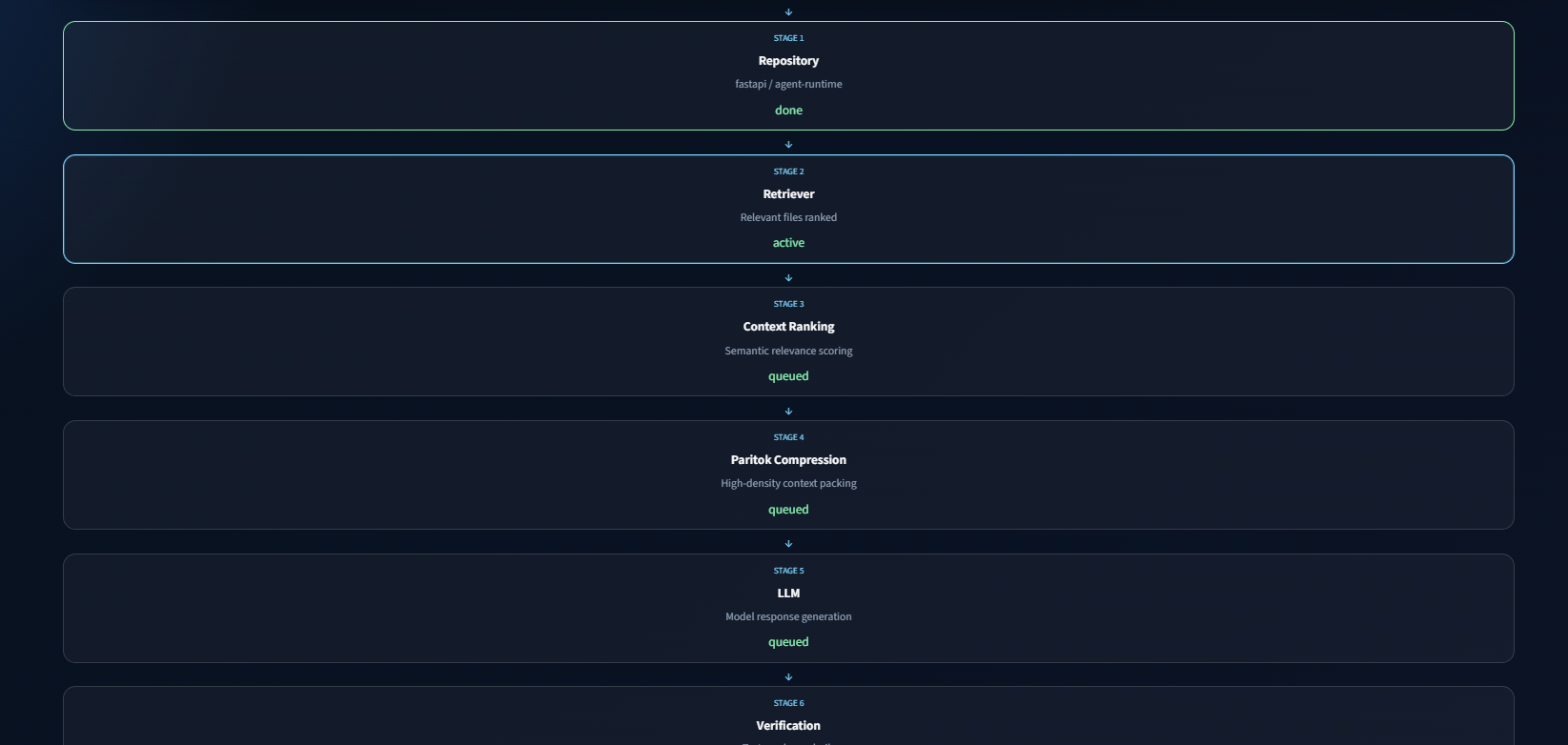
RepoAgent X follows a staged engineering pipeline.
Every request passes through the following workflow.
Repository

↓

Repository Loader

↓

Repository Indexer

↓

Semantic Retrieval

↓

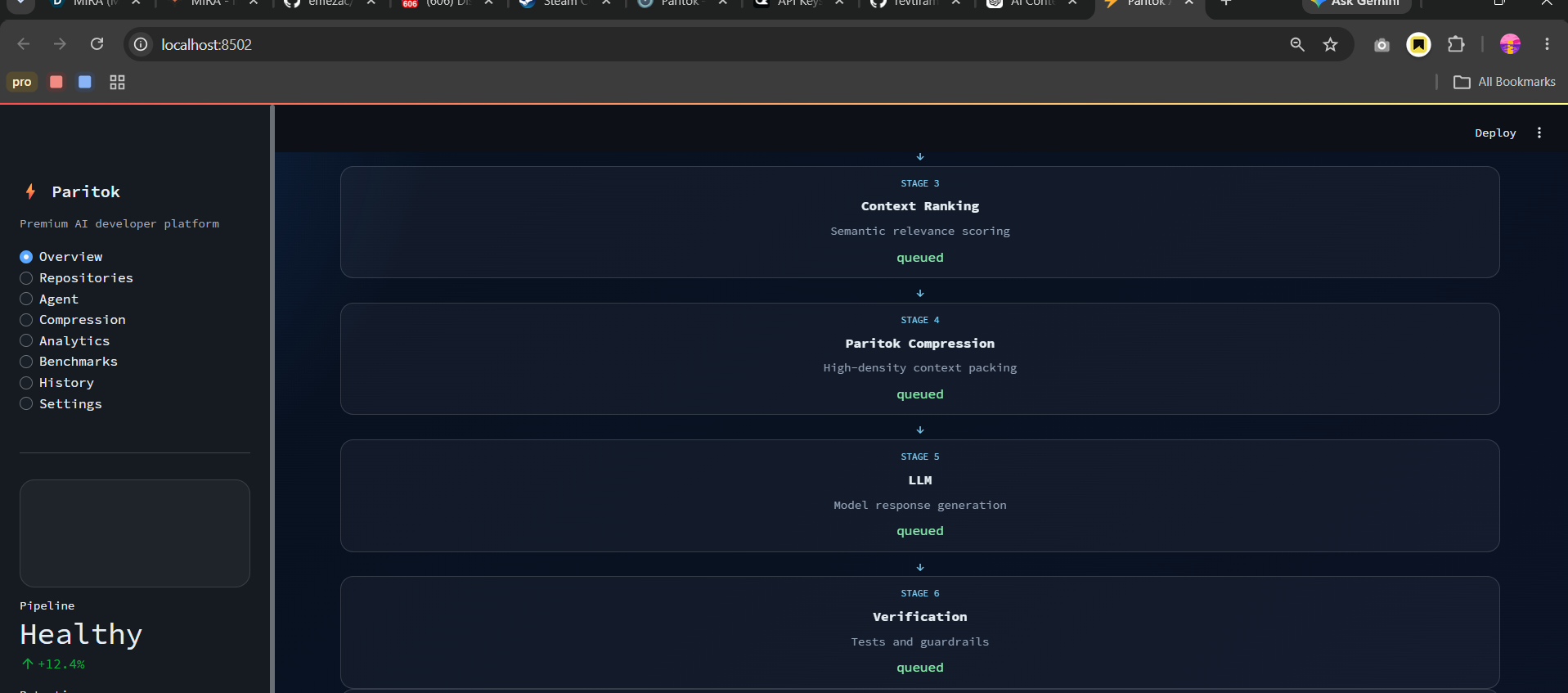
Context Ranking

↓

Planner Agent

↓

Paritok Context Compression

↓

Language Model

↓

Editor Agent

↓

Validator

↓

Executor

↓

Testing Agent

↓

GitHub Automation

↓

Analytics Dashboard
Each stage contributes a specific capability to the engineering workflow.
Repository Understanding
Everything begins when a developer submits:
- a GitHub repository
- a natural language engineering request
For example:
"Add JWT authentication"
or
"Implement Redis caching"
Instead of immediately sending the entire repository to an LLM, RepoAgent X first performs repository analysis.
The repository is cloned locally and parsed into an internal representation.
Functions, classes, modules and files are extracted and indexed.
This produces a searchable understanding of the repository rather than treating the repository as raw text.
By understanding repository structure before inference, later stages operate on meaningful software components instead of arbitrary chunks of code.
Semantic Retrieval
Once indexing is complete, the Retriever Agent identifies the repository components most relevant to the user's request.
Unlike keyword search, semantic retrieval understands intent.
For example,
"authentication"
may retrieve:
- middleware
- API routes
- user models
- security utilities
- configuration files
even when the exact keyword never appears.
Each candidate receives a relevance score based on semantic similarity.
The highest-ranked files continue through the pipeline.
This dramatically reduces unnecessary context before optimization even begins.
Context Ranking
After retrieval, repository context is ranked.
Every retrieved file receives additional metadata including:
- semantic relevance
- repository importance
- dependency relationships
- confidence score
- retrieval ranking
Instead of blindly forwarding every retrieved document, the system determines which repository components are actually valuable for solving the engineering task.
This stage creates the foundation for explainable context selection.
Planner Agent
Once repository context has been selected, the Planner Agent creates a structured engineering plan.
Rather than immediately generating code, the planner first determines:
- what needs to change
- which files are involved
- implementation order
- dependencies
- possible risks
This separates reasoning from implementation.
The result is a structured engineering plan that downstream agents can execute consistently.
Why Paritok Matters
Most AI coding assistants stop after retrieval.
RepoAgent X introduces another optimization stage.
After repository understanding, retrieval and planning have already determined what information is relevant, the selected context passes through Paritok.
This is where token optimization becomes meaningful.
Instead of compressing an entire repository, Paritok receives only carefully selected engineering context.
The result is a smaller prompt that still preserves the information required to complete the task.
This significantly reduces unnecessary token usage while maintaining the quality of repository understanding.
Paritok therefore acts as an optimization layer rather than a replacement for repository intelligence.
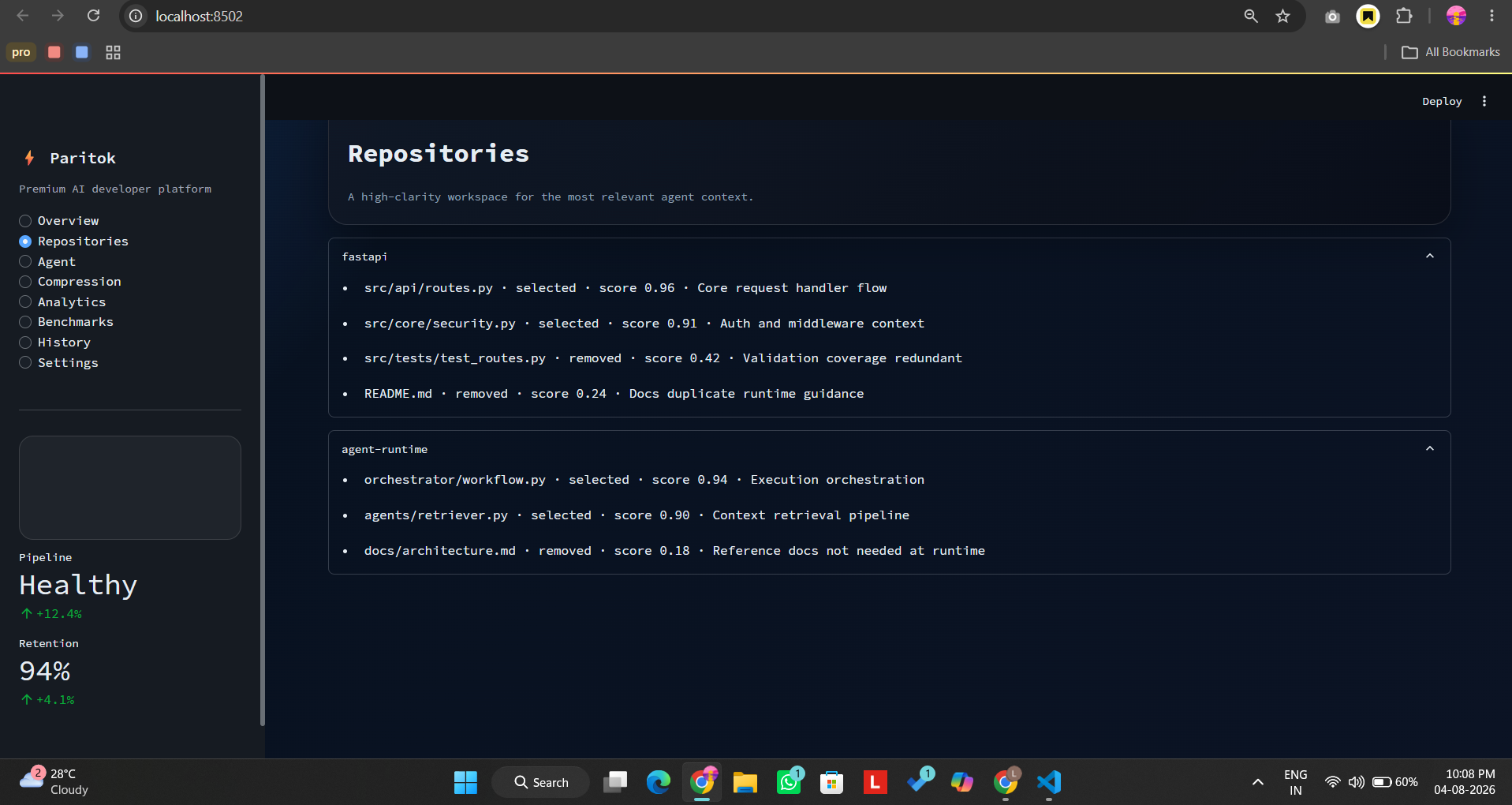
Explainable Context Compression
One of our primary goals was making compression transparent.
Most systems simply state that optimization occurred.
RepoAgent X explains every decision.
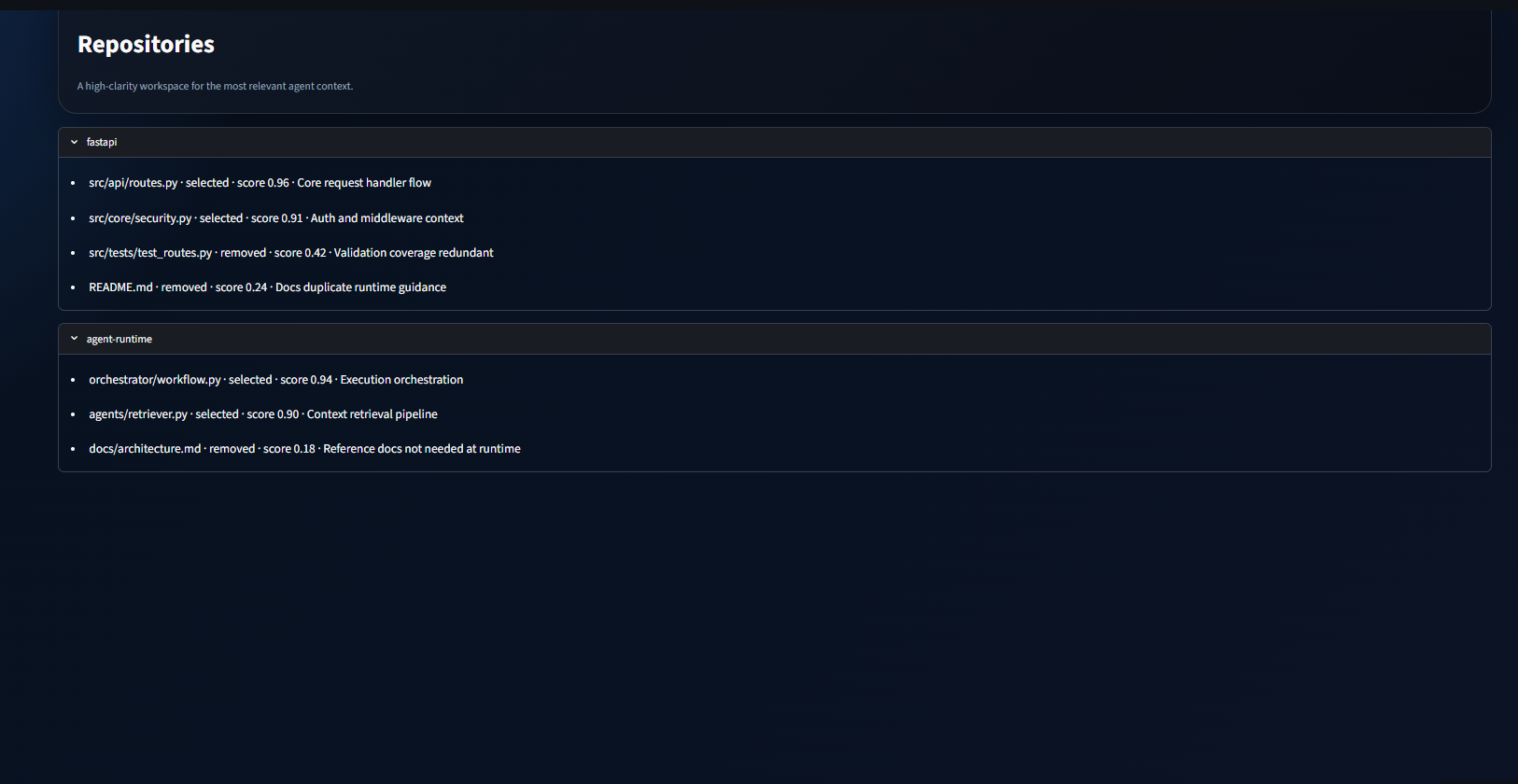
Developers can inspect:
- selected files
- removed files
- repository hierarchy
- confidence
- importance scores
- semantic relevance
- dependency relationships
Every compression decision is accompanied by an explanation describing why repository context was preserved or removed.
Rather than trusting a black box, developers can verify the reasoning themselves.
This significantly increases confidence in autonomous engineering workflows.
Multi-Agent Engineering
After optimized context reaches the language model, execution continues through multiple specialized agents.
Planner
Creates structured engineering strategy.
Editor
Generates code modifications.
Validator
Checks syntax and structural correctness.
Executor
Runs the modified implementation.
Tester
Generates and executes tests whenever possible.
GitHub Agent
Prepares commits, branches and pull requests.
By separating responsibilities, each agent performs one task well instead of requiring a single prompt to manage the entire engineering lifecycle.
Building a Developer Experience
A major design decision was treating observability as a core feature rather than an afterthought.
Developers should not only receive generated code.
They should understand how the AI reached its decision.
For this reason, we built a dashboard that visualizes every major component of the workflow.
The platform exposes:
- repository activity
- pipeline execution
- compression metrics
- benchmark results
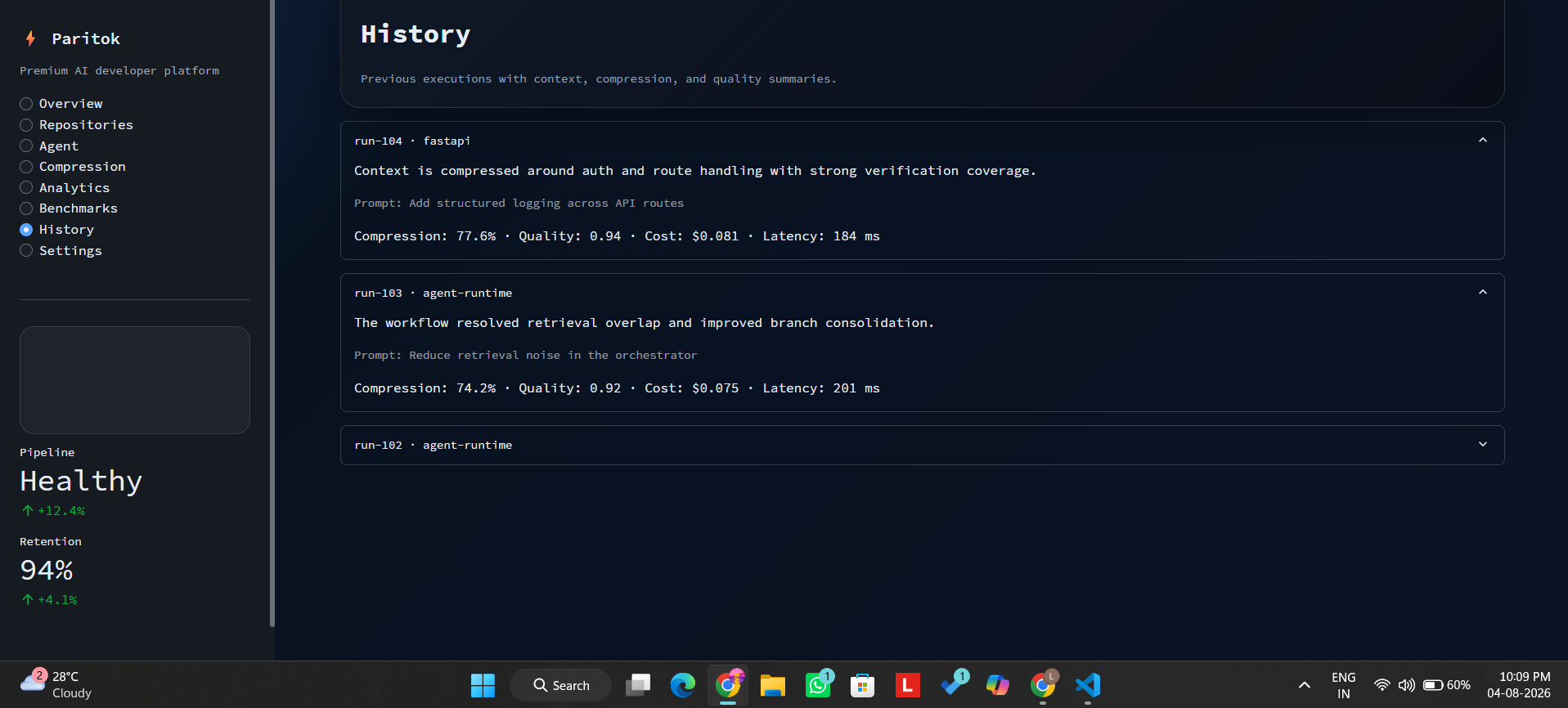
- request history
- token analytics
- execution status
This transforms AI software engineering from a black-box interaction into an inspectable engineering process.
Analytics Dashboard
One of the most distinctive parts of RepoAgent X is its analytics platform.
Instead of reporting only a final answer, every execution generates measurable engineering data.
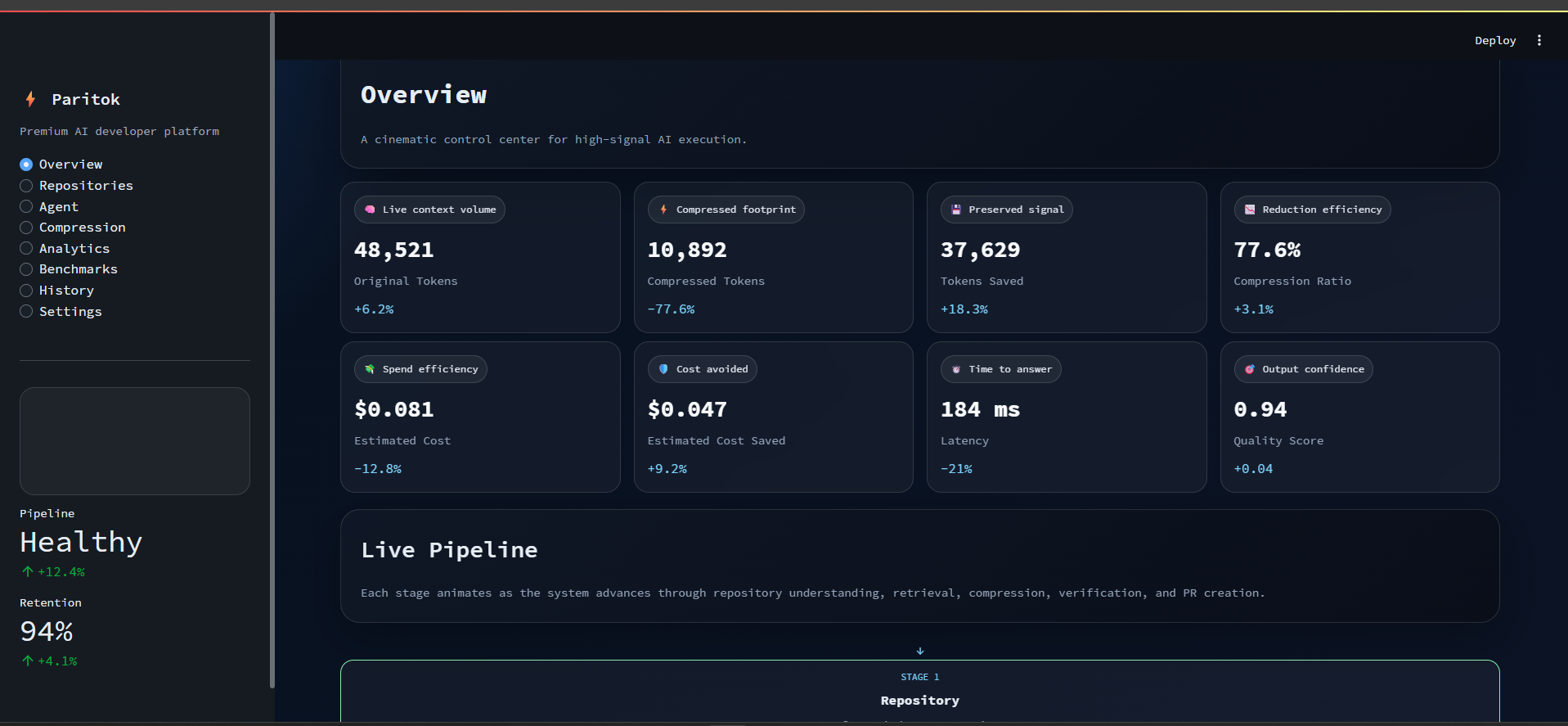
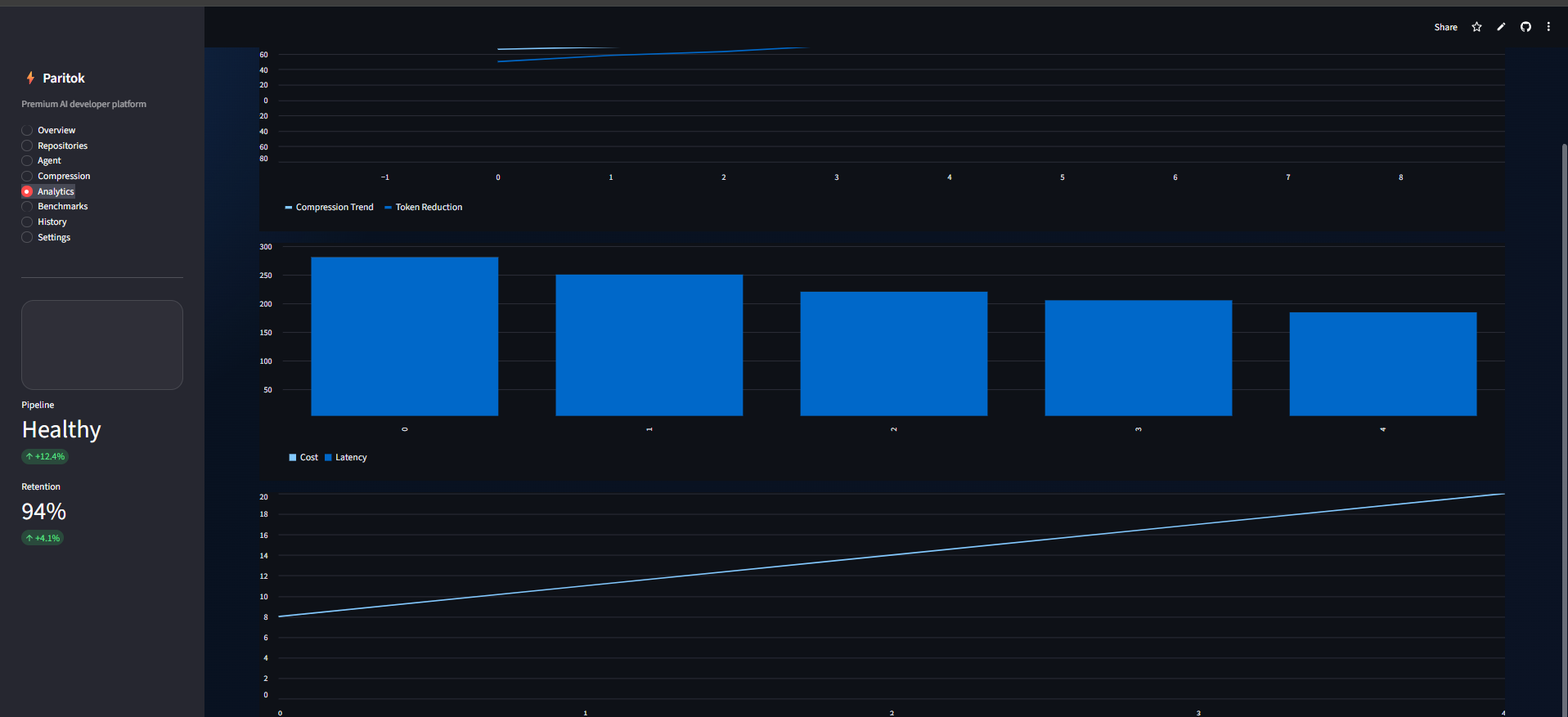
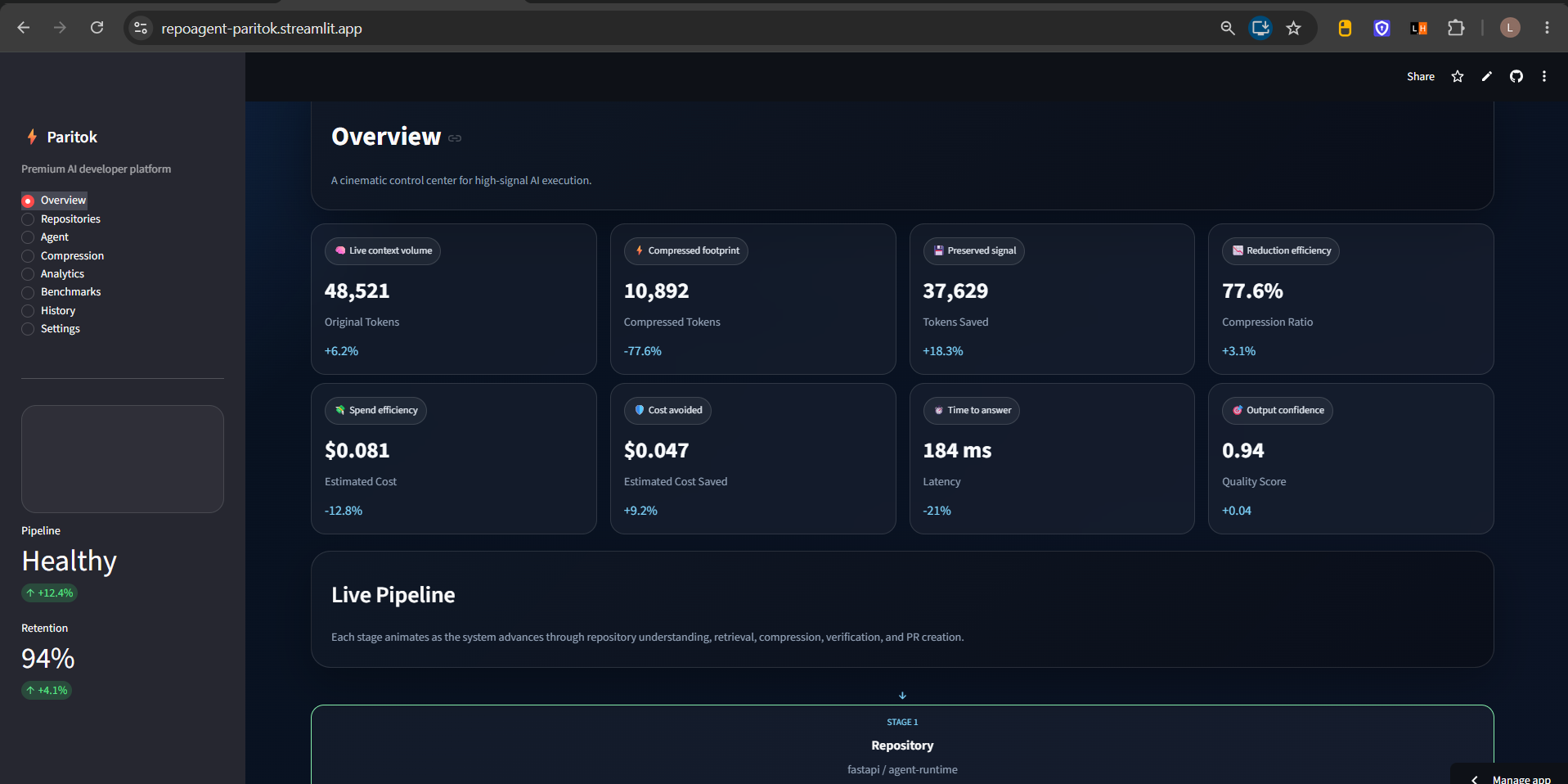
The dashboard displays metrics such as:
- Original Token Count
- Compressed Token Count
- Compression Ratio
- Estimated Token Savings
- Estimated Cost Savings
- Request History
- Pipeline Status
- Repository Statistics
- Latency Trends
- Quality Metrics
Rather than relying on assumptions, optimization becomes visible through measurable analytics.
Benchmarking Performance
Another major goal was allowing developers to evaluate optimization rather than simply trust it.
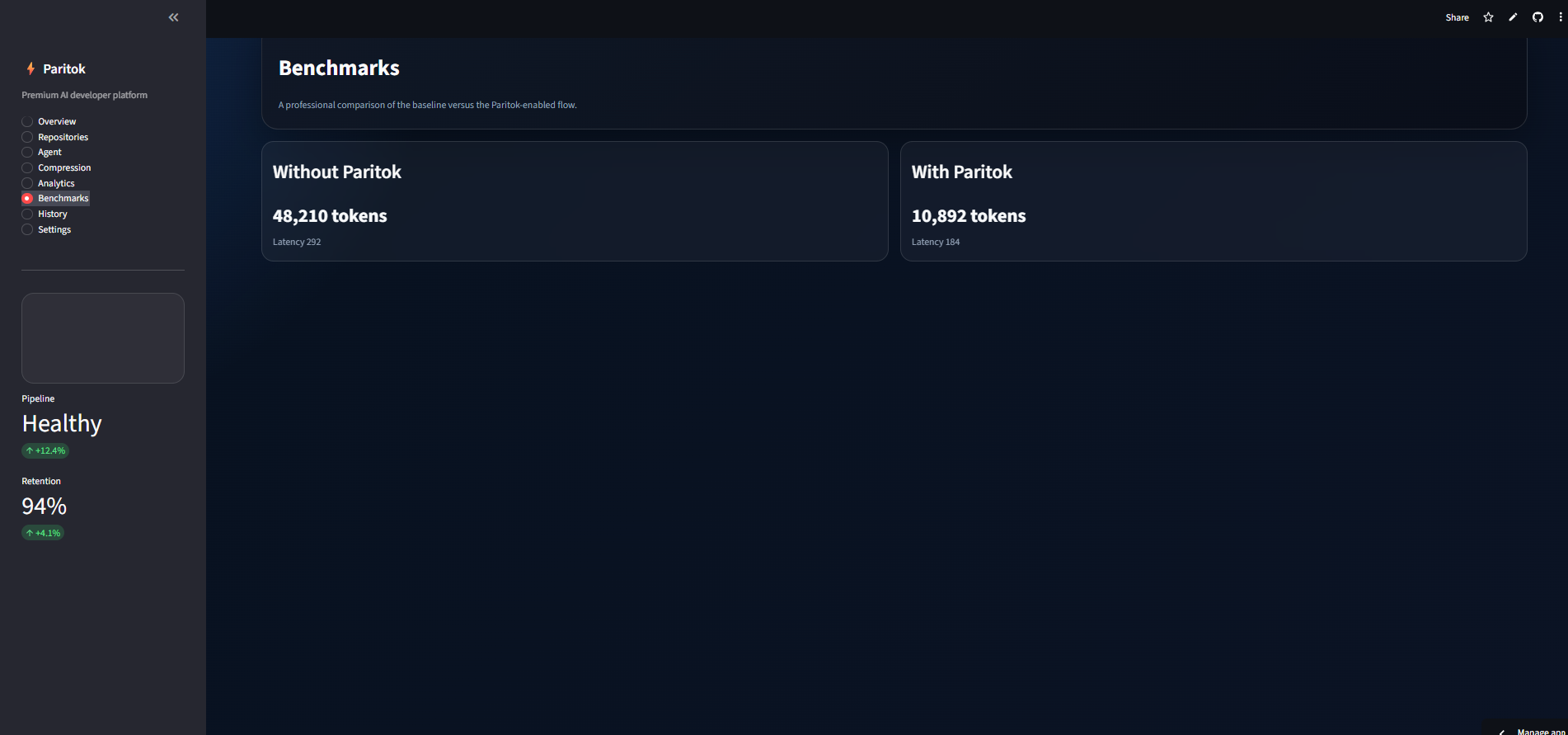
RepoAgent X includes benchmark views comparing engineering workflows with and without optimized context.
Developers can inspect differences in:
- token usage
- estimated cost
- latency
- execution time
- repository coverage
Benchmarking transforms optimization from a marketing claim into observable engineering evidence.
Designing for Scale
Throughout development we emphasized modularity.
Every major capability is implemented as an independent service.
This makes future improvements significantly easier.
Future extensions can include:
- additional retrieval strategies
- different compression providers
- multiple language models
- enterprise authentication
- distributed execution
- cloud-native deployments
without redesigning the overall architecture.
Instead of building a one-time hackathon prototype, we wanted RepoAgent X to resemble a production-ready AI engineering platform capable of evolving into a real-world developer tool.
Challenges We Faced
Building RepoAgent X was far more challenging than connecting a language model to a GitHub repository. The real engineering challenge was designing a system that could behave like an autonomous software engineer while remaining efficient, transparent, and trustworthy.
Throughout development we encountered several architectural and engineering challenges that shaped the final design.
Building Repository Intelligence
One of the earliest challenges was repository understanding.
Large repositories contain thousands of files, many of which have no relevance to the current engineering task.
Initially, retrieving repository context appeared straightforward. However, we quickly realized that simply retrieving semantically similar files was not enough.
Repositories contain hidden dependencies.
A seemingly unrelated configuration file may determine how authentication works.
A middleware component may influence multiple API routes.
Business logic may span several services.
Retrieving too little information produces incomplete solutions.
Retrieving too much information wastes tokens and increases latency.
Finding the right balance became one of the core design problems of RepoAgent X.
Separating Reasoning from Execution
Another major challenge was avoiding the temptation to solve every problem with a single LLM prompt.
Although modern language models are extremely capable, combining planning, editing, debugging, testing and repository understanding inside one prompt quickly becomes difficult to maintain.
Instead, we redesigned the system around specialized agents.
Each agent performs a single responsibility.
Planner.
Retriever.
Editor.
Validator.
Executor.
Tester.
GitHub Automation.
This architecture made debugging significantly easier while allowing every stage of the engineering workflow to evolve independently.
Explainability Instead of Black Boxes
One observation became increasingly obvious while testing existing AI coding assistants.
Most systems produce impressive code.
Very few explain why they produced it.
Developers rarely know:
- why files were selected
- why context was removed
- why a specific implementation strategy was chosen
- how much optimization actually occurred
This inspired one of the defining goals of RepoAgent X.
Every important engineering decision should be observable.
Rather than hiding optimization behind an API call, the platform visualizes repository understanding, context ranking, compression, benchmarks and execution metrics.
Explainability became just as important as automation.
Integrating Paritok Meaningfully
A major objective of this hackathon was ensuring that Paritok was not treated as an afterthought.
It would have been easy to simply route every request through Paritok and claim integration.
Instead, we designed the workflow so that Paritok operates after repository understanding, semantic retrieval and context ranking.
This means the optimization stage receives already-curated engineering context rather than an entire repository.
As a result, Paritok becomes part of the engineering architecture instead of functioning as an isolated optimization proxy.
Building a Professional Developer Experience
Hackathon projects often prioritize backend functionality while neglecting developer experience.
We wanted RepoAgent X to feel like a commercial AI platform rather than a prototype.
That required designing dashboards that communicate engineering decisions visually.
Instead of displaying raw logs, the interface presents:
- live pipeline execution
- repository analytics
- explainable compression
- benchmark comparisons
- token optimization
- request history
- engineering metrics
The dashboard became a critical component of the overall experience rather than simply an administrative interface.
Measuring Optimization
Optimization should never rely on assumptions.
Throughout development we asked ourselves one recurring question:
"Can developers actually measure the value created by the system?"
This led to the design of benchmark views, analytics dashboards and historical execution tracking.
Instead of claiming improved efficiency, the platform exposes measurable engineering data that allows developers to inspect repository activity and optimization over time.
Accomplishments We're Proud Of
Looking back, several achievements stand out.
Most importantly, RepoAgent X evolved from an idea about repository understanding into a complete autonomous software engineering platform.
The project successfully combines:
- semantic repository understanding
- multi-agent orchestration
- explainable engineering decisions
- Paritok context optimization
- interactive analytics
- benchmark visualization
- GitHub workflow automation
into a unified developer experience.
Rather than presenting optimization as a hidden backend feature, RepoAgent X makes every stage of the engineering workflow transparent and understandable.
For us, that represents the most meaningful accomplishment of the project.
What We Learned
Developing RepoAgent X fundamentally changed how we think about AI software engineering.
Initially, we believed the most important challenge was generating better code.
As development progressed, we realized something more important.
The quality of AI-generated software depends just as much on repository understanding and context selection as it does on the language model itself.
A powerful model cannot compensate for poor context.
Likewise, intelligently selected context allows existing models to perform significantly more effectively.
This shifted our focus away from simply generating code toward designing better engineering workflows.
Context Is an Engineering Problem
One of our biggest lessons was that context management should be treated as a software engineering discipline.
Repository understanding.
Retrieval.
Ranking.
Compression.
Validation.
Benchmarking.
These are all engineering problems rather than purely machine learning problems.
By solving these systematically, the overall quality of AI-assisted development improves.
Transparency Builds Trust
Developers trust systems they understand.
Rather than hiding optimization behind APIs, RepoAgent X explains every important decision.
Developers can inspect repository selection, compression, execution history and engineering metrics.
This level of visibility transforms autonomous AI from something developers simply use into something they can confidently verify.
AI Needs Better Developer Tools
Language models continue to improve every year.
However, developer tooling surrounding those models often lags behind.
Our project demonstrates that innovation does not necessarily require building a larger model.
Meaningful improvements can come from better orchestration, better context management, better explainability and better developer experience.
That philosophy guided every architectural decision throughout RepoAgent X.
What's Next
RepoAgent X was intentionally designed with extensibility in mind.
Future development will focus on expanding the platform into a complete AI software engineering ecosystem.
Planned improvements include:
VS Code Extension
Developers will be able to interact with RepoAgent X directly from their editor while maintaining repository context across development sessions.
Multi-Repository Intelligence
Support for analyzing dependencies across multiple repositories simultaneously.
Enterprise Collaboration
Shared workspaces.
Organization dashboards.
Role-based access.
Team analytics.
Advanced Benchmarking
Support for comparing multiple language models including Claude, GPT, Gemini and open-source models using identical engineering tasks.
Pull Request Intelligence
Automatically review pull requests.
Detect architectural issues.
Suggest improvements.
Generate review summaries.
Enterprise Analytics
Long-term engineering insights including:
- organization-wide token optimization
- repository activity
- engineering productivity
- model usage
- infrastructure cost
Smarter Context Policies
Developers will be able to define rules such as:
Always preserve:
- API contracts
- Security modules
- Configuration
Always remove:
- generated code
- documentation
- test fixtures
making context optimization even more controllable.
Conclusion
RepoAgent X began with a simple question.
Can AI software engineering become more transparent, more efficient and easier to trust?
That question evolved into an autonomous multi-agent engineering platform capable of understanding repositories, optimizing engineering context, visualizing AI decisions and helping developers work more effectively.
Paritok plays a central role in this vision by making context optimization an integral part of the engineering workflow rather than an isolated backend optimization.
Instead of treating token reduction as a hidden implementation detail, RepoAgent X transforms it into an explainable, measurable and developer-friendly experience.
Our goal was never simply to build another AI coding assistant.
Our goal was to build a platform that helps developers understand how autonomous AI engineering works, why engineering decisions are made and how intelligent context optimization can improve the future of software development.
We believe RepoAgent X demonstrates that the next generation of AI engineering platforms will not be defined solely by larger language models.
They will be defined by better workflows, better context management, better transparency and better developer experiences.
That is the future we hope RepoAgent X contributes to building.


Log in or sign up for Devpost to join the conversation.