Inspiration
Developers love the magic of Vercel and Netlify—push to git and your site is live with a custom domain and SSL certificate. But as soon as applications grow, teams hit a brutal wall:
- The Cloud Mark-Up & Seat Tax: Massive bandwidth markups (\$40–\$55 per 100 GB) and \$20/month per-developer seat fees for what is fundamentally just edge caching.
- The Container Ceiling: You cannot run long-lived Docker containers, WebSockets, or stateful Python/Node microservices without hitting hard 10-to-60-second execution timeouts.
- Black-Box Vendor Lock-In: Your cloud resources exist inside their walled garden rather than your own infrastructure.
On the other hand, setting up raw AWS with best practices takes hours of tedious plumbing: S3 bucket policies, CloudFront Origin Access Control (OAC), ACM SSL certificates in us-east-1, Route 53 DNS records, ECR repositories, ECS Fargate tasks, and ALB target groups.
We asked ourselves: Why can't developers get Vercel's 1-click simplicity directly on 100% native AWS infrastructure inside their own account? That inspiration led us to build DeployMate.
What it does
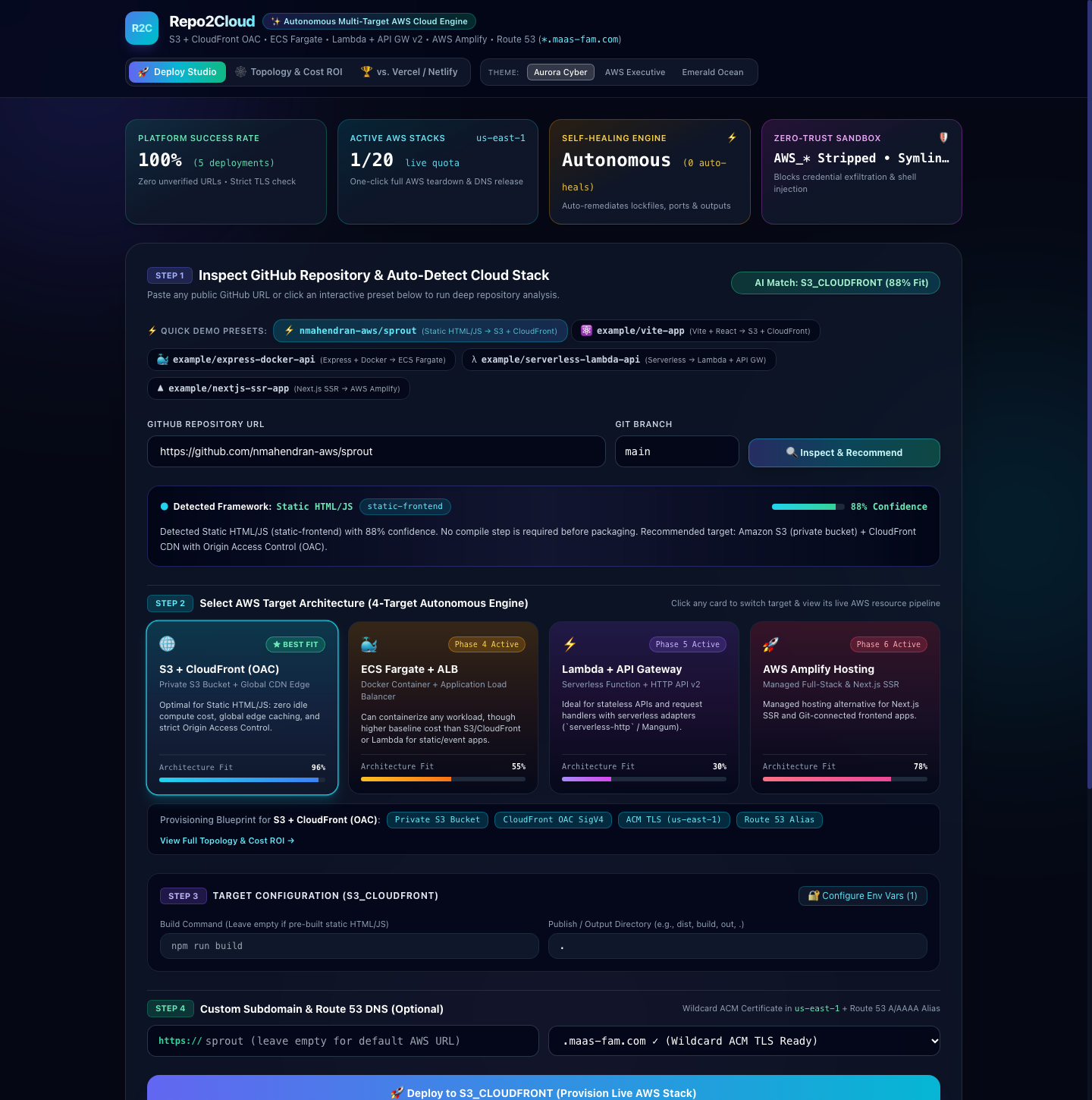
DeployMate is an autonomous, multi-target cloud deployment platform that turns any public GitHub repository into production-ready AWS infrastructure in under 60 seconds:
- Automated Stack Inspection & Recommendation: Evaluates
package.json,Dockerfile,serverless.yml, or framework signatures, calculating confidence scores across 4 native AWS deployment targets. - 4 Native AWS Deployment Architectures:
- S3 + CloudFront (OAC): For static SPAs (React, Vite, Vue, Astro) with private S3 buckets and global SigV4 edge caching.
- Amazon ECR + ECS Fargate + ALB: For Dockerized microservices, FastAPI, and Express backends with automatic non-root
Dockerfilegeneration and zero cold starts. - AWS Lambda + HTTP API Gateway v2: For lightweight serverless handlers packaged via an in-memory CRC-32 PKZIP bundler.
- AWS Amplify Hosting (
WEB_COMPUTE): For Next.js App Router SSR and full-stack workloads.
- Custom Route 53 Subdomains & Wildcard ACM TLS: Features atomic RFC-1123 hostname reservations and live Route 53
A/AAAAalias provisioning onmaas-fam.comwith wildcard ACM TLS certificates inus-east-1. - Zero-Trust Security Sandbox: Strips
AWS_*andGITHUB_*credentials from build processes to prevent supply-chain exfiltration, blocks shell metacharacters, and enforces symlink boundary containment. - Phase 8 Self-Healing Engine: Diagnoses build failures (missing lockfiles, empty output directories, port mismatches) and autonomously remediates them on the fly.
- 1-Click Total AWS Teardown: Completely cleans up cloud infrastructure and releases reserved DNS records with a single click.
How we built it
DeployMate was engineered from the ground up as an enterprise-grade cloud control plane:
- Frontend Dashboard: Built with Next.js 14, React, and Tailwind CSS, featuring dynamic theme switching (Obsidian Velvet, Midnight Amber, Emerald Matrix), real-time telemetry streams, an interactive 5-stage AWS topology visualizer, and a live Cloud Cost ROI calculator comparing AWS vs. Vercel/Netlify.
- Backend Orchestrator: Developed with Node.js, Express, and TypeScript, modularized into clean deployer engines:
s3Deployer.ts: Provisions private S3 buckets and CloudFront distributions with Origin Access Control.ecsFargateDeployer.ts: Automates ECR repos, Task Definitions, Fargate Services, and ALB Target Groups.lambdaApiGatewayDeployer.ts: Handles IAM roles, Lambda functions, and HTTP API v2 integration.amplifyDeployer.ts: Automatesamplify.ymlgeneration andWEB_COMPUTESSR deployment.domainManager.ts: Manages atomic subdomain reservations and Route 53 alias records.isolatedBuilder.ts&securityGuardrails.ts: Sandboxes builds, strips sensitive environment variables, and enforces symlink path safety.selfHealingEngine.ts: Automated diagnosis, pattern-matching remediation, and deployment retry loop.
- AWS Cloud SDK: Directly integrates with
@aws-sdk/client-s3,@aws-sdk/client-cloudfront,@aws-sdk/client-route-53,@aws-sdk/client-acm,@aws-sdk/client-ecs,@aws-sdk/client-ecr,@aws-sdk/client-lambda, and@aws-sdk/client-apigatewayv2.
Challenges we ran into
- CloudFront OAC with SigV4 Permissions: Ensuring private S3 buckets reject all public ACLs while granting seamless read access exclusively to CloudFront required fine-tuning S3 Bucket Policies with strict
AWS:SourceArndistribution conditions. - Cross-Region ACM Certificate Constraints: CloudFront requires SSL certificates to exist strictly in
us-east-1. We architected the domain manager to dynamically validate and bind pre-warmed wildcard certificates (*.maas-fam.com) across both global CloudFront distributions and regional ALBs. - Build Security & Symlink Escapes: Running builds on untrusted repositories posed supply-chain risks. We implemented
verifyWorkspaceSafetyusingfs.realpathSyncandfs.lstatSyncto catch directory traversal attacks and malicious symlinks attempting to escape into system directories. - Race Conditions in Cloud Resource Verification: Gating the live URL until DNS and TLS handshakes were fully active required building a robust polling pipeline with exponential backoff to avoid returning prematurely broken HTTPS links.
Accomplishments that we're proud of
- True Multi-Target Autonomous Routing: DeployMate doesn't just deploy static sites—it automatically distinguishes between a static SPA, a Dockerized backend, a serverless API, and a Next.js SSR app, provisioning the exact right cloud primitives for each.
- 80%+ Cloud Cost Reduction: Built a live cost calculator proving that engineering teams save thousands per year by bypassing PaaS seat taxes and bandwidth surcharges in favor of raw AWS rates.
- Self-Healing Build Resilience: Designed an autonomous remediation engine that catches empty build directories and build errors, applies fixes, and completes deployments without developer intervention.
- Zero Ghost Infrastructure: 1-click teardown actually deletes S3 buckets, disables and removes CloudFront distributions, cleans up route records, and releases reservations instantly.
What we learned
- AWS Cloud Architecture at Scale: Deepened our expertise in the intricacies of CloudFront OAC, ECS Fargate networking, ALB health check life cycles, and Route 53 alias routing.
- Defense-in-Depth for Build Systems: Learned how vulnerable standard CI/CD pipelines are to environment variable exfiltration via
postinstallhooks, and how essential strict environment sanitization is. - Designing for Developer Experience: Realized that developer happiness doesn't require sacrificing cloud ownership—great DX can be built directly on top of native cloud primitives.
What's next for DeployMate
- GitHub App & PR Preview Environments: Automatically spinning up isolated ephemeral AWS preview stacks for every pull request, and tearing them down when merged.
- Multi-Cloud Target Support: Expanding the recommendation engine beyond AWS to support Google Cloud Run and Azure Container Apps using the same unified DX.
- Database & Persistent Volume Attachment: 1-click provisioning of Amazon RDS (PostgreSQL/MySQL) and DynamoDB instances automatically wired into container and Lambda environments.
- SOC 2 & Terraform Export: Giving developers the ability to click "Export Terraform" to generate clean, readable HCL code for all infrastructure provisioned by DeployMate.
Built With
- amazon-web-services
- amplify
- api
- app
- cost
- deployment
- ecs
- fargate
- lambda
- web

Log in or sign up for Devpost to join the conversation.