-
-
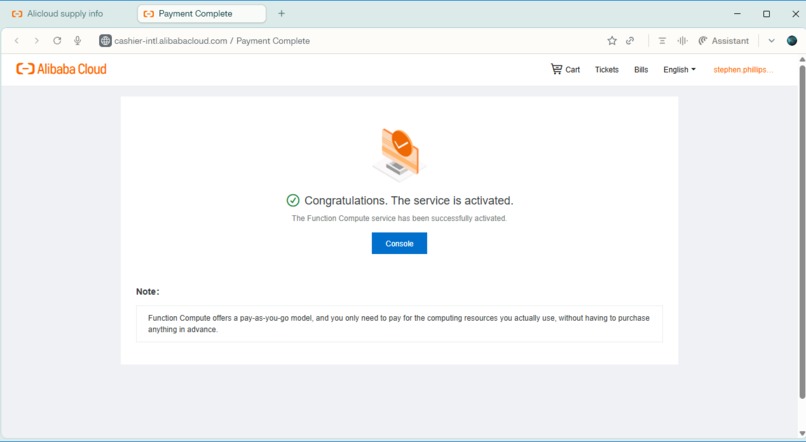
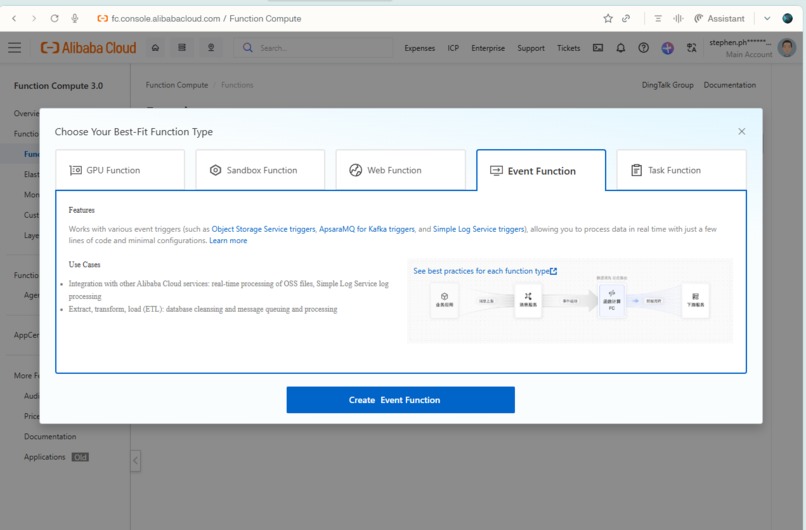
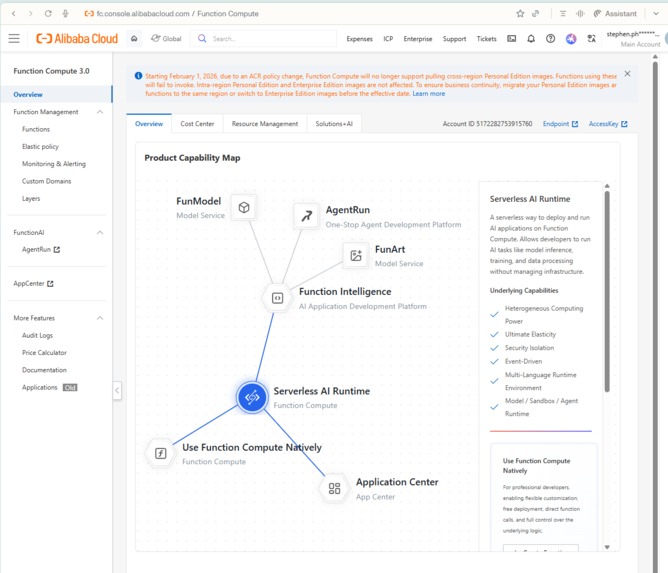
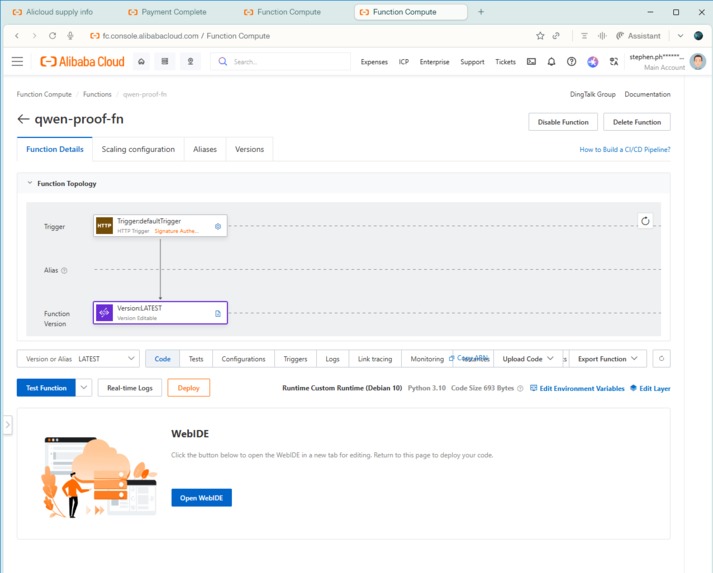
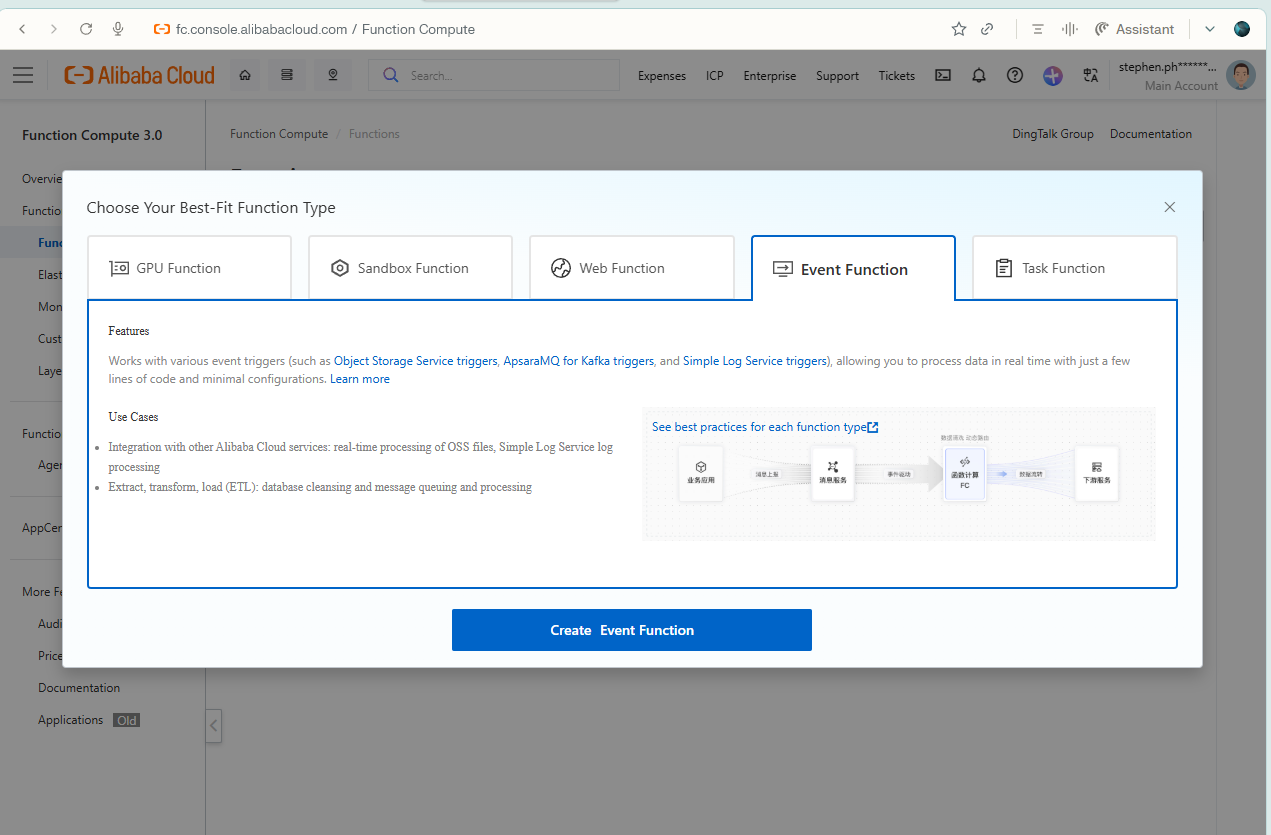
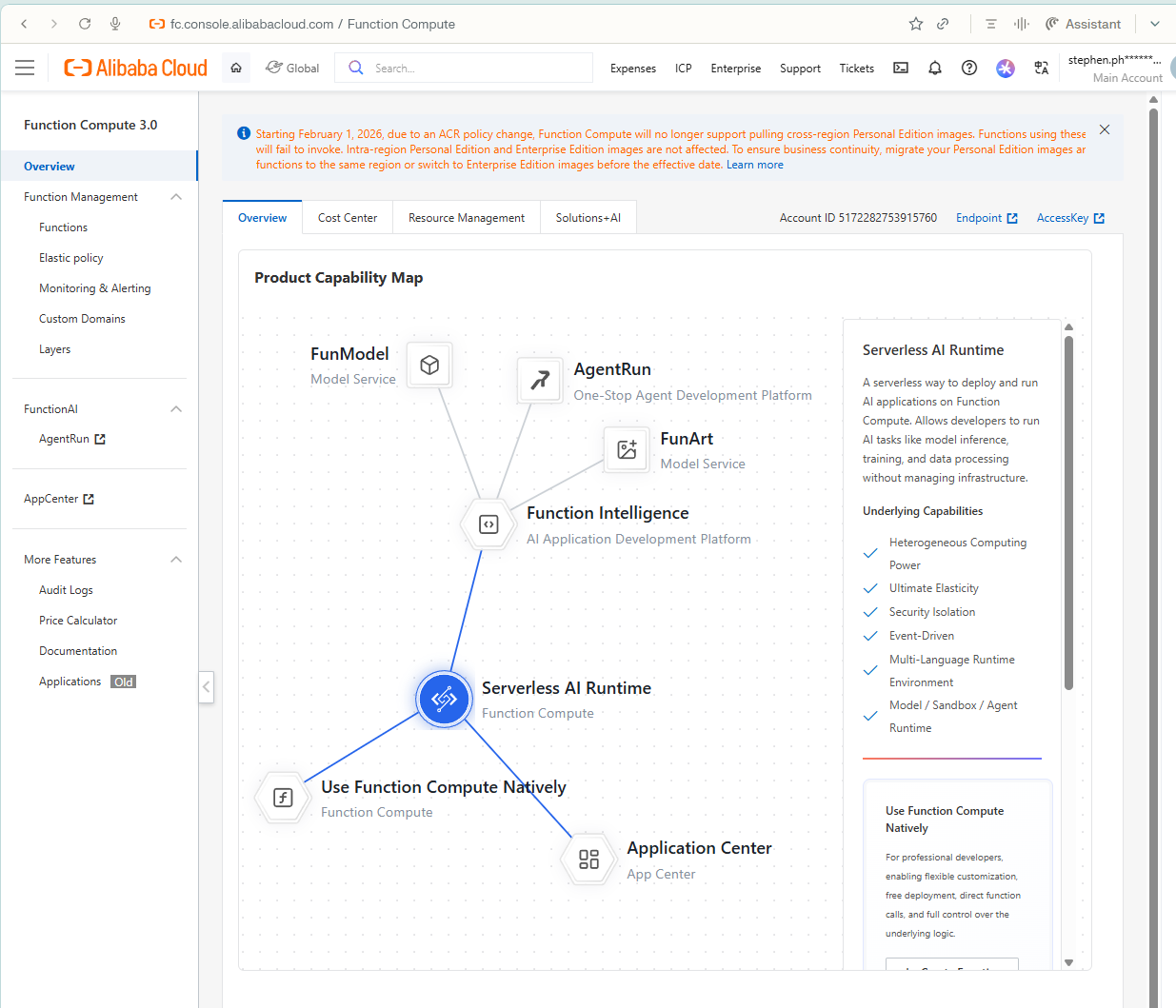
Alibaba Cloud Function Compute console — starting point for deploying the repo.spot serverless backend in the UK London region.
-
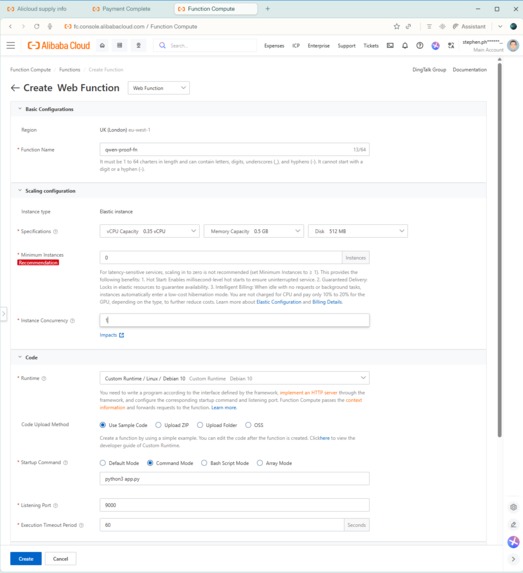
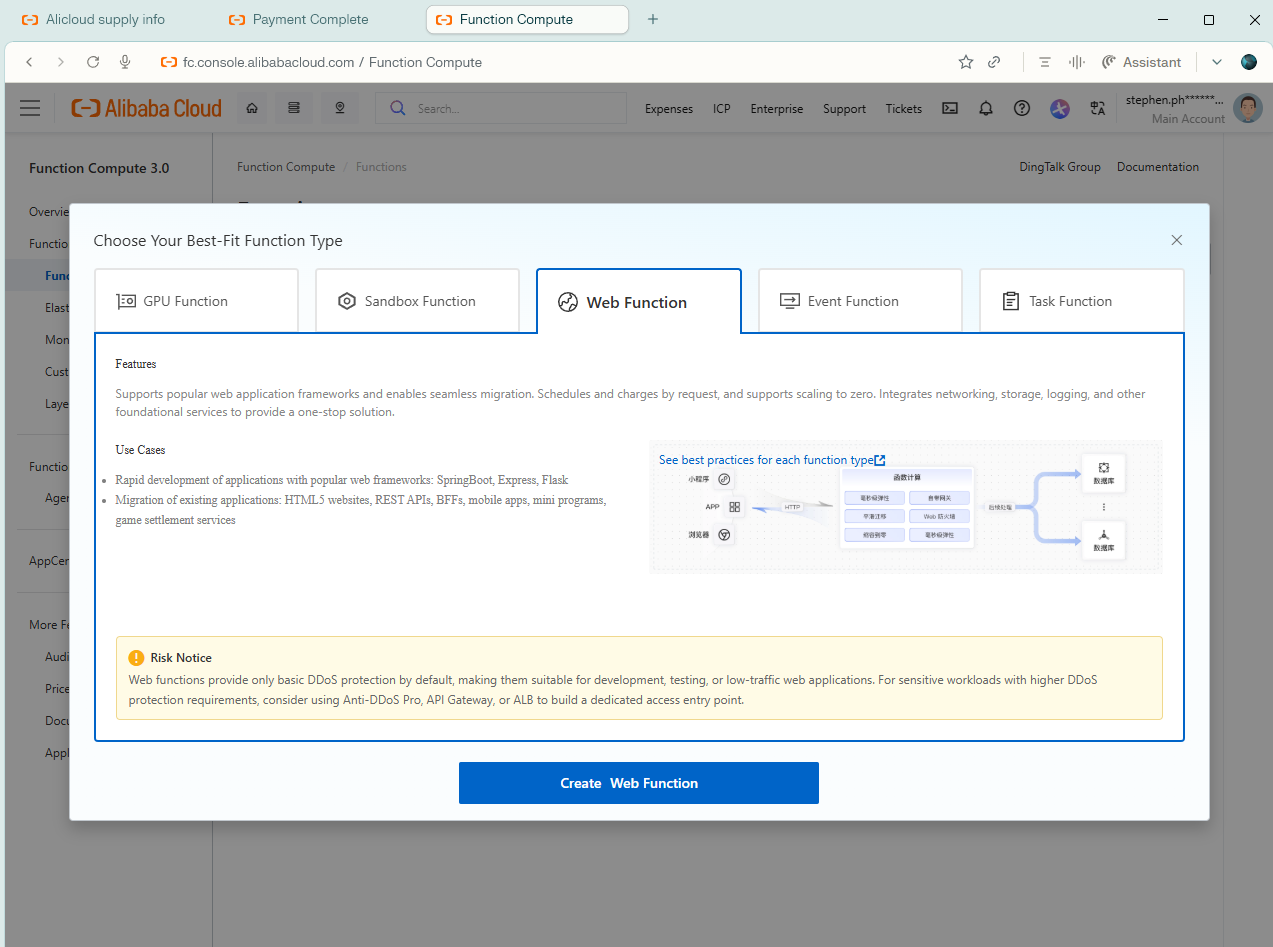
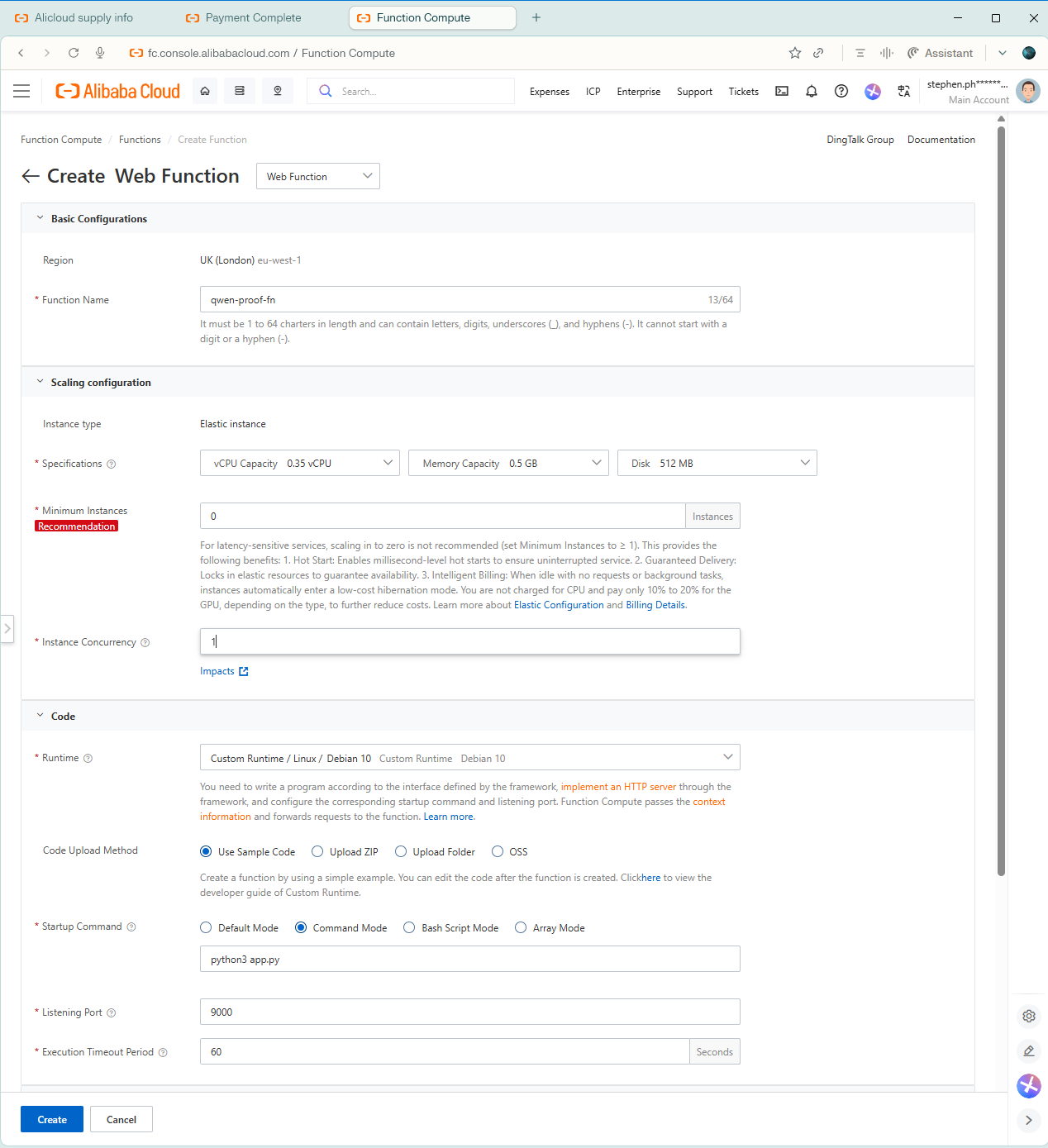
Function Compute web function config — custom runtime, qwen-proof-fn, UK London, min instances set to zero for cost control.
-
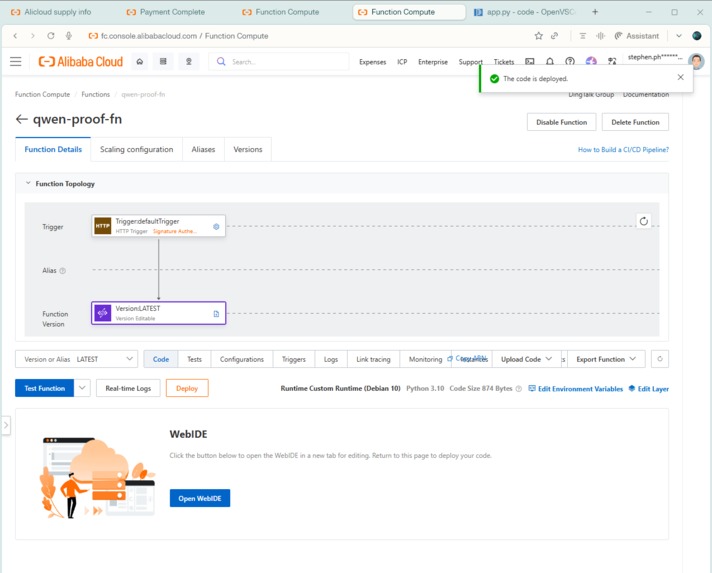
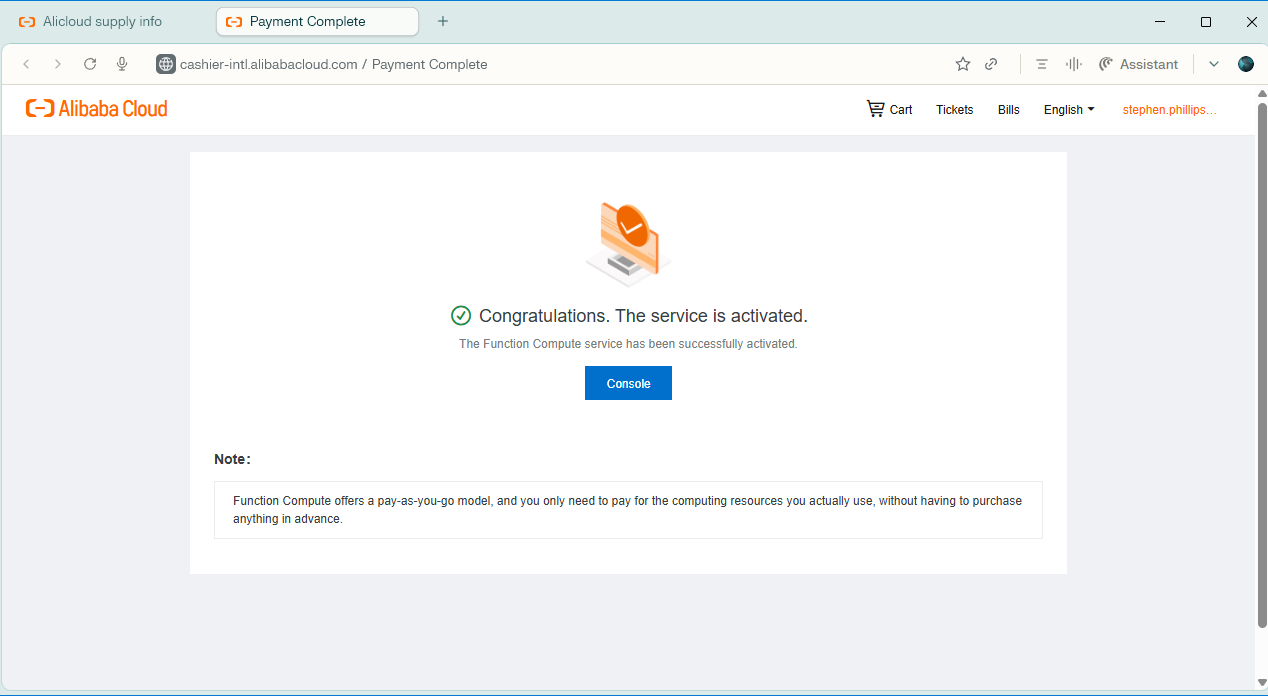
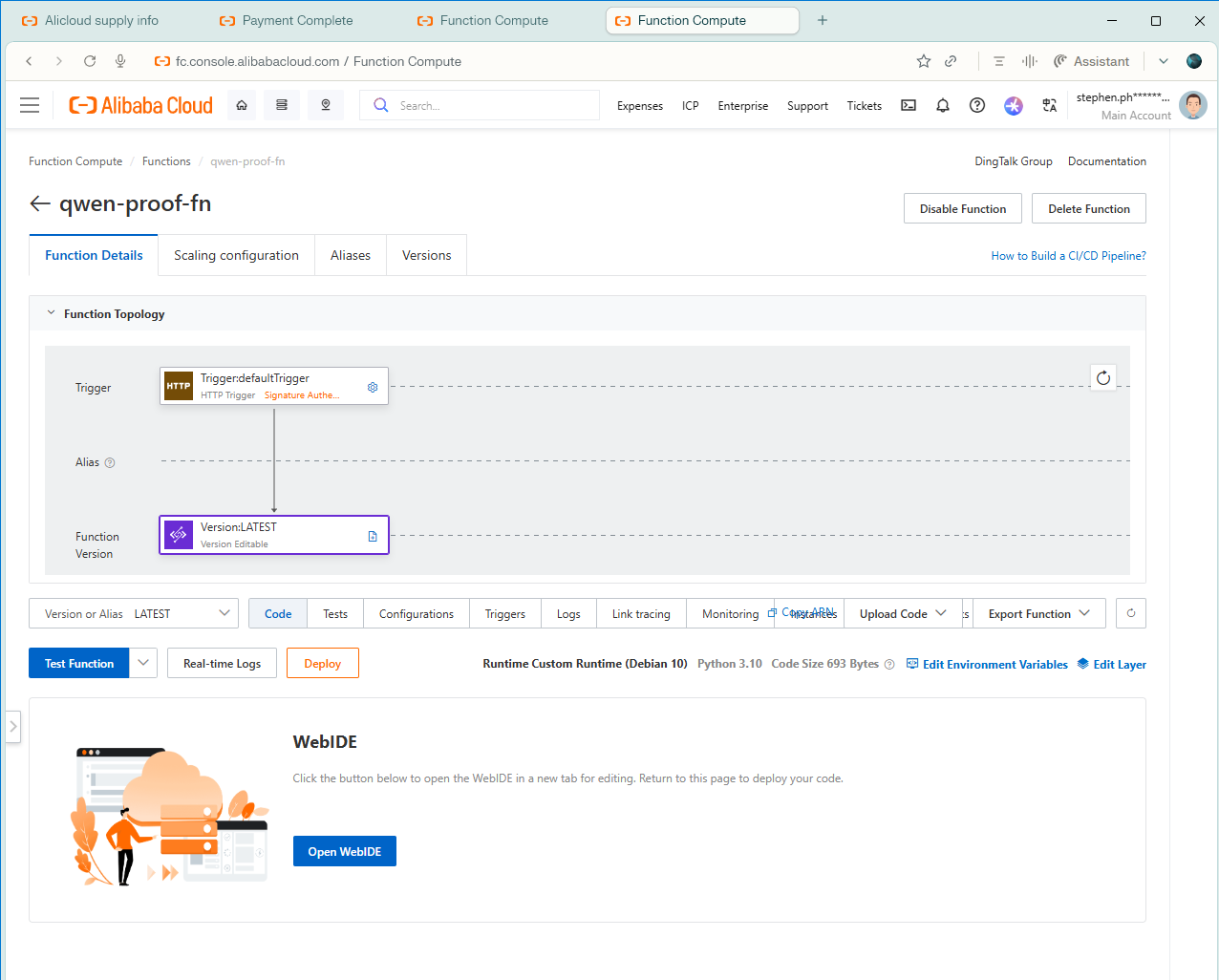
qwen-proof-fn created in Alibaba Cloud Function Compute with HTTP trigger active — the live serverless relay backend for repo.spot.
-
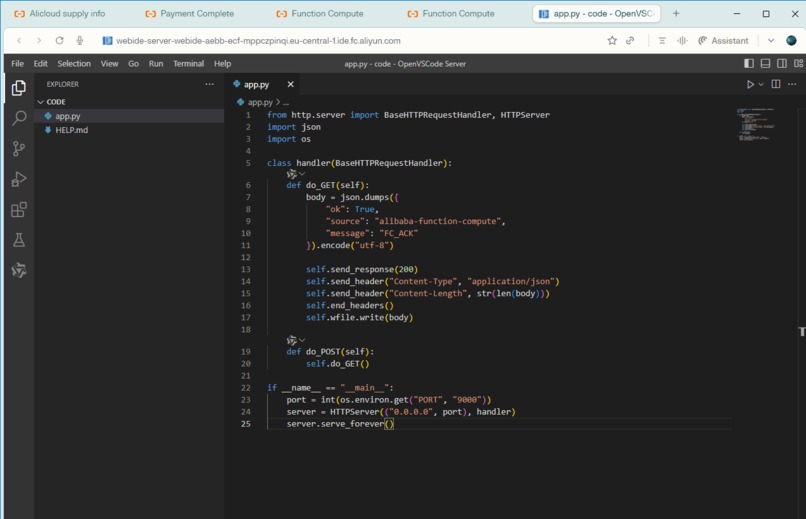
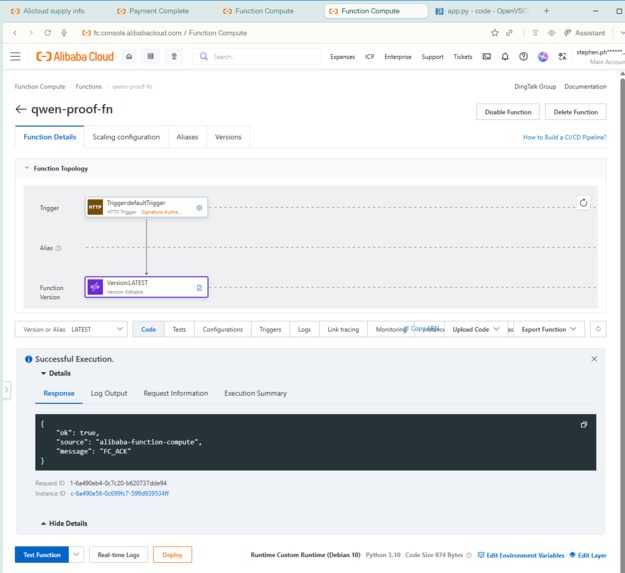
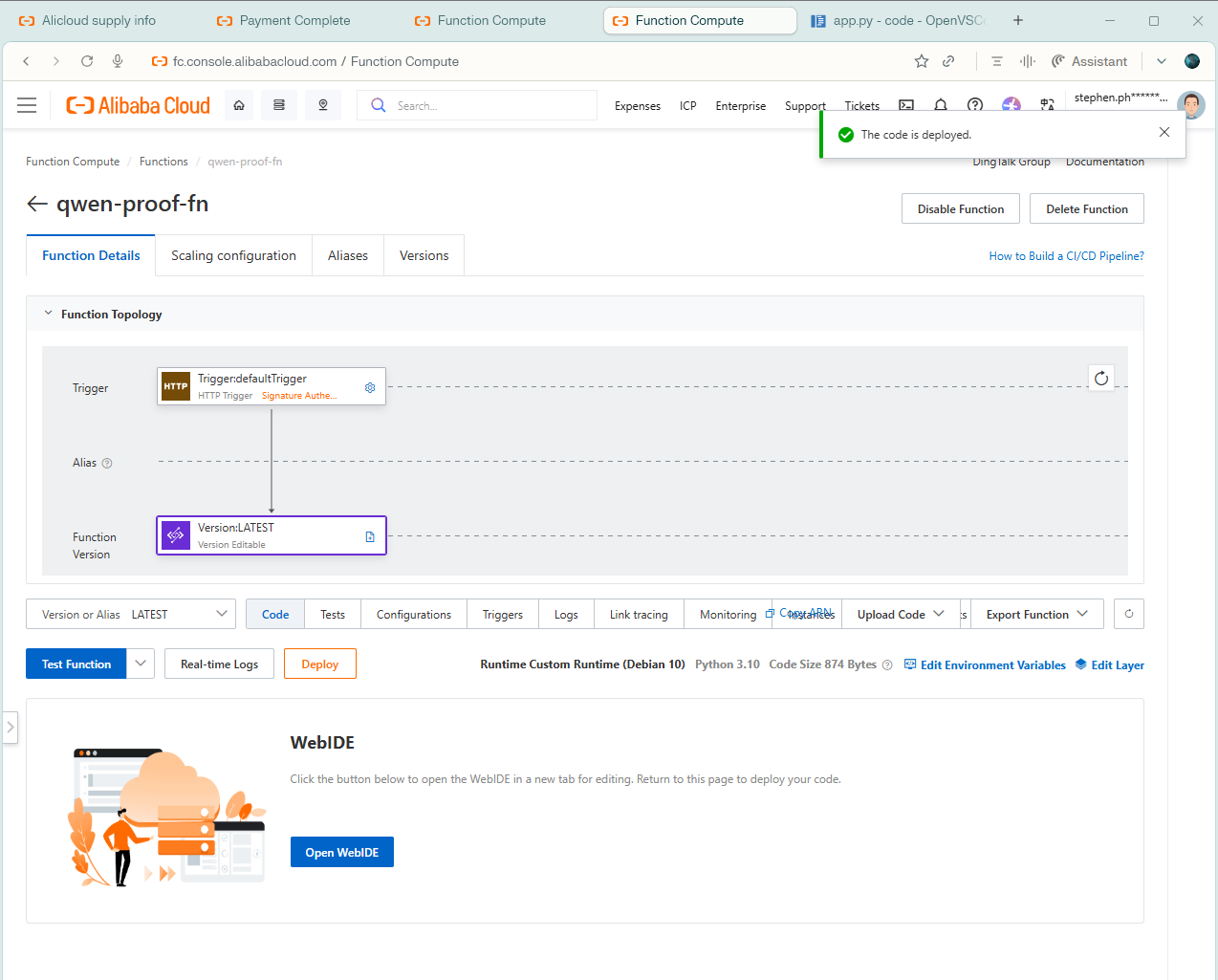
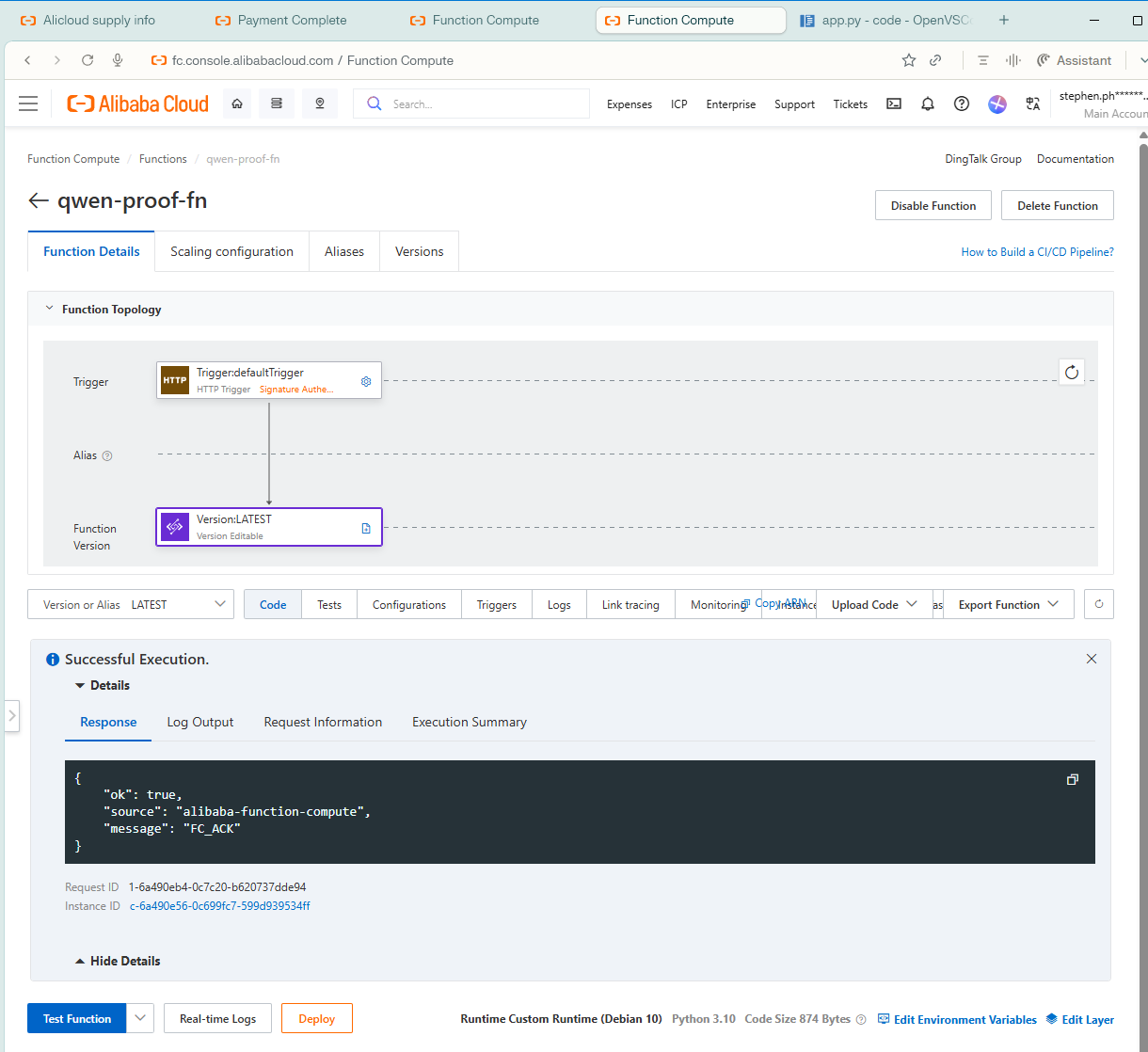
First successful FC console test — function executes and returns structured JSON, proving the Alibaba backend is live.
-
Final FC web function settings before deployment — custom runtime, 0.35 vCPU, 0.5 GB RAM, zero minimum instances.
-
repo.spot function overview after creation — HTTP trigger confirmed active, code editor and deploy controls ready.
-
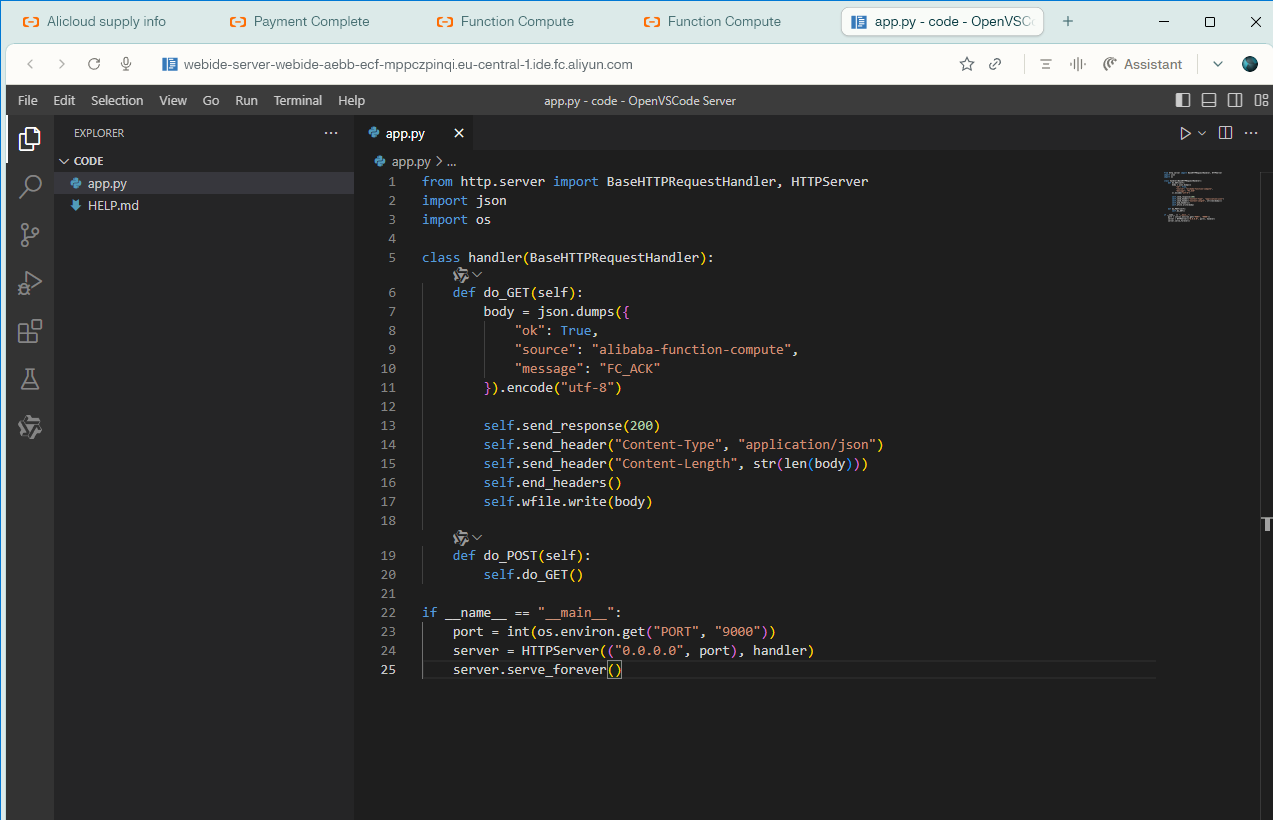
FC console test returning {"ok":true,"message":"FC_ACK"} — first proof of a working Alibaba Cloud backend deployment.
-
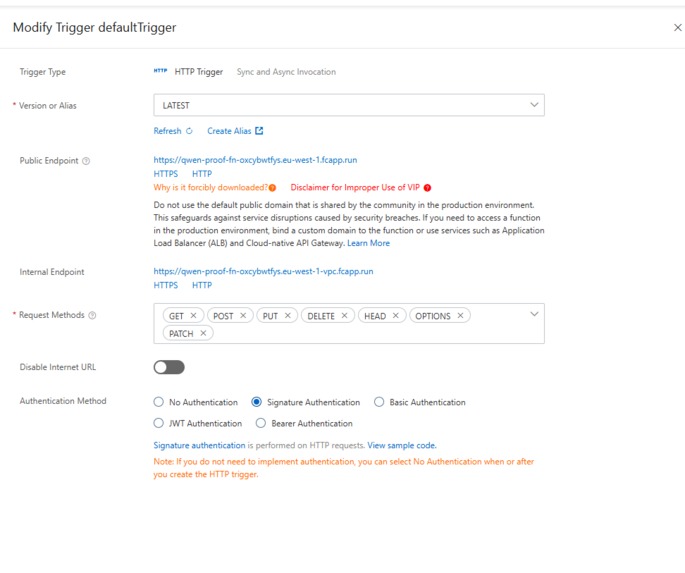
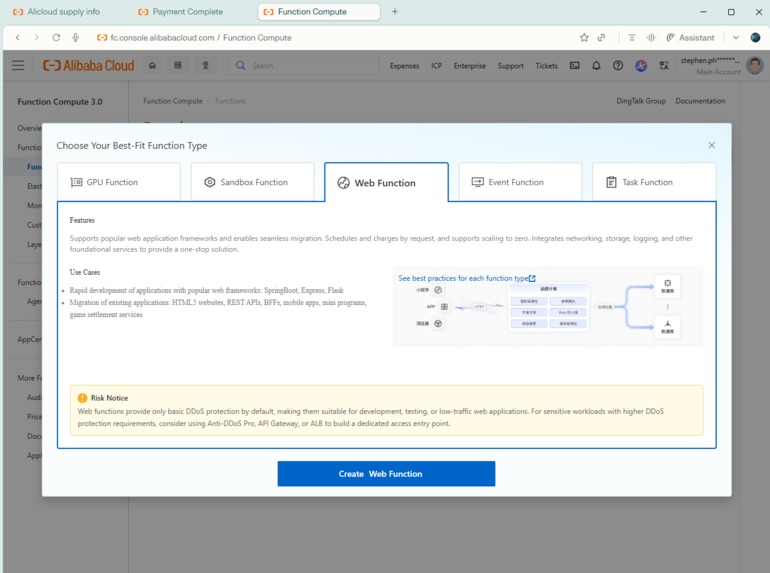
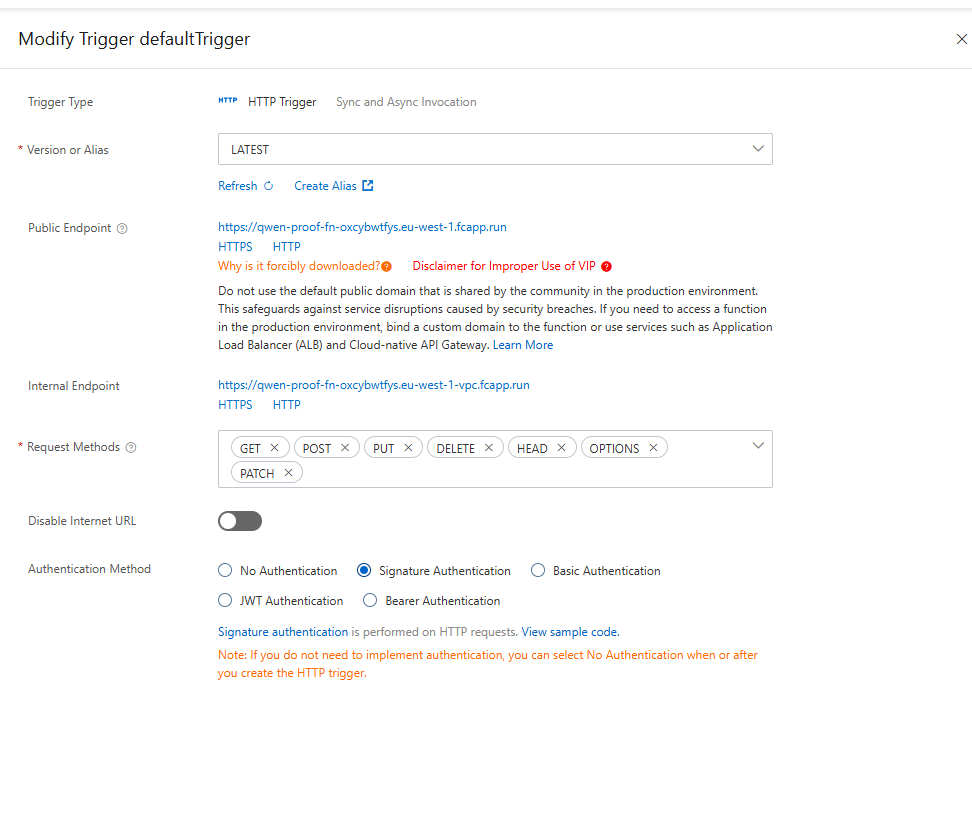
HTTP trigger auth settings — switching from Signature to No Authentication to enable direct browser access for public proof.
-
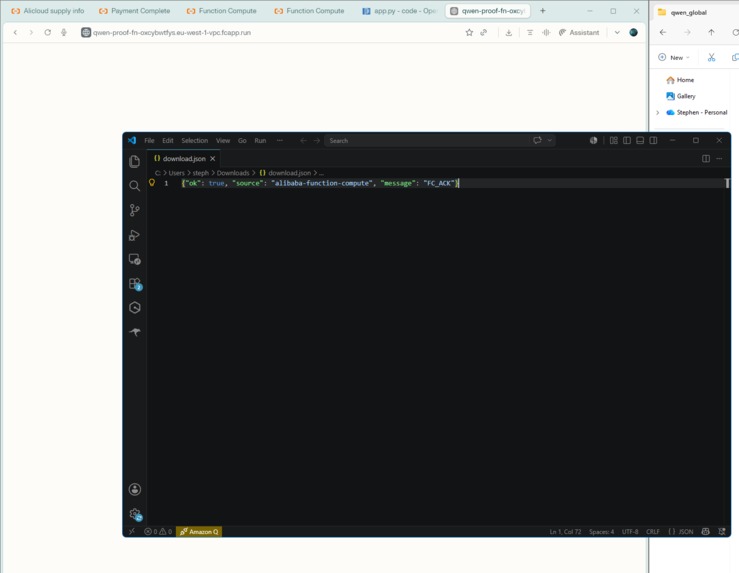
Qwen relay confirmed live — FC test returns {"ok":true,"source":"alibaba-function-compute","message":"FC_ACK"} from the cloud.
-
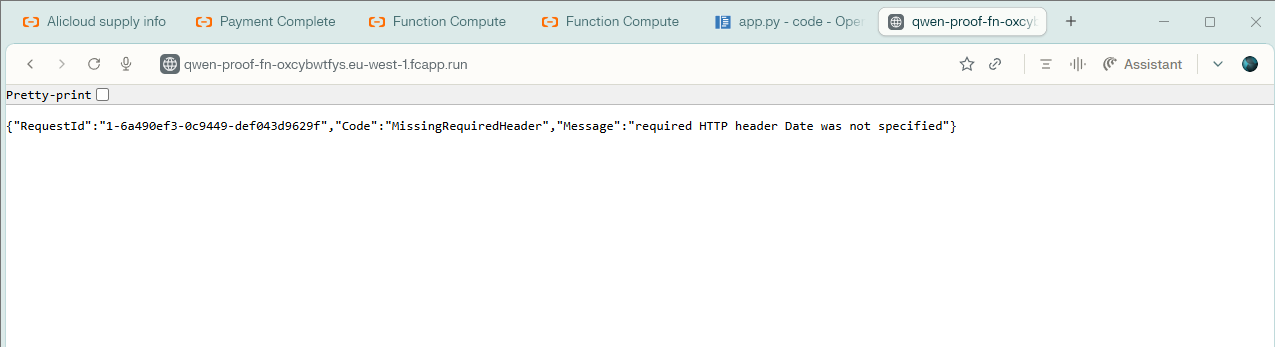
Trigger auth error on browser access — expected 401 before switching to No Authentication, confirming auth layer is working.
-
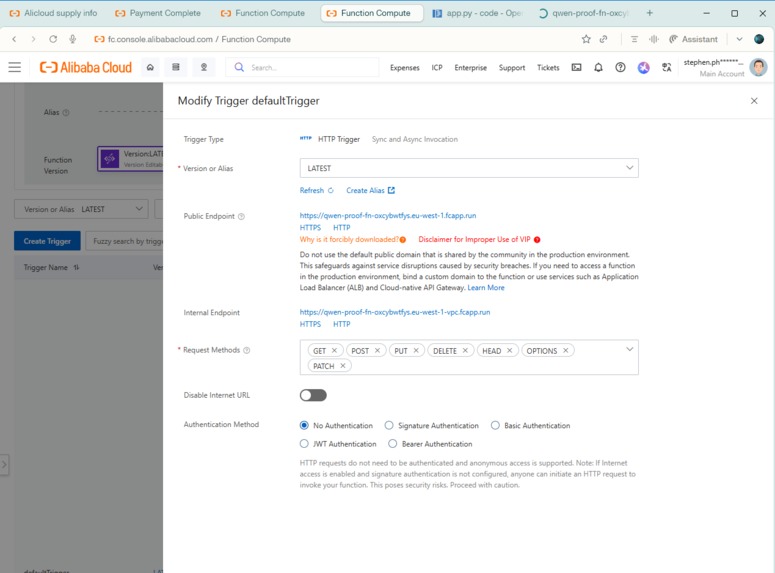
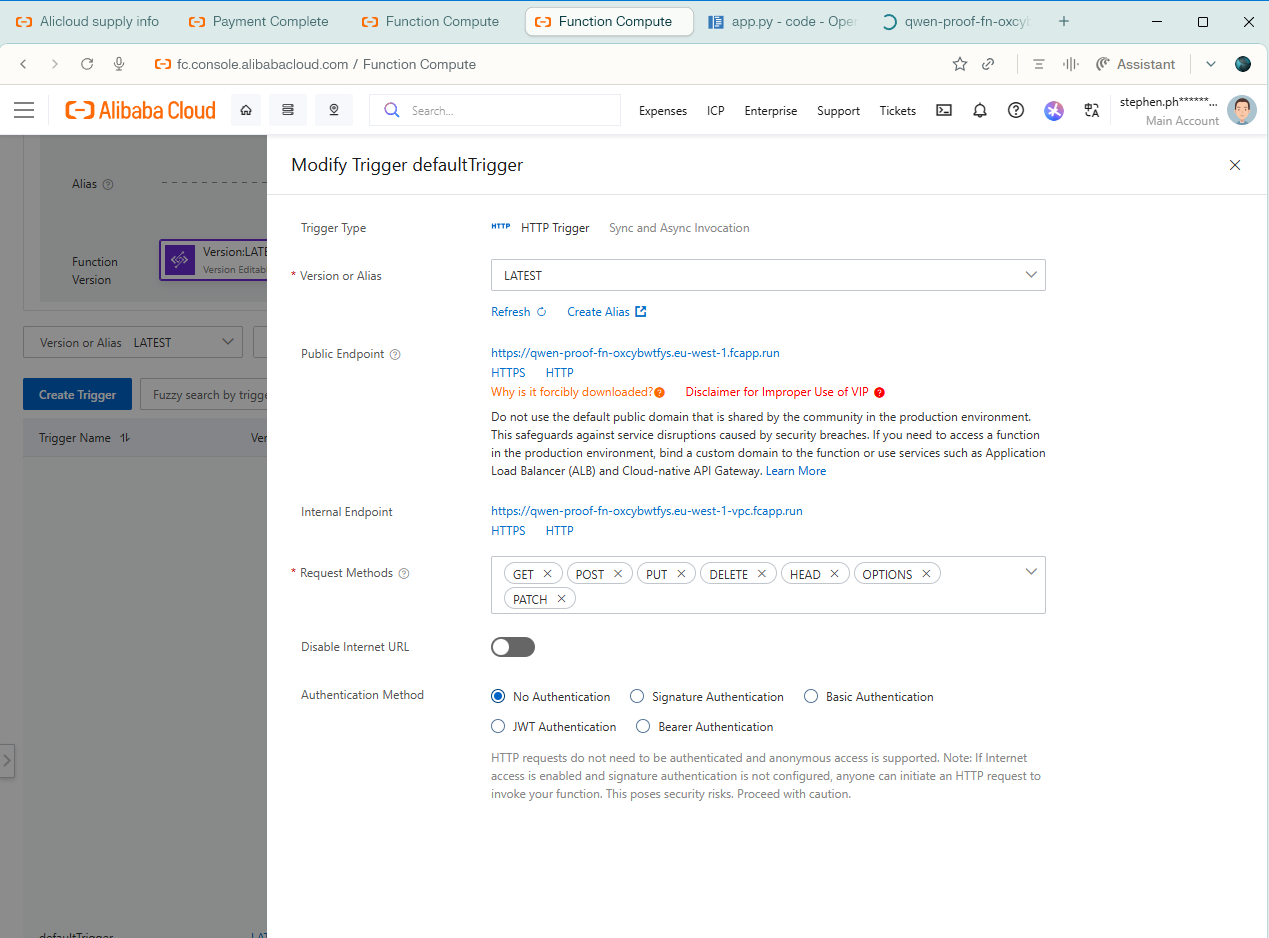
HTTP trigger set to No Authentication — allows direct browser access to verify the public FC endpoint returns JSON.
-
FC trigger set to Basic Authentication — endpoint protected before the GitHub repo went public for hackathon submission.
-
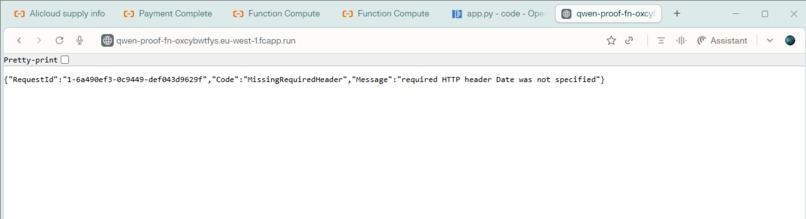
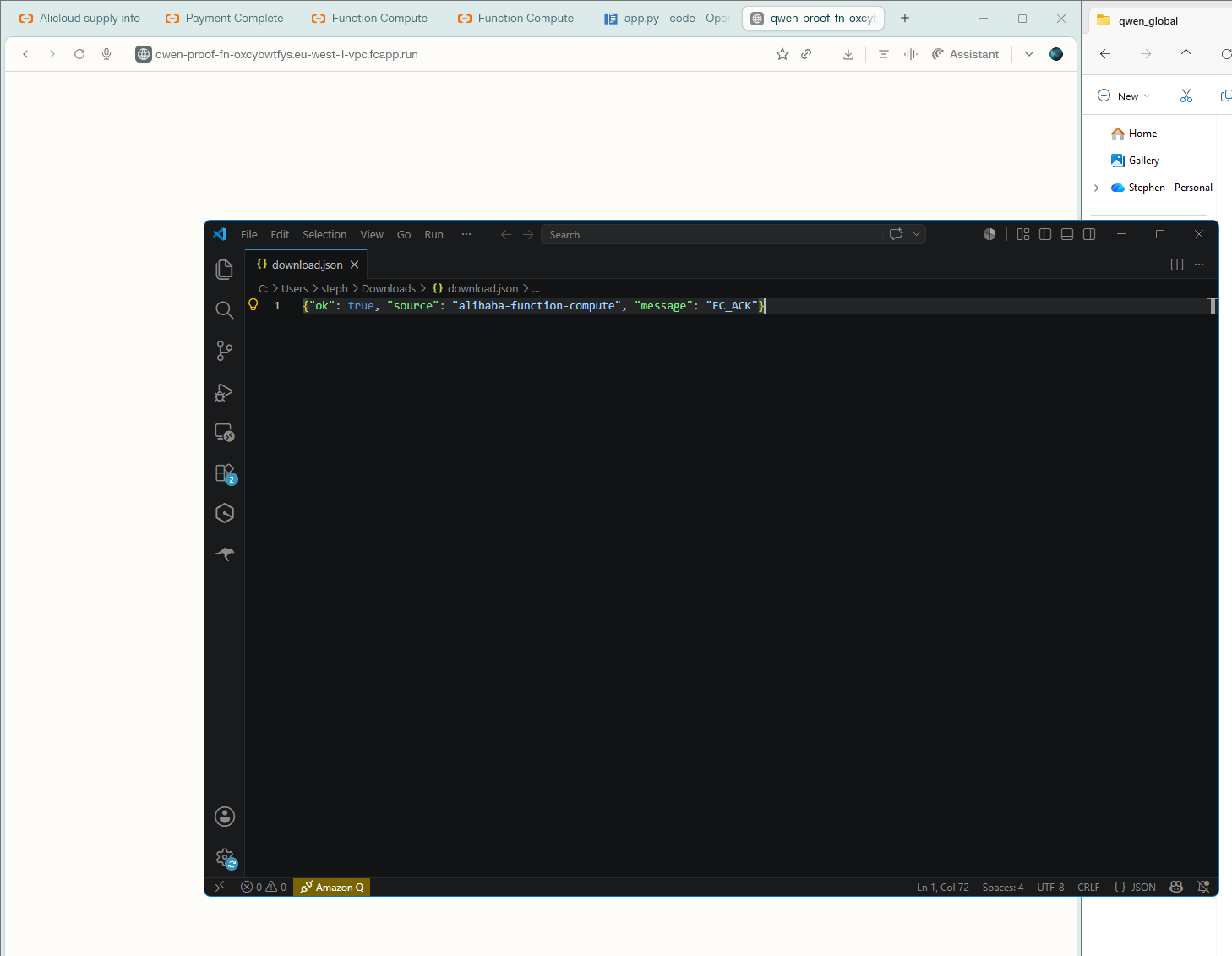
Browser hit on the live public FC endpoint downloading JSON — end-to-end proof the Alibaba Cloud backend is reachable and responding.
Inspiration
Security vulnerabilities in open-source repositories are found, triaged, and fixed by humans — a slow, expensive, and error-prone process. As a developer who maintains multiple open-source projects and actively tracks the AI/ML ecosystem, I wanted to explore whether a disciplined multi-agent system could replace that manual review loop with something faster, more consistent, and fully auditable.
The Agent Society track's emphasis on measurable gains over a single agent made this the perfect frame: not one "smart" model, but a structured team of three agents with distinct roles, hard stopping rules, and verifiable outputs.
What it does
repo.spot is an autonomous DevSecOps squad powered by Qwen Cloud. Given a repository URL or a set of files, it spins up a constrained 3-agent review pipeline:
- Auditor — scans the codebase, identifies vulnerabilities, and ranks each finding by a calculated risk score (
severity × exploitability × exposure). Only findings above a confidence threshold of 0.65 proceed. - Architect — receives the Auditor's ranked findings and proposes the minimal safe patch for each, outputting a structured diff with reasoning and assumptions listed explicitly.
- QA — reviews the proposed patch against the original finding. It either
APPROVEs, requests aREVISEwith one concrete blocking reason, orESCALATEs to human review.
The loop runs for a maximum of 2 rounds per file. If QA is not satisfied after round 2, the finding is escalated rather than left in an unresolved state. Every agent response is validated against a strict JSON schema before the workflow continues — invalid responses trigger one automatic repair prompt, then escalate on second failure.
The entire agent dialogue is streamed to a live frontend so judges and users can watch the swarm reason in real time.
How I built it
The orchestrator is written in TypeScript and communicates with all three agents via Qwen Cloud's Model Studio API. Each agent is a stateless function: it receives a typed JSON envelope, returns a typed JSON response, and never holds conversational state between rounds.
Key architectural decisions:
- Model-agnostic config — agents are selected via environment variables (
MODEL_AUDITOR,MODEL_ARCHITECT,MODEL_QA) so the best available Qwen endpoint can be swapped without touching orchestration logic. - Hard termination rules —
MAX_ROUNDS=2andRISK_THRESHOLD=0.65are enforced at the orchestrator level, not inside agent prompts, preventing any agent from extending the loop. - Schema-first design — every inter-agent message conforms to a shared Zod schema (
agentSchemas.ts), making the system trivially testable and the demo replay-safe. - Streaming UI — the orchestrator pipes agent log events to a lightweight frontend via server-sent events, giving a real-time view of triage → patch → challenge → approve/escalate.
Hosted and inferred entirely on Qwen Cloud (Alibaba Cloud), using the hackathon credits for compute and API access.
Challenges I ran into
The hardest problem was preventing the agents from entering "philosophical negotiation" — open-ended back-and-forth that looks impressive in a demo but fails under deadline pressure and produces no deterministic output. The fix was architectural: move all termination logic into the orchestrator, not the agent prompts, so no single agent can extend its own life.
A second challenge was schema reliability. Early iterations saw agents occasionally producing malformed JSON when patch diffs were large. The one-retry-then-escalate pattern solved this without sacrificing demo stability.
Accomplishments that I'm proud of
- A fully working 3-agent loop that produces structured, human-reviewable patch candidates with zero hallucinated file paths in testing.
- A real-time streaming UI that makes agent reasoning visible and verifiable — not a black box.
- A clean separation between orchestration logic and agent prompts, making the system easy to extend with a fourth agent (e.g. a Risk Prioritiser) without rewriting the core loop.
What I learned
Bounded agents outperform free agents in production demos. Giving each agent a single, narrow job and a hard exit condition produces more reliable and more impressive results than giving agents broad autonomy and hoping they converge.
Qwen Cloud's Model Studio API is genuinely fast at multi-turn structured completions, and the latency per round is low enough that the streaming UI feels responsive rather than sluggish.
What's next for repo.spot
- A fourth agent: Risk Prioritiser — sits before the Auditor and filters incoming findings by business impact, so the squad focuses on what matters most first.
- GitHub Actions integration — trigger the squad automatically on every PR, post findings as review comments, and block merge on unresolved escalations.
- Federation layer (A2M) — integrate with A2M (a local-first packaging and auditing layer for AI agents) so repo.spot's agent manifests can be shared, versioned, and verified across teams.
Built With
- cloudalibaba
- docker
- fastapi
- github
- node.js
- qwen
- react
- typescript
- zod


Log in or sign up for Devpost to join the conversation.