-
-
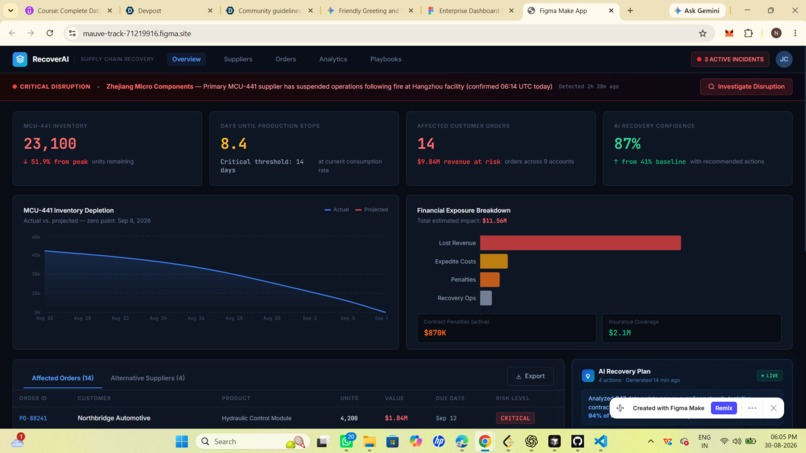
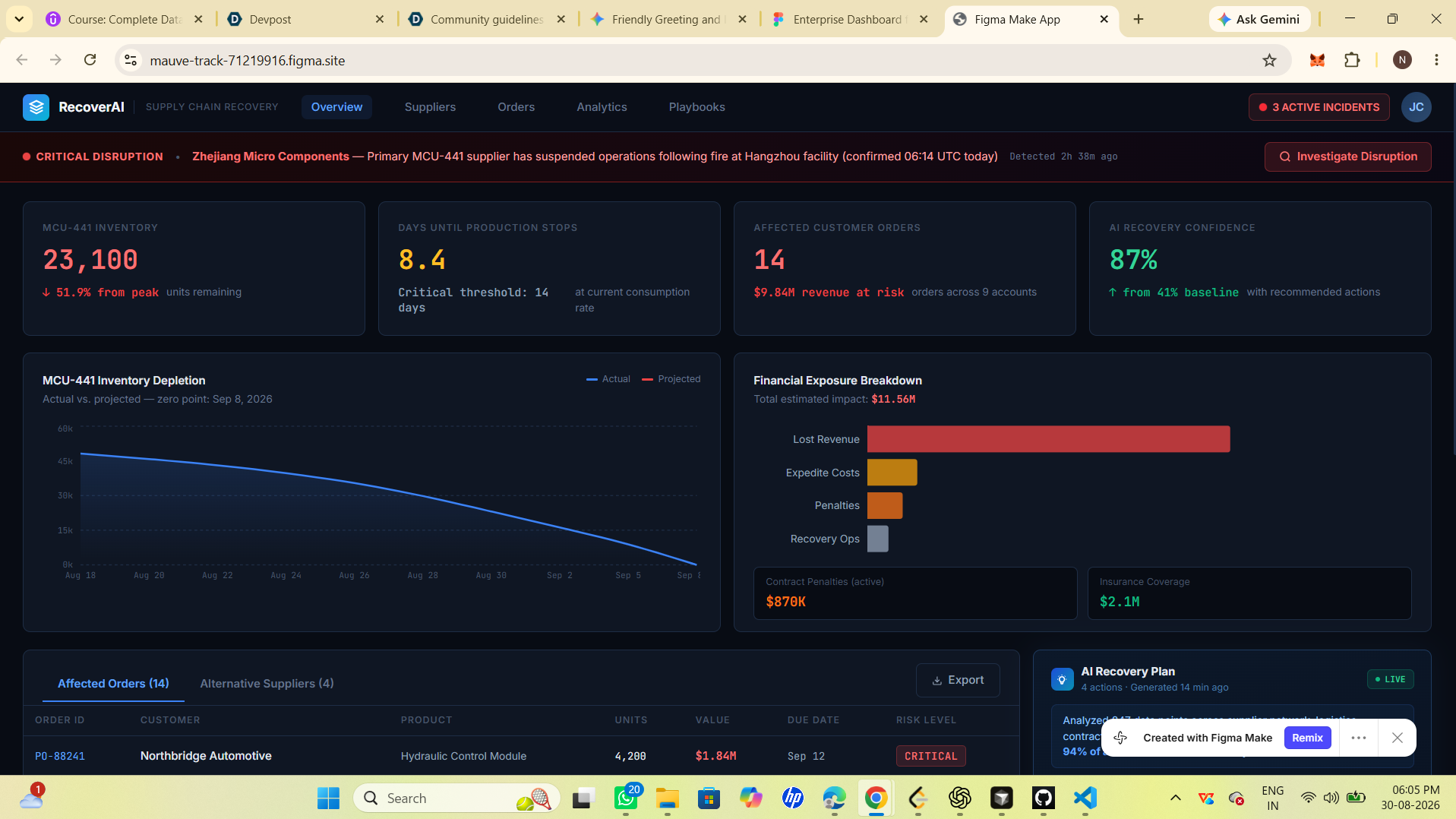
RecoverAI Supply Chain Dashboard — Real-time disruption monitoring, inventory risk, affected orders, financial exposure.
A supplier failure rarely affects just one part of a business. When a critical supplier suddenly stops operating, a company must quickly answer several interconnected questions: How much inventory is left? When will production stop? Which customer orders are at risk? Which customers have contractual or SLA priorities? Which alternative suppliers can actually meet the required quality, quantity, price, and delivery timeline?
We were inspired by the idea that companies often have this information spread across different systems, while supply-chain teams have very little time to make a decision.
We wanted to build an AI agent that doesn't simply alert a company about a supplier failure, but helps determine what the company should do next.
What we built
RecoverAI — Autonomous Supply Chain Recovery Agent is an AI-powered enterprise recovery system designed to respond to sudden supplier disruptions.
When a critical supplier fails, RecoverAI analyzes the disruption and builds a recovery strategy by considering:
- Current inventory and consumption rate
- Estimated time until production stops
- Affected products and customer orders
- Customer priority and contractual obligations
- Alternative supplier availability
- Supplier capacity and lead time
- Quality requirements
- Procurement and expedite costs
- Revenue at risk and potential penalties
Instead of presenting dozens of disconnected data points, RecoverAI turns them into a prioritized recovery plan that a human decision-maker can review and approve.
Our prototype demonstrates this through an enterprise dashboard containing disruption monitoring, inventory depletion forecasting, affected orders, financial exposure, alternative suppliers, and an AI Recovery Plan.
How we built it
For the initial hackathon prototype, we focused on demonstrating the complete decision-making workflow rather than building every enterprise integration.
We created an interactive enterprise dashboard using Figma Make, with a React-style application structure and simulated supply-chain data.
The prototype follows this workflow:
Supplier Disruption → Impact Analysis → Alternative Suppliers → Recovery Strategies → Human Approval
The dashboard presents the information an operations or supply-chain manager would need to make a recovery decision quickly.
What we learned
The biggest lesson was that supply-chain recovery is not simply a "find another supplier" problem.
Choosing an alternative supplier requires balancing multiple competing factors. A supplier with the lowest price may have a delivery time that is too long. A supplier that can deliver quickly may not have enough capacity or may fail quality requirements.
We therefore designed RecoverAI around total business impact, rather than optimizing for only one factor such as price or delivery time.
We also learned how important human oversight is for enterprise AI. RecoverAI is designed to recommend and prioritize actions while keeping the final approval with the responsible business decision-maker.
Challenges we faced
One of our biggest challenges was modeling the chain reaction caused by a supplier disruption.
A single supplier failure can affect inventory, production, customer orders, revenue, contractual penalties, and procurement costs simultaneously. We had to think about how these relationships could be represented in a way that is understandable to an operations team.
Another challenge was designing the prototype within a limited time while still making the concept easy to understand. We focused on a realistic enterprise dashboard and a clear end-to-end recovery workflow instead of trying to build unnecessary features.
What's next
Our prototype is the foundation for a more complete AI-native supply-chain recovery system.
In a production environment, RecoverAI could connect to ERP, procurement, inventory, CRM, logistics, and supplier systems to continuously monitor disruptions and generate recovery strategies in real time.
The long-term vision is simple:
When a supplier fails, RecoverAI doesn't just tell you that something went wrong. It helps you determine the best way forward.
Built With
- figma-make
- react
- typescript
