Inspiration:
As a UX designer/Web3 Developer, my ultimate goal is always to eliminate friction and craft intuitive experiences. When looking at how we currently use AI, I noticed a major disruption to our workflow: the constant need to break focus. Whenever we need AI assistance, we are forced to open new tabs, copy and paste information, and wait for responses before switching back to our actual work.
I realized that the cognitive cost of this constant context-switching is massive. To create a truly magical, uninterrupted experience, the time spent moving between tools needed to be reduced to zero. That realization sparked the idea for Repgent, an "ambient intelligence" that exists seamlessly within your current workspace, serving as a frictionless, always-there assistant.
What it does:
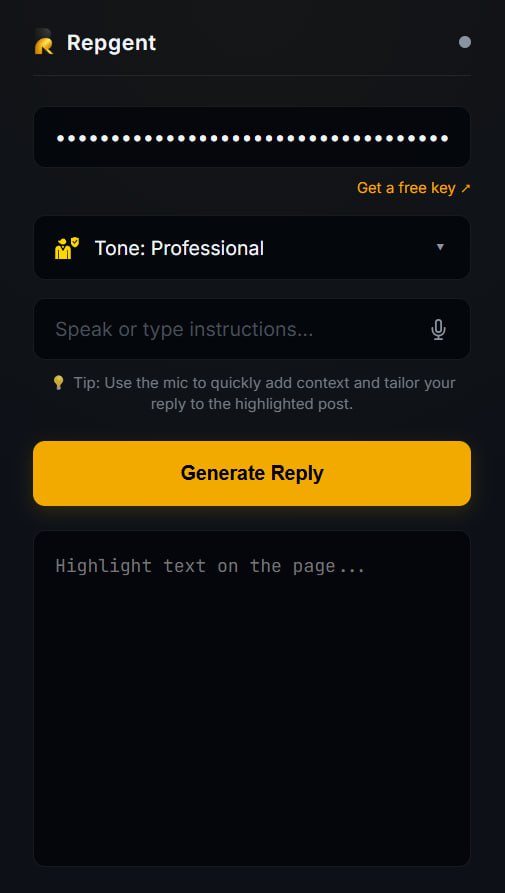
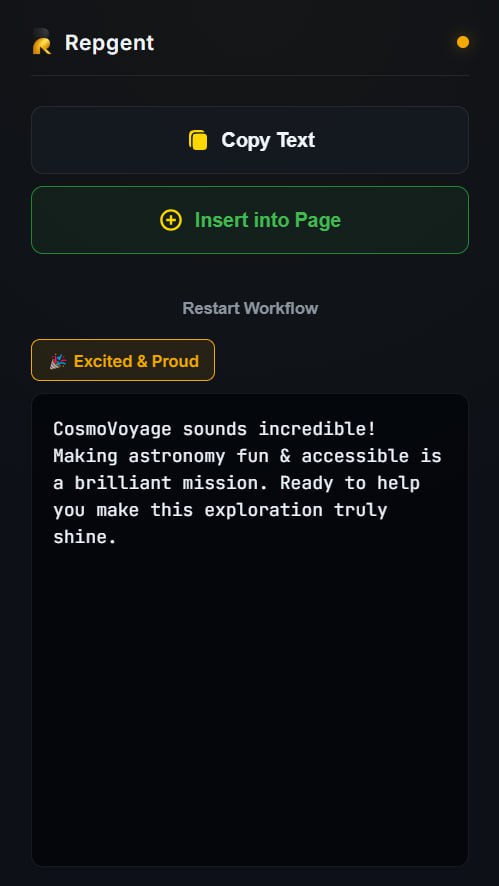
Repgent is an AI-powered Chrome extension built to weave intelligent help directly into your everyday tasks. Rather than relying on a bulky sidebar or forcing you to visit a separate website, Repgent introduces a sleek, interactive floating orb that lives directly on your active web page.
Driven by the Gemini API, it literally "sees" your current context. This allows you to instantly research, summarize, draft, or analyze information and directly insert the AI's output into your workspace without ever navigating away from what you are doing.
How we built it:
We engineered Repgent to bridge the gap between polished UI design and the often unpredictable nature of web browsers. The foundation of the extension is built on Manifest V3 architecture. We utilized background service workers that communicate seamlessly with content scripts, allowing the extension to securely pass the context of the webpage to the Gemini model. By focusing heavily on micro-interactions, we ensured the user interface remains unobtrusive and responsive while handling complex, asynchronous communication behind the scenes.
Challenges we ran into:
Developing a stable extension that manipulates web pages and manages real-time AI generation came with some serious technical hurdles:
Managing Volatile States: In early versions, if a user clicked away and the extension popup closed, the generated AI response vanished completely. We had to completely overhaul our state management to keep data persistent.
Tricky Page Insertions: Our "Insert into Page" feature struggled on modern, React-heavy platforms like Contra. Getting text to reliably insert directly into these complex workspaces required engineering highly specific targeting logic.
Strict Browser Permissions: We wanted to build a JARVIS-style voice interface, but the browser strictly blocked microphone access from within the extension's environment. We had to engineer secure workarounds just to get voice recognition off the ground.
API Limits and Context Drops: During heavy testing, we frequently hit the Gemini Free Tier limit of 20 requests, which initially caused the assistant to crash. Additionally, routine extension updates would sometimes break our content scripts, causing the agent to suddenly stop "seeing" highlighted text, which required constant debugging.
Accomplishments that we're proud of:
We are incredibly proud of successfully translating a deeply user-centric UX philosophy into a complex, highly technical AI tool. We took a complicated API integration and turned it into an invisible, frictionless experience for the user.
Designing the floating orb to feel like a natural part of the browsing experience rather than an annoying popup was a huge win. We also managed to build graceful error handling, ensuring that API rate limits are communicated clearly to the user instead of just failing silently.
What we learned:
We discovered that building a flawless AI tool requires much more than creating some line of codes. It demands a deep understanding of asynchronous operations, navigating strict browser security protocols, and an obsession with the tiny details that keep users in their flow state.
The process also gave us profound, hands-on experience with Manifest V3 architecture and the complexities of manipulating code across different websites.
What's next for Repgent:
Our immediate goal is to expand the team by bringing on a dedicated technical co-founder to help scale the backend and optimize the code.
On the product side, we want to perfect the JARVIS voice feature, expand our contextual awareness to handle complex applications like Google Workspace, and upgrade our Gemini tier to smoothly support a growing base of users.
Built With
- chrome-extension-api
- chrome-extensions-platform
- css
- gemini-api
- html
- javascript
- manifestv3
- web-dom-api
- webspeechapi


Log in or sign up for Devpost to join the conversation.