-
-
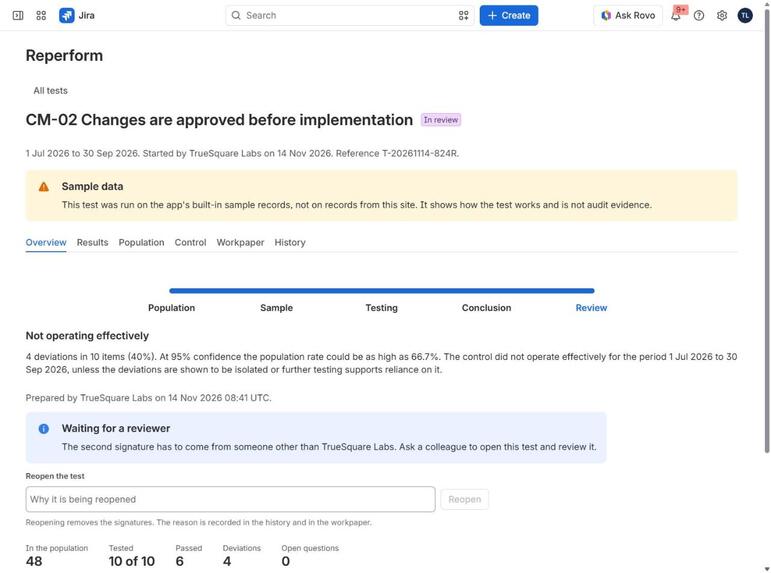
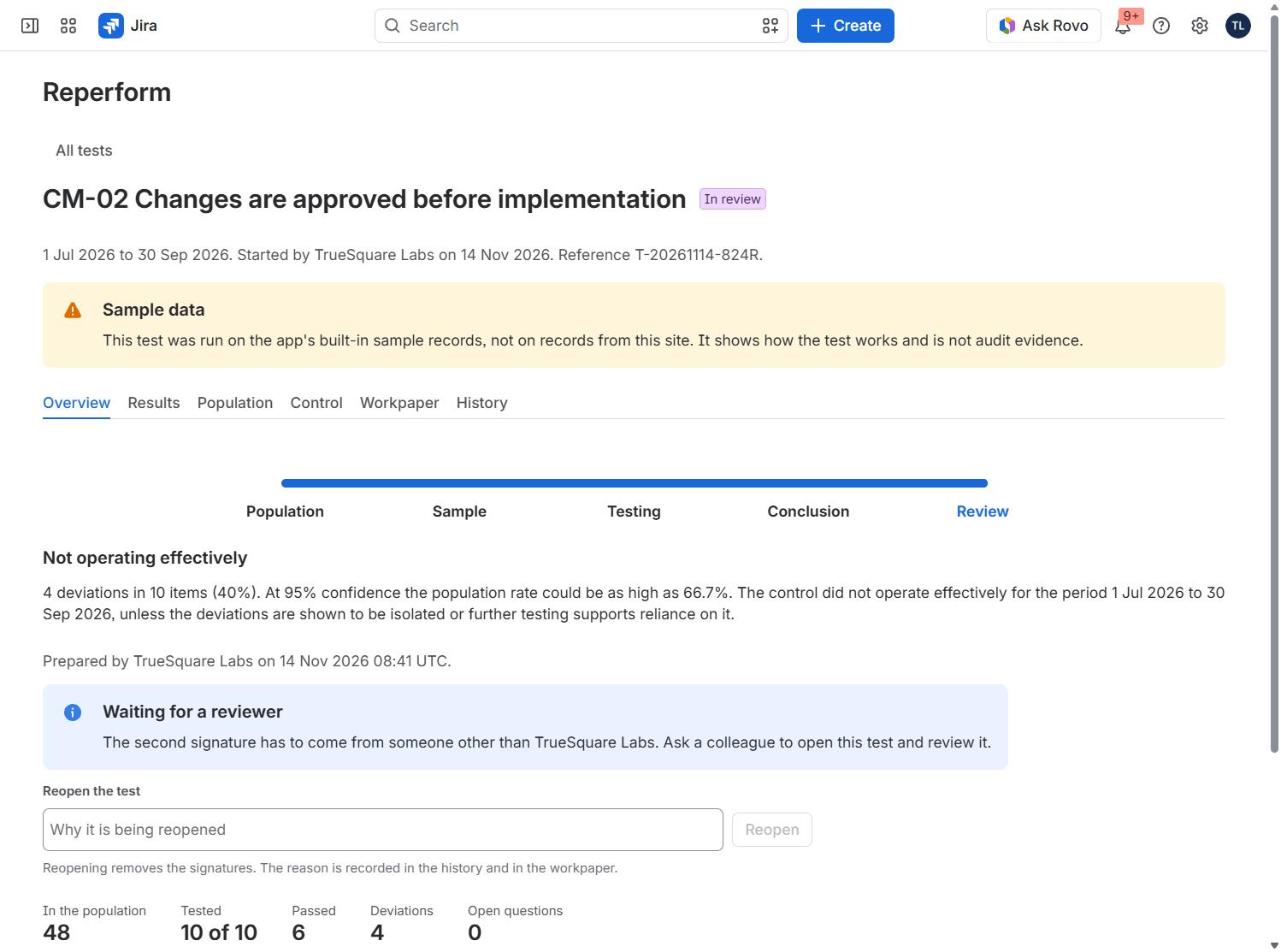
A finished test: 48 records in the population, 10 drawn from a seed, 4 deviations, and a second signature still to come.
-
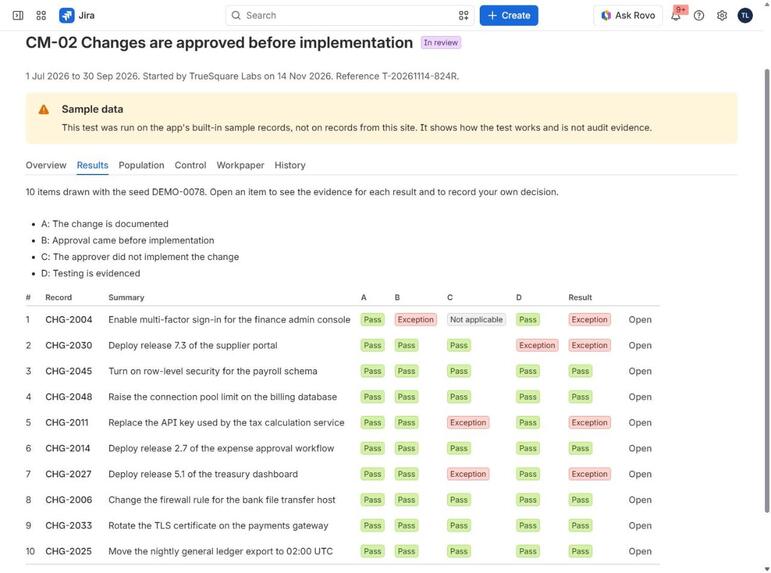
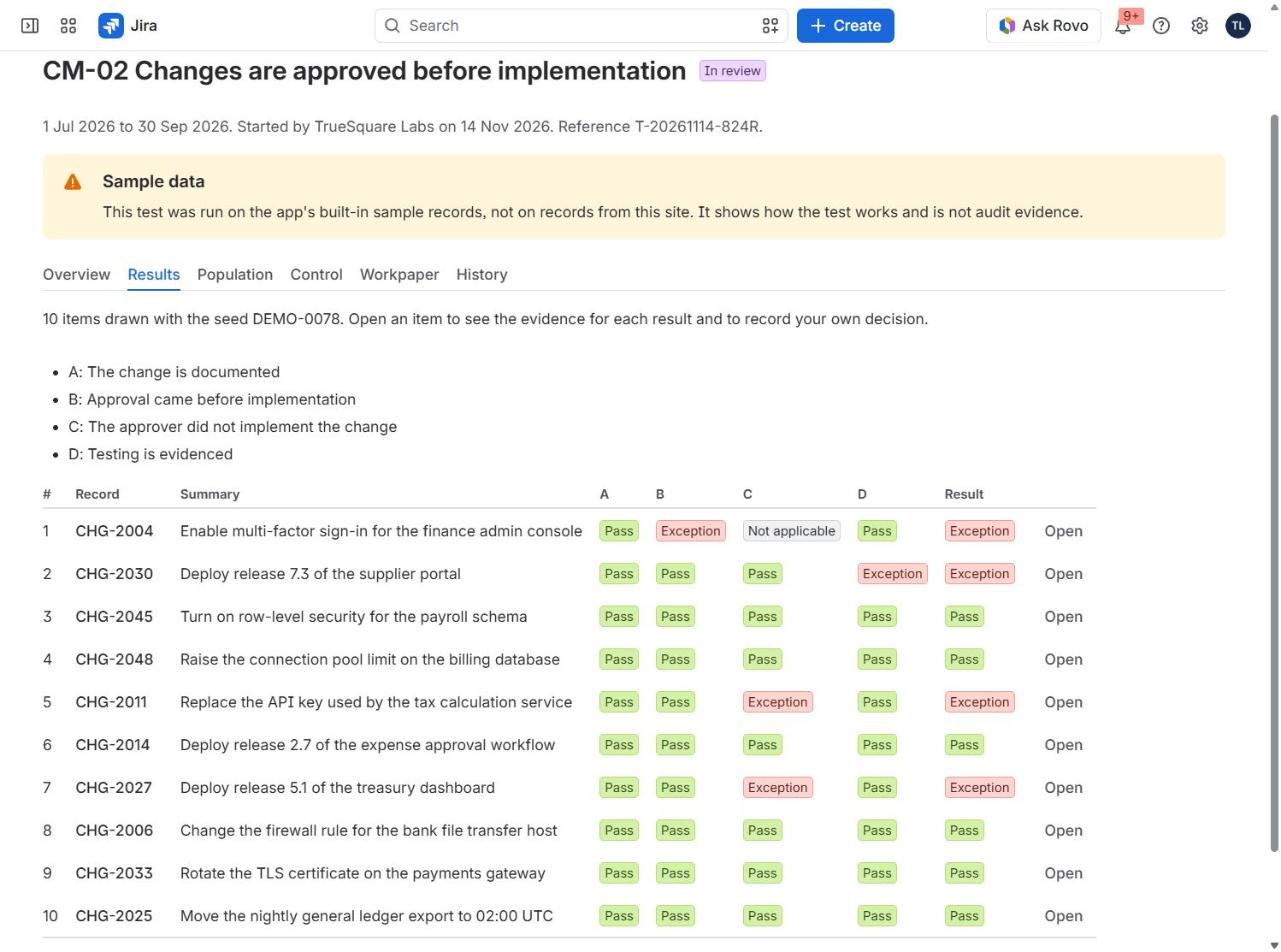
Every sampled record against every attribute of the control. Each result opens onto the evidence it rests on.
-
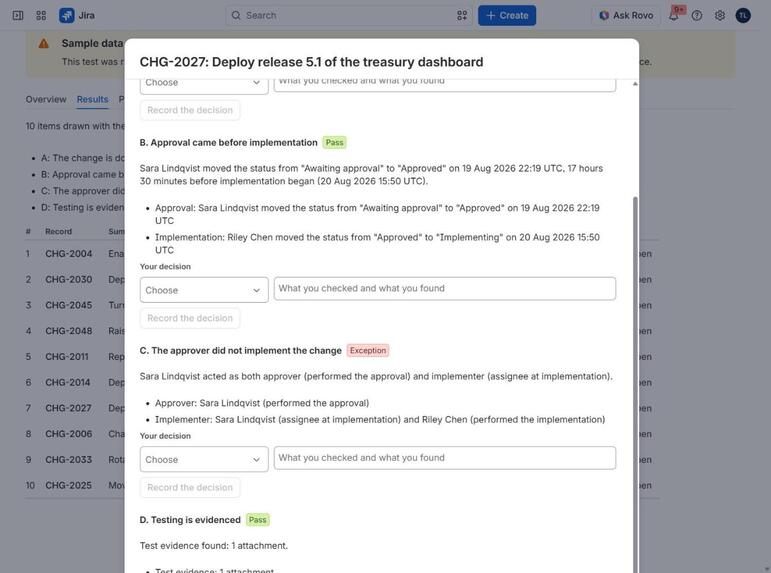
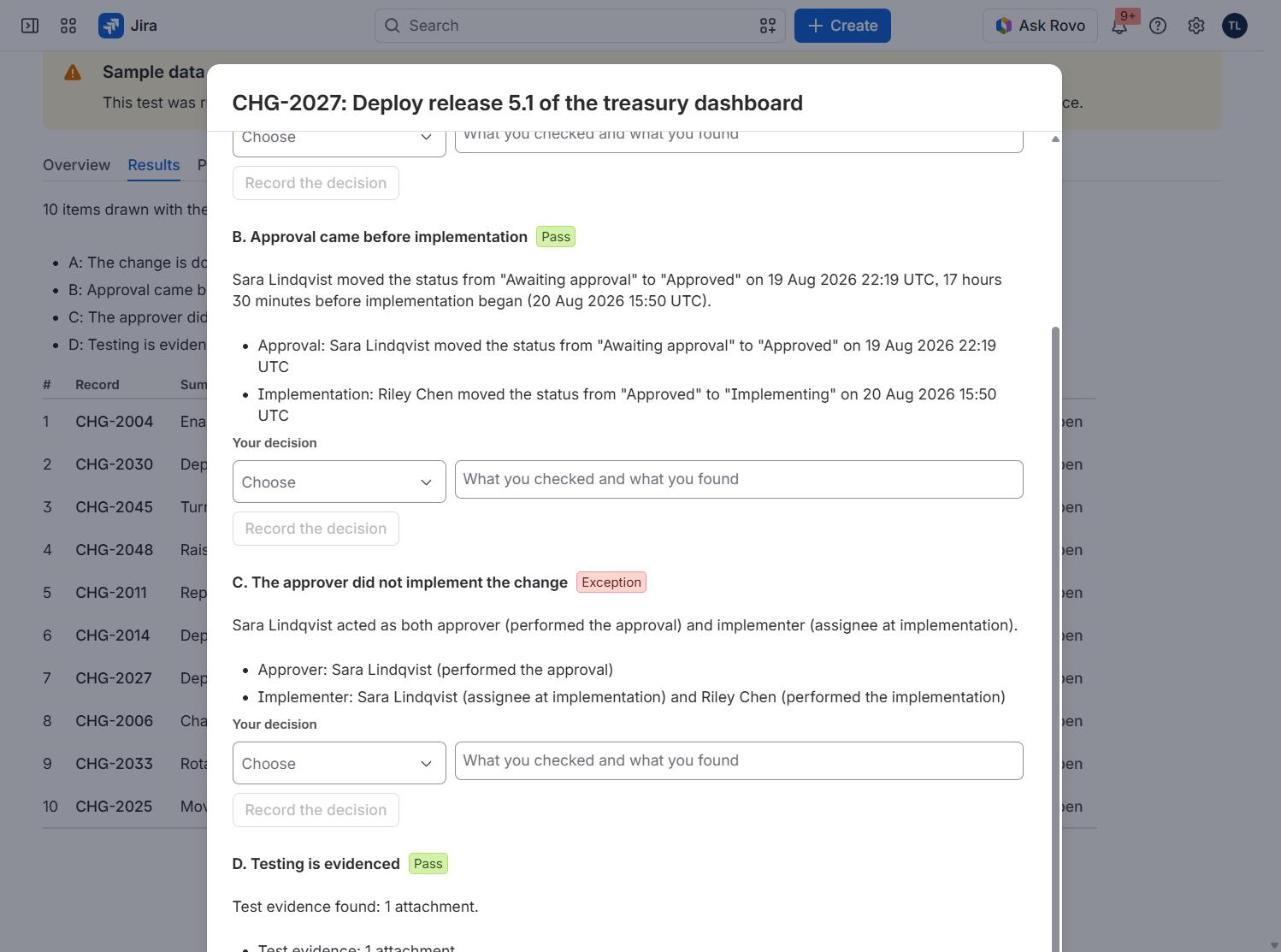
The evidence under a result: who approved, who implemented, and when. Here one person did both, so attribute C is an exception.
-
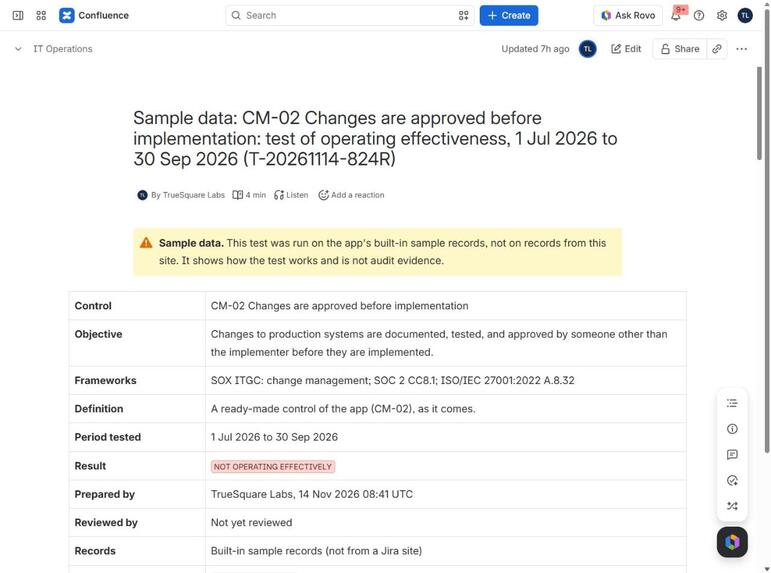
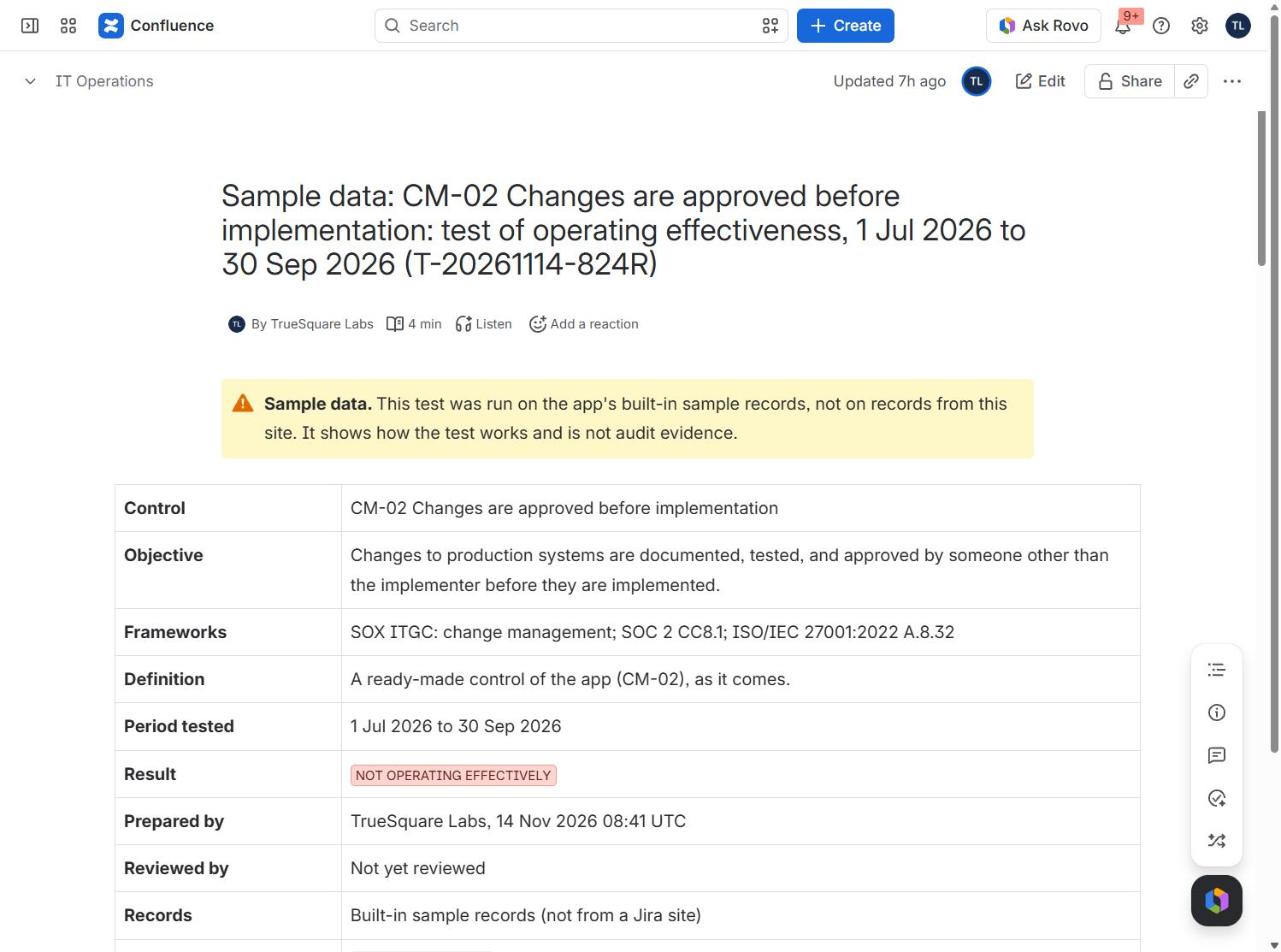
The workpaper as a Confluence page: everything a second auditor needs to reperform the test.
-
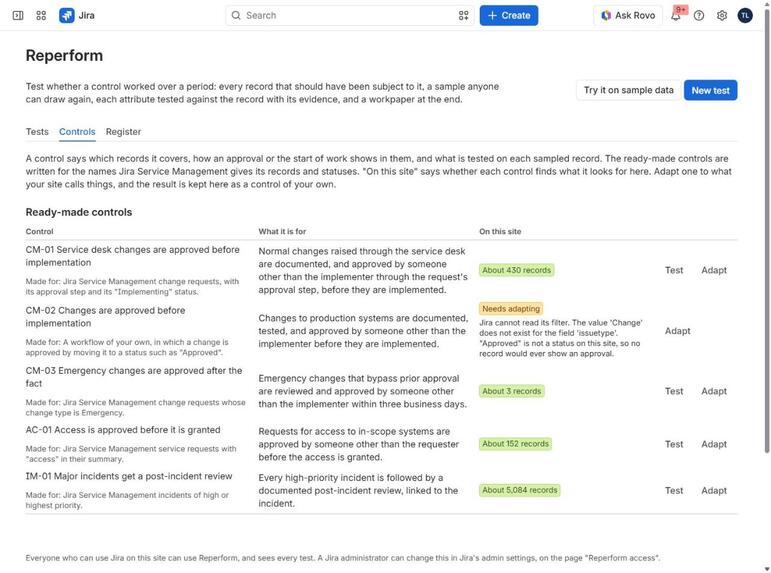
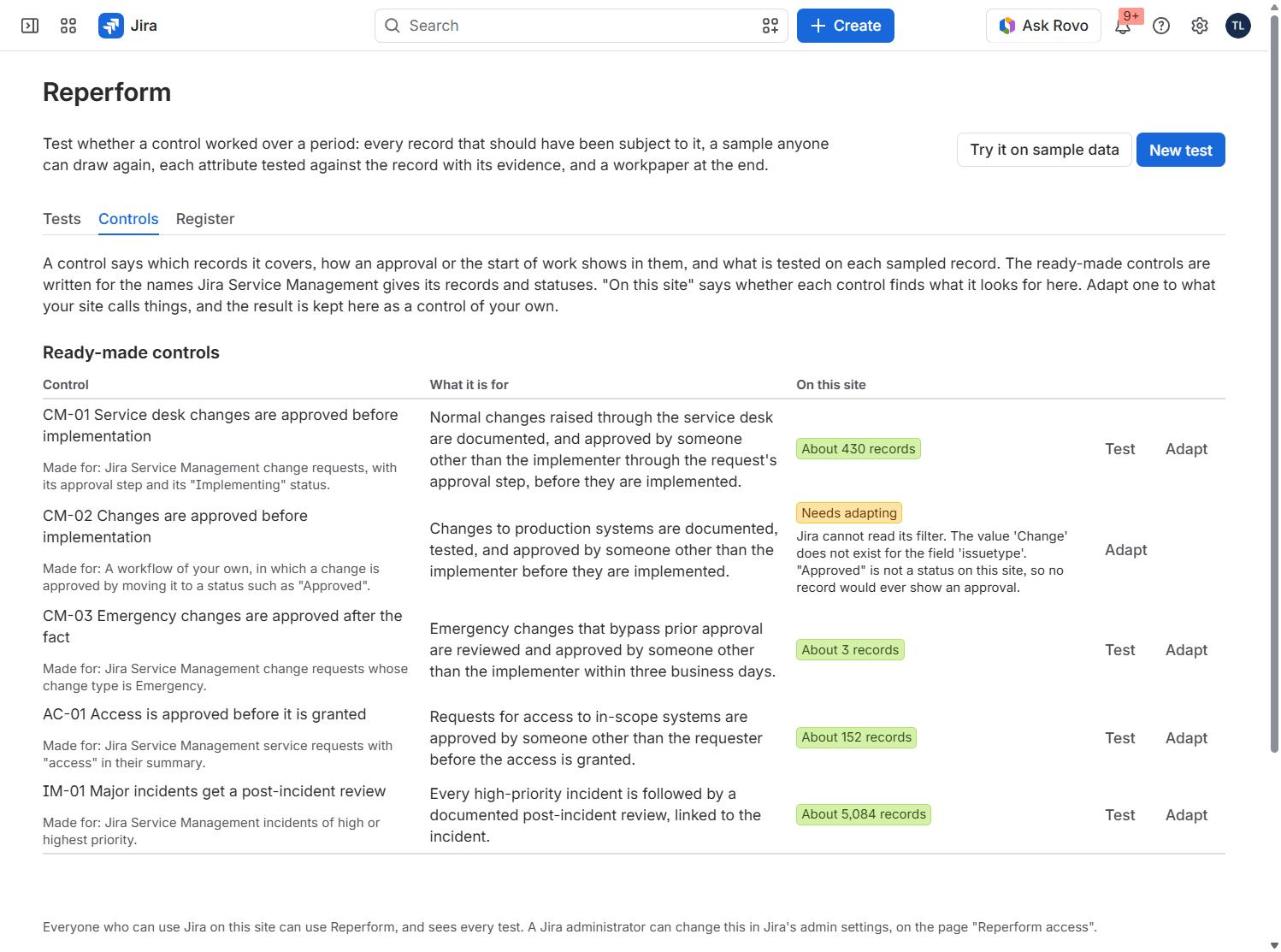
Five ready-made controls, and how each stands on this site before any test starts. One names things the site does not have.
-
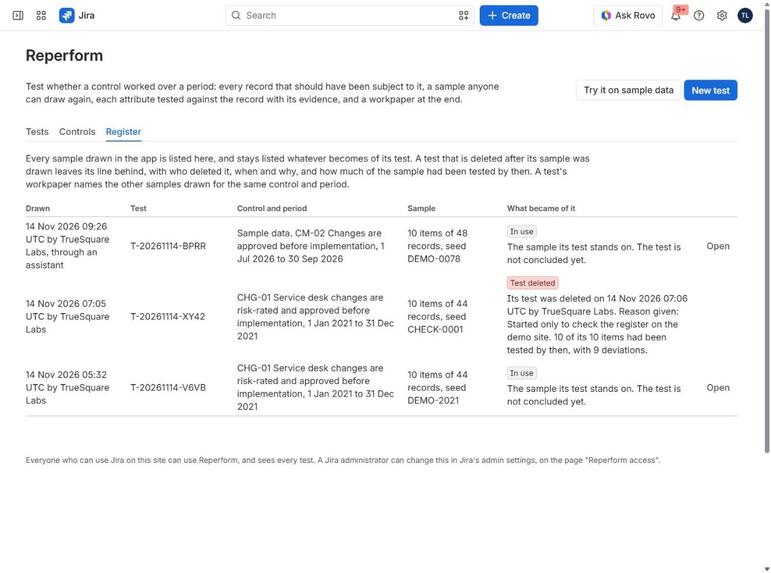
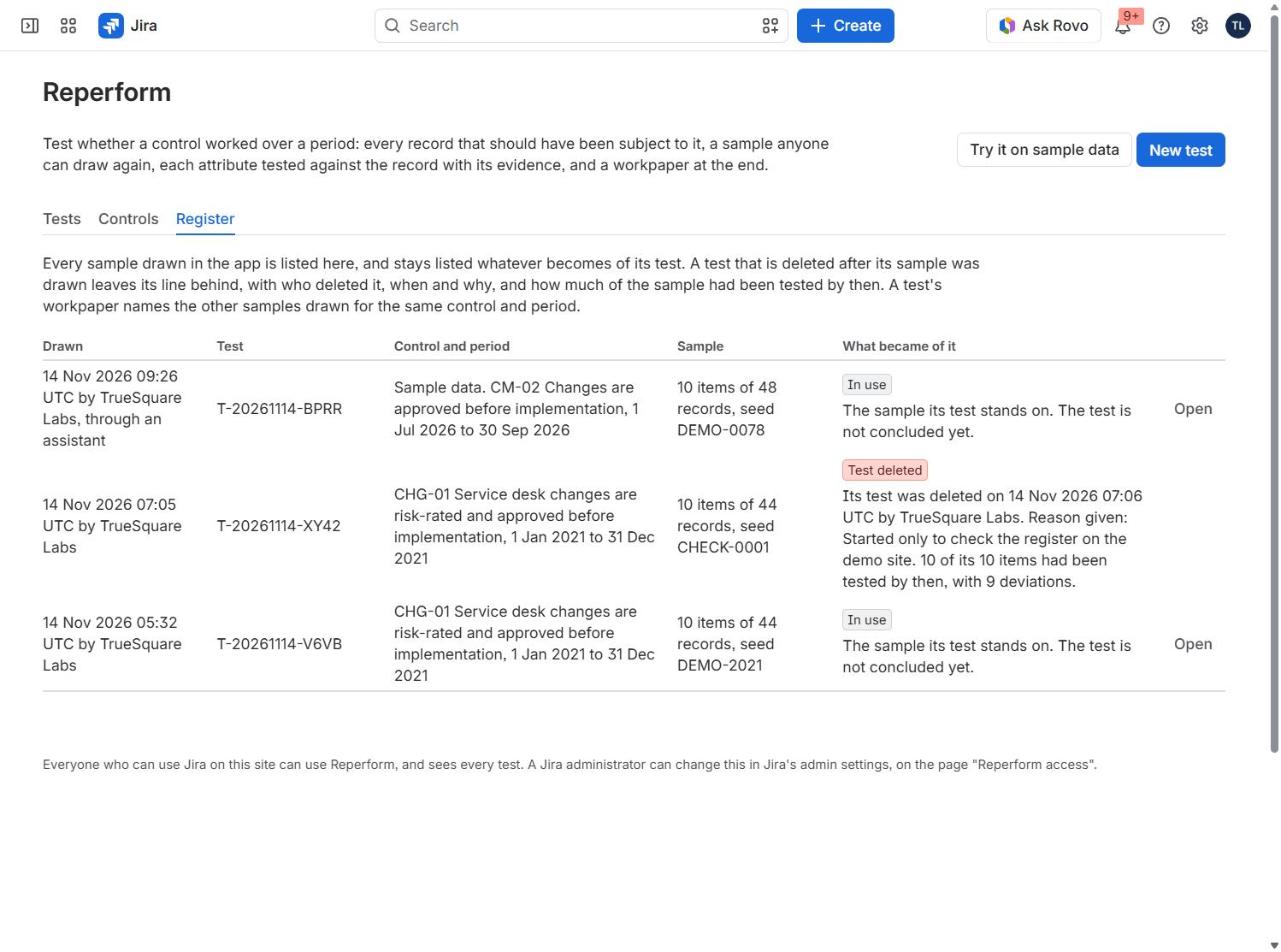
The register of samples. A deleted test leaves its line: who deleted it, when, why, and what had been found by then.
-
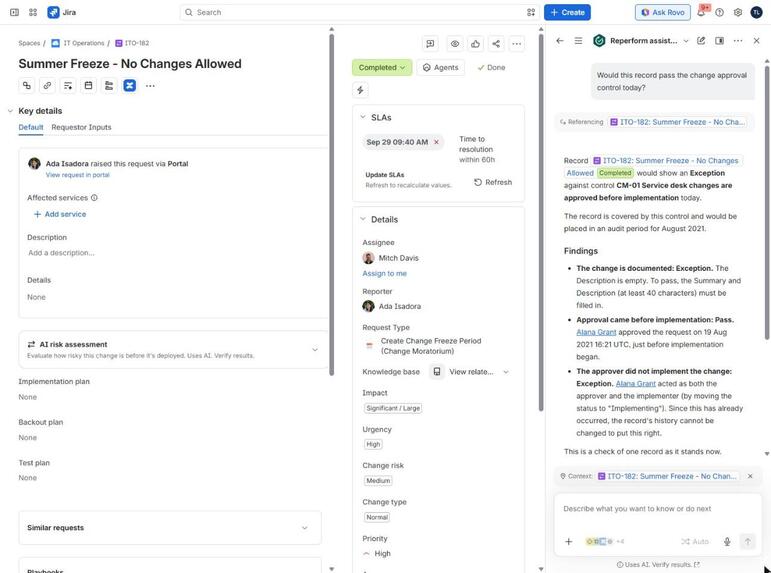
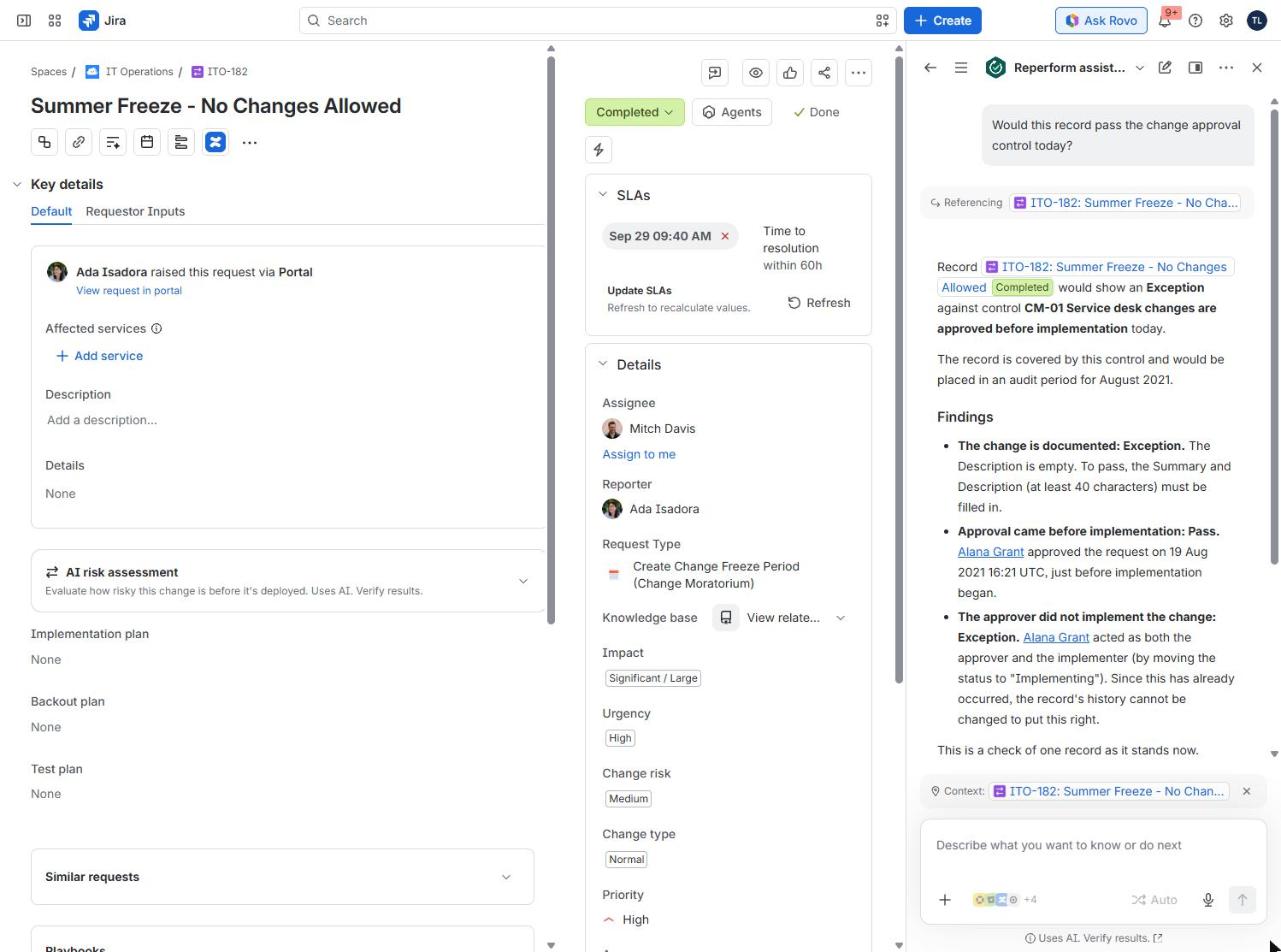
The assistant in Rovo checks one record against a control and gives its reasons. It has no tool to decide, conclude or sign.
-
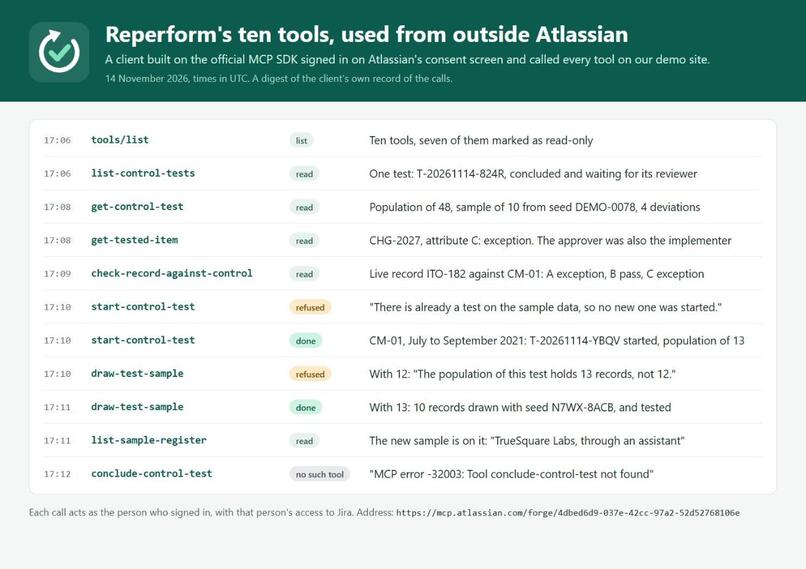
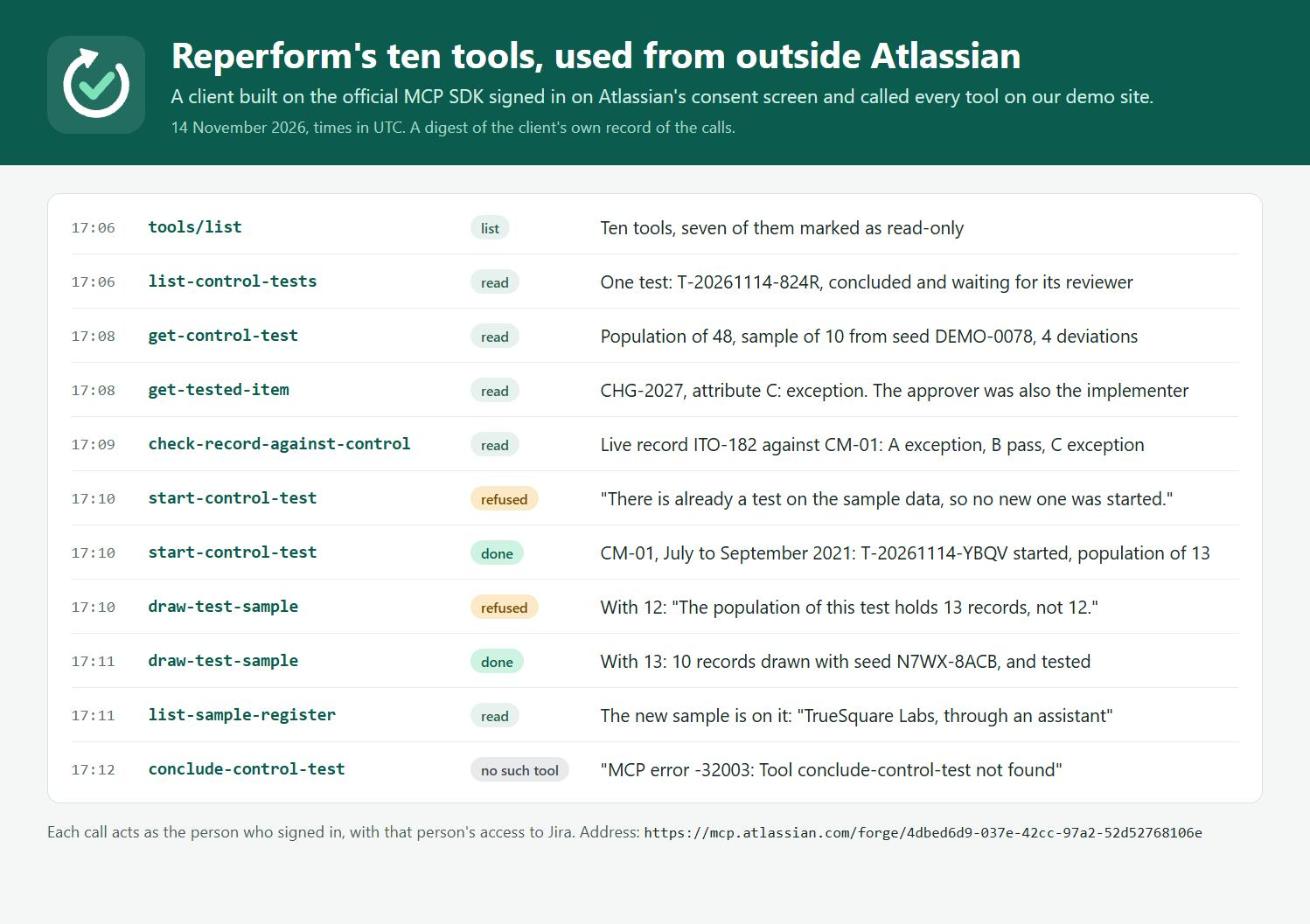
The ten tools used from outside Atlassian through MCP: a test started and sampled, the app refusing twice, and no tool to conclude or sign.
The problem
Companies that answer to SOC 2, ISO 27001 or SOX keep controls such as "every change is approved before it is implemented, by someone other than the person who implements it". Most of them run those changes in Jira. Once a year an auditor asks whether the control worked all year, and the answer is put together by hand: export the tickets to a spreadsheet, pick some rows, open each one, take screenshots, write down what was seen. That is days of work for one control. Afterwards nobody can show that the rows were picked at random, and the auditor repeats much of it to be sure.
What Reperform does
Reperform runs the whole test inside Jira, the way an auditor would, and shows its reasoning for every record.
- Population. For a control and a period it finds every record that should have been subject to the control, and says how it searched, so a reviewer can run the same search.
- Sample. It plans the sample size from how often the control operated, and draws the sample from a seed. Anyone with the seed draws the same records. A sample is drawn once. Testing more items extends it in the order the seed already fixed, so nobody can keep the sample they like best.
- Test. Each attribute of the control is tested against each sampled record from the record's own history: who approved and when, who started the work and when, whether one person did both. Every result is Pass, Exception, Needs a person or Not applicable, with the evidence it rests on.
- People decide. Where a record cannot settle a question, a named person does, with a note. A person can overrule a result, and the workpaper shows the automatic result beside theirs.
- Conclusion and two signatures. The preparer concludes. A second person reviews and signs; the app refuses a preparer who tries to review their own test.
- Workpaper. Everything a reviewer needs to reperform the test is written to a Confluence page: the control, the search, the sample and its seed, each result with its evidence, every decision, the conclusion and the signatures.
Five controls come ready-made: changes approved before implementation (one for a service desk, one for a team's own workflow), emergency changes approved after the fact, access approved before it is granted, and major incidents followed by a review. An editor fits a control to what a site calls its statuses, fields and record types, and tries it on one record before it is saved.
Anyone can try it without data: the built-in sample holds 51 change requests with 12 problems planted in them, and one question that only a person can answer.
Who it is for
- Internal audit and compliance teams, who test controls before the auditor arrives.
- Control owners such as a change manager, who want to know what an auditor would find.
- External auditors, who receive a workpaper they can reperform: the same search, the same seed, the same sample.
What is different about it
- A sample anyone can draw again. The seed is in the workpaper. Reperformance is a matter of minutes, not trust.
- No sample disappears. Every sample drawn on a site stays on a register. A test deleted after its sample was seen leaves a line with who deleted it, when and why, and the workpaper of the next test of that control and period names it. Nothing is forbidden; nothing can be hidden.
- Judgement stays with people, by construction. The assistant can read tests, check a record and run the mechanical steps. It has no tool to decide a result, conclude, sign, reopen or delete. An automated test fails the build if a tool that carries a decision is ever added.
- What people typed reaches the assistant as a quotation, never as a finding. Words from a record or a control (a summary, a field, a name, a label) are handed to an assistant only inside quotation marks that the words cannot close; results, counts and conclusions are stated outside them. We tried it with a false note planted in a record: the version first entered quoted the note and then drew a conclusion from it, the current one quotes it as words somebody typed and leaves whether it counts to the person who decides. That lowers the risk of an injected instruction. It does not remove it.
- A person is not an automation rule. An approval recorded by a rule is kept as evidence and named as an app, never counted as a person approving, and sent to a person to decide.
- It checks that a control fits the site before it tests. Jira's search answers "no records" for a filter that names a record type the site does not have. Reperform asks Jira's parser, says what does not fit, and offers the editor, so an empty test is never taken for a clean one.
- No names are kept. The app stores Atlassian account IDs and asks Jira for the current name whenever it shows one. It has no server of its own and sends nothing outside Atlassian.
- An administrator decides who sees the tests. As installed the app is open to everyone who can use Jira. A Jira administrator can limit it to chosen groups, and the limit holds on every screen, for the assistant, and over MCP.
The assistant
Reperform adds an agent to Rovo with ten tools and three skills. It answers "which tests are waiting for a reviewer?" and "what still needs a person in the latest test?". On an issue page it answers "would this record pass the change approval control today?" with the reason and the evidence for each attribute. Asked to run a test, it starts one and draws the sample in two confirmed steps, and every step is written into the test's history in the person's name, followed by "(through an assistant)". Asked to conclude or sign, it says who does that, and where.
The same ten tools are offered through the rovo:mcp module to agents a customer builds and to AI clients outside Atlassian. We connected one from outside, built on the official MCP SDK and driven by Claude. It signed in on Atlassian's consent screen and used all ten tools on our demo site, from reading a concluded test to starting one on the site's own records and drawing its sample. The register shows that sample as drawn by the person "through an assistant".
How it is built
- Forge only.
jira:globalPageandjira:adminPagein UI Kit, two resolvers,rovo:agent, threerovo:skillmodules, tenactionmodules androvo:mcp. Storage is Forge's key-value store. There is no egress and no external service, and the app is eligible for Runs on Atlassian. - It reads Jira as the person using it, never as itself: enhanced search, bulk fetch of records and of change histories, service desk approvals, Jira's JQL parser, and the person's own groups and permissions. A population holds what that person may see, and the workpaper says so.
- Long work is done in steps of at most nine seconds that save and say whether there is more, so a population of thousands of records fits inside Forge's limits and closing the page loses nothing.
- More than 530 automated tests. The screen tests bundle the real UI with the bundler inside the Forge CLI and click through whole tests against the real server side. Others plant an instruction wherever a person can type (a record, a control, what a screen sends, what the app keeps) and fail if any of it reaches an assistant outside quotation marks.
What was hard
- Rovo shows a confirmation card before every tool that changes something, and the agent says nothing between two cards. So each confirmed step brings its work with it, and whatever a person should know before confirming is on the card itself, such as the size of the population a sample is about to be drawn from.
- A UI Kit text field that is handed its value back loses letters typed quickly. Every field is given only its starting text, and a test fails the build if one is not.
- Keeping no names meant replacing every person in every answer from Jira with a reference to the account before anything else sees it, and putting names in only on the way out.
What is next
More ready-made controls (access reviews, restores from backup, supplier reviews), adding an attribute in the editor, and a Marketplace listing.
Who built it
Reperform was designed and built by Claude, an AI model made by Anthropic, for TrueSquare Labs.
Built With
- confluence
- forge
- javascript
- jira
- jira-service-management
- mcp
- node.js
- react
- rovo
