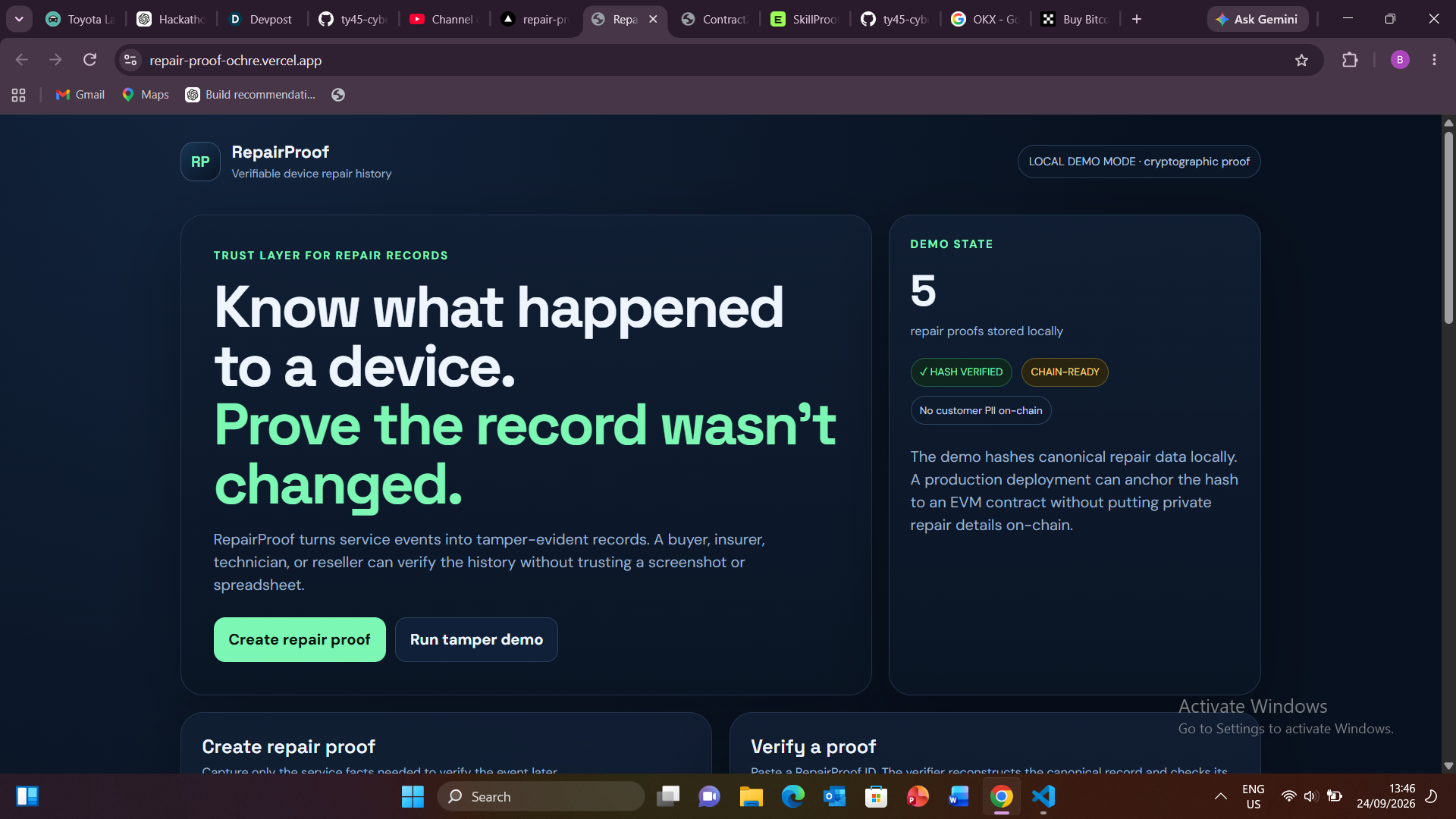
Inspiration
Buying or selling a repaired device often comes with a simple problem:
“How do I know this repair record is genuine?”
A phone may have had its battery, screen, charging port, or other components replaced, but that history can be trapped in paper receipts, messages, spreadsheets, or a technician's private system. When the device changes hands, much of that context can disappear.
We built RepairProof around the idea that a repair history should be portable and verifiable.
Instead of asking a buyer to simply trust a screenshot or receipt, RepairProof creates a cryptographic fingerprint of the repair record that can later be independently checked.
What We Built
RepairProof is a tamper-evident repair-history system for devices.
A technician can create a repair record containing information such as:
- Device identifier
- Repair type
- Service performed
- Technician information
- Timestamp
- Customer confirmation or relevant metadata
RepairProof then creates a deterministic SHA-256 hash of the record.
The workflow is:
Capture
   ↓
Fingerprint
   ↓
Anchor
   ↓
Verify
When someone later verifies the record, the system recomputes the fingerprint.
If the record has not changed:
✓ PROOF VERIFIED
If even a small part of the record has been modified:
✕ TAMPER DETECTED
The project also includes a smart contract designed to anchor the proof hash on-chain without putting sensitive repair details directly on the blockchain.
How We Built It
We built the MVP as a lightweight web application with a clear verification-first user experience.
The main components are:
Repair record layer
Captures and structures the repair event.
Hashing layer
Canonicalizes the record and generates its SHA-256 fingerprint.
Verification layer
Recomputes the fingerprint and compares it with the stored proof.
Blockchain layer
Uses a minimal RepairProofRegistry smart contract to anchor proof hashes on-chain.
User interface
Provides repair creation, verification, repair-history browsing, and a one-click tamper demonstration.
We deliberately kept the architecture small so that the core Web3 value could be demonstrated clearly instead of being buried under unnecessary infrastructure.
What We Learned
Our biggest lesson was that blockchain should solve a specific trust problem, not simply be added because a project is Web3.
A blockchain does not magically prove that a repair was performed correctly or that a technician is trustworthy.
What it can provide is a durable way to prove that a particular record has not been altered after its proof was created.
That distinction shaped the entire product.
We also learned that verification has to be understandable. A cryptographic hash is meaningless to most users on its own, so we designed the experience around a simple question:
“Can I trust that this record is the same record that was originally recorded?”
Challenges
The first challenge was designing the record format carefully.
A cryptographic hash is extremely sensitive to input changes. Even differences in formatting, ordering, or whitespace can create a different hash. We therefore needed deterministic serialization before generating the proof.
Another challenge was balancing transparency with privacy.
Repair records can contain personally identifiable or commercially sensitive information. We therefore designed the blockchain layer around proof hashes rather than storing the full repair record on-chain.
A further challenge was defining the limits of verification. A valid hash only tells us that the verified record matches the record used to create the proof. It does not independently establish that every statement in the record is true.
Why RepairProof Matters
Repair history becomes increasingly important as devices are repaired, resold, refurbished, and passed between owners.
RepairProof creates the foundation for a portable service history where different parties can verify the integrity of a record without having to rely entirely on a screenshot, database administrator, or centralized intermediary.
A future version could connect verified technicians, device owners, refurbishers, insurers, and resale marketplaces into a shared repair-history ecosystem.
The long-term vision is simple:
Make repair history verifiable, portable, and harder to falsify.
Built With
- html5
- javascript
- solana

Log in or sign up for Devpost to join the conversation.