Inspiration
Every year, millions of electronic devices are discarded due to small and easily fixable problems such as loose wires, faulty connectors, or damaged components. Many people lack the technical knowledge to diagnose and repair these issues, and repair services can often be expensive or inaccessible.
As engineering students and technology enthusiasts, we realized that modern AI systems are capable of understanding both images and natural language. This opened an opportunity to create an intelligent system that could act like a personal repair technician.
The idea behind RepairMate AI was simple but powerful:
What if anyone could point their camera at a broken device and instantly receive expert guidance on how to fix it?
This vision inspired us to build an AI-powered repair assistant that democratizes technical knowledge, empowers users to repair devices themselves, and helps reduce global electronic waste.
What it does
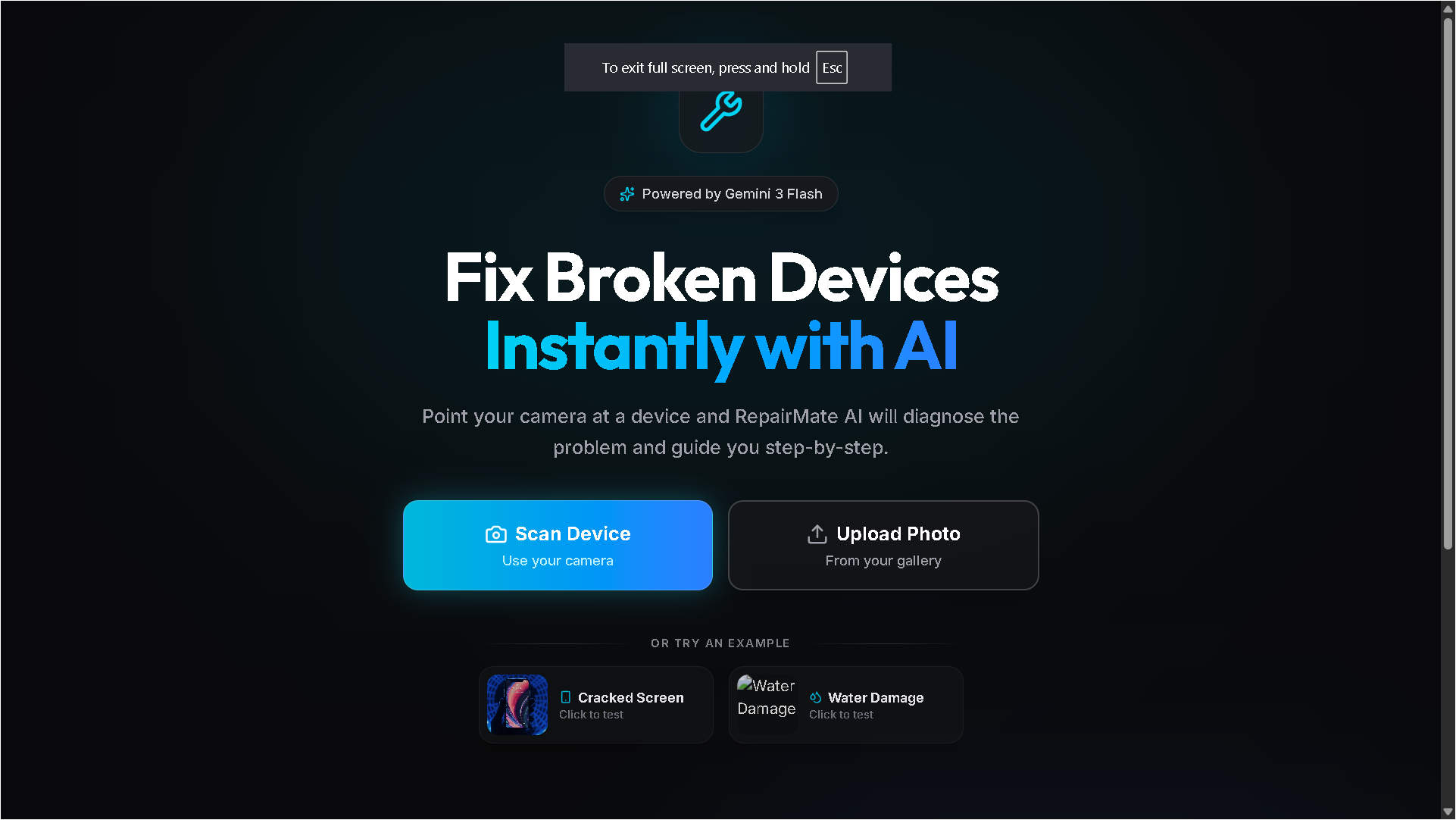
RepairMate AI is a multimodal AI repair assistant that helps users diagnose and fix broken devices using just a photo.
Users simply:
Upload or capture an image of a broken device
Ask a question about the issue
Receive AI-powered analysis and step-by-step repair guidance
The system uses Google Gemini’s multimodal capabilities to:
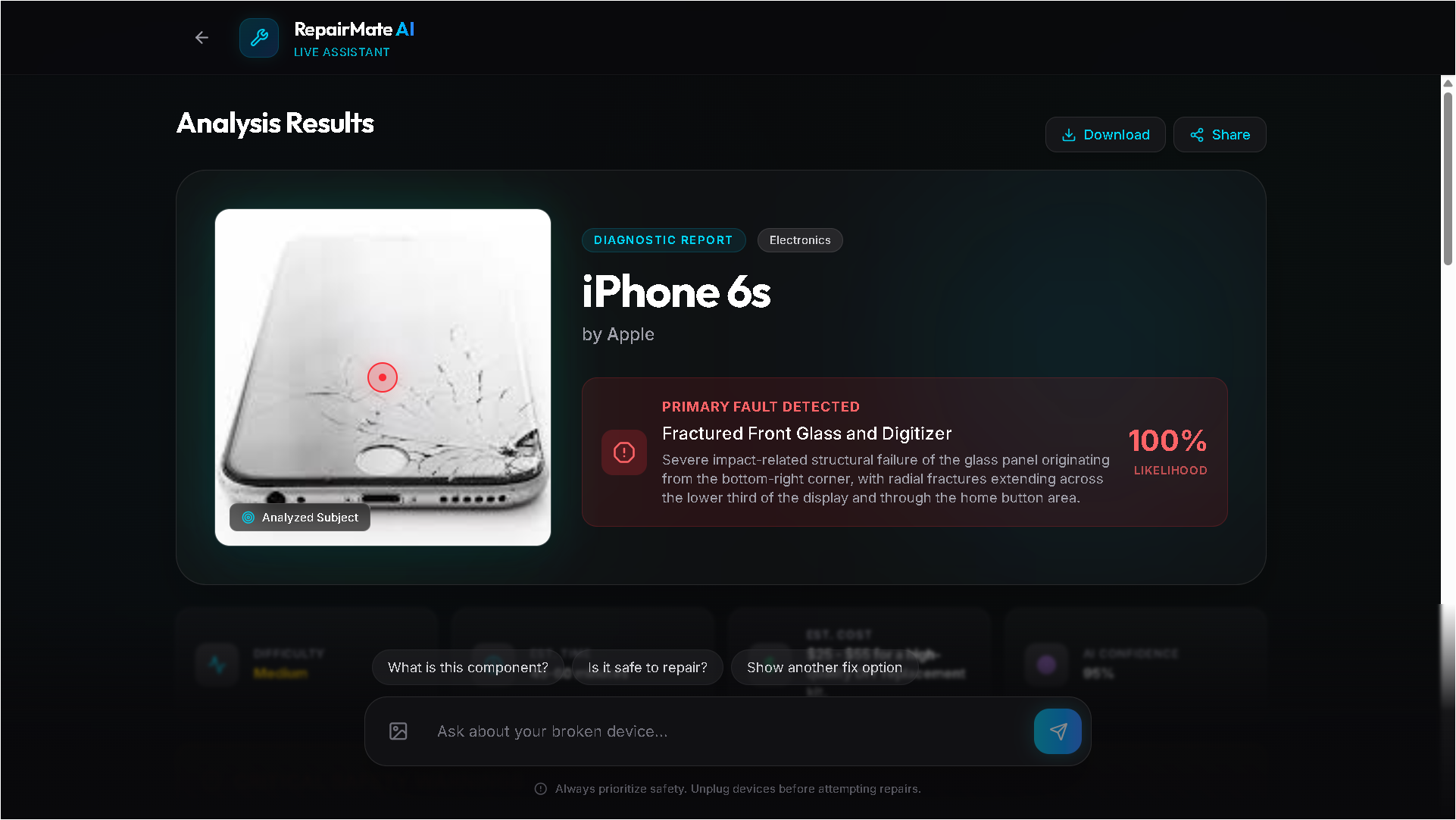
Identify the device and visible components
Detect potential faults or damage
Generate structured repair instructions
Recommend tools required for repair
Provide safety warnings for risky repairs
The platform also includes:
Context-aware follow-up chat
Repair difficulty estimation
Estimated repair time
Sustainability impact analysis (e-waste reduction)
This creates a live AI repair assistant experience, similar to consulting a professional technician.
How we built it
RepairMate AI was built using a modern web stack combined with Google’s Gemini AI models.
Core technologies used
Frontend
React 19
TypeScript
Vite
UI and animations
Tailwind CSS
Framer Motion
AI integration
Google GenAI SDK (@google/genai)
Gemini multimodal models for image analysis and reasoning
Additional tools
React Markdown for rendering AI responses
Base64 image processing for vision input
System workflow
The user uploads or captures an image of a broken device.
The image is converted into Base64 format.
The image and user prompt are sent to the Gemini multimodal model.
The AI analyzes the device and generates a structured response using a strict JSON schema.
The frontend renders the response into a clean diagnostic dashboard showing repair instructions, tools, and safety warnings.
The user can continue asking follow-up questions through a context-aware chat interface.
This architecture allows RepairMate AI to function as a live conversational repair agent.
Challenges we ran into
Building RepairMate AI involved several technical and design challenges.
Ensuring reliable AI responses
One of the biggest challenges was preventing the AI from generating incorrect repair instructions. To address this, we implemented:
strict system instructions
structured JSON outputs
clear safety guidelines
Handling multimodal input
Working with image inputs required efficient encoding and transmission. We had to ensure that images were properly formatted for the Gemini API while maintaining performance.
Designing a clear UI for technical instructions
Repair instructions can easily become overwhelming. We focused on designing a card-based dashboard that presents information in a simple and structured way.
Safety considerations
Some repairs involve high voltage or dangerous components. We implemented safety warnings and professional repair recommendations to protect users.
Accomplishments that we're proud of
We are proud of several aspects of RepairMate AI.
Successfully built a multimodal AI repair assistant using Gemini models.
Implemented structured AI outputs that power a clean diagnostic dashboard.
Created a context-aware chat system that maintains conversation history.
Designed a user-friendly interface that simplifies complex technical repair steps.
Demonstrated how AI can contribute to sustainability by reducing electronic waste.
Most importantly, we built a system that shows how AI can empower everyday users to solve real-world technical problems.
What we learned
This project helped us gain deeper insights into several areas:
Multimodal AI systems
We learned how to combine vision, reasoning, and natural language interaction to build a useful AI agent.
Prompt engineering and AI safety
Designing reliable AI responses required careful prompt design and structured output constraints.
Product design for AI applications
We discovered that the user interface is just as important as the AI model itself. Presenting AI results in a clear and intuitive way significantly improves user experience.
Real-world problem solving
This project reinforced how AI can be used not only for automation but also for practical human assistance.
What's next for RepairMate AI – AI Technician for Everyday Devices
RepairMate AI has strong potential for future expansion.
Some of our planned improvements include:
Live camera repair guidance for real-time troubleshooting
Augmented reality overlays showing exactly where to repair components
Voice interaction with the AI technician
Community repair knowledge base
Integration with spare parts marketplaces
Partnerships with device manufacturers for repair documentation
Our long-term vision is to transform RepairMate AI into a global AI repair platform that empowers people everywhere to repair devices, reduce waste, and extend the life of technology.


Log in or sign up for Devpost to join the conversation.