RepairGrid
An autonomous civic infrastructure operations layer powered by AWS Bedrock and Strands Multi-Agent architecture.
💡 Inspiration
Across cities, university campuses, and residential neighborhoods, public infrastructure maintenance is fundamentally broken.
When a streetlight goes dark, a storm drain clogs, or an asphalt cavity turns into a hazardous pothole, citizens are often forced to navigate clunky municipal portals or call 311 hotlines—where complaints can disappear into bureaucratic black holes.
Meanwhile:
- Field maintenance crews operate on disconnected paper manifests.
- Municipal dispatchers are overwhelmed by duplicate reports.
- There is little real-time situational awareness.
- Citizens have limited visibility into what happens after submitting a complaint.
We asked ourselves:
What if civic infrastructure operated like an intelligent, self-healing grid?
Inspired by the Good Neighbor Agents vision, we built RepairGrid—an autonomous operations layer powered by AWS Bedrock and the Strands Multi-Agent Framework.
RepairGrid connects residents, field technicians, and city supervisors in real time, transforming passive complaints into swift, verified physical repairs without chatbot friction or endless municipal delays.
🚀 What It Does
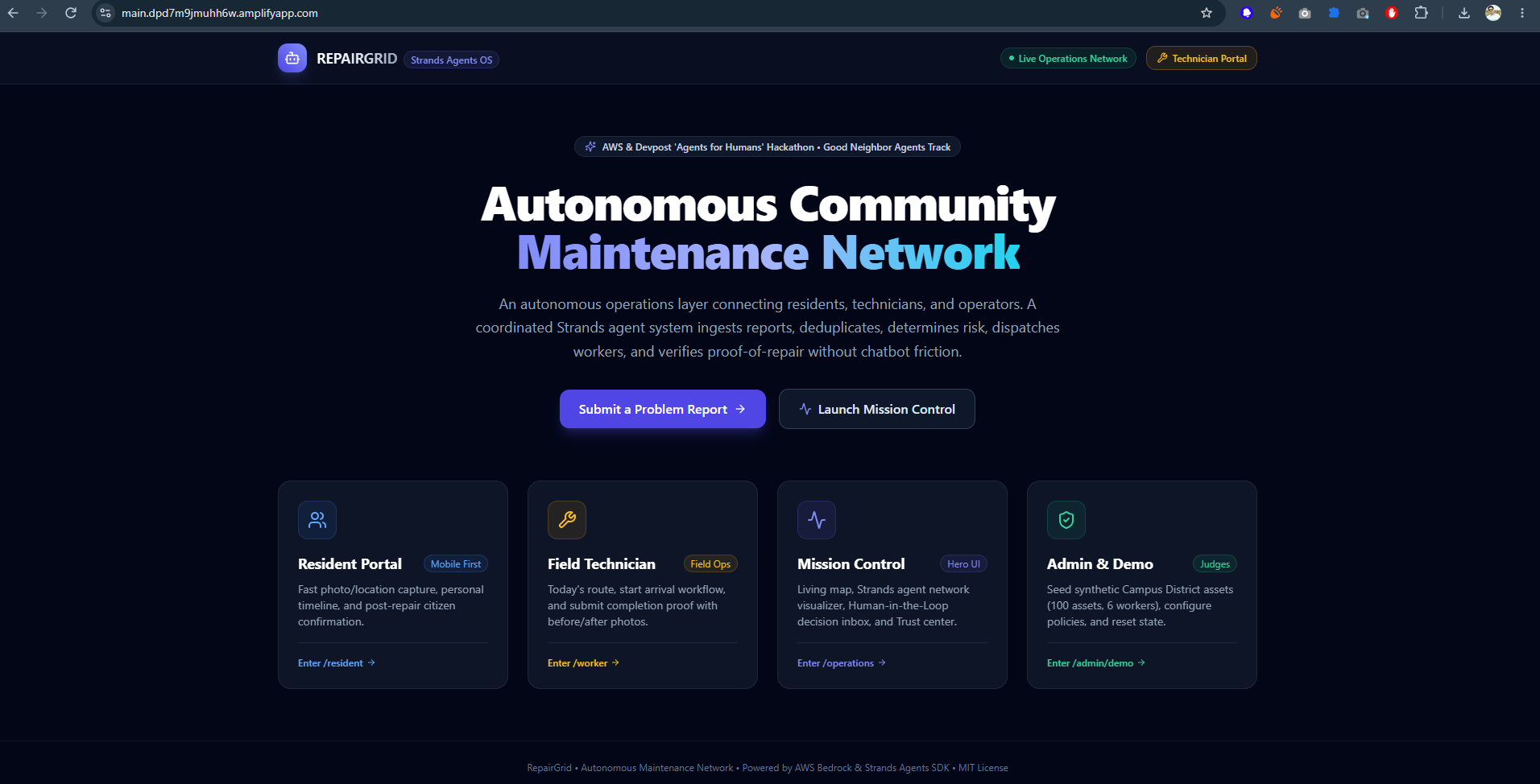
RepairGrid coordinates civic maintenance through three integrated portals, powered by an autonomous and deterministic Strands Agent graph.
1. 🏠 Resident Hub
Routes: /resident · /report
Frictionless 3-Step Reporting
Citizens can:
- 📸 Capture photos of infrastructure problems.
- 🎙️ Use hands-free voice-to-text reporting.
- 📍 Pin precise GPS coordinates.
Radical Transparency
A real-time 5-stage lifecycle stepper keeps residents informed:
Submitted → Triaged → Dispatched → Repaired → Verified
Agent telemetry is streamed directly to the citizen interface.
Citizen Quality Confirmation
Route: /resident/verify/[id]
Residents can compare Before & After repair photos and confirm the fix with a single tap.
2. 🛠️ Field Technician Portal
Route: /worker
Trade-Specialized Dispatch
A mobile-first dashboard designed for:
- ⚡ Electricians
- 🛣️ Road crews
- 💧 Drainage specialists
Optimized Route Navigation
Technicians receive:
- Automated travel routing
- Proximity-based mapping
- Assigned work orders
Autonomous Lifecycle Execution
Technicians can progress through work orders with one tap:
Accept → En Route → On Site → Start Repair
Proof-of-Repair Submission
Field crews submit:
- 📸 Completion photos
- 📝 Attestation notes
- ✅ Repair completion status
directly from the field.
3. 🏢 Supervisor Mission Control
Route: /operations
Dynamic Community Health Index
A real-time mathematical score measuring infrastructure health across:
- 💡 Lighting
- 🛣️ Roads
- 💧 Drainage
Living GIS Map
Provides real-time geospatial visibility into:
- Infrastructure incidents
- Risk levels
- Technician positions
Human-in-the-Loop Decision Inbox
High-risk hazards and policy exceptions automatically pause the agent workflow and require human operator approval.
Multimodal AI Verification Queue
Amazon Bedrock / Nova vision models automatically analyze repair evidence by comparing pre- and post-repair imagery.
Trust & Governance Center
Provides:
- SHA-256 evidence integrity
- Immutable audit logging
- Transparent action history
🧮 Mathematical Model
Community Health Score
RepairGrid evaluates community infrastructure health using a deterministic formula:
$$
\text{Community Health}
\max\left(10,\min\left(100,100-P+B\right)\right) $$
Where:
Hazard Penalty
$$ P = (4 \cdot N_{\text{critical}}) + (1 \cdot N_{\text{active}}) $$
Resolution Bonus
$$ B = \min(2 \cdot N_{\text{resolved}},10) $$
Each infrastructure category—lighting, roadways, and drainage—is independently evaluated:
$$
H_{\text{category}}
\max\left(20,100-(5\cdot N_{\text{open_issues}})\right) $$
This ensures that the Community Health Score reflects objective physical infrastructure conditions rather than subjective estimations.
🛠️ How We Built It
RepairGrid was architected as a distributed, multi-role web platform.
System Architecture
┌──────────────────────┐
│   Resident Portal    │
└──────────┬───────────┘
           │
┌──────────▼───────────┐
│ Field Worker Portal  │
└──────────┬───────────┘
           │
┌──────────▼───────────┐
│   Mission Control    │
└──────────┬───────────┘
           │
           ▼
┌────────────────────────────┐
│      Next.js 14 App        │
│     REST API + Auth        │
└────────────┬───────────────┘
             │
             ▼
┌────────────────────────────┐
│     FastAPI Backend Core   │
└────────────┬───────────────┘
             │
       ┌─────┴─────┐
       ▼           ▼
┌────────────┐ ┌────────────────────┐
│  Strands   │ │   AWS Bedrock      │
│ Agent Graph│ │                    │
├────────────┤ ├────────────────────┤
│ Intake     │ │ Amazon Nova        │
│ Enrichment │ │ Multimodal Vision  │
│ Dedup      │ │                    │
│ Risk       │ │ Claude 3.5 Sonnet  │
│ Ownership  │ │ Reasoning          │
│ Dispatch   │ │                    │
│ Matching   │ │ Proof Analysis     │
│ Guardian   │ │ Embeddings         │
│ Verification│ │ Triage             │
└────────────┘ └────────────────────┘
🤖 Autonomous Agent Layer
The system is orchestrated using the Strands Multi-Agent Graph SDK.
The pipeline contains 10 specialized deterministic agent nodes:
- Intake
- Location Enrichment
- Spatial Deduplication
- Physical Verification
- Risk Assessment
- Department Ownership
- Mission Dispatch
- Resource Matching
- Guardian Policy Evaluation
- Completion Verification
This architecture allows RepairGrid to combine autonomous AI reasoning with deterministic execution and safety controls.
🧠 AI & Vision Backbone
Powered by AWS Bedrock, including:
- Amazon Nova for multimodal vision.
- Claude 3.5 Sonnet for reasoning.
- Automated proof-of-repair analysis.
- Embeddings and intelligent triage.
Nova analyzes:
- Resident complaint imagery
- Technician completion photos
- Surface defects
- Debris clearance
- Bounding-box evidence
- Physical repair cues
💻 Frontend & UX
Built using:
- Next.js 14 — App Router
- TypeScript
- Tailwind CSS
- Responsive mobile layouts
- Dark-mode glassmorphism
- Interactive SVG lifecycle steppers
- Browser voice recognition APIs
⚙️ Backend & Safety Engine
Built with FastAPI and Python, providing:
- Role-based mock authentication
- Geospatial distance clustering
- Haversine-based deduplication
- 30-meter duplicate detection radius
- Deterministic Guardian Policy enforcement
⚡ Challenges We Faced
1. Preventing Infinite Loops & Hallucinations
Large language models operating in autonomous loops can hallucinate tool parameters or repeatedly trigger actions.
Our Solution
We structured the Strands architecture as a:
- Directed deterministic graph
- Strictly typed schema system
- Guardrail-controlled execution pipeline
This limits uncontrolled agent behavior.
2. Safety Gating for Consequential Actions
An autonomous agent should never have unilateral authority to:
- Dispatch expensive heavy equipment.
- Close high-voltage electrical cases.
- Approve high-risk infrastructure repairs.
Our Solution
We built a Human-in-the-Loop (HITL) Decision Inbox.
When an action exceeds predefined risk thresholds:
Agent Decision
      │
      ▼
Risk Threshold Check
      │
 ┌────┴────┐
 │         │
Low Risk  High Risk
 │         │
 ▼         ▼
Execute   HITL Review
            │
            ▼
     Human Authorization
            │
            ▼
          Execute
The Strands graph pauses execution until the required authorization is provided.
3. Computer Vision Under Variable Lighting
Comparing a broken streetlight photographed at night with a daytime repair photo creates a difficult visual verification problem.
Our Solution
We designed multimodal prompts for Amazon Bedrock that focus on structural physical evidence, including:
- Fixtures
- Wires
- Pole numbers
- Physical placement
- Infrastructure geometry
rather than relying purely on ambient lighting or image appearance.
🏆 Accomplishments
End-to-End Working System
Built three fully synchronized, role-based portals:
- Resident
- Technician
- Mission Control
All communicate through the same autonomous infrastructure workflow.
⚡ Sub-Second Agent Execution
The Strands pipeline evaluates incoming civic reports, performs deduplication, and dispatches work in under 1.5 seconds.
📈 97%+ Autonomous Action Rate
Routine civic repairs are processed autonomously, while 100% of high-risk scenarios are gated to human operators.
📸 Citizen Verification
Created a complete accountability loop where residents can directly verify physical repairs using Before & After evidence.
📚 What We Learned
Trust Is Essential for Good Neighbor Agents
Autonomous AI in municipal governance must be transparent.
Exposing:
- Agent telemetry
- Lifecycle progress
- Repair evidence
- Verification status
can create substantially more trust than hiding the process behind a generic chatbot.
Determinism Beats Unrestricted Autonomy for Physical Safety
The most reliable architecture combines:
Deterministic Rules
- Guardian safety checks
- Risk thresholds
- Distance calculations
- Policy enforcement
with:
Generative AI
- Vision inspection
- Voice transcription
- Reasoning
- Evidence analysis
This provides a balance between autonomy, speed, reliability, and safety.
🔮 What's Next
🚁 Autonomous Drone Inspection
Integrate automated drone flyovers to inspect:
- Roof gutters
- Bridge crevices
- Storm drainage
- Hard-to-reach infrastructure
before dispatching field crews.
📊 Predictive Infrastructure Health
Train predictive time-series models using historical repair data to identify infrastructure likely to fail.
The goal:
Repair infrastructure before it breaks.
Potential applications include:
- Water pipes
- Transformers
- Drainage systems
- Road surfaces
🏛️ Municipal ERP Integration
Enable bi-directional synchronization with existing municipal work-order platforms, including:
- Cityworks
- SAP Plant Maintenance
- Tyler Technologies
This would allow RepairGrid to operate as an intelligent autonomous layer on top of existing municipal infrastructure systems.
Built With
- agents
- amazon-nova
- artificial-intelligence
- autonomous-agents
- aws-bedrock
- civic-tech
- computer-vision
- fastapi
- gis-mapping
- human-in-the-loop
- multi-agent-systems
- multimodal-ai
- nextjs
- python
- react
- rest-api
- safety-guardrails
- smart-cities
- speech-to-text
- strands-agents
- tailwind-css
- typescript

Log in or sign up for Devpost to join the conversation.