Inspiration
We noticed a simple contradiction: products are becoming more advanced, but repairing them is often becoming harder for ordinary people.
When an appliance starts making a strange noise or a device stops working, most consumers do not know whether the problem is minor, expensive, or even repairable. The easiest decision becomes replacement.
That creates unnecessary spending, unnecessary waste, and the loss of products that may still have years of useful life.
We asked:
What if repairability was as visible and understandable as price?
That question led to RepairBeforeReplace.
What it does
RepairBeforeReplace is a repair-first product ecosystem designed to help people make an informed decision before replacing a product.
At the center of the concept is a Repair Passport — a persistent identity for a physical product containing information such as:
- Repairability Score
- Common failure points
- Replaceable components
- Maintenance requirements
- Available spare parts
- Repair history
- Estimated repair costs
- Expected remaining lifespan
- Verified repair options
A QR code or NFC tag can connect the physical product to its Repair Passport.
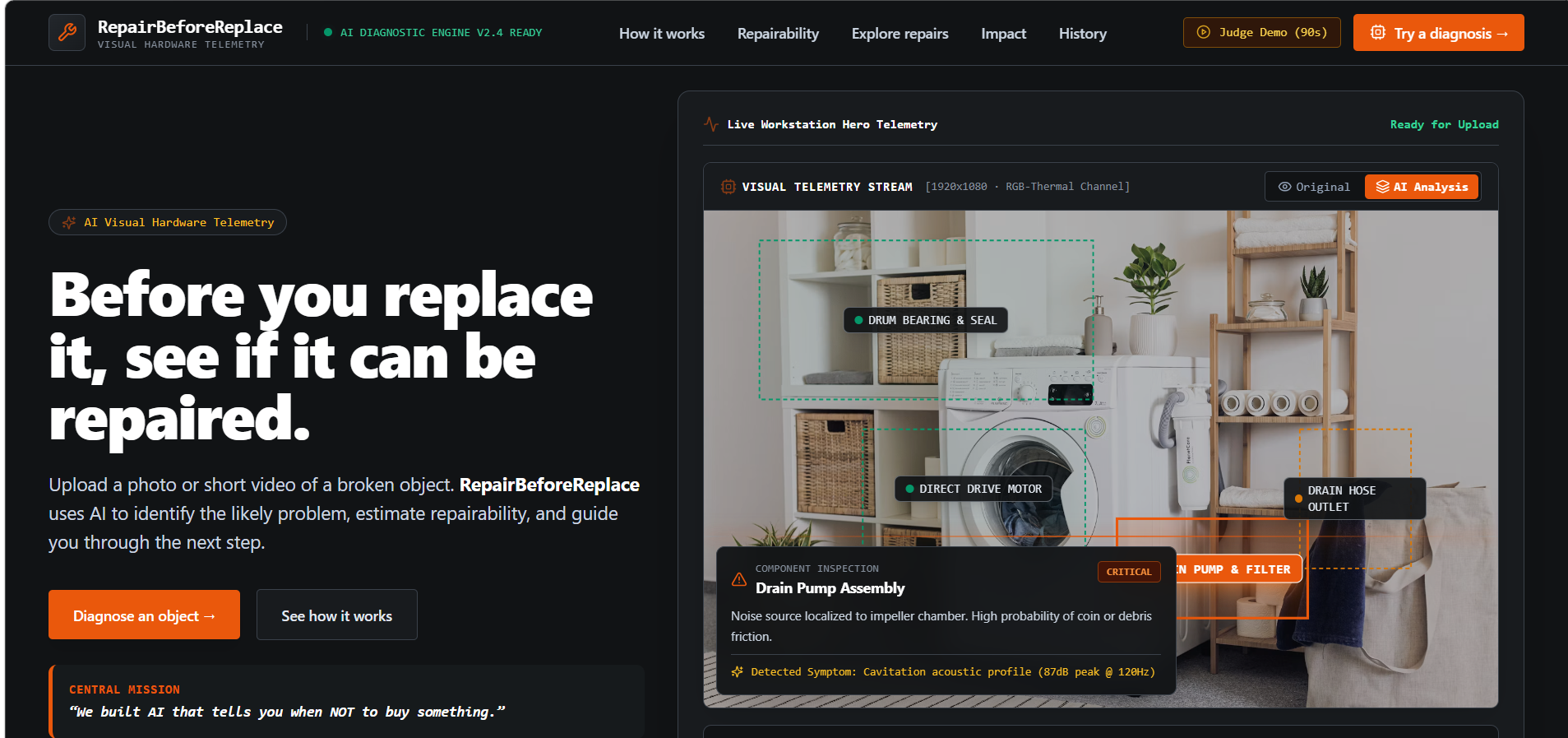
When something breaks, users can describe the problem or provide a photo/video. The system can then guide them toward a likely diagnosis, appropriate repair steps, estimated cost, and whether professional assistance is recommended.
The goal is not simply to diagnose a fault.
The goal is to answer the more important question:
“Should I repair this before I replace it?”
How we built it
We approached RepairBeforeReplace as a product and service design challenge, then built an interactive prototype to demonstrate how the ecosystem could work in practice.
We mapped the full lifecycle of a product:
Purchase → Use → Maintenance → Failure → Diagnosis → Repair → Reuse → Resale
We then designed a system that keeps repair information available throughout that lifecycle.
Our prototype demonstrates:
- Repair Passport — the product's persistent repair identity.
- Repairability Score — a simple way to communicate how realistically a product can be repaired.
- Visual Diagnosis — a guided way to identify possible problems from photos or videos.
- Repair Guide — step-by-step instructions with safety warnings.
- Repair History — records of maintenance and previous repairs.
- Repair Network — connects owners with appropriate repair providers.
- Second-Life Information — allows repair history and condition information to remain useful when a product changes owners.
We designed the experience around a simple principle:
Make repair visible before replacement becomes the default.
Challenges we ran into
One of the biggest challenges was avoiding the assumption that every product can be repaired in the same way.
A washing machine, laptop, bicycle, and power tool have completely different components, safety requirements, repair processes, and parts ecosystems.
We therefore designed the concept around a standardized framework with category-specific information, rather than trying to create one universal repair procedure.
Another challenge was trust.
Repair recommendations can affect safety and money, so the system should never present an uncertain diagnosis as fact. Our design therefore separates likely causes from confirmed information and clearly identifies situations where professional assistance is recommended.
We also had to balance simplicity with useful technical information. Most consumers do not want a service manual — they want to understand:
What might be wrong? Can it be repaired? How much might it cost? What should I do next?
That became the foundation of our user experience.
Accomplishments that we're proud of
We are proud of turning a broad sustainability problem into a concrete product ecosystem rather than another generic recycling concept.
Our strongest design decisions include:
- A Repair Passport that follows the physical product through its lifetime.
- A simple Repairability Score that makes an otherwise invisible product characteristic understandable.
- A repair-vs-replace comparison that helps users make decisions based on cost and lifespan.
- A repair history that can remain valuable even when ownership changes.
- An interactive prototype demonstrating how diagnosis, repair guidance, and product history can work together.
Most importantly, we designed the concept around preventing waste before it happens, rather than only managing waste after disposal.
What we learned
We learned that sustainability is often approached too late.
Recycling is important, but a product that never needed to be discarded is an even better outcome.
We also learned that repairability is not only a technical property. It is an information problem.
A product may be repairable, but if the owner cannot find the right information, spare parts, trusted repairer, or realistic cost estimate, replacement still becomes the easier option.
That led us to a broader insight:
Making repair possible is not enough. We need to make repair understandable and convenient.
What's next for RepairBeforeReplace
Our next step would be to pilot the Repair Passport with a small number of product categories such as washing machines, bicycles, laptops, and power tools.
We would work with manufacturers, repair professionals, retailers, and consumers to define standardized Repair Passport information.
Long term, we envision RepairBeforeReplace becoming a repairability standard for physical products.
A future product label could show:
Repairability: 82/100 Parts availability: Good Typical repair cost: ₹800–₹1,500 Expected lifespan: 10+ years
before a customer even purchases the product.
The larger vision is simple:
Products should not become disposable simply because people don't know how to fix them.
Repair it. Record it. Keep it in use.
Built With
- industrial-design
- product-design
- repairability-framework
- service-design
- sustainability
- ux-design

Log in or sign up for Devpost to join the conversation.