-
-
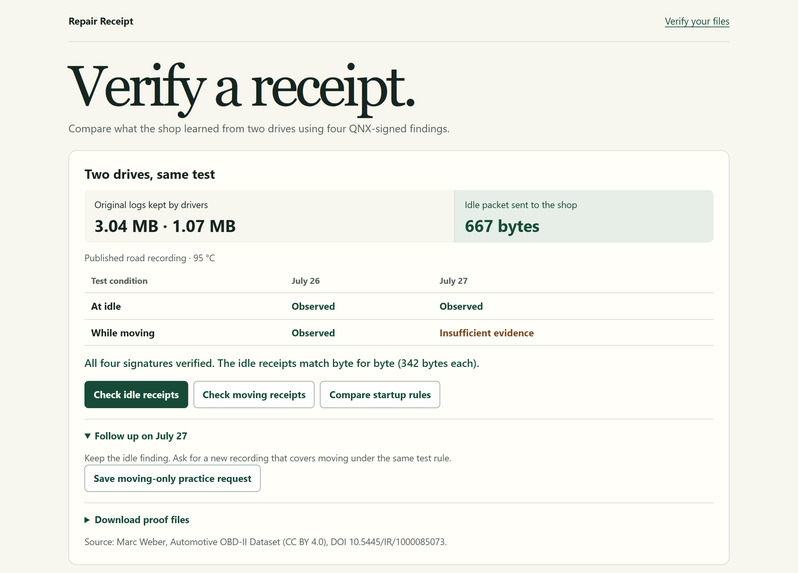
Two published drives produce the same idle packet. The shop can request moving-only coverage for the gap.
-
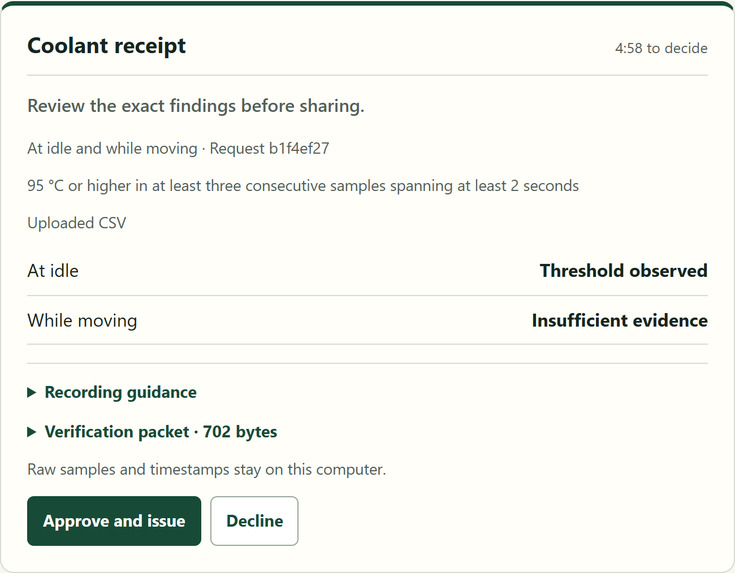
QNX prepares a receipt for the driver to review. The preview shows both findings, the test rule and the exact file size.
-
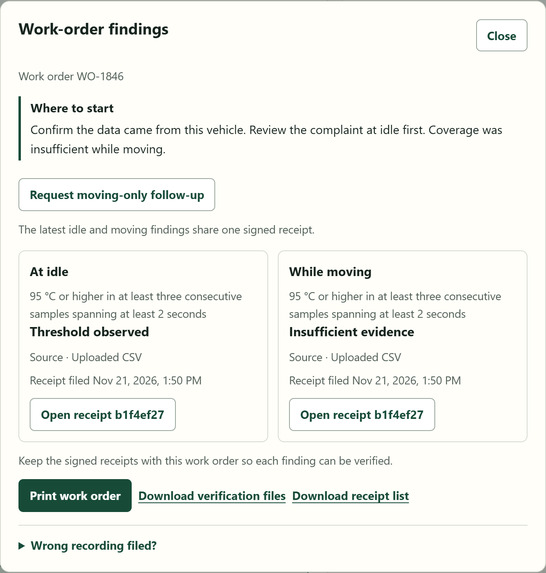
The shop files the verified idle finding and requests only the missing moving condition.
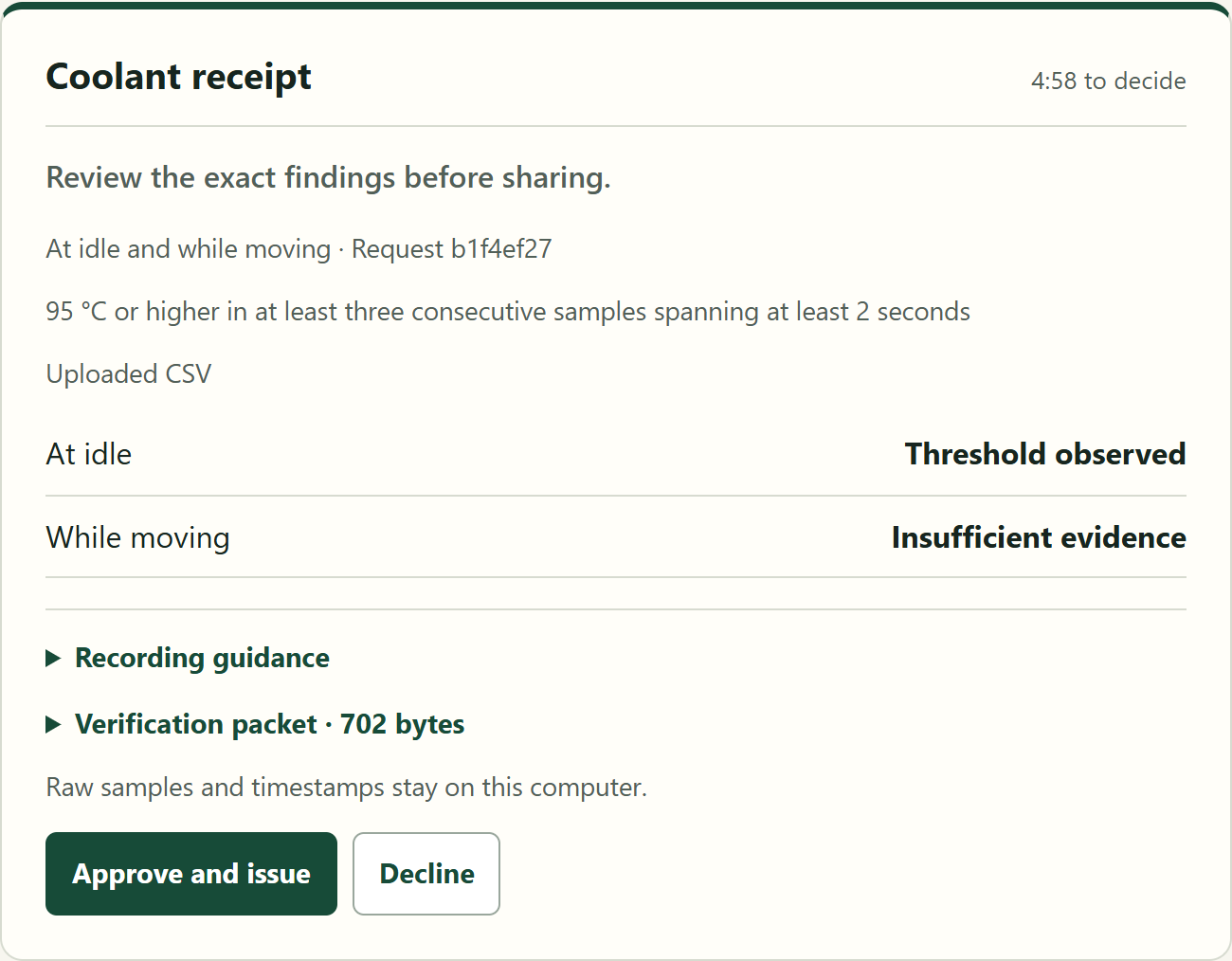
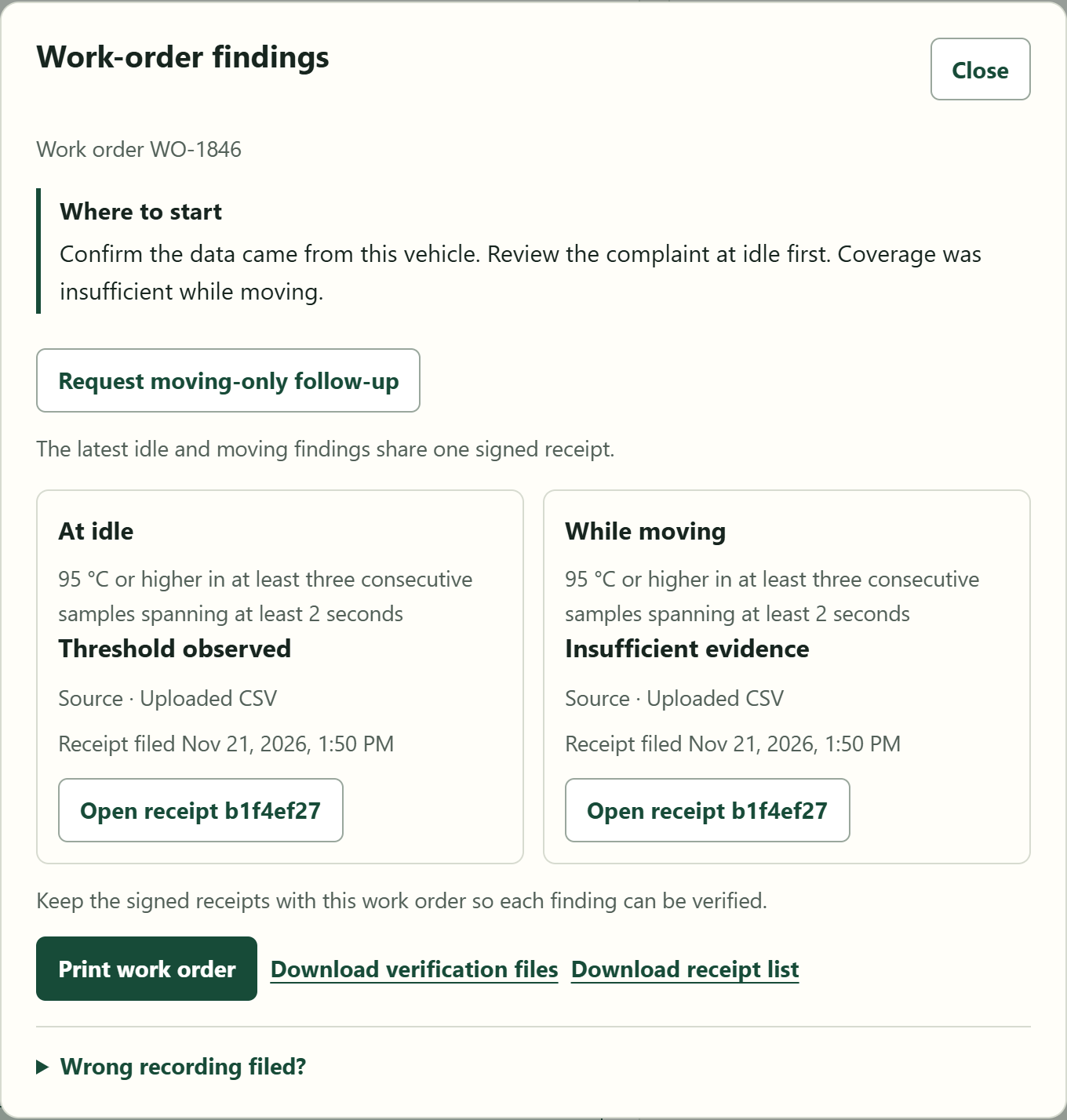
“The temperature gauge crept up in traffic.” The shop needs to know whether coolant crossed its test threshold at idle or while the car was moving. A scan-tool export can also carry timestamps, location and sensor history from the rest of the trip.
The shop sends a file that names the condition and test rule. Repair Receipt runs the check in a local QNX guest and shows the driver the exact finding before asking for consent. The driver sees the exact file size and the fields that travel with the signed finding. The shop verifies the approved, signed finding against its original request. The raw trip log stays with the driver.
Try the proof offline
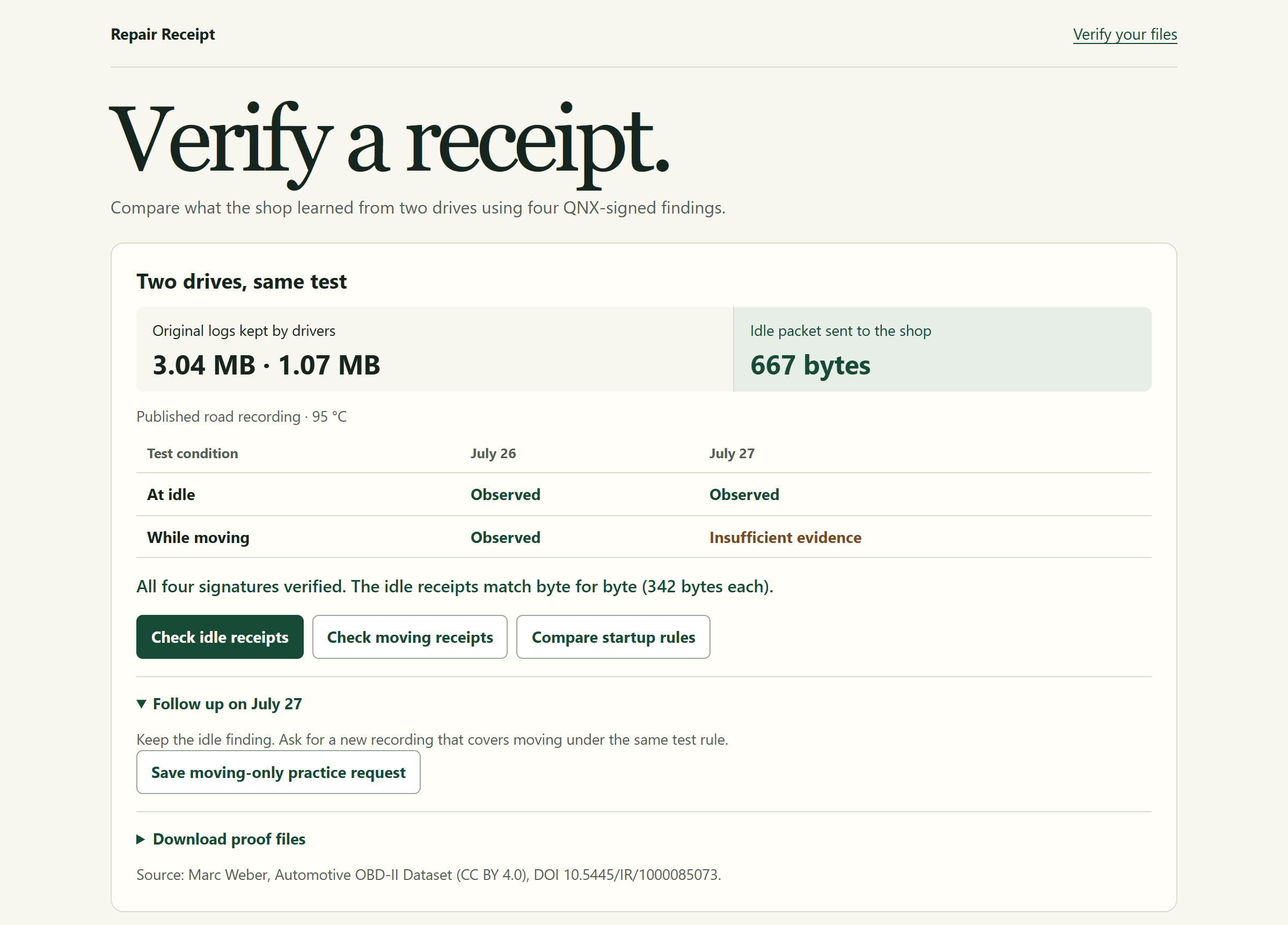
Open the HTML in a Chromium browser. It verifies four signatures and compares two published drives under the same 95 °C test. Logs of 3.04 MB and 1.07 MB produced the exact same 667-byte idle verification packet. While moving, July 26 showed a sustained crossing and July 27 had insufficient coverage. Open Follow up on July 27 to save a moving-only practice request under the same rule. The codelab takes that downloaded file through QNX consent and back into the verifier. Offline verifier · KIT dataset · Measured disclosure
Why operating condition matters
A GM investigation of a Tahoe fleet's cooling-fan complaint asks technicians to take measurements at idle. A Hino service tip concerns a temperature rise at higher speeds or under load. That operating context affects how a shop might try to reproduce a complaint. GM service bulletin · Hino service tip
Why the first second matters
All 81 KIT recordings begin with incomplete readings. A shop can choose a signed rule that allows an incomplete opening if the first complete sample arrives within one second. QNX tells the driver the time excluded before approval. At the 105 °C prototype threshold, 65 of 81 recordings supported both answers with the allowance, up from zero under the whole-recording rule. The 16 recordings with later gaps kept their original findings. Compare startup rules reproduces the July 27 example in the offline verifier. Entire-recording results · Startup allowance results
Why QNX 8.0
A networkless QNX guest authenticates the encrypted samples and evaluates them in a vault process. The vault signs the exact preview after the driver consents. Neutrino message passing and a QNX channel policy give the exporter a route to the approved receipt through an intermediary. The recording and vault memory stay private. Vault and consent code · Channel policy
The codelab boots the same guest executable three times. Remove one channel grant and QNX denies export even after approval. Restore the grant and decline to see the receipt withheld. Approve with the grant restored and verify the signed packet. The simulated OBD-II path uses a 350 ms budget across four serial exchanges. A reply that misses the deadline leaves a coverage gap. Three-trial codelab · Serial timing tests
What remains to validate
The build runs on QNX 8.0 in QEMU with published road recordings and a simulated serial adapter. The receipt describes the recorded samples under the agreed rule. The technician chooses the vehicle-specific threshold and makes the diagnosis. Mechanic feedback, vehicle-side key provisioning and physical adapter testing remain open.
How I used Codex
I used Codex to build the review and consent flow, create the three-trial policy lab, test the driver and shop in a browser, and measure import and startup performance. The application evaluates a deterministic test rule in QNX.
Built with
QNX Everywhere SDP 8.0, QNX Neutrino IPC and security policy, QNX6, QEMU x86-64, C, OpenSSL Ed25519 and AES-256-GCM, Python, SQLite, HTML, CSS and JavaScript.
How to build and test
Download and extract the tested source to a short path such as %USERPROFILE%\rr. Install QNX SDP 8.0, QEMU for x86-64 and 64-bit Python 3.10 or later. Open Command Prompt in the folder that contains build-qnx.cmd. It builds the guest with the SDP's qcc -Vgcc_ntox86_64 and compiles the policy with secpolcompile. Download the tested source ZIP
python -m venv .venv
call .venv\Scripts\activate.bat
python -m pip install -r requirements-live.txt
build-qnx.cmd
start-live.cmd --check
Run start-live.cmd --practice for the driver and shop workflow. Enroll the temporary driver key, create a request for both conditions at 95 °C, and upload fixtures\kit-july-27.csv on the driver page. Approve and file the packet to open the work-order findings and create the moving-only follow-up.
Run start-live.cmd --policy-lab --policy-transcript native-review.md to save the native transcript and one-line policy diff. Run start-live.cmd --road-lab to repeat the four signed road trials. Full walkthrough · Expected native transcript
The demo uses screen captures of the running application and narration synthesized locally from my own recording.
