-
-
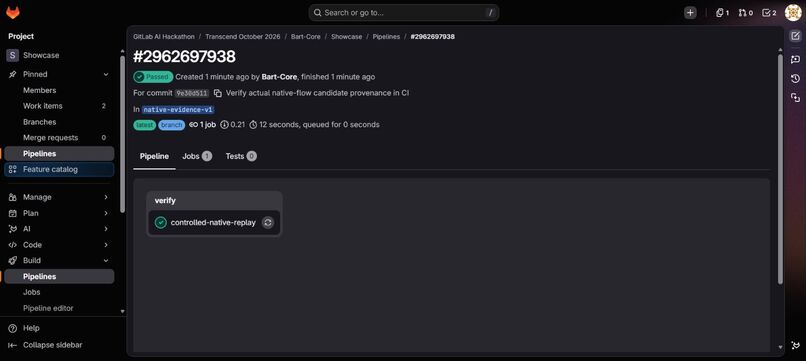
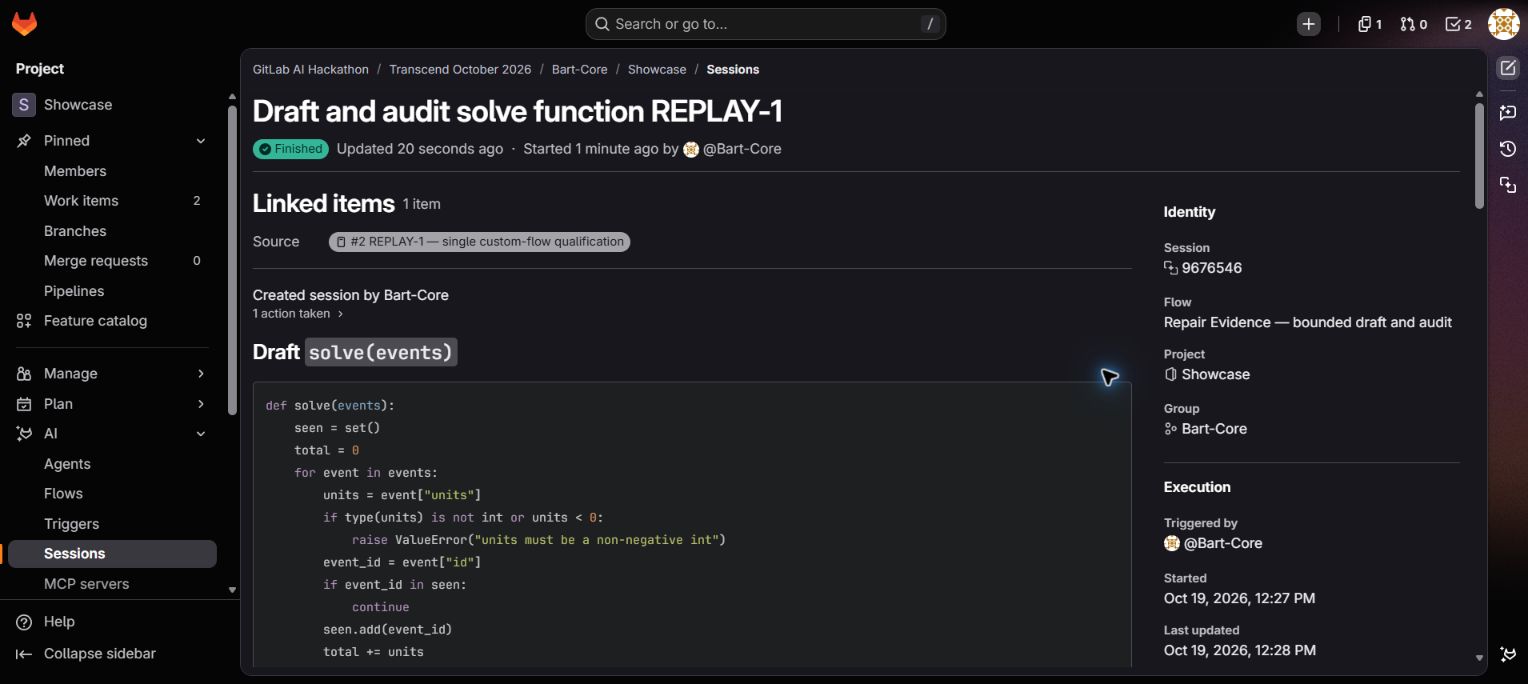
Actual project evidence. Native execution and separate local verification are distinguished in the project story.
-
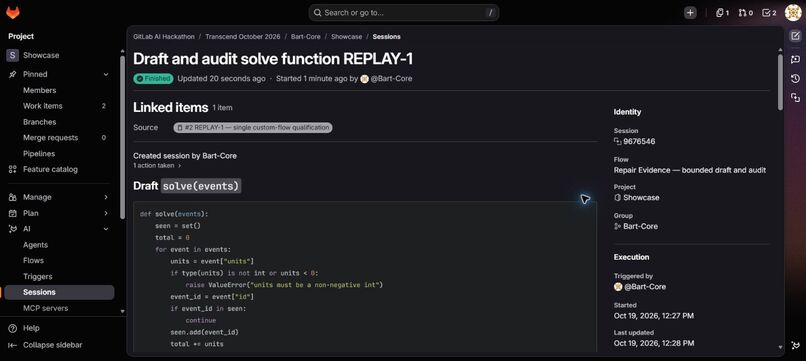
Actual project evidence. Native execution and separate local verification are distinguished in the project story.
-
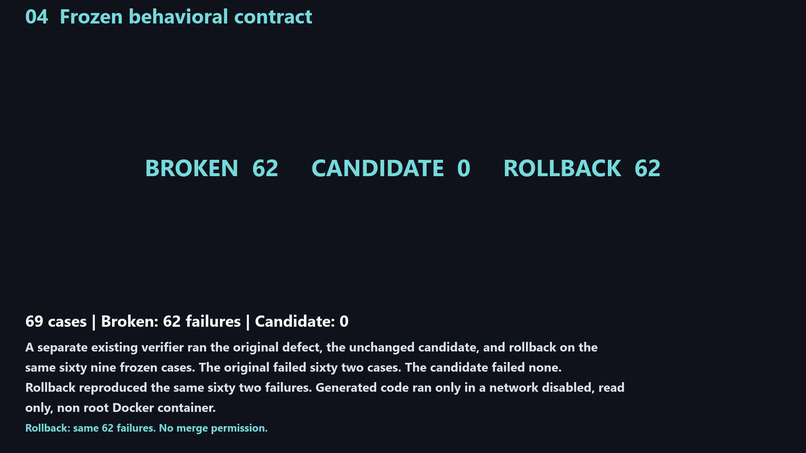
Actual project evidence. Native execution and separate local verification are distinguished in the project story.
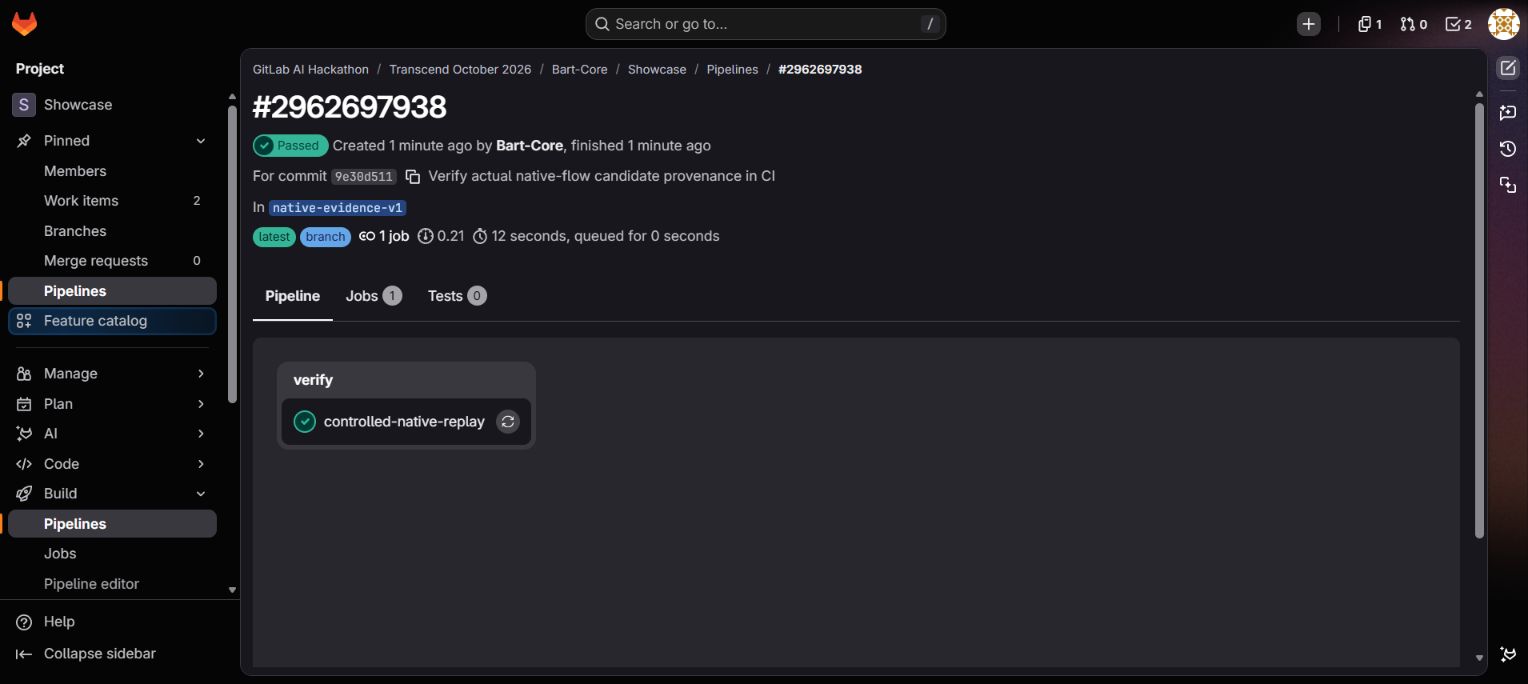
Inspiration
A persuasive repair explanation is not proof that a patch works. We wanted to keep the original defect as a negative control and separate generated code from the authority that judges its results.
What it does
Repair Evidence is new Path A work built for this hackathon. A deliberate Mention in our competition project starts a private two-stage GitLab Duo custom flow. The first stage drafts a Python repair for a synthetic retry-aware event total; the second returns the same source, audits assumptions and explicitly says NOT VERIFIED. The flow has no repository or shell tools and no repository clone.
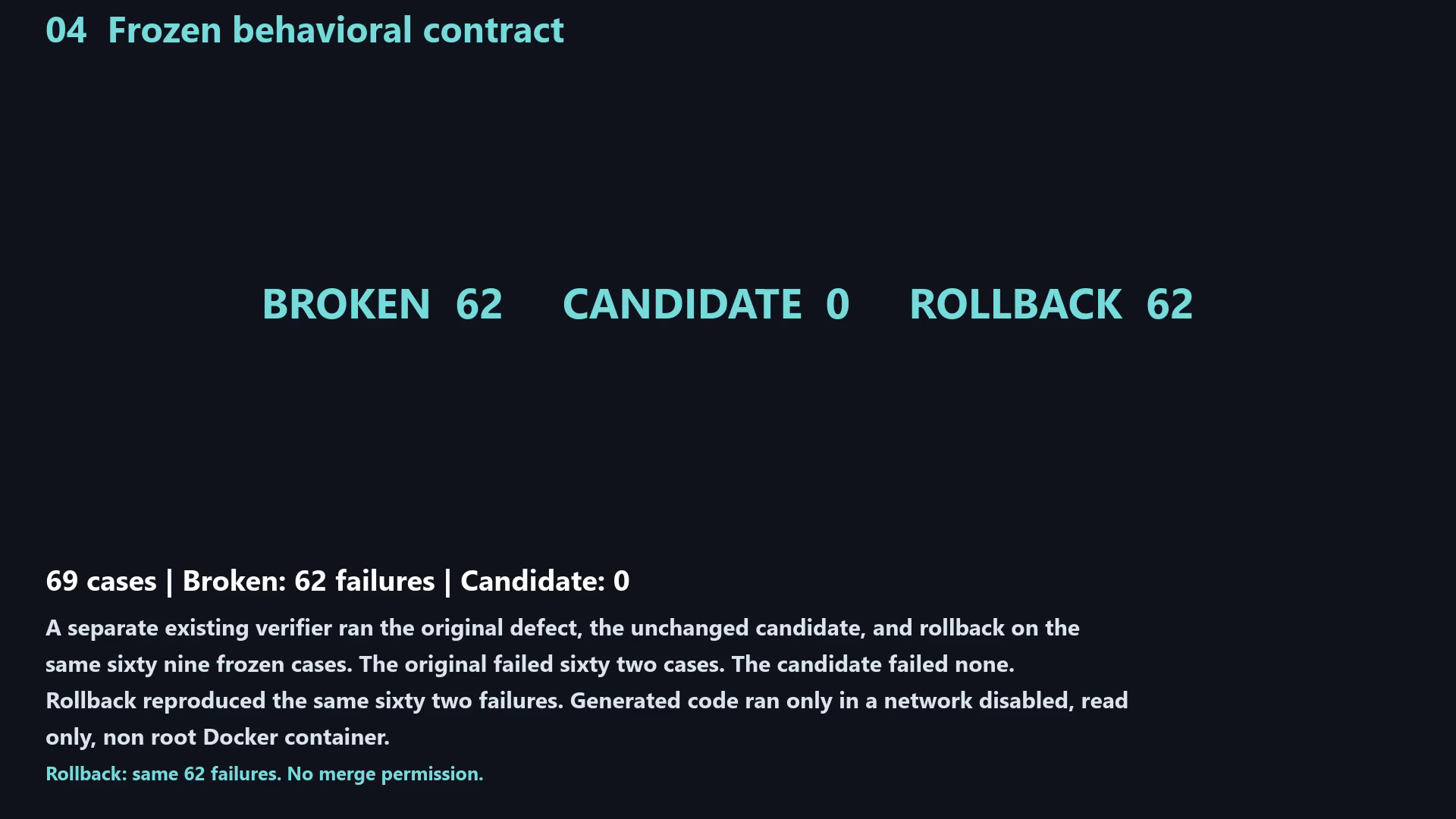
The exact candidate then goes through a separate offline, read-only, non-root Docker verifier against a previously frozen behavioral contract. Original, candidate and rollback receive identical inputs. Source hashes bind the receipt to exact bytes. GitLab CI rechecks sources, policy suites and receipt consistency. Nothing authorizes automatic merge or production deployment. The local verification handoff is orchestrated outside the native flow; we do not claim that the GitLab flow invokes Docker end-to-end.
Actual evidence
Native custom-flow session9676546 finished in68seconds on19October2026. The unchanged candidate passed69 frozen synthetic cases; original and rollback each failed the same62 cases. The initial local attempt had Docker access denied and remained UNKNOWN; the completed isolated run is retained separately. GitLab CI pipeline2962697938/job17280734111 passed49 suite checks plus receipt consistency in12seconds. CI replay is not a fresh cloud Docker experiment.
How we built it
GitLab Duo Agent Platform custom YAML, Python3.12 standard-library verification, pinned-image local Docker isolation, and GitLab CI. MIT-licensed standalone sources and synthetic data only. We reused local tools; no paid API, hosting, tunnel or billing setup was added. The native drafting and audit stages are automated; candidate capture and the external verifier handoff remain explicit.
Challenges
GitLab rejected the documented max_cycles field, so no hard model-step ceiling is claimed. Model self-critique must not become self-certification. The audit does not receive the complete original task context. A CI artifact download was browser-blocked; we preserved that boundary and distinguish visible GitLab logs from a downloaded original artifact.
What we learned
This is one author-designed synthetic task, not a broad agent benchmark. The full behavioral contract alone also caught every measured defect, so incremental rollback detection benefit is not established. No novelty, general superiority, external independent review, prize probability or hostile-code security certification is claimed. Hash-consistent receipts are not signed attestations. The useful result is a working, inspectable evidence boundary.
What is next
Pass the original requirements explicitly to the audit stage, evaluate preregistered unseen tasks, and strengthen trusted evidence collection before claiming broader effectiveness. Human outcome review remains required.
Reproduce and inspect
The public GitLab evidence branch contains the MIT license, instructions, pinned source archives, flow configuration, candidate and receipts. Extract the original archive first, then the flow archive into the same fresh directory. Review the collector before actually running generated code in the documented isolated container. The updated 2m18s English demo records the real project tab during native session 9687415 (19 October 2026, 75 seconds, job17286028512). It shows the running flow, generated draft, finished state and static NOT VERIFIED audit. This is a low-frame-rate browser capture with gaps cut and explanation cards, not reconstructed UI or a simulation; it is silent. This new candidate has not undergone the earlier independent tests. The 69-case results above belong only to original session9676546.

Log in or sign up for Devpost to join the conversation.