-
-
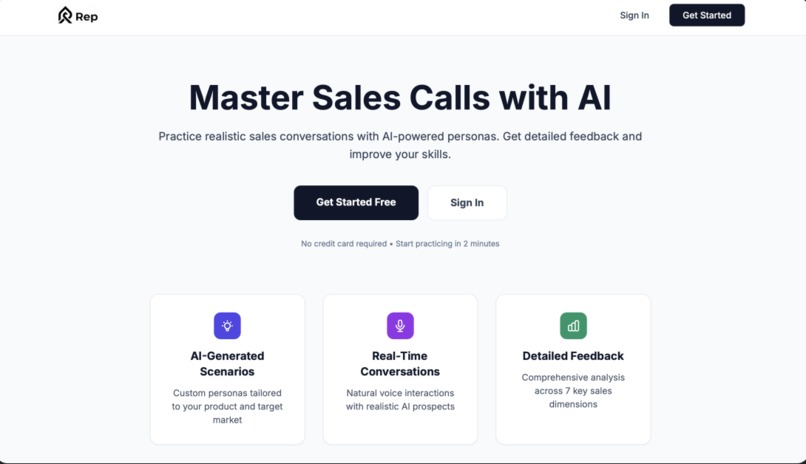
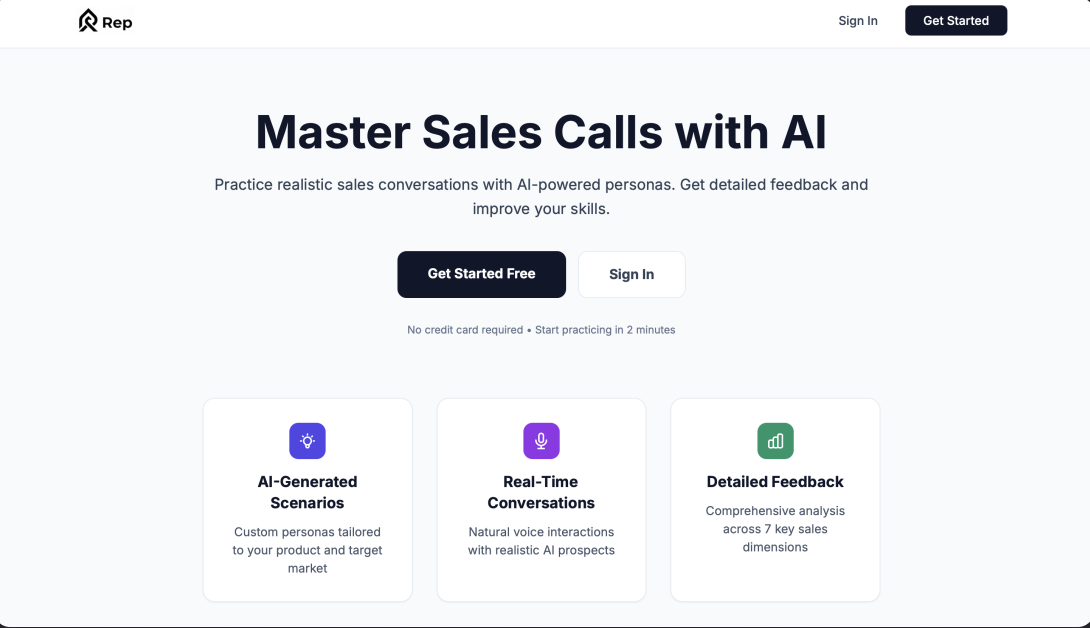
Landing Page
-
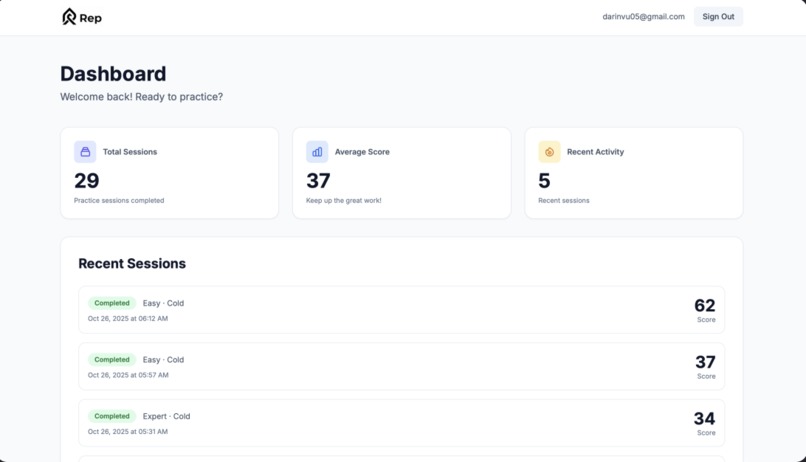
Personalized Dashboard
-
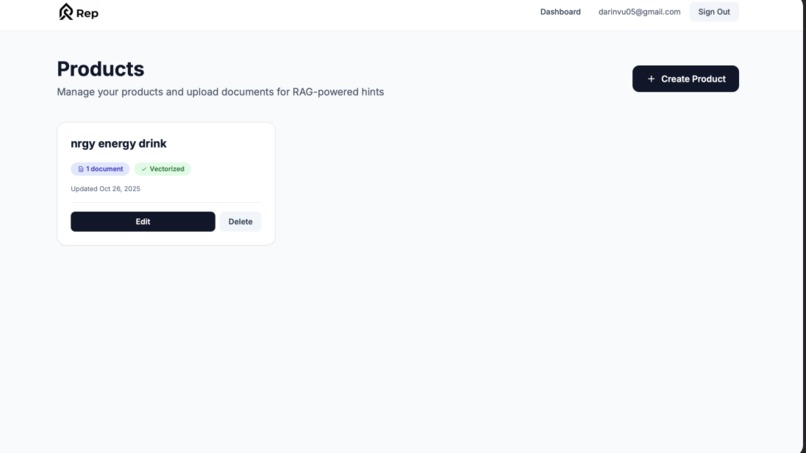
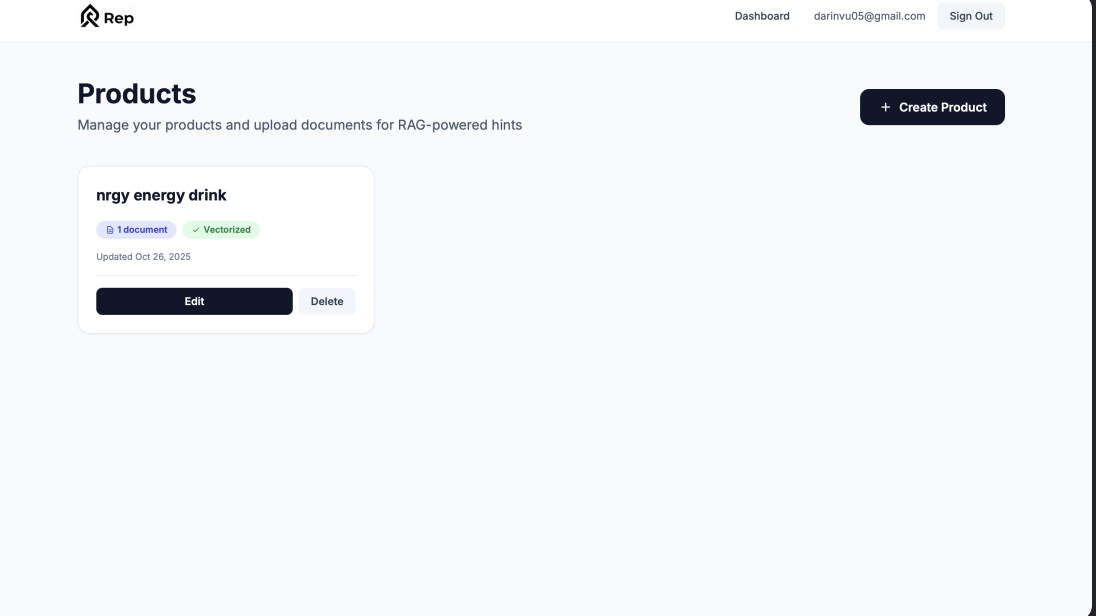
Product section that lists vectorized information.
-
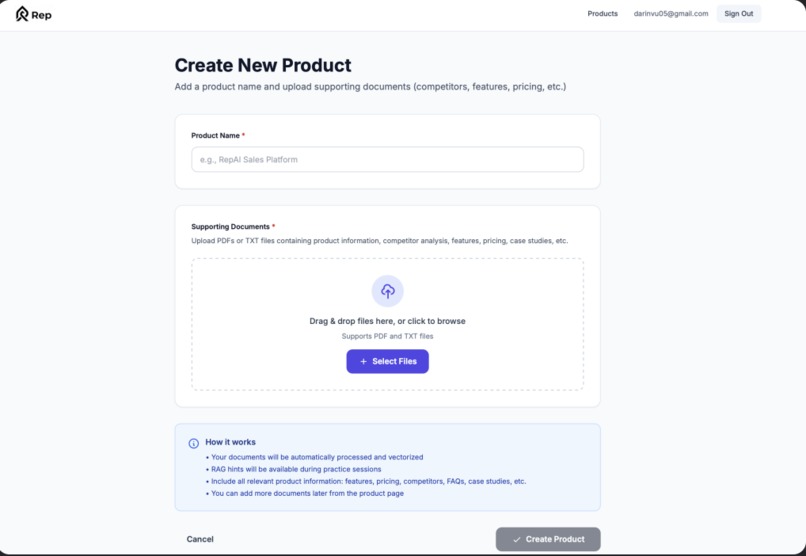
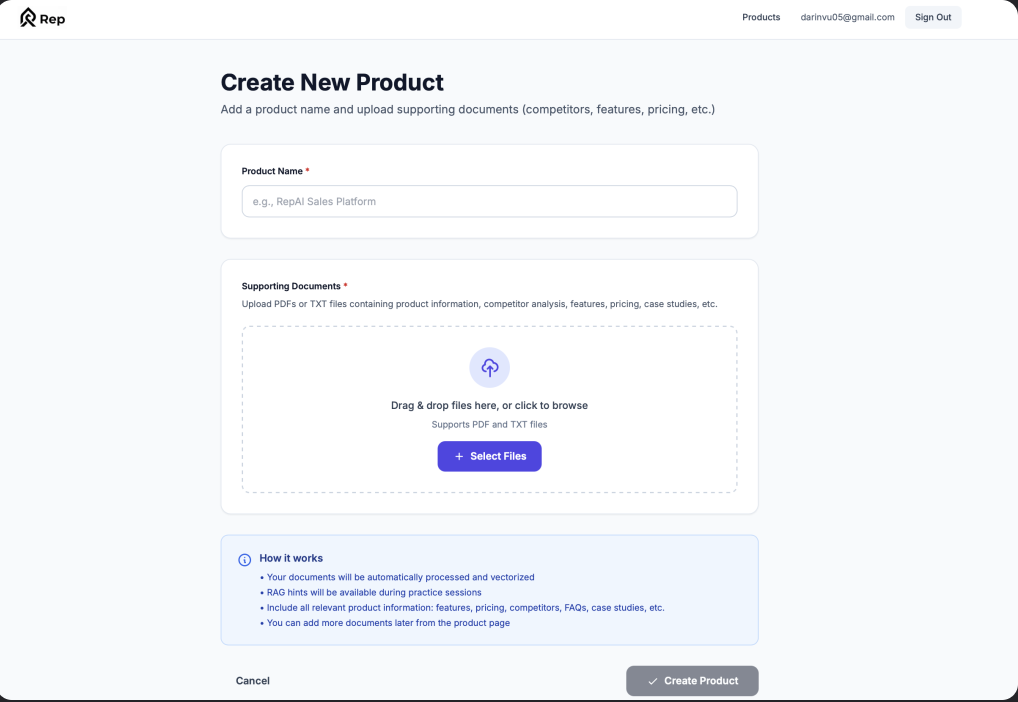
Product creation page.
-
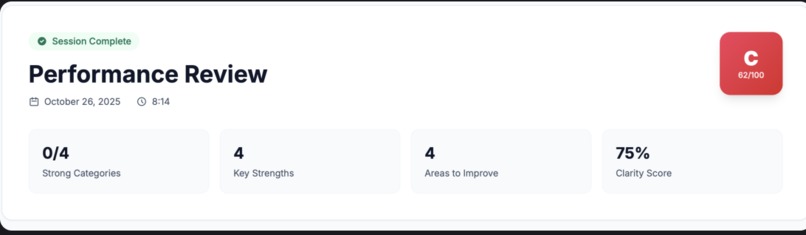
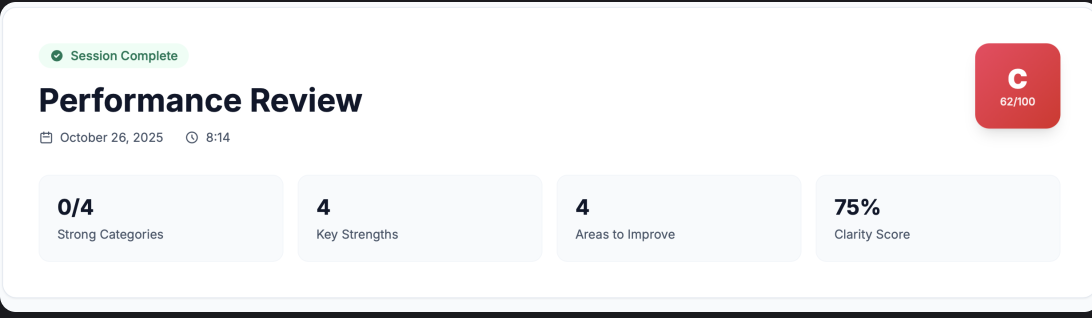
Overvall performance review.
-
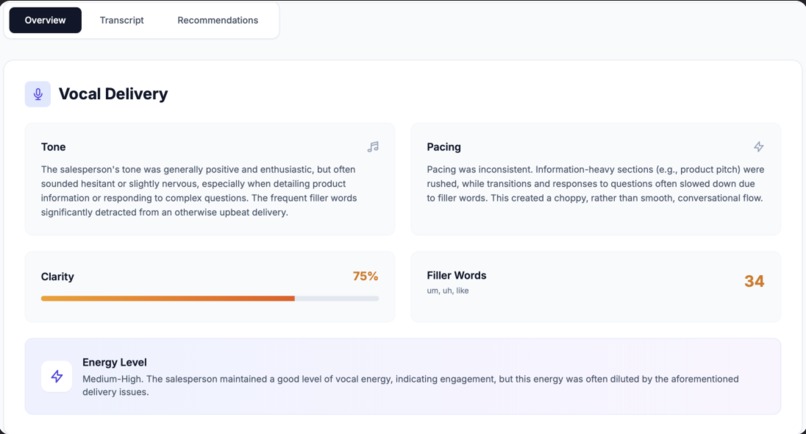
Vocal Delivery review.
-
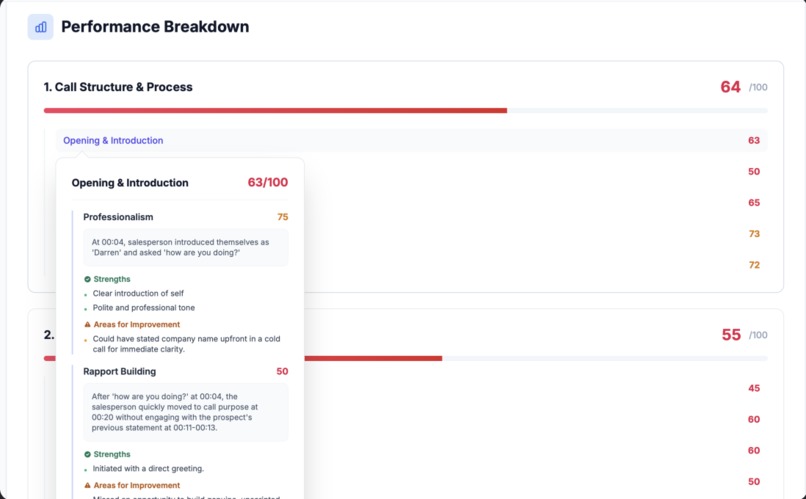
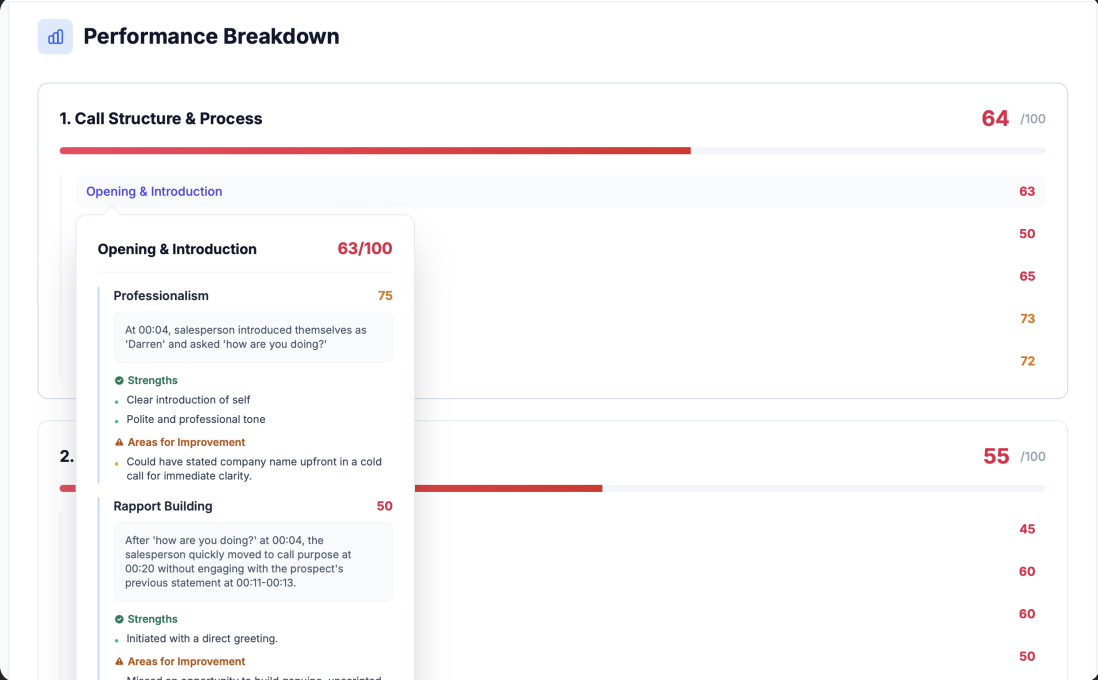
Performance Breakdown by category. Hovering over category will give you details.
-
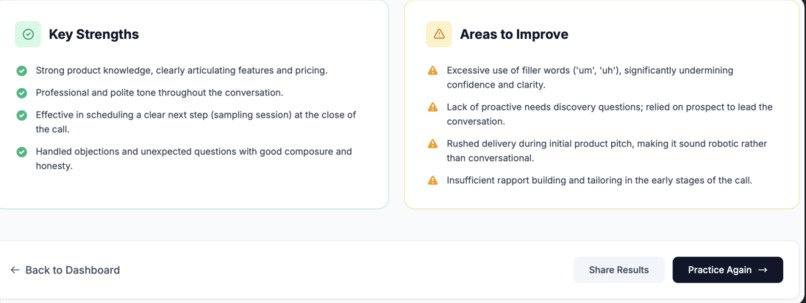
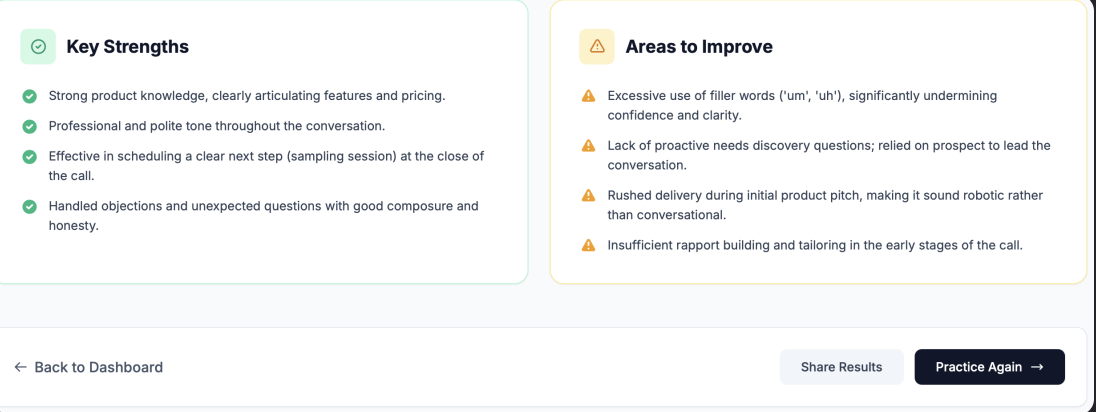
List of strengths and weaknesses.
-
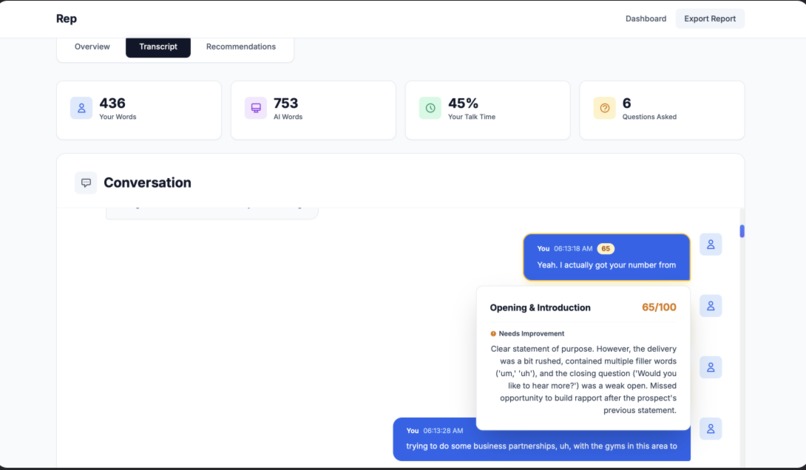
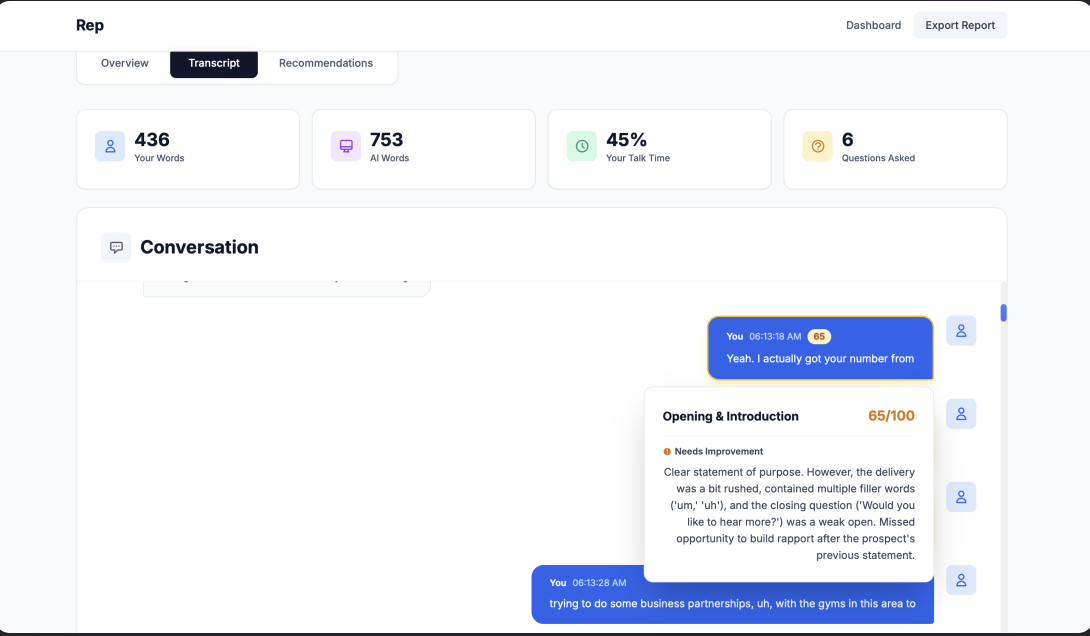
Transcript review section with entire transcript and AI notes on user messages.


About Rep
The Inspiration
Sales is one of the highest-paid professions, yet most sales reps get minimal practice before jumping on real calls with prospects. Athletes practice thousands of hours before game day—why shouldn't salespeople?
We were inspired by a simple realization: the best way to get better at sales is to practice, but practice partners are expensive, inconsistent, and hard to schedule. What if AI could be your perfect practice partner—available 24/7, infinitely patient, and able to simulate any buyer persona?
The idea crystallized when we saw the convergence of four technologies:
- Claude's advanced reasoning for realistic role-play
- ChromaDB + Claude for RAG system to retrieve product information in real time
- Real-time voice AI Agent with sub-500ms latency
- LLM-powered performance analysis
We realized we could build something that doesn't just record calls—it actively makes salespeople better.
How We Built It
Architecture Overview
We built a full-stack platform with three distinct AI pipeline stages:
Setup → Practice → Analysis
  ↓            ↓                                           ↓
Claude   Vapi (with ElevenLabs)   Gemini
Frontend Stack:
- Next.js 14 with React 18 for the web app
- Tailwind CSS + shadcn/ui for beautiful, responsive design
- Vapi Web SDK for crystal-clear voice conversations
- Zustand for lightweight state management
Backend Stack:
- FastAPI (Python) for async API endpoints
- Supabase (PostgreSQL) for data persistence with RLS
- ChromaDB for RAG-based hint system
- Vapi for voice AI orchestration
The Three-Stage Pipeline
Stage 1: Scenario Generation (Claude)
When users input their product details and target persona, we use Claude 4.5 Sonnet to generate hyper-realistic buyer scenarios:
scenario = await claude.messages.create(
    model="claude-4-5-sonnet",
    messages=[{
        "role": "user",
        "content": f"Generate realistic buyer persona for {product}..."
    }]
)
The AI creates:
- Full persona backstory (role, company, pain points)
- 3-5 realistic objections they'll raise
- Hidden information (budget, timeline, competitors)
- Personality traits and communication style
- and much more
Stage 2: Real-Time Conversation (Vapi + RAG)
We integrated Vapi to handle the entire voice pipeline:
- Speech-to-text (Deepgram Nova-2)
- LLM orchestration (Claude as the buyer)
- Text-to-speech (ElevenLabs)
- Sub-500ms latency for natural dialogue
RAG-Powered Hints: We built a hint system using ChromaDB that retrieves relevant sales information on the product the user is selling during the call:
const vapi = new Vapi(apiKey);
vapi.start(assistantId);

vapi.on('message', (message) => {
    if (message.type === 'transcript') {
        // Real-time transcript updates
        displayTranscript(message);
    }
});
Stage 3: Performance Analysis (Gemini)
After the call, we run comprehensive analysis:
Core Analysis: Ge evaluates 7 skill categories (Discovery, Objection Handling, Rapport Building, etc.) with specific examples and timestamps.
# Embed sales best practices
vector_store = chromadb.PersistentClient(path="./chroma_data")
hints_collection = vector_store.get_or_create_collection("sales_hints")

# Retrieve context-aware hints
results = collection.query(
    query_texts=[user_message],
    n_results=3
)
The system scores performance on a 0-100 scale per category:
$$\text{Overall Score} = \frac{1}{7}\sum_{i=1}^{7} S_i$$
where $S_i$ represents each skill category score.
What We Learned
Technical Breakthroughs
Voice AI is Production-Ready: Vapi's infrastructure gave us sub-500ms latency without building complex audio pipelines. This was game-changing—natural conversation requires instant responses.
LLMs as Actors: Claude is shockingly good at roleplay when given detailed personas. The key is in the prompt engineering—we spent days iterating on the system prompt to make buyers feel authentic.
RAG for Real-Time Coaching: Embedding sales best practices in ChromaDB and retrieving relevant hints during calls was more effective than we expected. The context-aware suggestions feel like having a sales coach in your ear.
WebSocket State Management: Coordinating real-time transcript updates, audio streaming, and UI state required careful architecture. We learned to separate concerns and use React's concurrent features.
Product Insights
Feedback Must Be Specific: Generic feedback like "good job" doesn't help. We had to timestamp exact moments and quote conversations to make insights actionable.
Difficulty Calibration Is Hard: Making scenarios progressively harder while keeping them realistic required extensive prompt engineering and testing.
Users Want Progress Tracking: The analytics dashboard became as important as the practice itself. Seeing improvement over time drives engagement.
Challenges We Faced
Challenge 1: Audio Latency Battle
Problem: Initial experiments with custom WebRTC + OpenAI Realtime API had 1-2 second delays, killing conversation flow.
Solution: Switched to Vapi, which handles the entire audio pipeline with optimized edge infrastructure. Latency dropped to <500ms, making conversations feel natural.
Challenge 2: Transcript Synchronization
Problem: Real-time transcripts from Vapi arrived out-of-order, causing UI jumps and confusion.
Solution: Implemented event sequencing with timestamps and a reconciliation algorithm:
def reconcile_transcript(events):
    sorted_events = sorted(events, key=lambda x: x['timestamp'])
    deduplicated = remove_duplicates(sorted_events)
    return merge_partial_transcripts(deduplicated)
Challenge 3: Cost Optimization
Problem: Running three Claude API calls per session (scenario, conversation, analysis) was expensive (~$2-3 per session).
Solution:
- Caching common scenarios (reduced scenario costs by 70%)
- Using Claude Haiku for simple tasks
- Batching analysis requests
- Implementing strict session duration limits
Final cost: ~$1.00-1.85 per 15-min session
Challenge 4: Feedback
Problem: Initial analysis was too vague: "You did well on discovery."
Solution: Structured output with:
- Timestamped examples from transcript
- Specific quote + feedback pairs
- Side-by-side comparison of what was said vs. what could've been said
- Quantified metrics (talk time ratio, questions asked, objections handled)
What's Next
We're just getting started. Future plans include:
- Multi-persona calls (practice with buying committees)
- Voice cloning (practice with recordings of real buyers)
- Team features (manager dashboards, shared scenario libraries)
- CRM integration (import real prospect data)
- Mobile app (practice anywhere)
The Big Lesson
Building AI products is less about the models and more about the orchestration. The magic isn't in one API call—it's in chaining multiple AI services together with great UX to create something that feels seamless.
Rep proves that with the right architecture, AI can be more than a chatbot—it can be a coach, a practice partner, and a path to mastery.


Log in or sign up for Devpost to join the conversation.