-
-
-
-
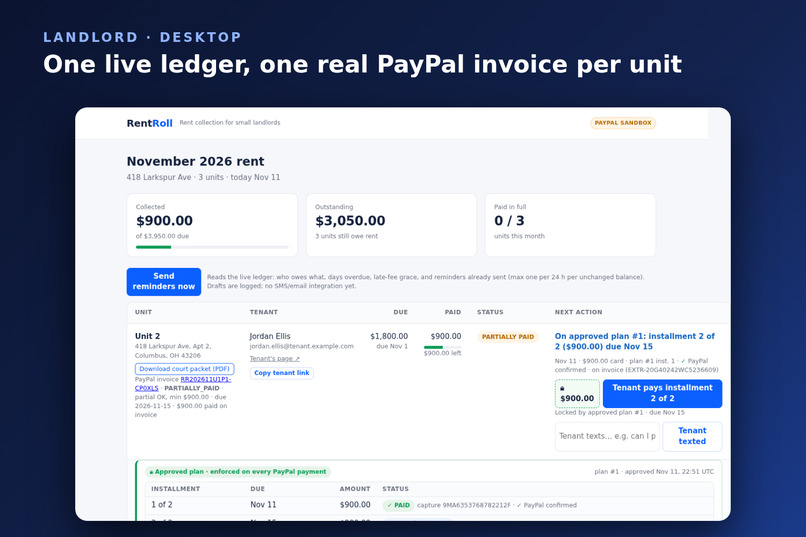
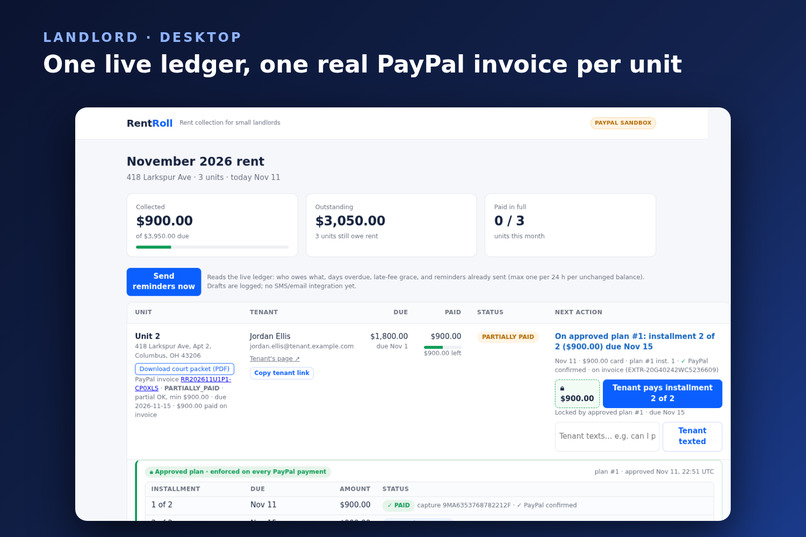
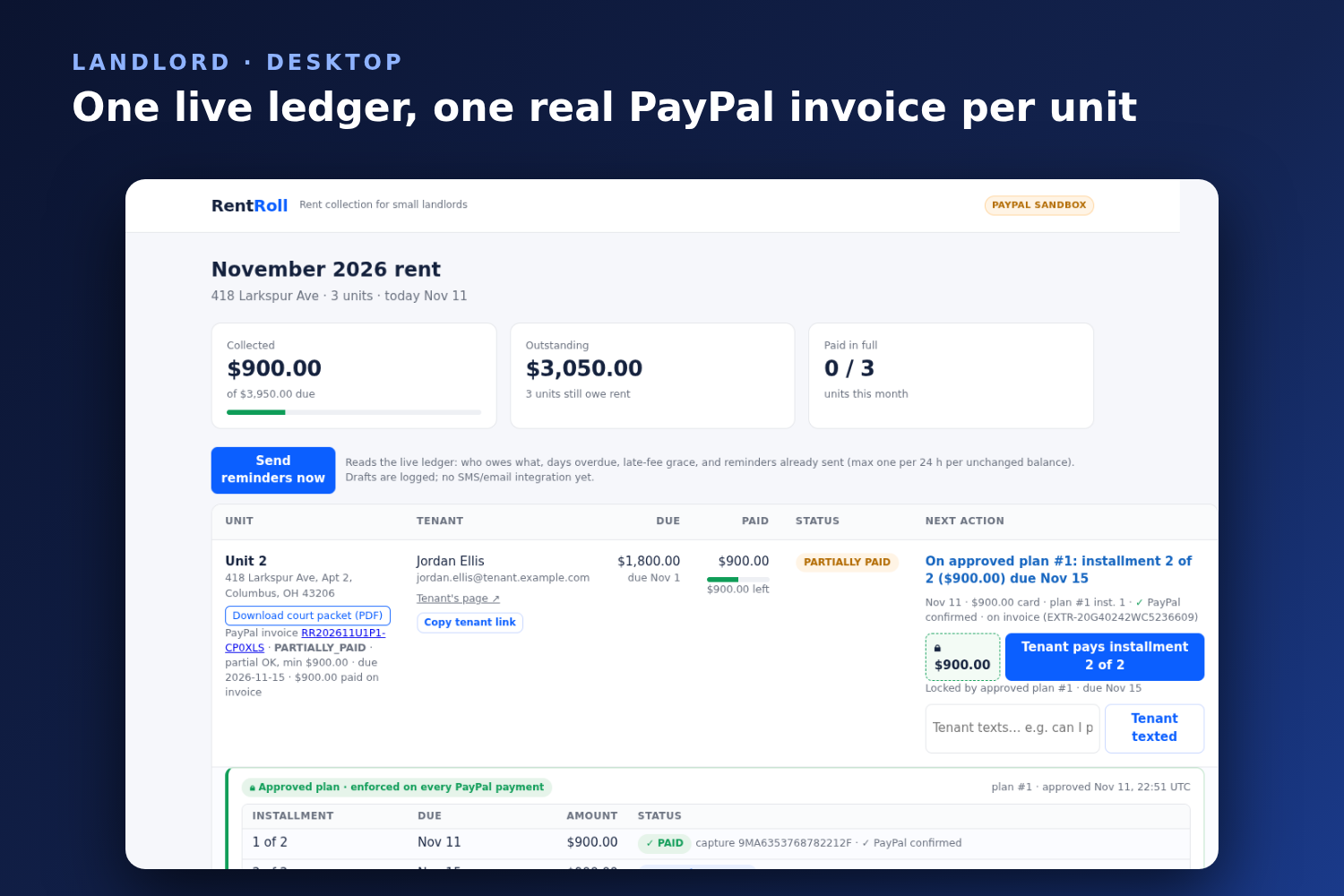
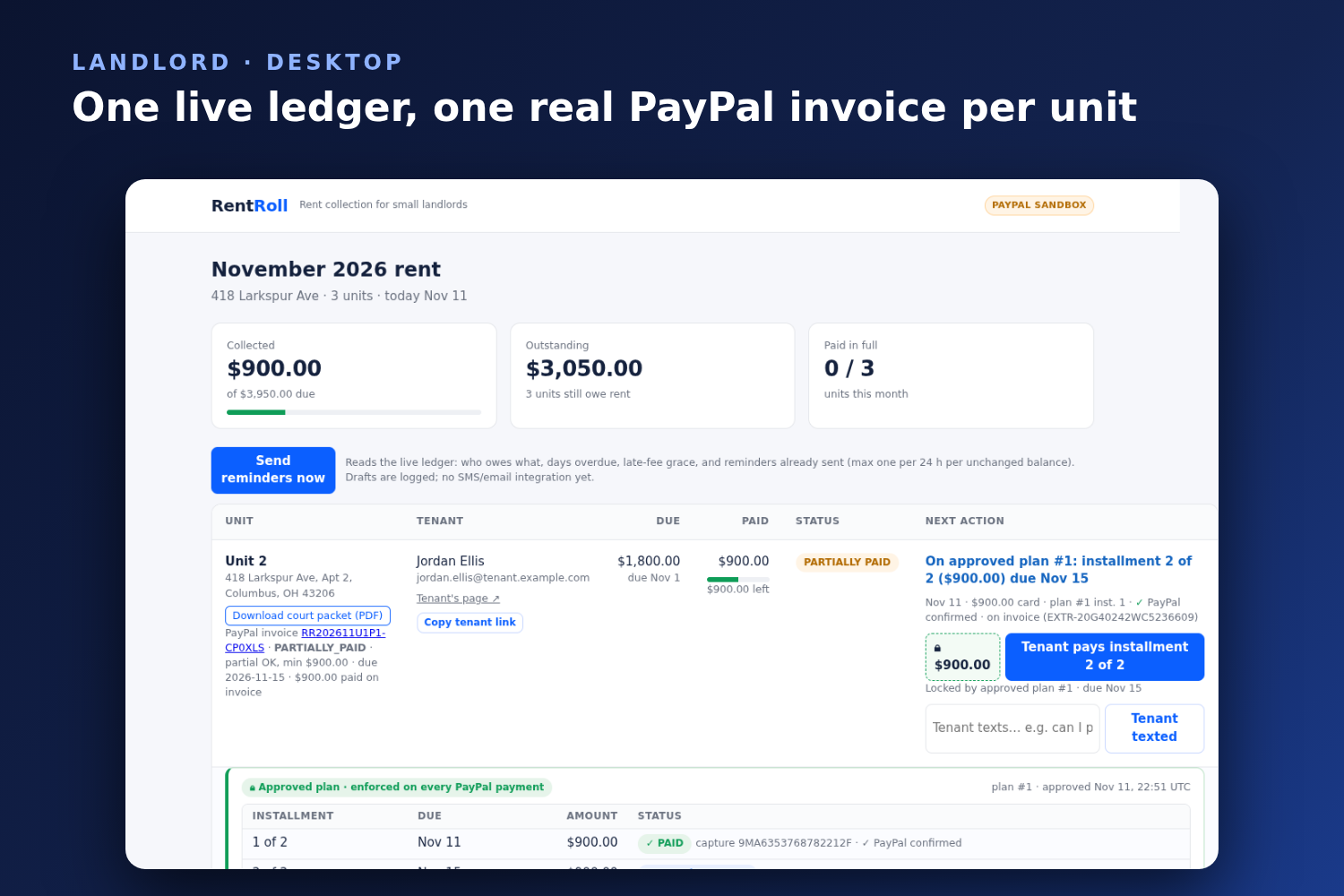
Landlord UI
-
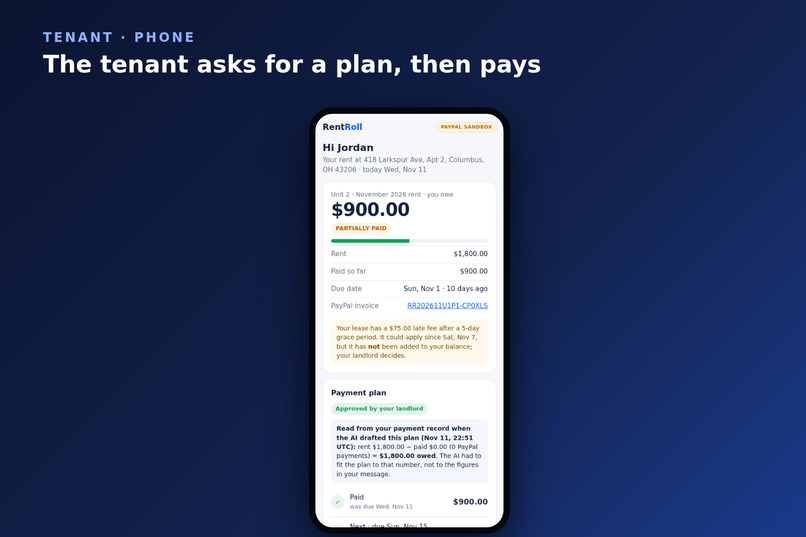
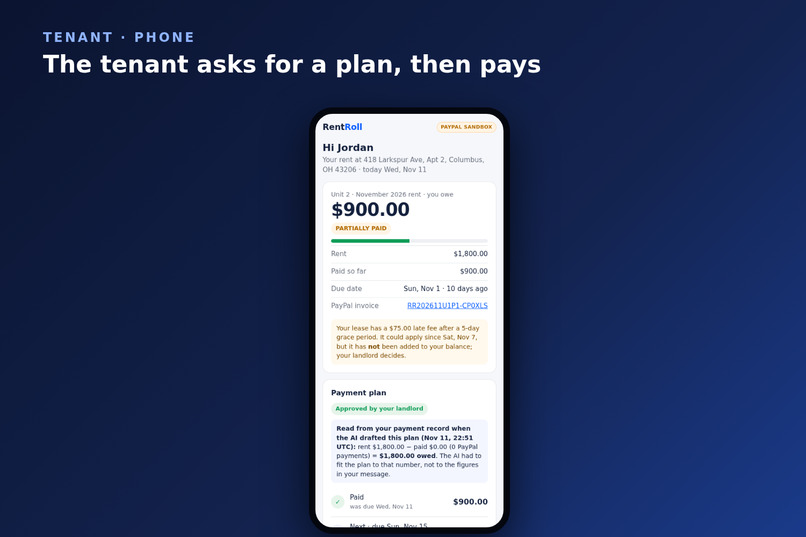
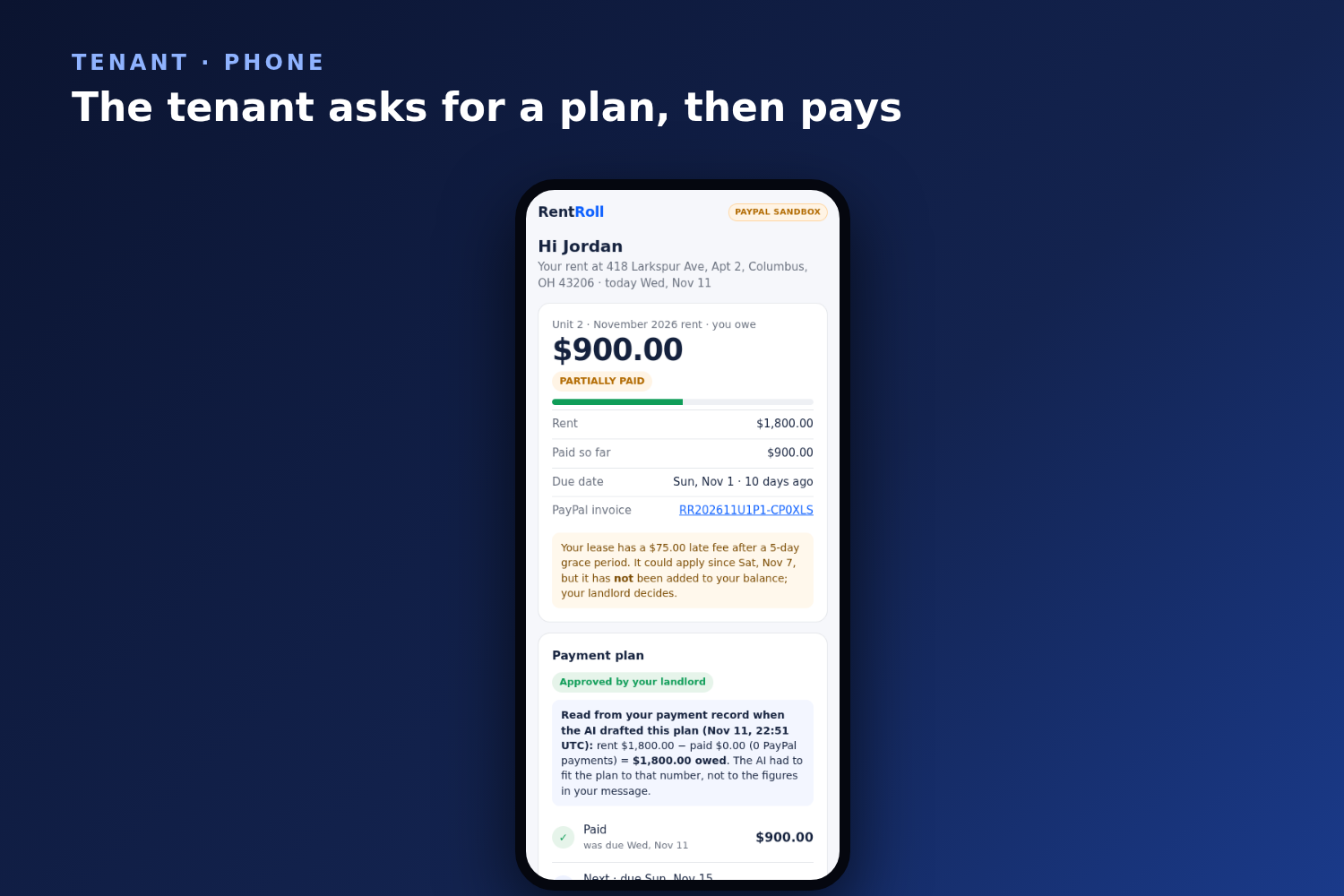
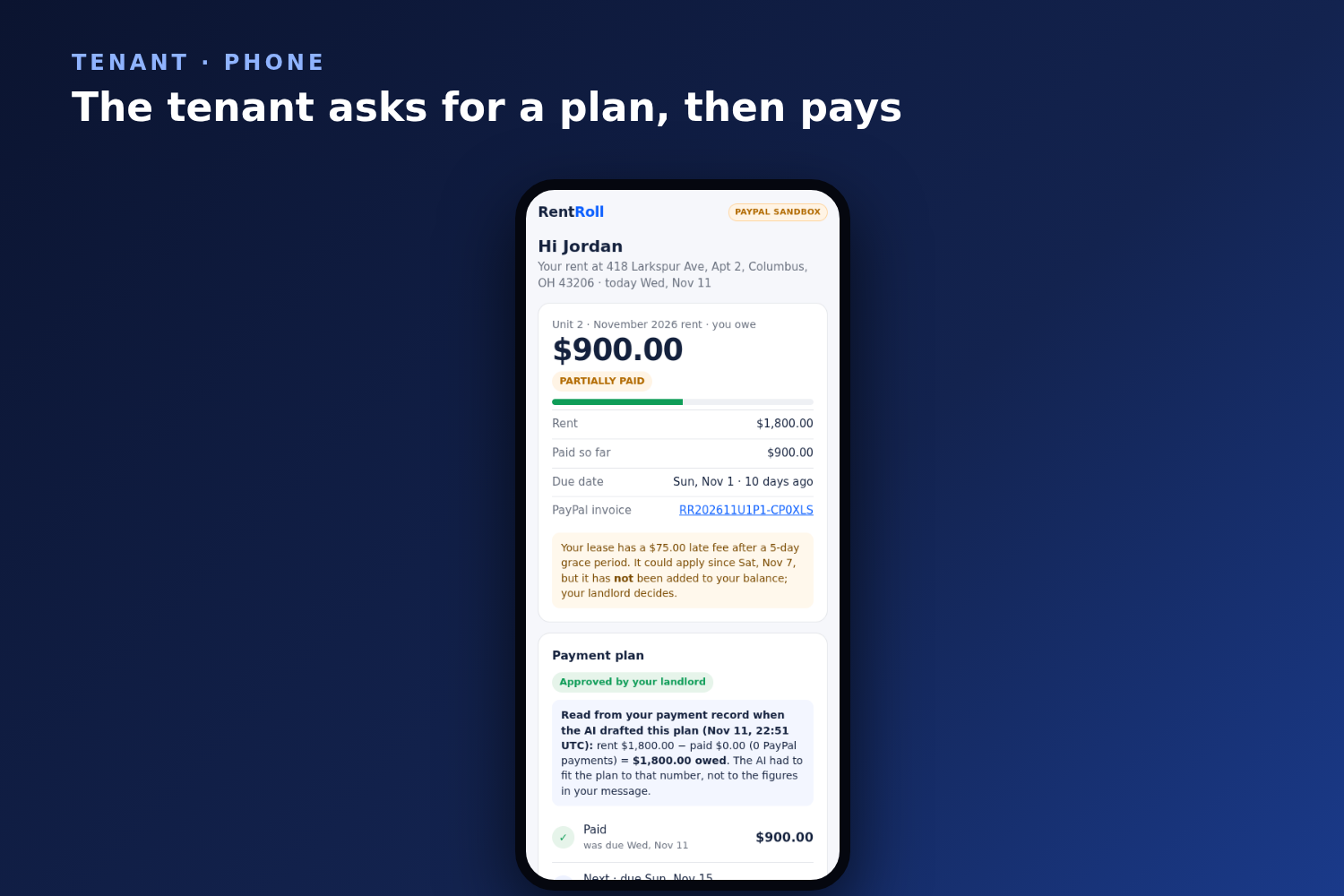
Tenant UI
-
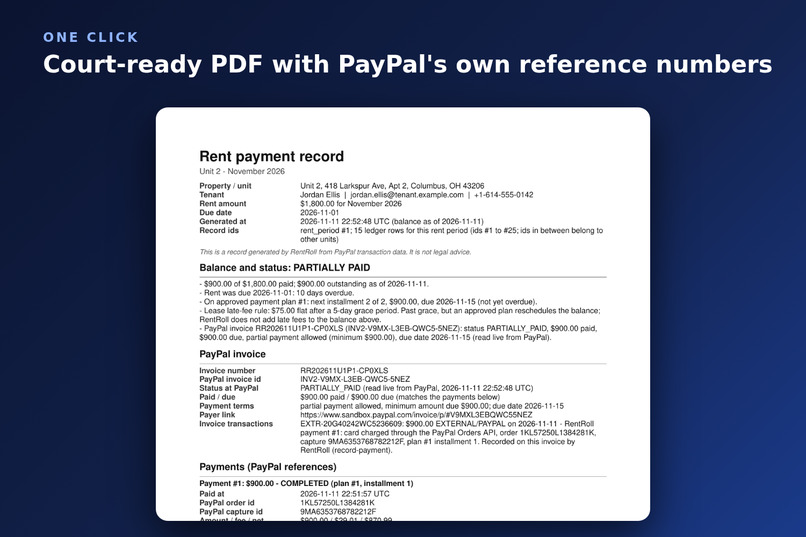
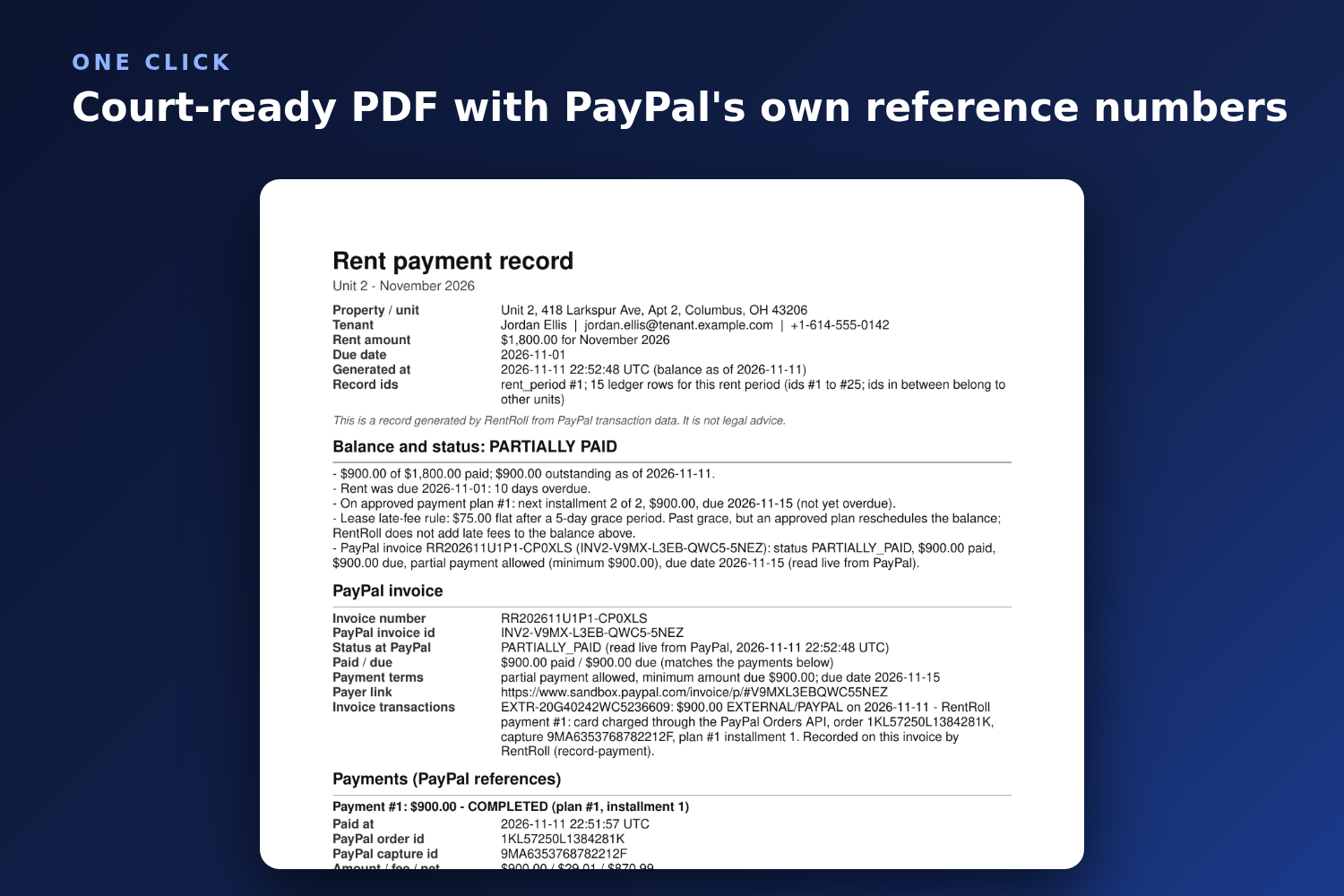
Court PDF
Try it (for judges)
- Live demo: https://nikopi5.tail4aaac7.ts.net/ (PayPal sandbox, no real money moves)
- Login:
judge-87ba79/XJViJsMgMy27zo0pfePt - Steps:
- Pick a unit and click "Tenant's page ↗" to see the tenant's phone view.
- Type a request like
can I pay 600 now and the rest on the 20th. - Approve the AI's plan on the landlord dashboard.
- Pay the installment from the tenant page.
- Download the court packet.
Inspiration
"Top of each month is my wife and I asking each other if the tenant paid rent." — a landlord on r/Landlord, November 2026
We read 2,617 Reddit posts about payment problems. About thirty came from small landlords chasing rent by hand. They own one to four units, and their tenants pay over Zelle, Venmo and PayPal. Every month they check three apps to see who paid. When a tenant texts "can I pay 800 now and the rest on the 15th?", the deal lives in that text thread. Nobody checks the next payment against it. If it ends up in small claims court, the landlord rebuilds the story from screenshots.
What it does
RentRoll is rent collection for landlords with one to four units, built on PayPal.
- One real PayPal invoice per unit per month, created and sent through the Invoicing API.
- The tenant gets a private link that works on a phone, with no account and no app. They see what they owe and can ask for more time in plain words.
- The AI reads the real ledger first. Our code works out the balance from completed PayPal payments, and only then does the model turn the tenant's message into a plan that adds up to it.
- Approval changes the PayPal invoice itself. When the landlord approves a plan, RentRoll turns on partial payment, sets the minimum amount due to the next installment, and moves the due date. Then it reads the invoice back to confirm PayPal stored the change.
- Only the agreed amount gets through. PayPal enforces a minimum, not a schedule, so RentRoll refuses any other amount before PayPal is ever called.
- PayPal's signed webhooks reconcile every payment against a fresh read of the invoice.
- Reminders follow the real state. A friendly nudge comes inside the grace period, a firm reminder once the late fee applies, and a formal notice after two weeks. They stop the moment the tenant pays.
- One click makes a court-ready PDF: every message, plan, reminder and payment, dated, with PayPal's own invoice, order and capture numbers.
How we built it
- Backend: Node.js, Express and SQLite. pdfkit generates the court packet.
- PayPal: Invoicing API v2 for the monthly invoices and plan updates, the Orders API for the sandbox card payment, and webhooks with signature verification. It's all in the sandbox.
- AI: NVIDIA Nemotron (
nemotron-3.5-lightning-30b-a3b) through NVIDIA NIM, used for two jobs: turning a tenant's message into a payment plan, and writing reminder text. - The model never gets the last word. Plan amounts must add up to the real balance, dates must be valid, and reminders must quote the exact amount owed. A plan that fails goes to "needs review" and can't be approved. A reminder that fails falls back to a fixed template.
- Hosting: a Raspberry Pi 5 behind Tailscale Funnel, which also receives PayPal's webhooks.
- How the code got written: Claude Code wrote it, run by an orchestrator agent, sprint by sprint, each on its own branch. Before anything merged, a fresh AI tester that hadn't written the code ran it against the real PayPal sandbox and reported pass or fail with evidence.
Challenges we ran into
- PayPal enforces a minimum, not a schedule. An invoice can say "at least $600", but it can't say "$600 now, $1,200 on the 20th". So RentRoll keeps the schedule itself, writes the next installment onto the invoice, and refuses any other amount before calling PayPal.
- Paying an invoice in the sandbox normally needs a buyer login. Our demo's tenant pays with a PayPal sandbox test card through the Orders API. RentRoll then records that capture on the invoice, and PayPal moves the invoice to PARTIALLY_PAID, then to MARKED_AS_PAID.
- Invoicing permission. On our first night every Invoicing call returned 403, so we built on Orders and switched the core back to real invoices once access worked.
- The AI tester caught a real security bug. In an early sprint, forged webhooks were accepted. It was fixed and re-tested before merging.
Accomplishments that we're proud of
- The ledger matters, and we measured it. A tenant had paid $800 of $1,800 and asked to pay "900 now and the rest later".
- With the ledger, the model proposed $900 + $100.
- With only the rent amount, the same model proposed $900 + $900, overcharging by $800, and our validator rejected that plan.
- Every number in the demo is real sandbox data: real invoices, real captures, real signed webhooks.
- The landlord and the tenant each have their own screen, and both read the same ledger.
What we learned
- A chatbot can write a payment plan. It can't see what was paid, and it can't stop PayPal from taking the wrong amount. The useful part of the AI here is small. The product around it is the useful part.
- Fees are an honest weakness. Avail, TurboTenant and Zillow collect rent by bank transfer for free. In our sandbox runs PayPal took $25.82 on an $800 payment. RentRoll is for landlords whose tenants already pay through PayPal or Venmo, who negotiate partial payments, and who need a record they can take to court.
- Real user posts beat guesses. The Reddit posts gave us the persona, the exact wording tenants use, and the court-packet idea.
What's next for RentRoll
- Send reminders by SMS and email. Today they're drafted and logged, not sent.
- Let tenants pay on PayPal's hosted invoice page and with Venmo. The webhook code for this is written but not tested end to end.
- Support security deposits and move-in payments, so the keys only change hands after the money has cleared.
- Add multi-month history and a yearly statement for taxes.
Built With
- express.js
- node.js
- nvidia-nim
- paypal-invoicing-api-v2
- paypal-orders-api
- paypal-webhooks
- pdfkit
- sqlite
- tailscale
