-
-
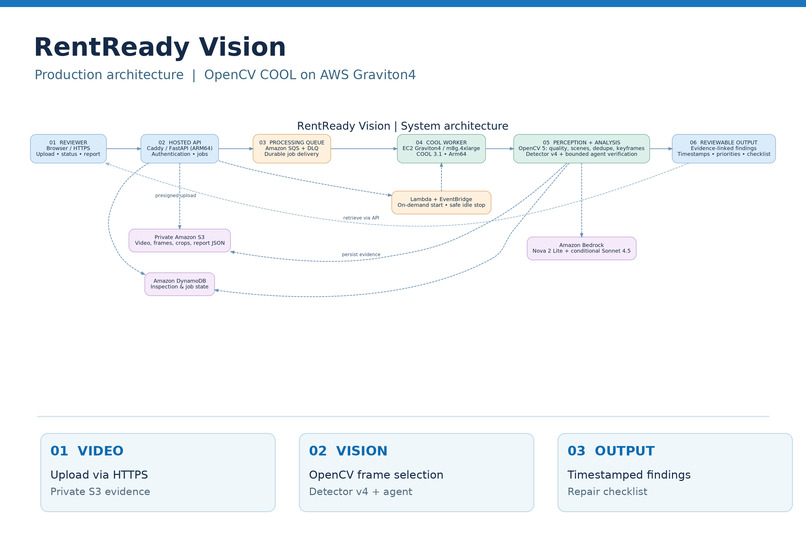
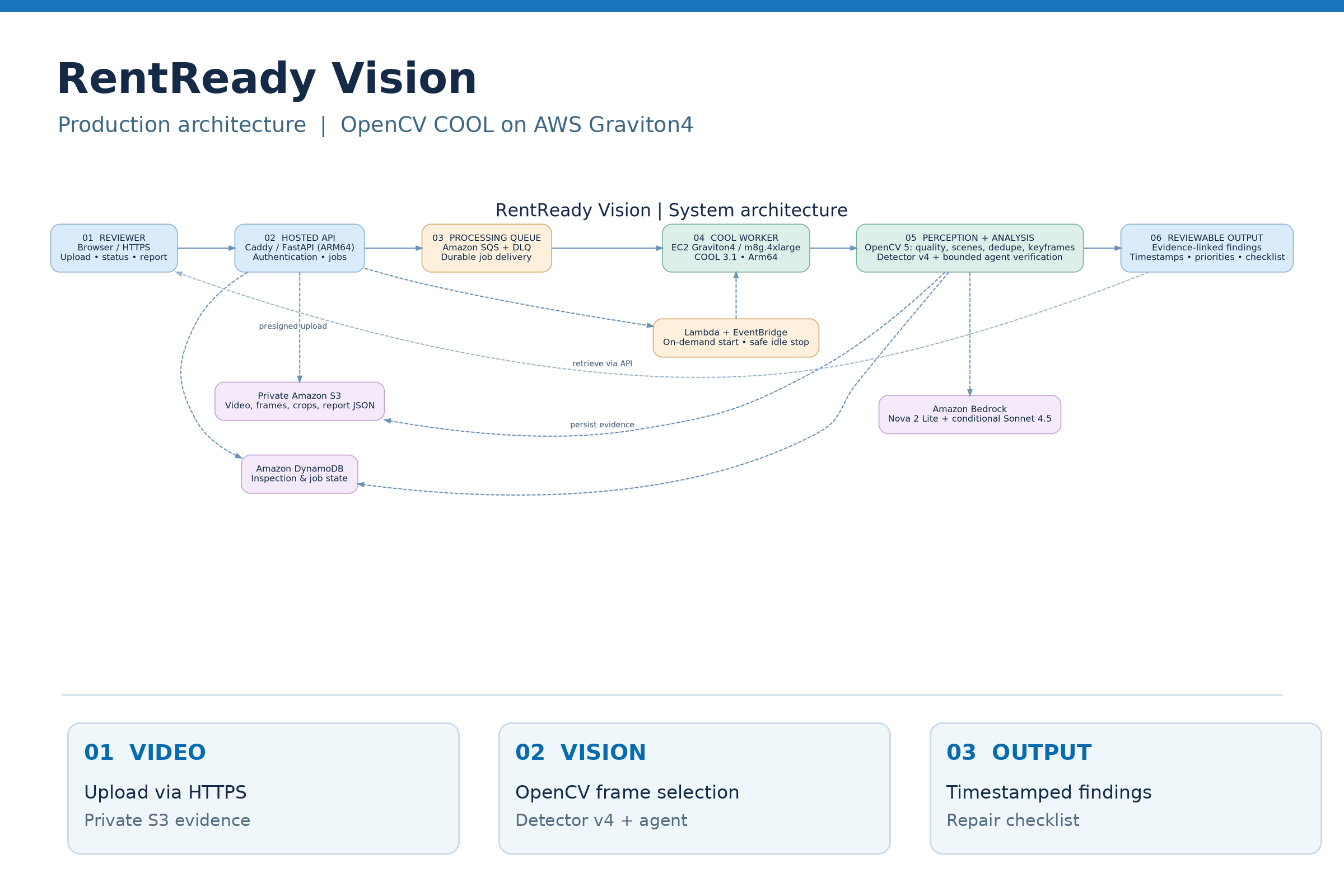
RentReady Vision architecture: OpenCV COOL on AWS Graviton4, Bedrock-assisted analysis, and evidence-linked rental inspection reports.
-
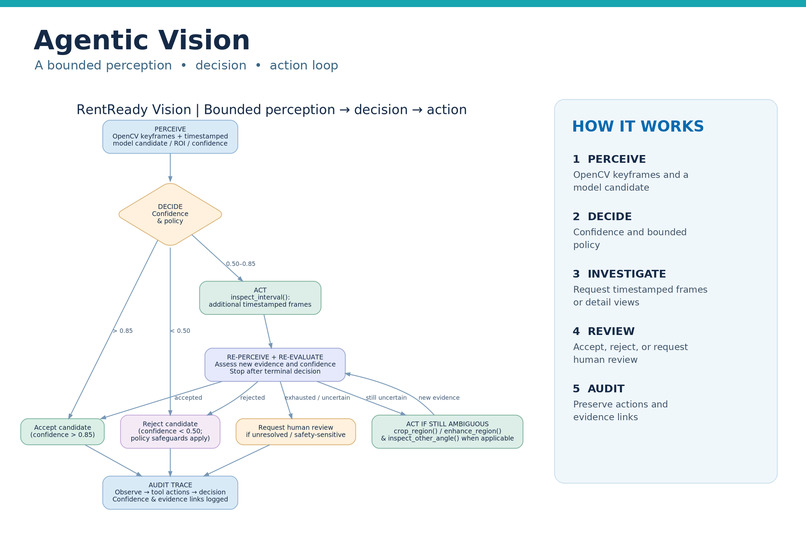
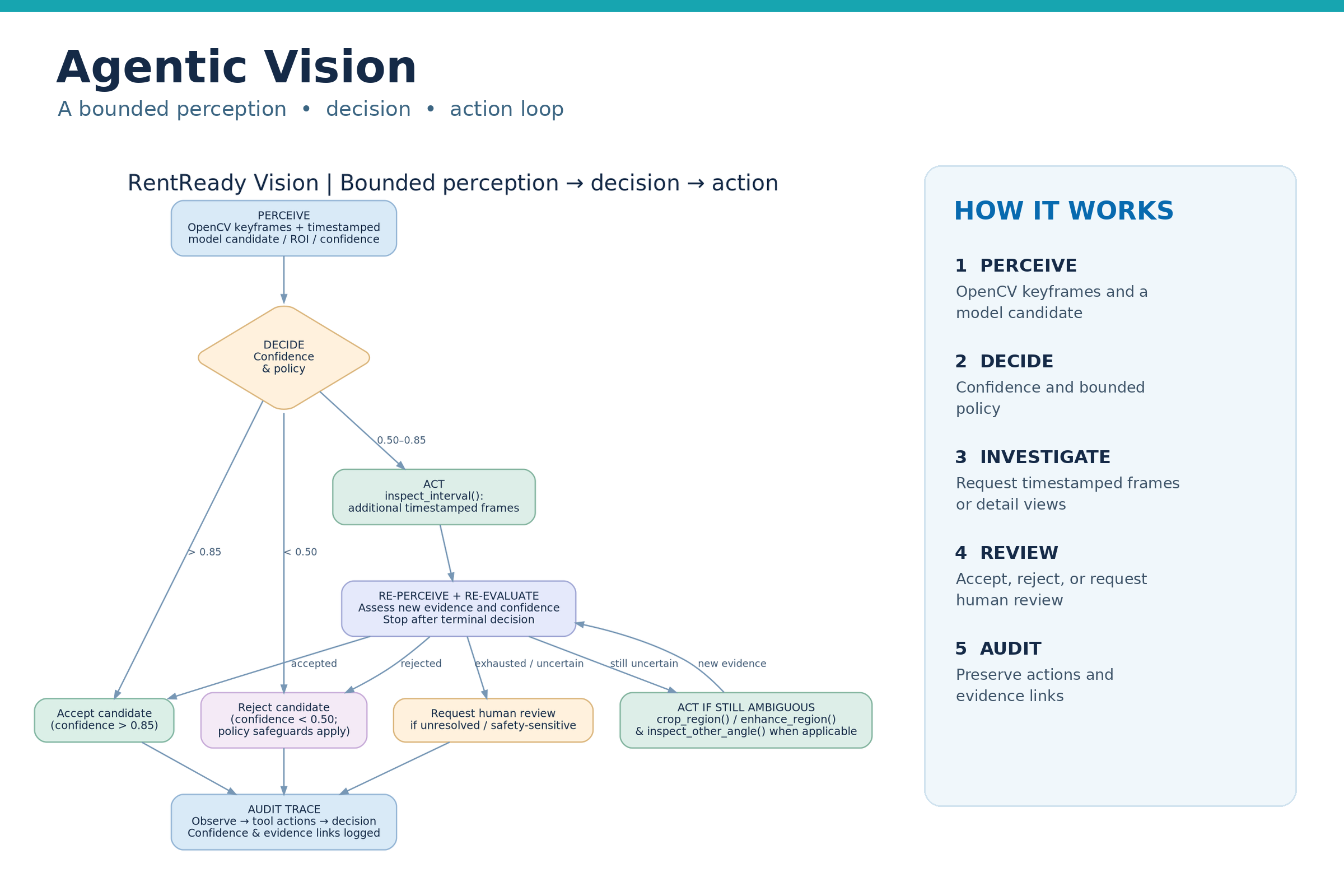
Agentic Vision: A bounded perception-decision-action loop that gathers evidence, reassesses uncertain findings, and logs decisions.
-
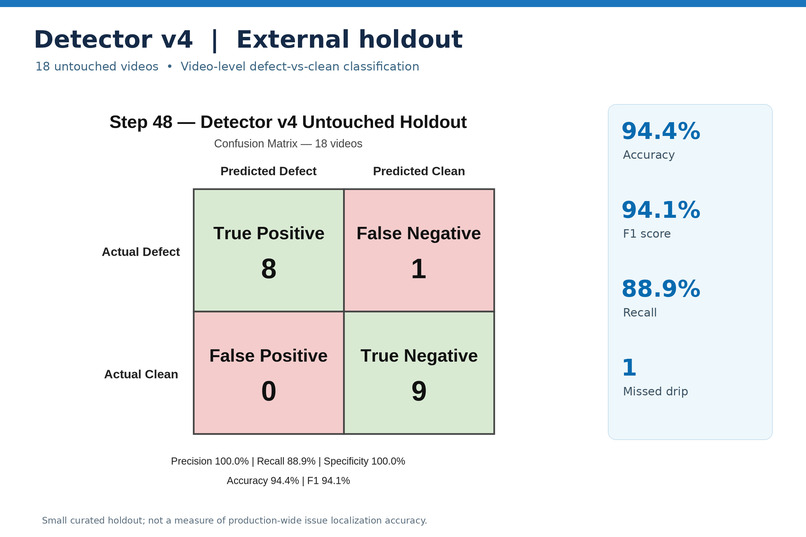
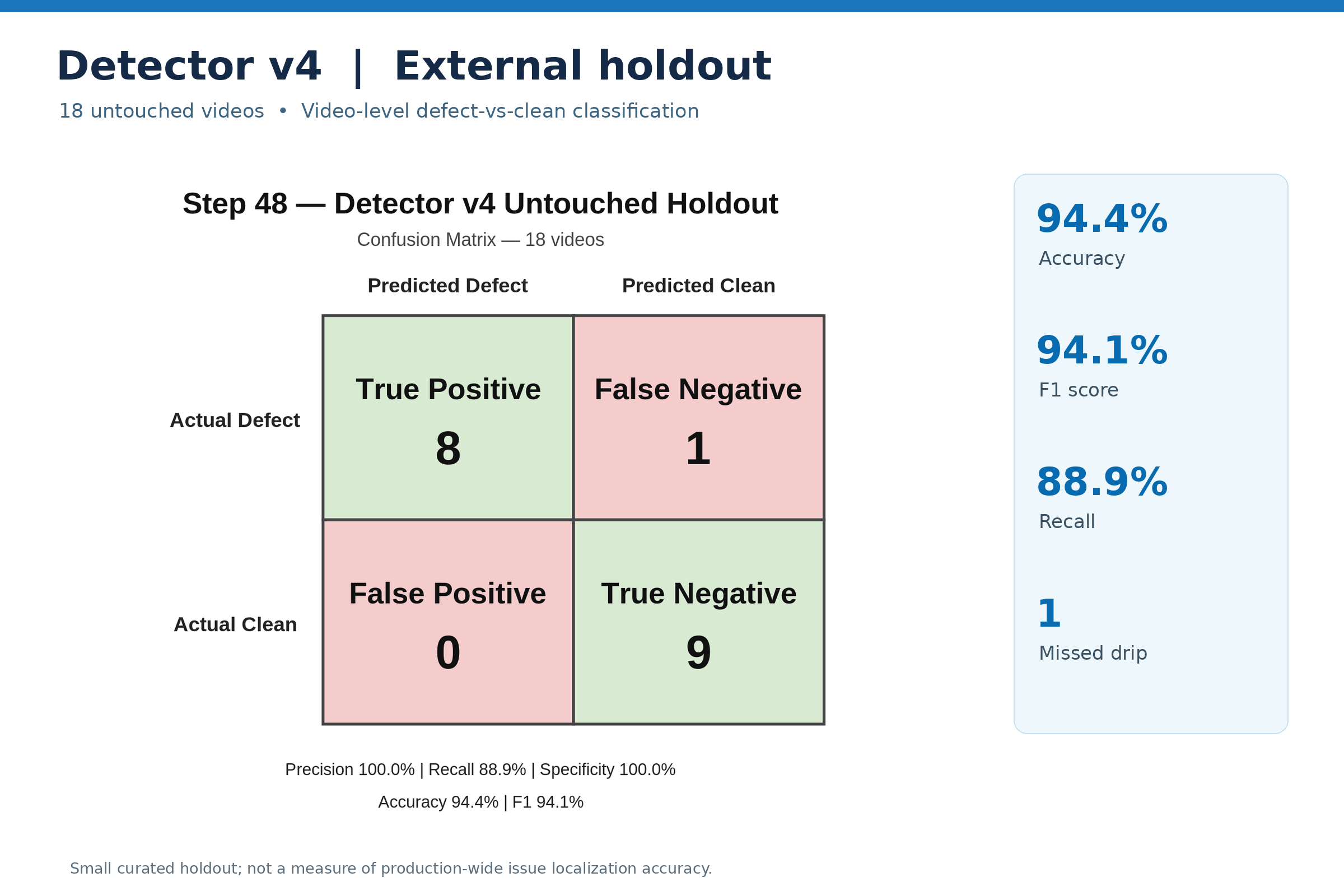
Detector v4: 94.4% accuracy and 94.1% F1 on a frozen 18-video holdout, measuring video-level defect classification.
Inspiration
Preparing a rental property for a new tenant involves inspecting rooms, identifying maintenance issues, documenting damage, and prioritizing repairs. This process can be time-consuming, subjective, and easy to get wrong.
I created RentReady Vision to make property inspections more accessible, consistent, and actionable using computer vision and agentic AI.
Walk through once. Know what to fix before you rent.
What it does
RentReady Vision transforms a smartphone walkthrough video into an AI-assisted property inspection report.
Users upload a video of a house or apartment. The application analyzes the walkthrough, identifies potential visible maintenance issues, and generates a structured report containing:
- Potential defects and maintenance concerns
- Supporting images and video timestamps
- AI-generated issue descriptions and recommended actions
- Repair priorities and a rental-readiness score
- Visual highlights identifying potential issue locations
- Direct links from findings to supporting video evidence
- An actionable rental preparation checklist
Instead of manually reviewing an entire video, landlords and property managers can focus on potential issues and their supporting evidence.
The goal is to turn an ordinary walkthrough video into actionable information while keeping humans in control of inspection decisions.
How we built it
RentReady Vision combines OpenCV 5, OpenCV COOL, agentic AI, Amazon Bedrock, and AWS cloud infrastructure.
OpenCV 5 — Intelligent video perception
OpenCV is a core part of the inspection process, not simply a video decoder.
The pipeline uses:
- Laplacian-based sharpness analysis to evaluate frame quality
- Brightness measurements to identify poorly exposed images
- Lucas–Kanade optical flow to estimate camera motion
- HSV histograms and ORB feature matching to detect scene changes and redundant frames
- Adaptive keyframe selection to retain informative evidence
- Targeted frame extraction, cropping, and enhancement for follow-up inspection
This reduces redundant visual input and helps focus AI processing on useful evidence.
OpenCV COOL — Optimized processing on AWS Graviton4
The cloud worker runs the official Cloud-Optimized OpenCV Library (COOL) runtime on an AWS EC2 Graviton4 instance.
We benchmarked stock OpenCV 5.0.0 against the COOL OpenCV 5.1.0-dev build on the same Graviton4 hardware.
Across five measured runs per environment:
- Stock OpenCV mean workload time: 161.719 seconds
- COOL mean workload time: 150.696 seconds
- 6.8% lower measured processing time
- 7.3% higher sampled-frame throughput
- Equivalent selected scenes and evidence frames
These results apply to the benchmarked OpenCV workload on one walkthrough, not complete application processing time. The compared environments used different OpenCV builds and versions.
Agentic Vision — Perception, decision, and action
RentReady Vision implements a bounded agentic workflow that can investigate uncertain findings instead of relying only on an initial classification.
The agent can:
- Observe a potential issue and evaluate its evidence.
- Decide whether additional inspection is necessary.
- Request additional video frames around the relevant timestamp.
- Use cropping, enhancement, or another camera angle when supported by the investigation.
- Reassess the finding and record a decision or need for human review.
A recorded production trace demonstrates the agent retrieving 15 additional frames during a targeted investigation, with its reported confidence changing from 0.80 to 0.90 before an acceptance decision.
Agent actions, evidence references, and decisions are recorded for traceability. Additional evidence does not guarantee that a finding is correct.
AWS cloud architecture
The application uses:
- Amazon EC2 Graviton4 + COOL: OpenCV video processing
- Amazon Bedrock: Model-assisted visual analysis
- Amazon S3: Private video and evidence storage
- Amazon SQS: Durable asynchronous processing
- Amazon DynamoDB: Inspection and job state
- AWS Lambda and EventBridge: On-demand worker lifecycle management
- Amazon CloudWatch: Operational monitoring
- Python and FastAPI: Backend APIs and inspection orchestration
- Terraform: Infrastructure management
The processing worker starts on demand and can shut down when idle to help reduce unnecessary compute costs.
Challenges we faced
One major challenge was distinguishing genuine property defects from reflections, shadows, normal materials, and misleading visual patterns.
Other challenges included:
- Preserving brief defects while reducing unnecessary video frames
- Detecting small or partially obscured issues
- Managing long-running cloud processing
- Preventing duplicate findings
- Controlling AWS and AI inference costs
- Designing reliable agentic follow-up behavior
- Providing understandable evidence and maintaining human oversight
We developed labeled evaluation datasets, compared detector configurations, and documented failure cases.
One important lesson was that agentic reinspection does not always improve correctness. In a small two-candidate experiment, further investigation recovered a genuine issue but also reinforced a false positive.
We preserved these results to guide future improvements.
Accomplishments
1. Working end-to-end application
Built and deployed a cloud-hosted system that transforms uploaded walkthrough videos into evidence-linked inspection reports and actionable checklists.
2. Detector v4 — 94.4% holdout accuracy
Evaluated Detector v4 on a frozen external holdout containing 18 previously untouched videos:
- 9 videos containing defects
- 9 clean videos
- 8 true positives
- 9 true negatives
- 0 false positives
- 1 false negative
Results: 94.4% accuracy, 100% precision, 88.9% recall, and 94.1% F1.
The missed case was a dripping faucet. These results measure video-level defect-versus-clean classification on a small curated holdout, not comprehensive issue detection, precise localization, or production-wide accuracy.
3. Measured COOL performance improvement
Demonstrated a 6.8% reduction in mean OpenCV workload runtime on AWS Graviton4 compared with the tested stock OpenCV environment, while preserving equivalent selected evidence.
4. Traceable Agentic Vision
Implemented targeted visual investigation with recorded actions, evidence, confidence changes, and bounded decision policies, including a verified production action trace.
5. Cloud deployment and operational safeguards
Implemented private storage, asynchronous processing, security controls, measured processing progress, cancellation support, and on-demand worker management.
What we learned
Building RentReady Vision reinforced that useful computer vision requires more than identifying objects in individual images.
Reliable inspection assistance depends on temporal context, frame quality, geometric reasoning, evidence traceability, uncertainty handling, and human verification.
We also learned that evaluation must distinguish video-level detection, precise issue localization, agent decision quality, and end-to-end application performance.
What's next
Our planned improvements include:
- Adding user feedback to confirm or reject individual findings
- Improving detection of transient water leaks and subtle defects
- Expanding independent evaluation datasets
- Improving issue localization and agentic verification
- Introducing secure individual user accounts
- Further optimizing cloud processing costs
Our long-term vision is to make AI-assisted property condition documentation more practical, accessible, and trustworthy.
RentReady Vision is an AI-assisted inspection tool, not a substitute for a licensed professional inspection. AI-generated findings require human verification.
Built With
- amazon-bedrock
- amazon-cloudwatch
- amazon-dynamodb
- amazon-ec2
- amazon-sqs
- amazon-web-services
- aws-graviton
- aws-lambda
- cool
- fastapi
- opencv
- python
- terraform

Log in or sign up for Devpost to join the conversation.