Inspiration
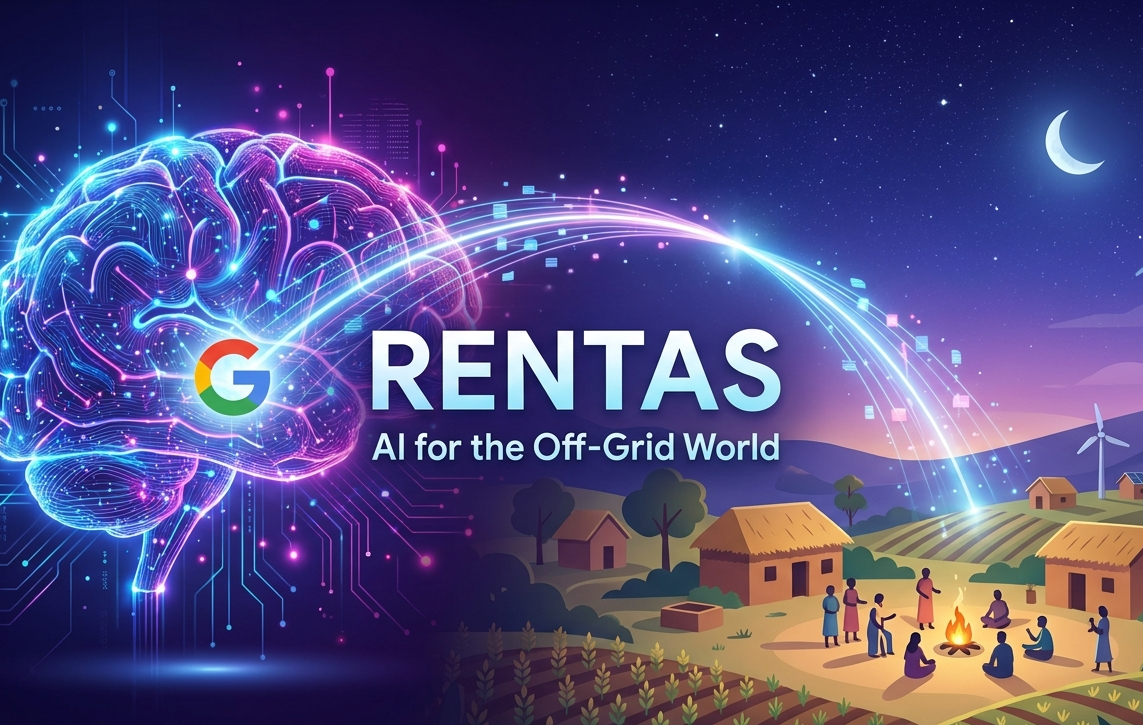
The inspiration for Rentas comes from a stark global reality: while international organizations like the WHO and FAO publish life-saving medical guides and agricultural remedies, they are almost always trapped in high-bandwidth, heavy English PDFs. For remote, marginalized, or off-grid communities relying on 2G connections and basic SMS, this critical knowledge is completely out of reach due to language barriers, file sizes, and connection costs.
Honestly, I’m quite new to AI and agentic workflows. I decided to join the Google "All Things Agentic Hackathon” purely for fun, to support this amazing campaign, and to challenge myself to try something completely new! While I’m explored the capabilities of Gemini 3.5, I’ve realized that instead of building another generic chatbot, I could create something with a real social impact. That is how Rentas was born—a project to "cross borders" (which is what Rentas means in Malay) and democratize life-saving information for everyone and everywhere.
What it does
Rentas is an autonomous, background-running agent designed to bridge the global digital divide. It does not wait for user queries; instead, it runs completely in the background to:
- Monitor & Ingest: Automatically track newly published directories of global medical and agricultural resources.
- Translate & Adapt: Using Gemini 3.5 to translate complex documents into over 100 local dialects and simplify scientific jargon into easily digestible local instructions.
- Compress: Applying a custom, low-bandwidth text-encoding style (inspired by RTK + Caveman style compression) to strip up to 90% of token fluff.
- Distribute: Automatically push these ultra-compact, high-utility summaries directly to local community leaders via low-bandwidth channels which they already use, such as SMS, WhatsApp, and Telegram.
How i built it
I built Rentas using Google's cutting-edge AI stack and serverless infrastructure to ensure strict compliance with the hackathon rules: • The Brain: Google Gemini 3.5 Pro and Gemini 3.5 Flash via the Vertex AI API handle all heavy reasoning, multilingual translation, and text simplification. • The Framework: Antigravity SDK paired with the Google GenAI SDK orchestrates the multi-agent delegation and background execution. • The Infrastructure: Google Cloud Run hosts the core event-driven containerized worker services.
- Google Cloud Pub/Sub manages the asynchronous job queue, ensuring translation and compression tasks execute reliably.
- Google Cloud Firestore serves as my persistent memory bank to store localized vocabulary indexes and regional context.
- Google Cloud SQL (PostgreSQL + pgvector) stores semantic document chunks for offline-first vector matching.
Challenges that i ran into
As a newcomer, the learning curve was incredibly steep! My biggest challenge was wrapping my head around asynchronous architectures and managing event-driven queues with Google Cloud Pub/Sub.
Technically, the hardest part was writing the prompt logic for the RTK + Caveman-style text compression. It was a delicate balancing act to strip away 90% of the text's physical size for low-bandwidth networks, while absolutely ensuring that the core medical or agricultural advice remained 100% scientifically accurate. A single misplaced word could mean the difference between a successful crop cure and a ruined harvest.
Accomplishments that im proud of
For someone who entered this hackathon just to "cuba-cuba" (try things out), I’m incredibly proud that I managed to build a fully functional, production-ready, background-driven agent! Rentas successfully listens to document updates, runs them through my complex Gemini compression pipeline, and broadcasts them live to SMS and Telegram bots. Proving that an enterprise-grade Google Cloud stack can be set up by a beginner is a huge personal win!
What I’ve learned
I’ve learned that building an AI agent is less about making the AI "talk" and more about engineering the architecture that supports it. I’ve gained hands-on experience with Vertex AI, serverless containers on Cloud Run, and vector storage. More importantly, I’ve learned that advanced AI doesn't always have to serve flashy, heavy web-apps—it can be scaled down beautifully to help someone holding a 15 year old Nokia phone in a remote village.
What's next for Rentas
Rentas is just a beginning. The next step is to upgrade the regional memory bank in Firestore to support interactive two-way SMS Q&A. This will allow village leaders to reply directly to an automated alert, letting the Gemini agent answer their follow-up questions in their local dialect. I also plan to conduct real-world field testing with local NGOs to optimize the system's performance on actual 2G networks.
Built With
- antigravity-sdk
- asynchronous-workflows
- docker
- docker-compose
- gemini-3.5-flash
- gemini-3.5-pro
- google-cloud
- google-cloud-firestore
- google-cloud-pub/sub
- google-cloud-run
- google-cloud-sql
- google-genai-sdk
- markdown
- node.js
- pgvector
- postgresql
- python
- retrieval-augmented-generation-(rag)
- sms-gateway-api
- telegram-bot-api
- vector-databases
- vertex-ai-api
- whatsapp-business-api

Log in or sign up for Devpost to join the conversation.