-
-
ReNova CareFlow – AI Multi-Agent Healthcare System Demo
-
ReNova CareFlow – AI Multi-Agent Healthcare System Demo
-
ReNova CareFlow – AI Multi-Agent Healthcare System Demo
-
ReNova CareFlow – AI Multi-Agent Healthcare System Demo
-
ReNova CareFlow – AI Multi-Agent Healthcare System Demo
https://renovacareflow.netlify.app/
Inspiration
Healthcare is fragmented across time, systems, and visits.
Patients repeatedly re-explain their history. Clinicians only see isolated snapshots, not progression. Critical context is lost between encounters.
This leads to delayed insight, missed patterns, and inconsistent care.
I built ReNova CareFlow around a simple idea:
What if patient care had memory?
Not static records — but a continuous, evolving understanding of health over time.
That idea became ReNova CareFlow.
What it does
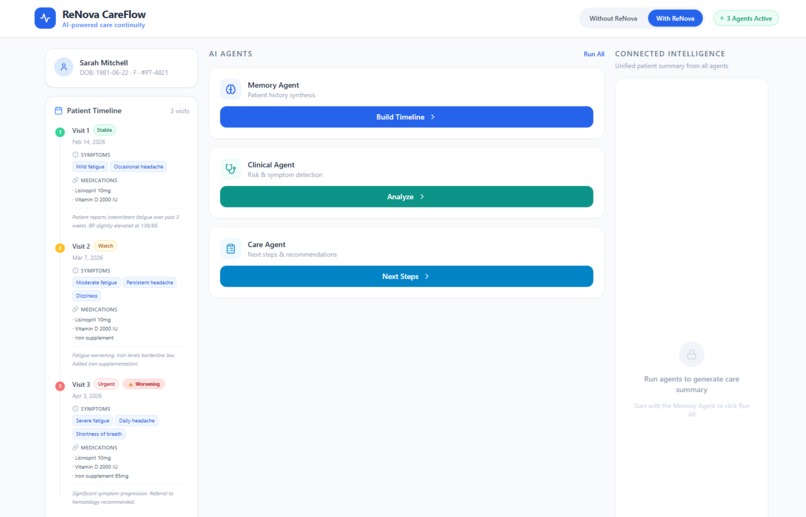
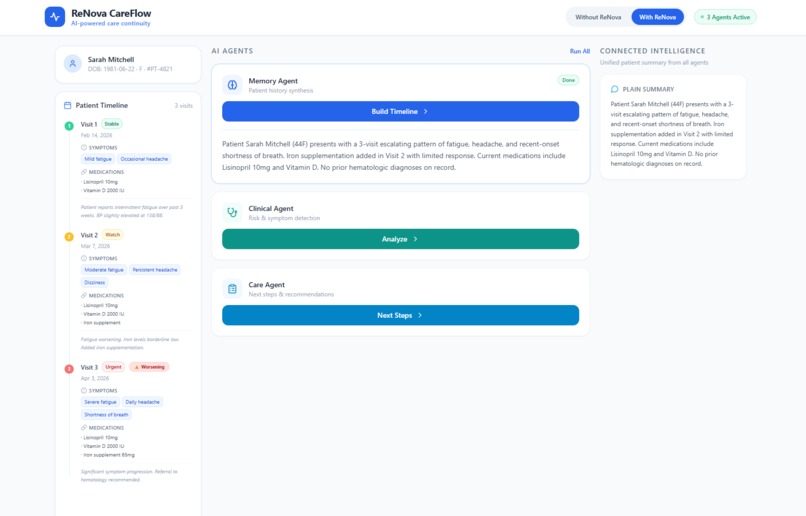
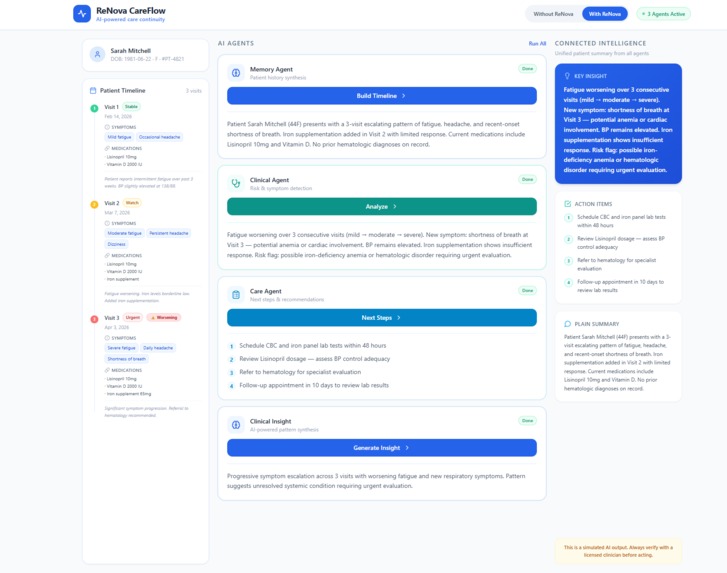
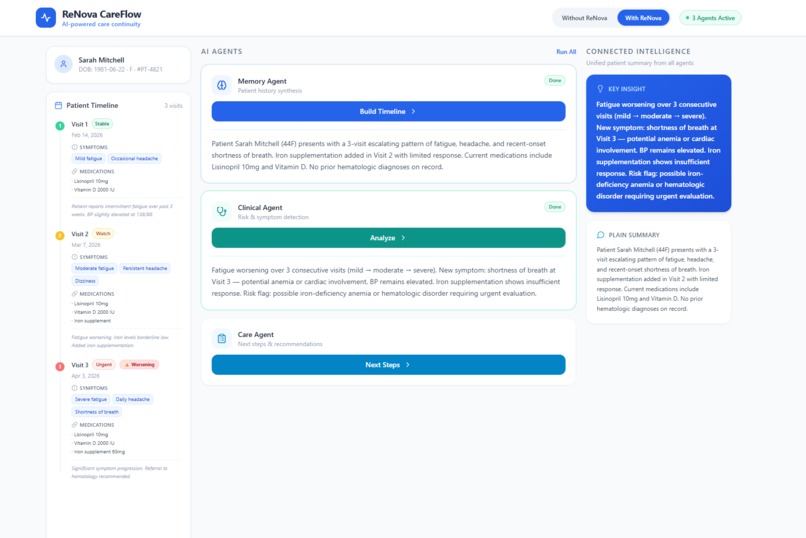
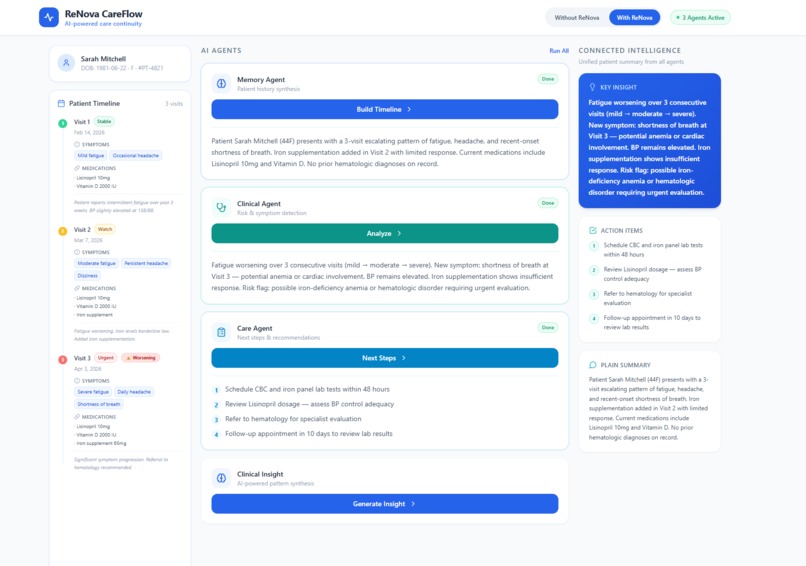
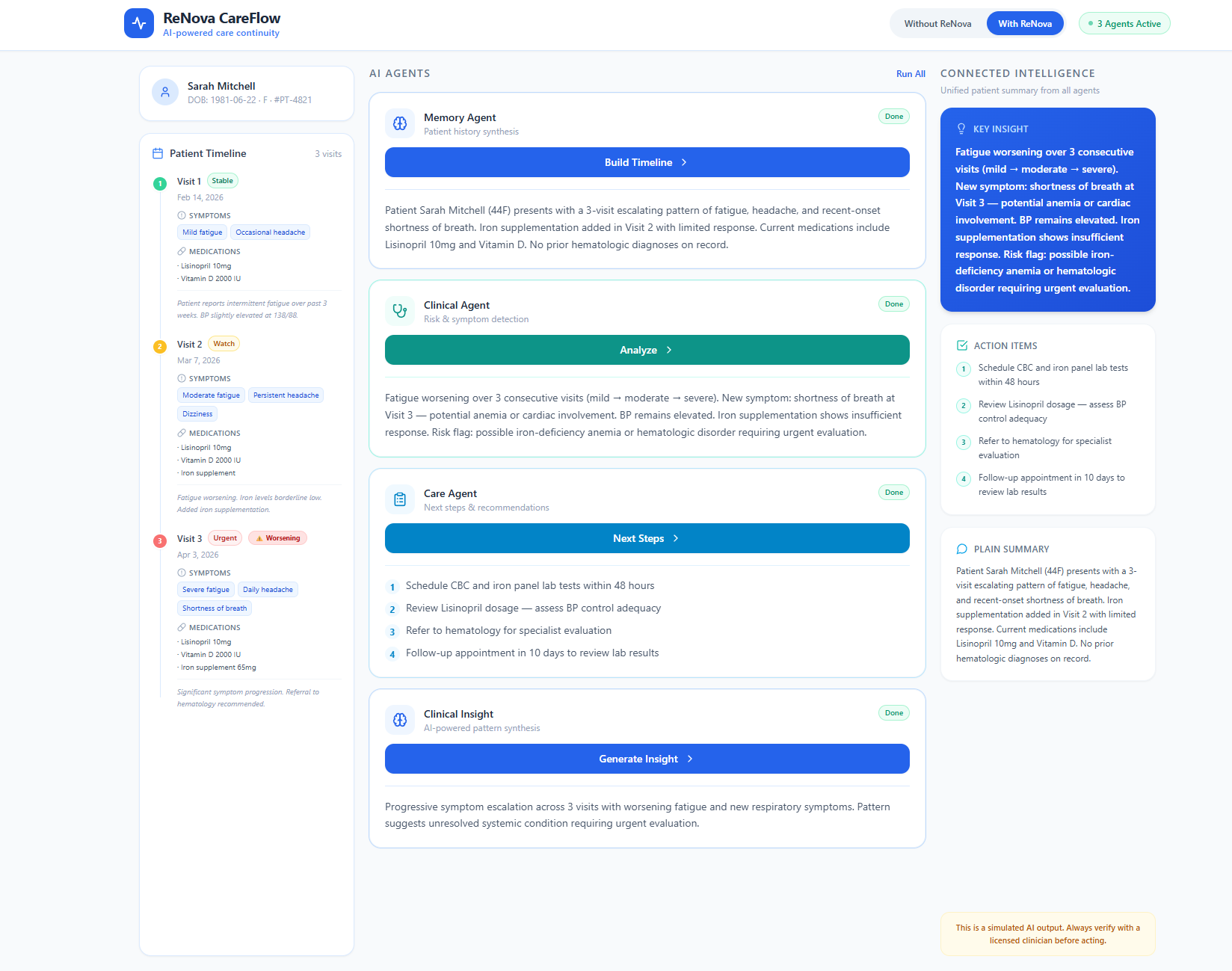
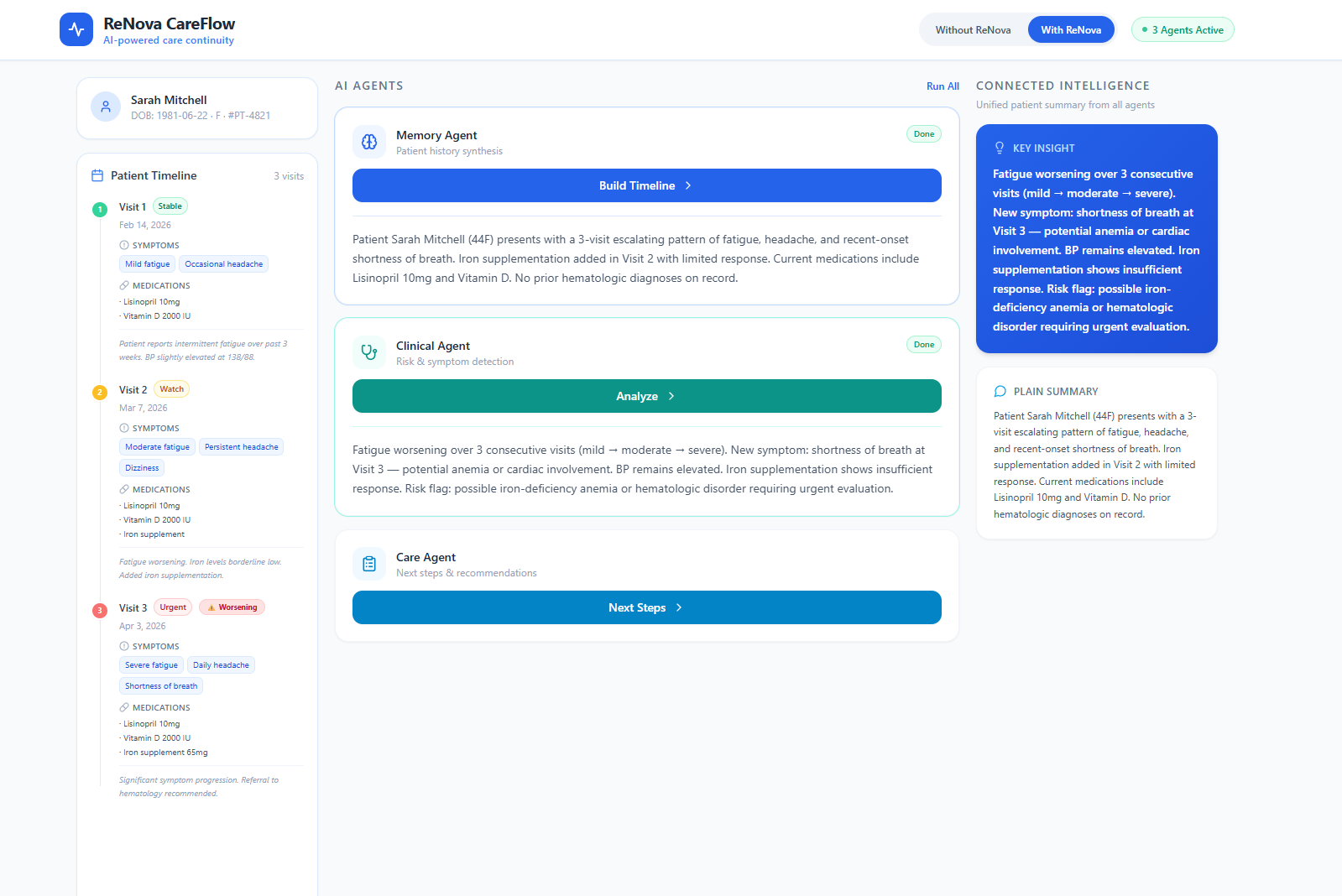
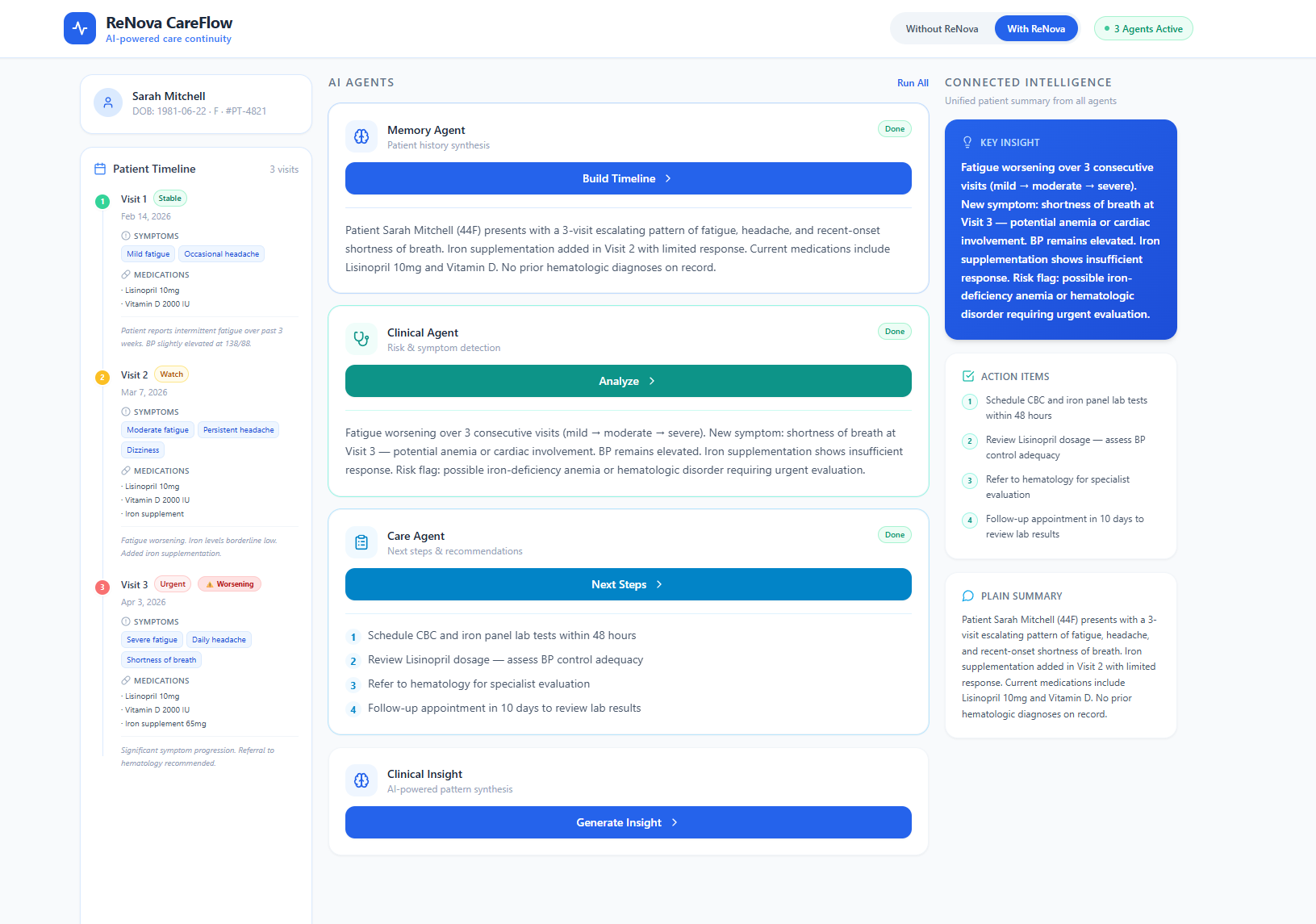
ReNova CareFlow is a multi-agent AI system that transforms fragmented medical visits into a continuous clinical narrative.
Instead of isolated encounters, it builds a longitudinal patient view across:
symptoms medications lab results clinical decisions
Three specialized AI agents work together:
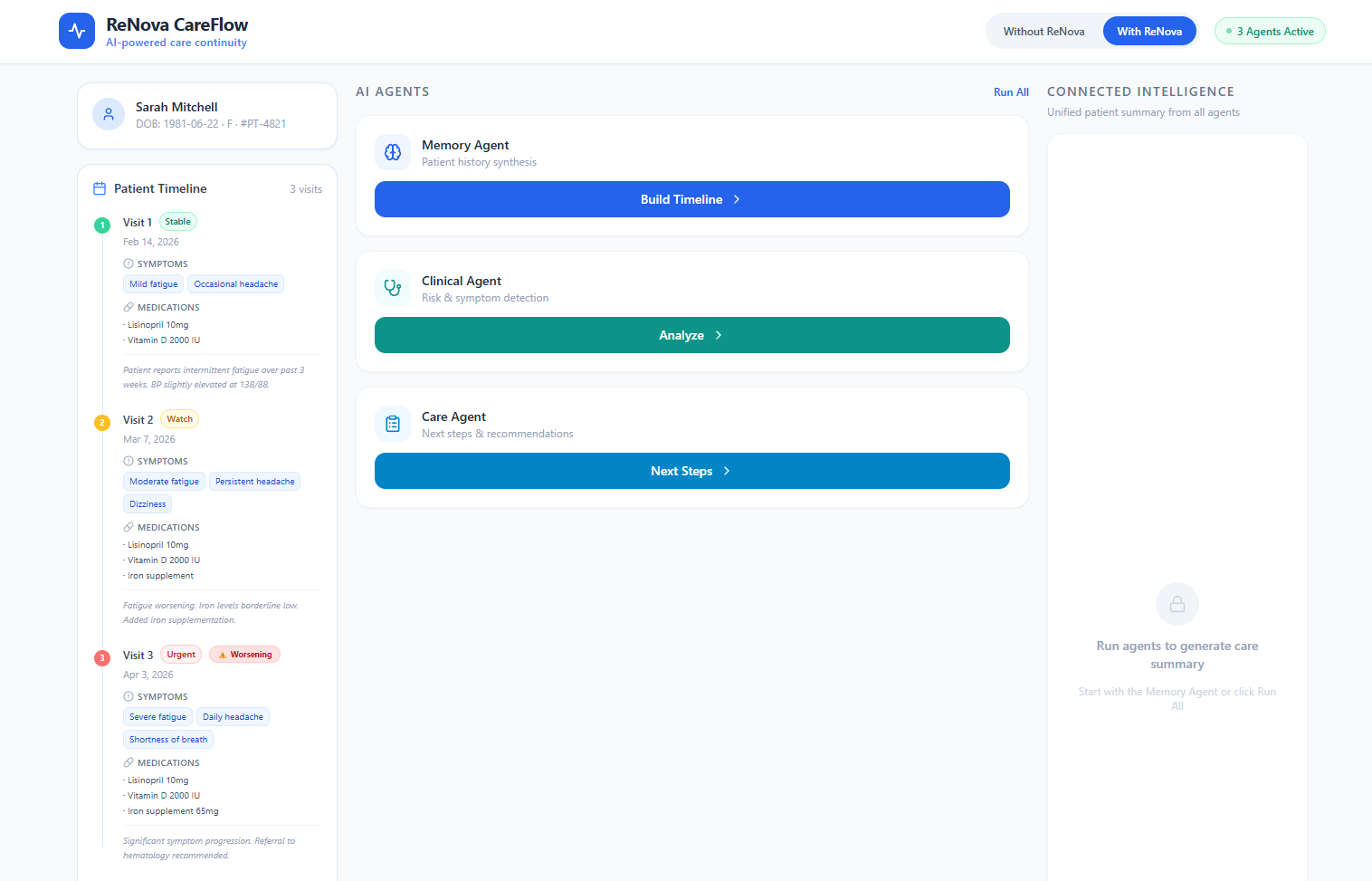
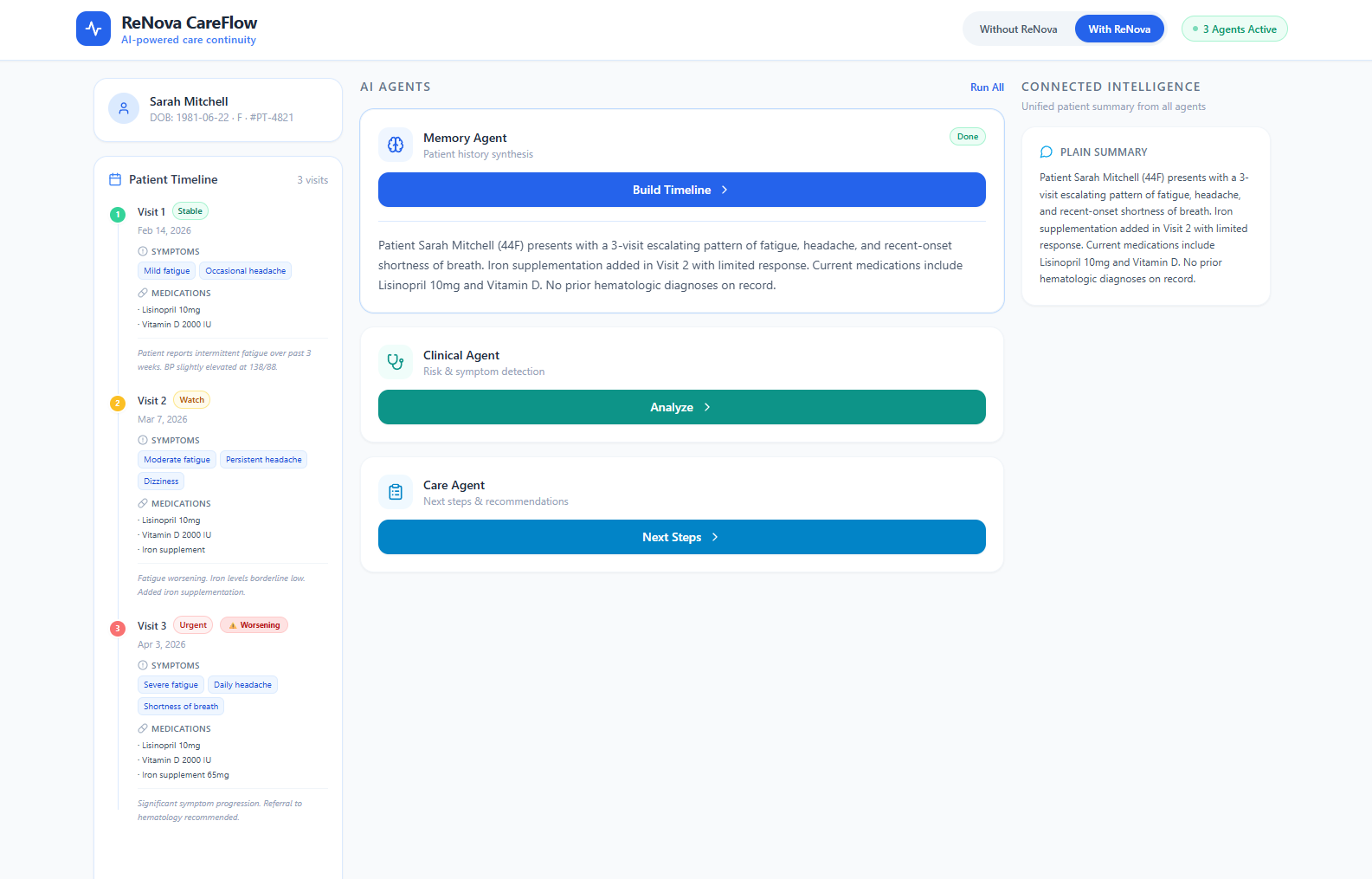
Memory Agent → constructs a structured patient timeline Clinical Agent → detects risk patterns and symptom progression Care Agent → generates clear, actionable next steps
The system outputs a unified clinical understanding that improves decision-making and highlights deterioration earlier.
How I built it
ReNova CareFlow is built as a modular multi-agent system using MCP-style tool orchestration.
Synthetic patient data simulates realistic clinical progression Each agent operates independently with a defined responsibility Shared tools provide structured access to patient information
Example tool layer:
get_patient_history() summarize_lab_results() detect_risk_trends()
Agents collaborate through structured outputs, forming a simple but extensible reasoning pipeline.
The result is a lightweight but scalable architecture for longitudinal healthcare intelligence.
Challenges I faced
The main challenge was transforming raw medical data into meaningful continuity.
Healthcare data is inherently fragmented — AI needs structure, context, and temporal awareness to generate value.
Key focus areas included:
defining clear separation of agent responsibilities ensuring outputs are actionable, not generic modeling realistic clinical progression within a constrained demo
A key balance was maintaining clinical relevance while keeping the system simple and demo-ready.
What I learned
The most important insight was that healthcare AI value does not come from isolated intelligence — but from continuity.
Single-step assistants provide momentary support, but multi-agent systems enable:
longitudinal reasoning pattern detection over time earlier identification of risk progression
I also learned that modular AI systems become significantly more powerful when each component has a narrow, well-defined role.
What's next for ReNova CareFlow
ReNova CareFlow can evolve into a clinical continuity layer for:
chronic disease management elderly care post-hospital recovery caregiver coordination
In the long term, this approach can serve as a foundation for continuous, context-aware healthcare systems that bridge fragmented medical data into a unified patient journey.

Log in or sign up for Devpost to join the conversation.