Inspiration
A medication shortage is rarely one document edit. A hospital may need to change a policy, an order set, a pump library, pharmacy labels, staff communications, population exceptions, and a legacy system with no API. Those artifacts can drift independently even when every team is acting in good faith. The dangerous failure is not an obviously bad answer; it is a plausible change that quietly misses one dependency.
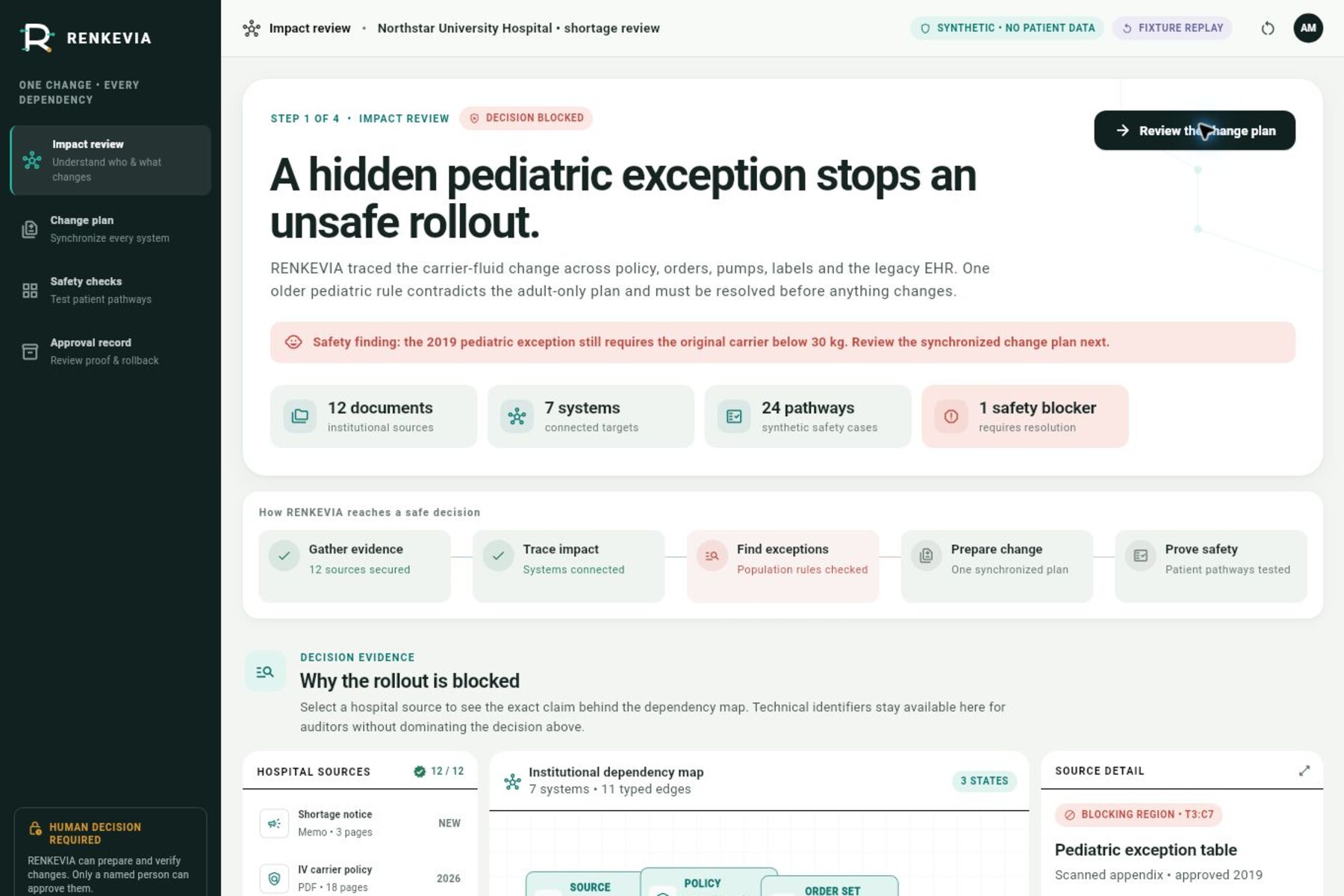
RENKEVIA is built around that coordination failure. In our synthetic scenario, an adult-focused IV-carrier shortage patch looks complete but fails one hidden pediatric pathway. The product must find that exception, recompile every affected artifact, prove the revision, preserve specialist dissent, and prepare the legacy change without granting an AI authority to commit it.
What it does
RENKEVIA is a Flutter Web institutional change compiler, not a clinical chatbot. Its connected workspaces form one causal journey:
- Impact review seals a mixed synthetic corpus and maps dependencies across twelve artifacts and seven institutional systems.
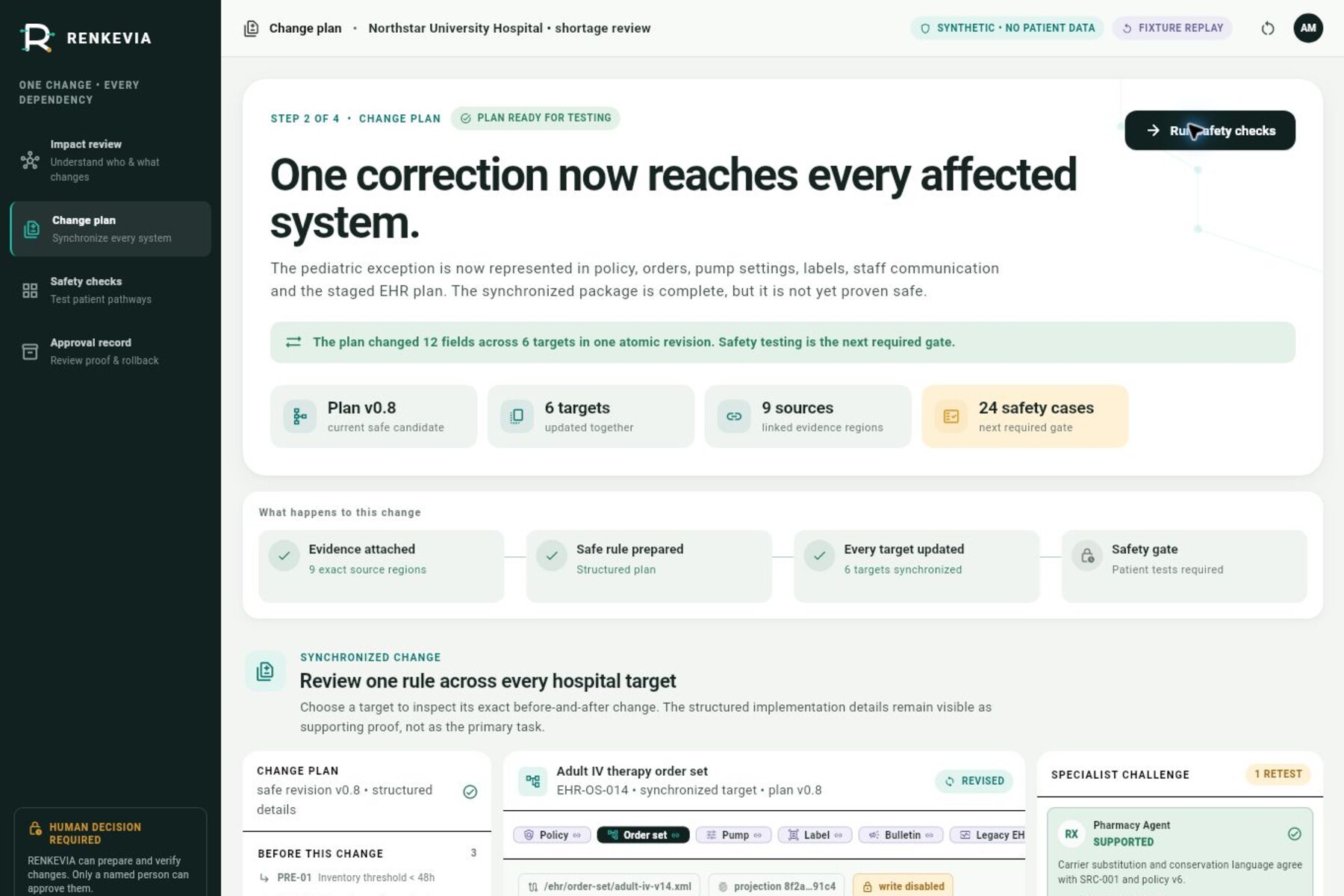
- Change plan turns evidence into a typed Patch IR and projects one reversible change across six target artifact types.
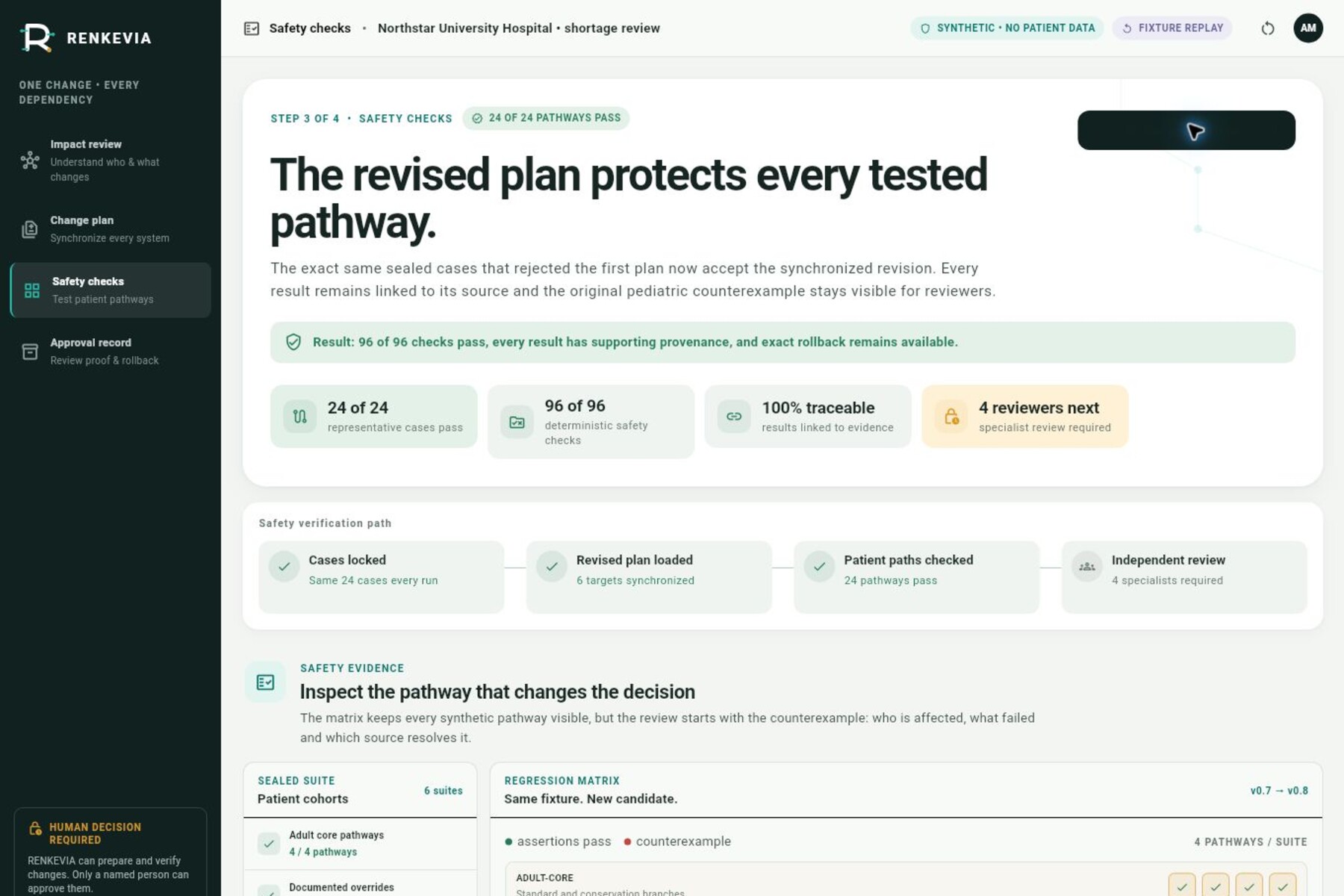
- Safety checks run 24 synthetic patient pathways and 96 deterministic assertions. Candidate v0.7 fails one pediatric assertion; v0.8 reaches 24/24 and 96/96 with exact rollback.
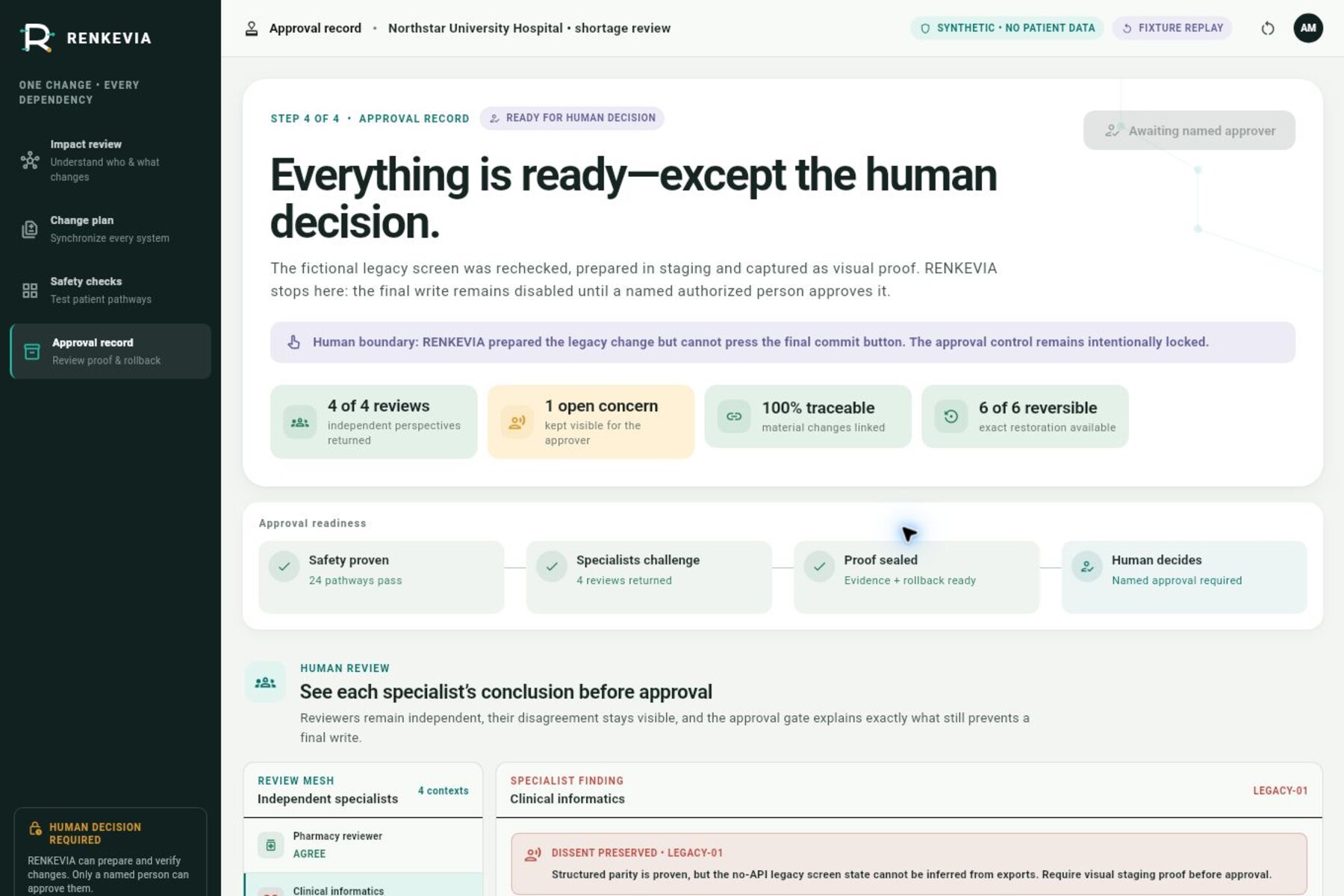
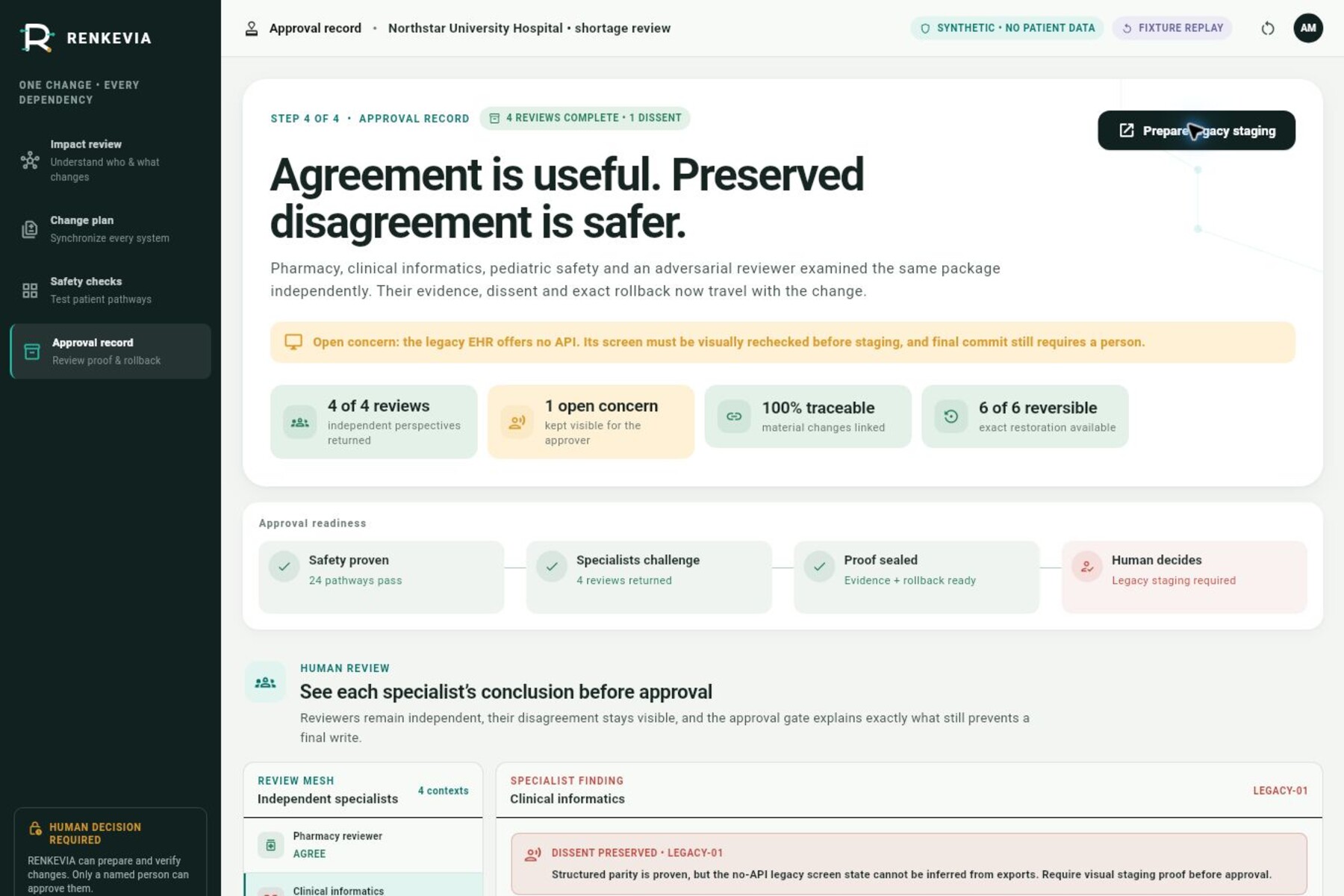
- Approval record challenges the candidate through independent pharmacy, clinical-informatics, pediatric-safety, and adversarial reviews while preserving dissent, provenance, approval state, and rollback evidence.
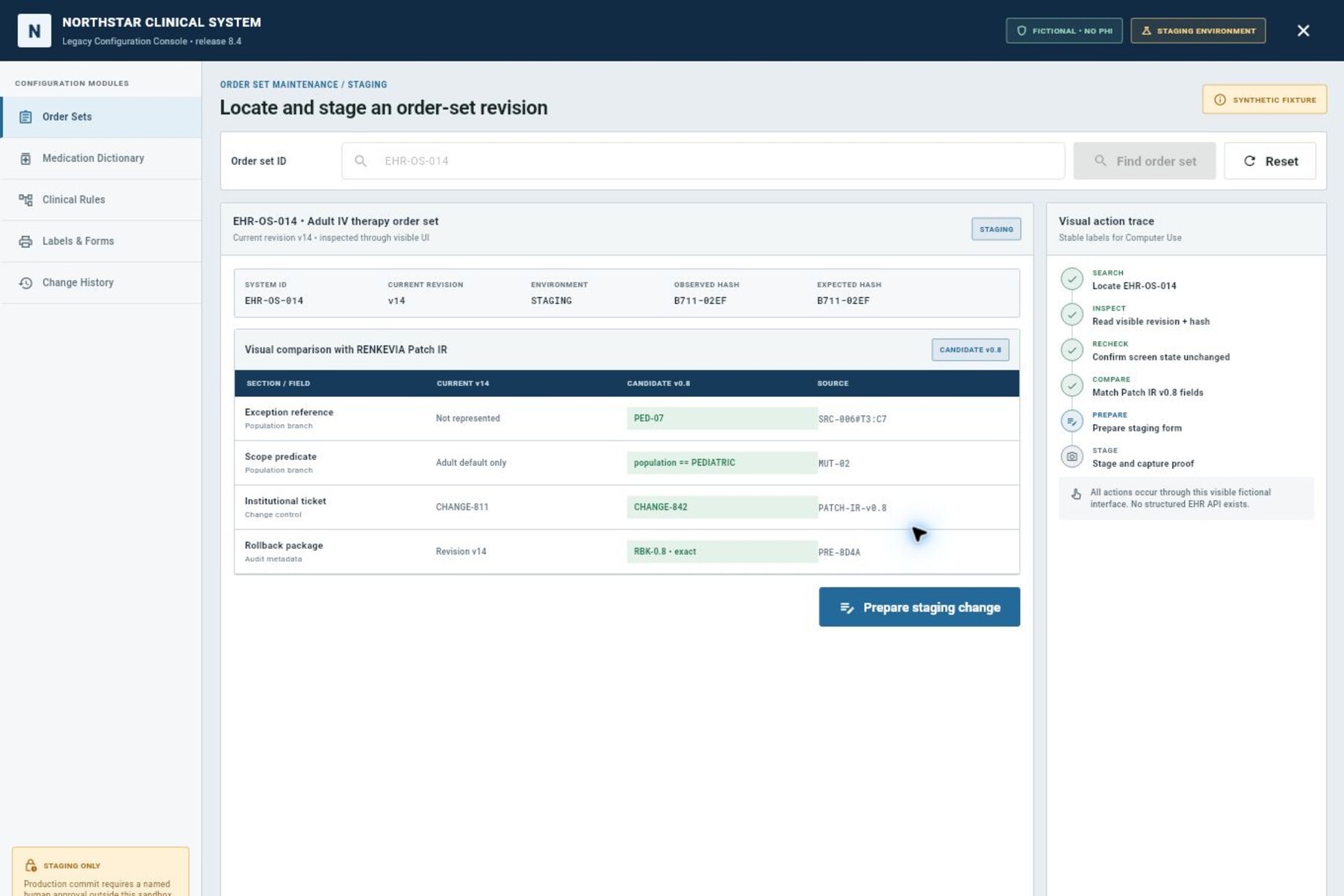
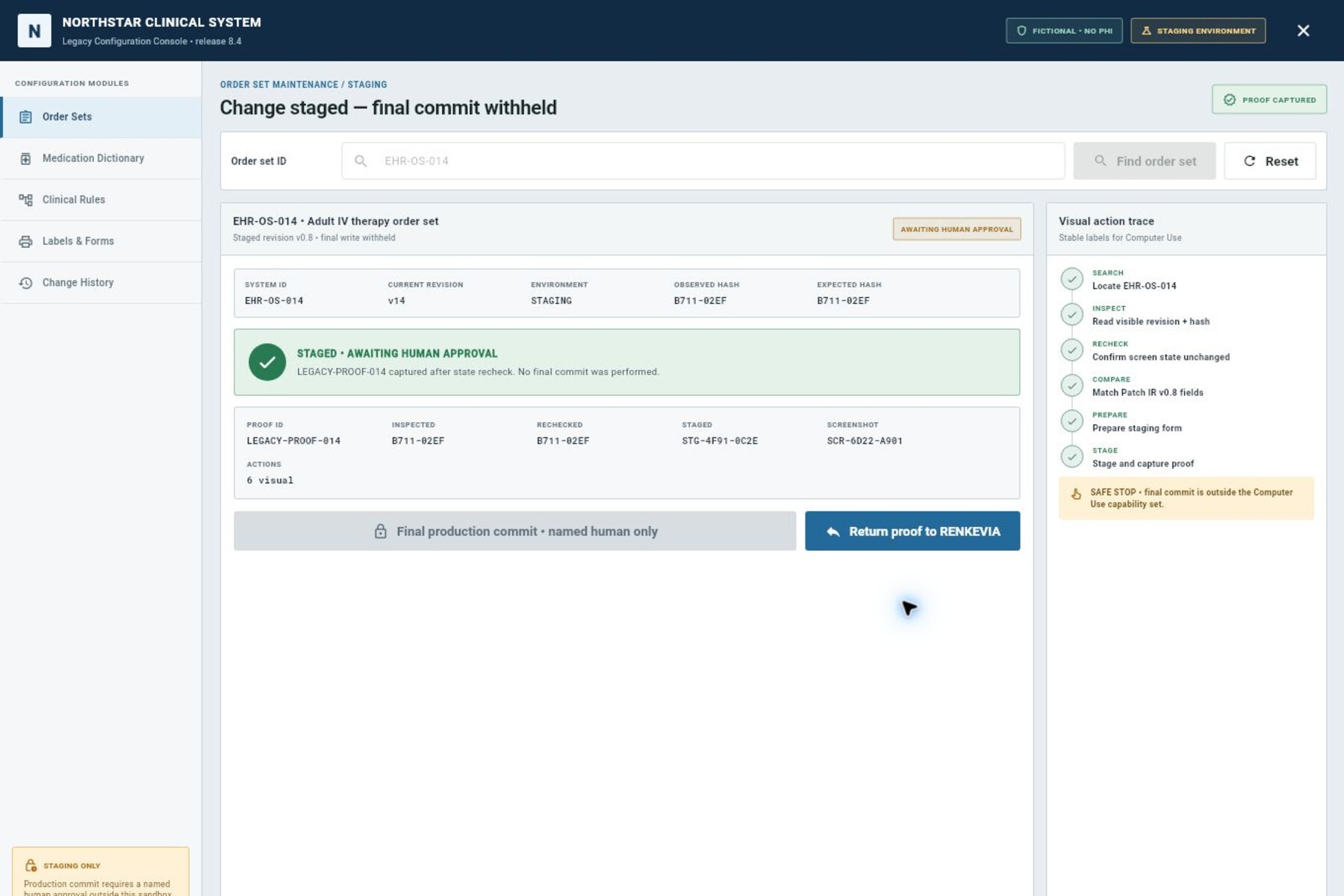
A separate fictional system, Northstar Clinical System, represents a no-API legacy EHR. The controlled browser flow locates the order set, rechecks screen state, stages the Patch IR, captures visual proof, and stops before the final commit button. Only a named human can approve the final write.
Why a simple chatbot cannot reproduce it
The language model never owns software truth. GPT-5.6 proposes strict, schema-constrained objects; deterministic TypeScript validates evidence references, applies diffs, executes patient regressions, calculates coverage, enforces approval blockers, and verifies exact rollback. The UI exposes the chain from source region to mutation, failed assertion, specialist finding, staged legacy field, and human gate. A fluent answer cannot mark itself safe.
How GPT-5.6 is used
- Sol handles the highest-consequence cross-corpus contradiction resolution and typed Patch IR revision.
- Programmatic Tool Calling runs bounded read-only patient-test fan-out, deduplicates and aggregates failures, and returns only relevant anomalies.
- Multi-agent review gives four independent specialists separate evidence packets; the root compiler cannot erase dissent or approve its own patch.
- Computer Use operates only the allow-listed fictional legacy sandbox, with state rechecks and an intercepted final commit.
- Luna and Terra handle bounded lower-risk routing and extraction work so model choice follows consequence and cost.
The hackathon demo is visibly labelled FIXTURE REPLAY and uses only synthetic data. The live contract is fail-closed: the browser never receives the OpenAI API key, and a network, budget, schema, or provenance failure blocks the run instead of silently substituting fixture data.
How Codex was used
Codex drove the engineering loop from product contract to deployment: freezing safety and evaluation boundaries, implementing the TypeScript compiler and Flutter Web surfaces, generating adversarial and responsive tests, inspecting real browser captures, diagnosing font and mobile-density defects, refining the UX, and building the verification pipeline. Every iteration had to survive formatting, static analysis, unit tests, deterministic replay, release build, and responsive browser inspection.
Accomplishments
- One coherent transformation instead of a feature parade.
- A reproducible red-to-green proof: 23/24 to 24/24 pathways and 95/96 to 96/96 assertions.
- Evidence-linked Patch IR projected into six synchronized institutional artifact types.
- Independent review with preserved dissent, deterministic approval blockers, hash-chained audit evidence, and exact rollback.
- A responsive Flutter Web interface usable from mobile to wide desktop.
- A fictional no-API EHR staging loop that proves the change and refuses the autonomous final write.
Challenges
The hardest design problem was separating impressive model behavior from trusted behavior. A successful API response can never toggle approval; programmatic tools remain read-only; independent agents may disagree without dissent being summarized away; and Computer Use stays visually compelling while stopping safely. The second challenge was making dense institutional evidence understandable on a phone without reducing the product to chat.
What we learned
Advanced model capabilities are most credible when each has a narrow causal job. Long-context reasoning is valuable for contradictions; code is better for repeatable tests; independent agents matter when disagreement matters; Computer Use matters when the real constraint is a system with no API; and human approval must remain a product state, not a sentence in a prompt.
What's next
This hackathon build uses synthetic data and is not a medical device or a production clinical system. The next step is a controlled pilot design with a hospital change-management team: institution-owned synthetic or de-identified fixtures, preregistered baselines, security review, workflow-time and omission metrics, and explicit validation of every target-system adapter before any real operational use.
Built With
- codex
- computer-use
- dart
- flutter-web
- github
- github-actions
- gpt-5.6
- multi-agent
- node.js
- openai-responses-api
- programmatic-tool-calling
- typescript

Log in or sign up for Devpost to join the conversation.