Inspiration
Every building has a history that disappears the moment the installer leaves. When the power goes out or a wall starts to stain, the electrician or plumber who shows up is usually starting from zero: no record of what was normal, no idea where circuits or pipes actually run, and nothing to compare against. We asked a simple question: what if a building could remember? What if the routine inspection on an ordinary Tuesday became the head start someone needs on the worst day?
What it does
RENITELI is a thermal inspection concept that gives a building a visual memory. It works in two moments:
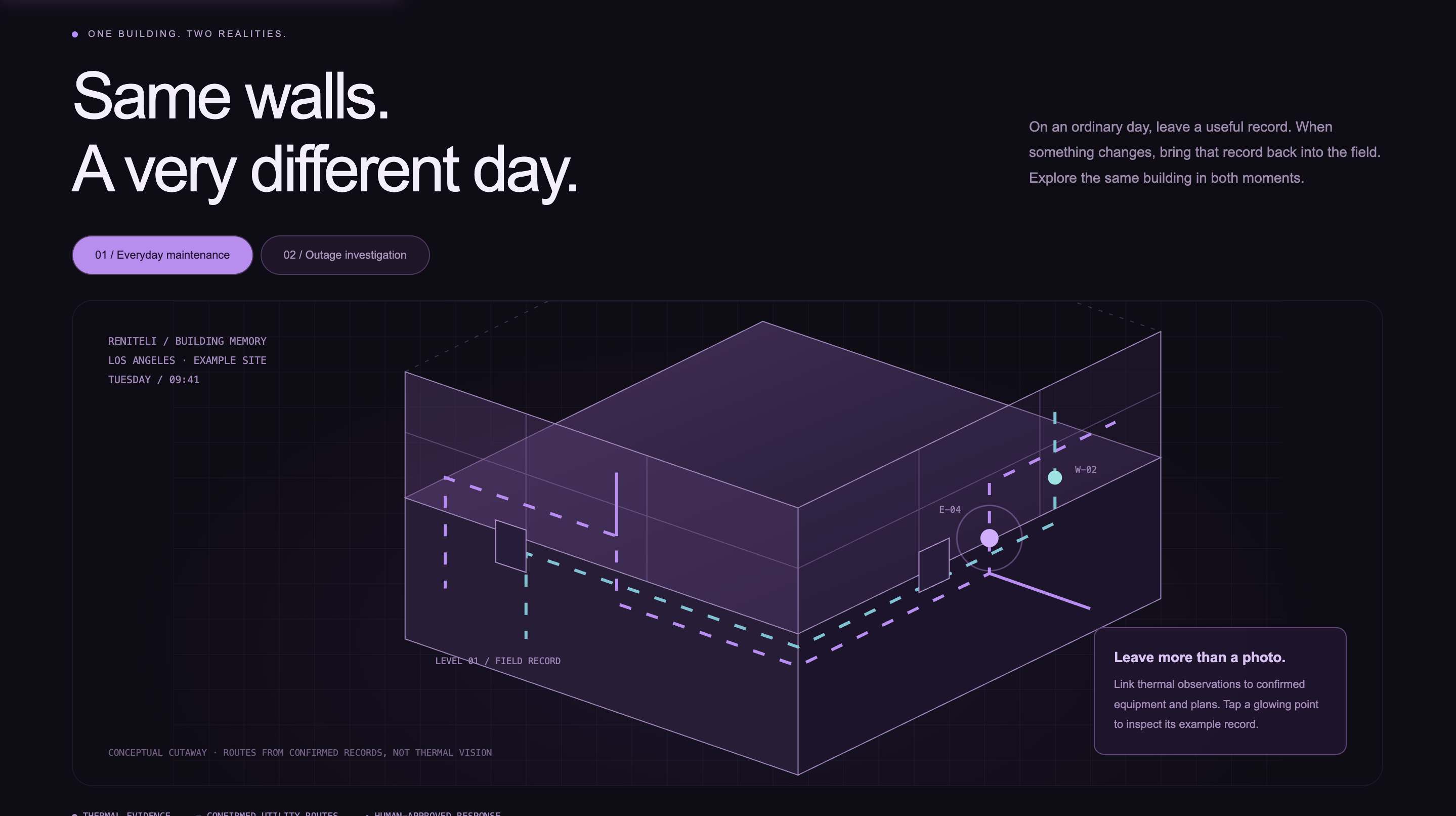
- The everyday: During installation or maintenance, electricians and contractors capture a thermal baseline for a specific wall, room and circuit. They link it to confirmed equipment labels and utility routes from plans or exposed work.
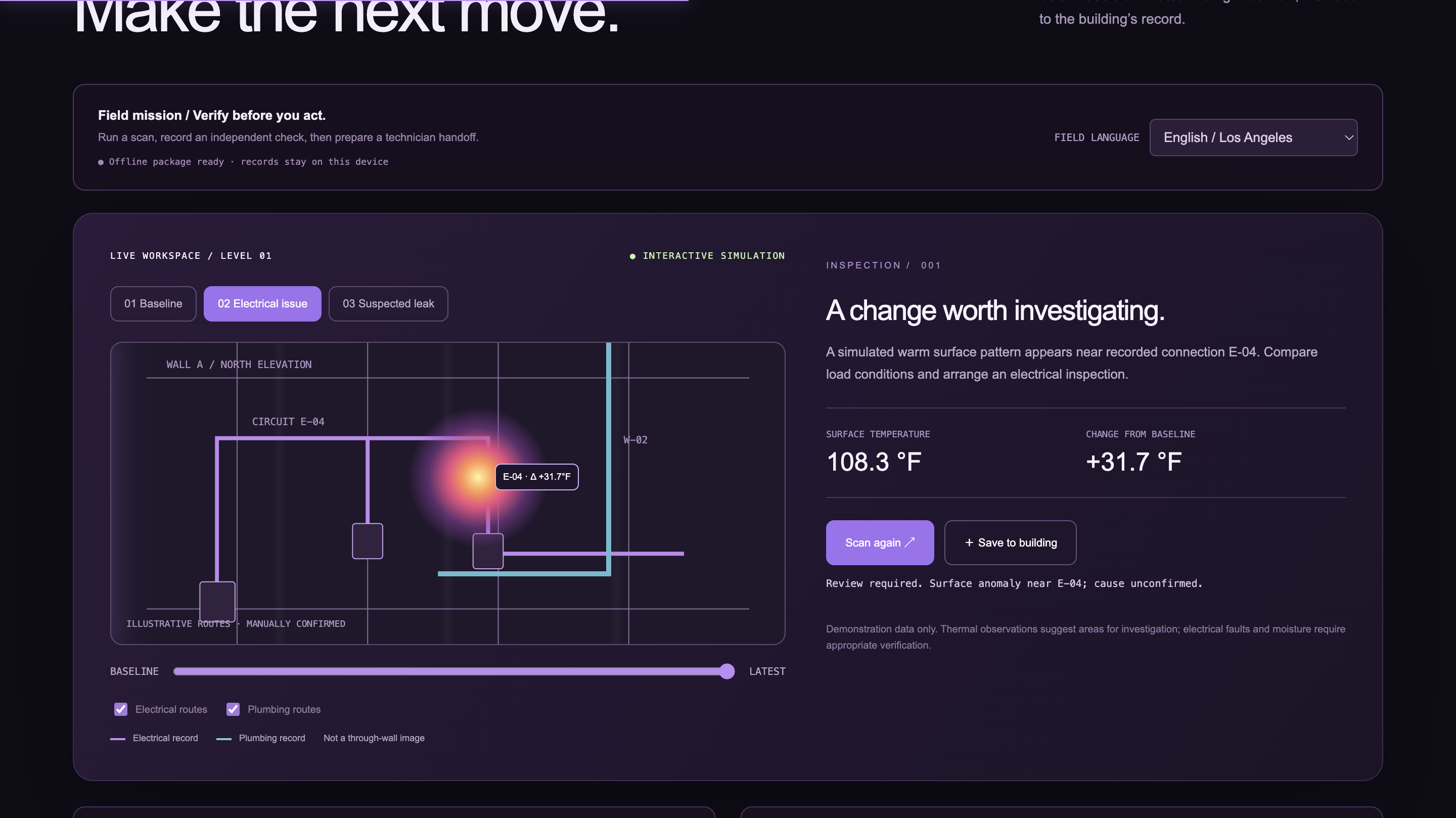
- The unexpected: During an outage or a suspected leak, a technician revisits the same location, scans again, and RENITELI highlights what changed compared to the baseline: For example, circuit E-04 gives the next person a specific place to investigate instead of a whole building to search.
Every finding is treated as a starting point, not a verdict. The workflow requires a separate manual verification step before generating a technician handoff, and the app never operates a breaker or valve. It also supports English (Los Angeles) and Spanish (Mexico City) field workflows. Evidence and equipment labels stay traceable, while the instructions and handoff text follow the selected language.
How we built it
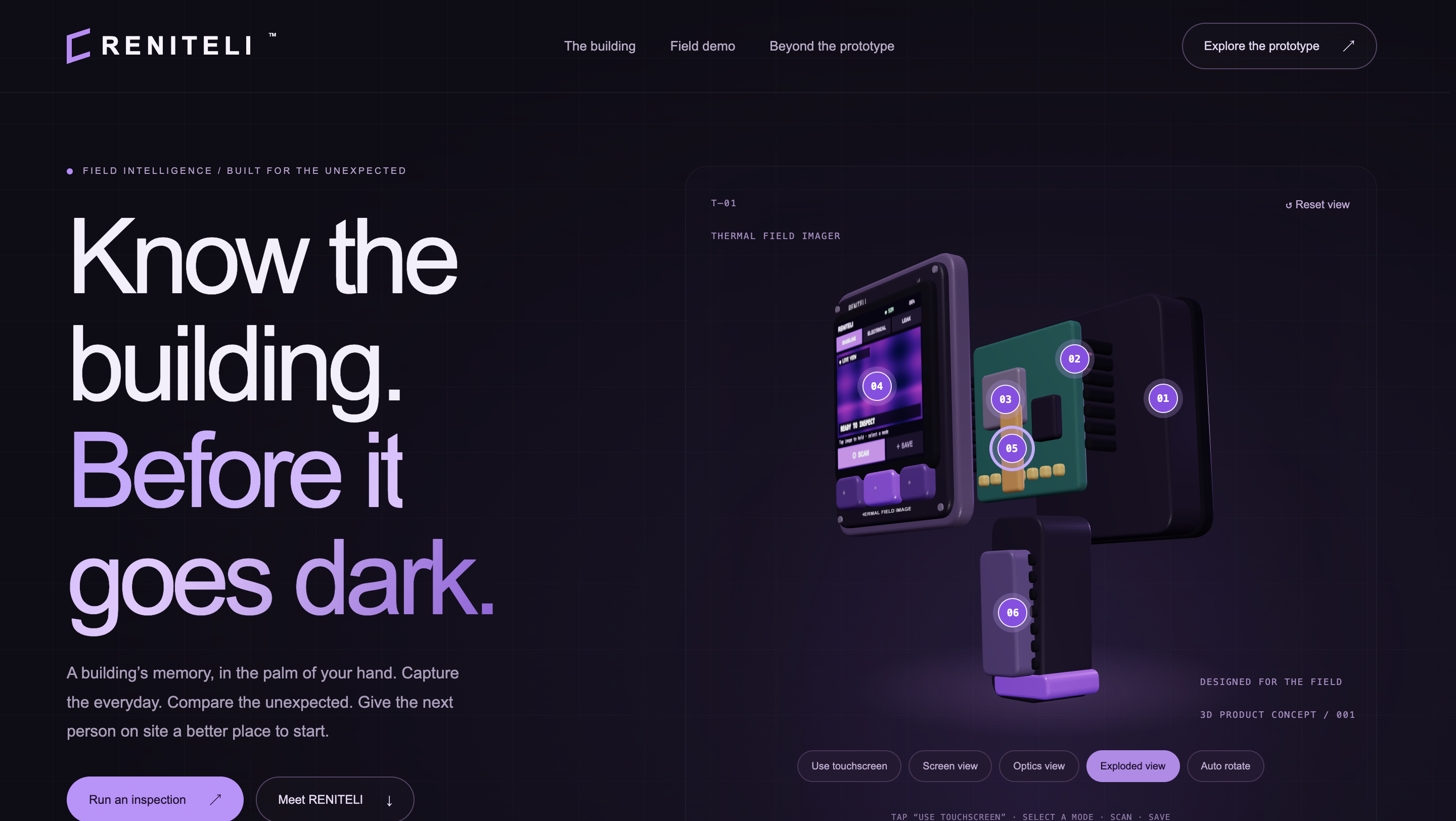
- Interactive 3D device concept: a rotatable model of the T-01 thermal field imager with screen, optics and exploded views, plus a working touchscreen mode. [Three.js / React Three Fiber?]
- Simulated inspection workspace: baseline, electrical issue and suspected leak scenarios, with plumbing and electrical route overlays drawn from "confirmed records" rather than thermal vision.
- Building record: a floor-plan view where saved inspections attach to a specific level, room and wall. Records are stored locally in the browser and can be exported as JSON.
- Offline-first: the workspace caches so it can reopen without a connection, which matters in basements and during outages.
- Localization: a bilingual workflow with region-specific example sites.
- Stack: [React / Next.js / Vite?]**, deployed on Vercel.
Challenges we ran into
- Thermal imaging measures surface temperature. It doesn't see through drywall or map hidden utilities on its own. Rather than overpromise, we built RENITELI around that limit: utility routes come from confirmed plans and technician records, and thermal readings sit on top as evidence. That design choice is what makes every finding trustworthy.
- A tool that points people toward electrical faults has to slow them down at the right moment. We built in deliberate friction: a required manual verification step before any handoff, and clear guidance that faults and moisture must be confirmed by the right professional. RENITELI directs the investigation. It never takes action on its own.
- We wanted judges and future users to know exactly where the prototype stands. The full software workflow works today, and we defined measurable pilot criteria (time-to-locate, record completeness, false-flag rate) to validate the hardware in the field.
Accomplishments that we're proud of
- A complete, clickable inspection loop: scan → compare to baseline → record verification → prepare handoff → save to the building record → export.
- A 3D hardware concept that makes the product tangible, not just a dashboard.
- A bilingual workflow that shows the same evidence can travel across borders and crews.
- A realistic path out of the hackathon. Instead of hand-waving "raise money," we mapped out NSF I-Corps customer discovery, a measured hardware pilot, and possible SBIR/STTR R&D.
What we learned
- In the field, one false alarm costs more than a missing feature. Being clear about what the tool can't do made the whole concept stronger.
- A thermal photo on its own is a guess. A thermal photo next to a recorded baseline is evidence.
- The hard problem isn't capturing a thermal image. It's making sure the next technician can find, understand, and act on it.
- Its hard to make a hardware adapted porduct.
What's next for RENITELI
- Customer discovery: interview electrical contractors and water-restoration teams to validate the repeat-inspection and handoff workflows, ideally through a regional NSF I-Corps program.
- Hardware bench tests: connect a real thermal sensor, test temperature reporting, and record conditions like load, distance and surface type so comparisons are fair.
- Field pilot: work with contractors who revisit the same rooms, and measure time-to-locate, record completeness, and false-flag rate with and without RENITELI.
- Shared records: move from browser-only storage to optional sync so a building's memory can pass from one crew to the next.
- Funding: assess fit for NSF SBIR/STTR to support genuine technical R&D.

Log in or sign up for Devpost to join the conversation.