Inspiration
Renewable energy planning is usually fragmented across static maps, spreadsheets, and isolated datasets. We wanted to build a tool that brings everything into one place: an interactive map where users can explore renewable potential, account for real-world siting constraints, and generate actionable recommendations.
What it does
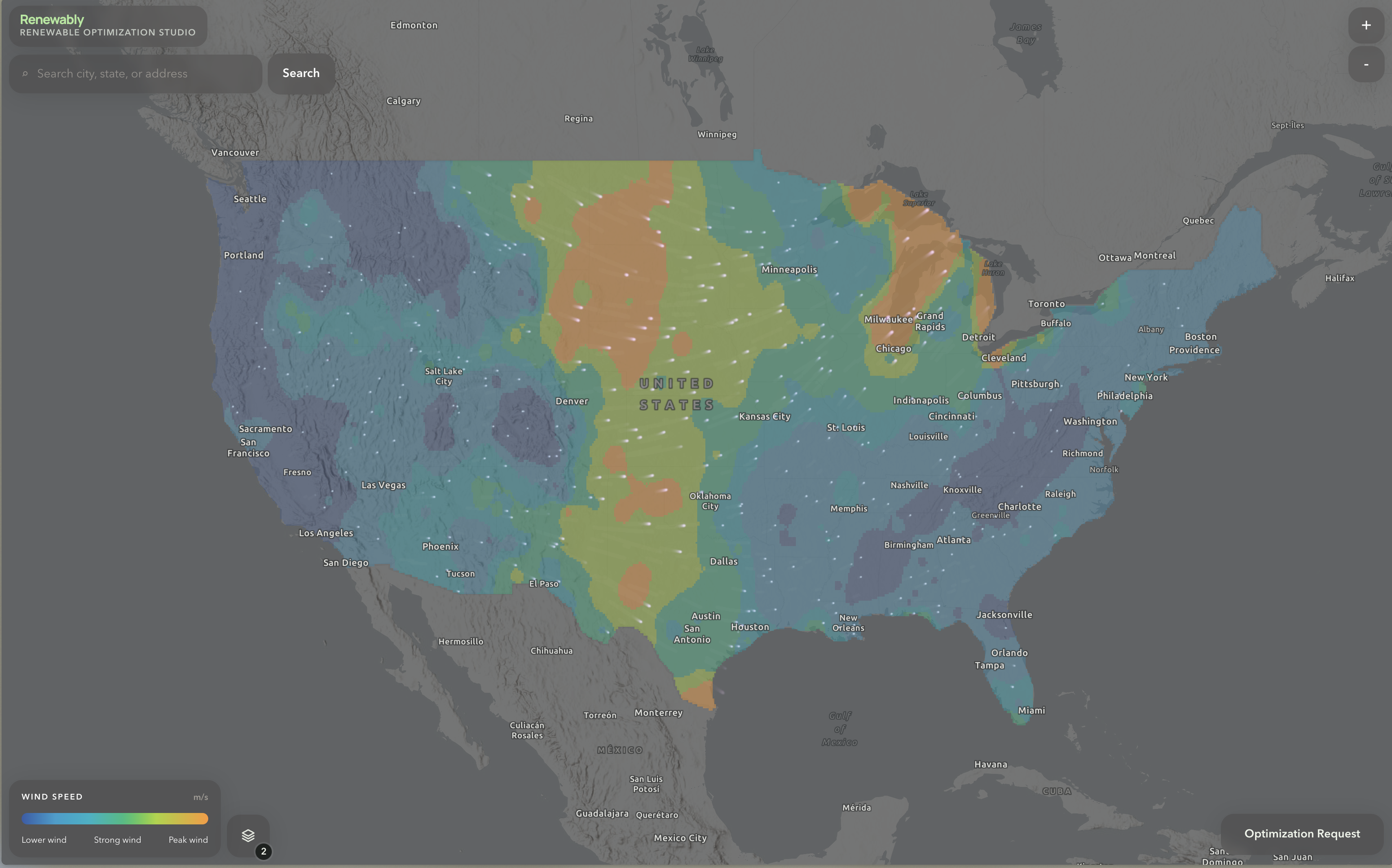
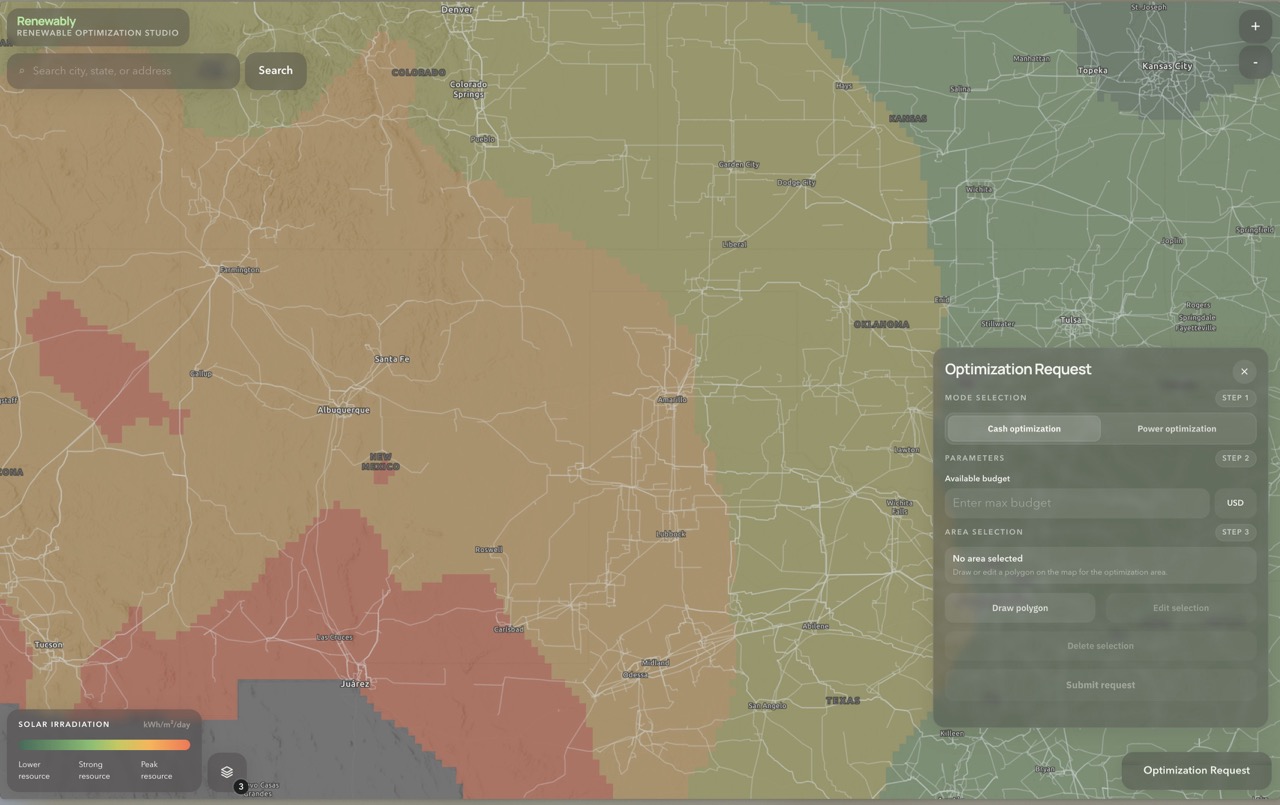
Renewably is an interactive renewable energy siting platform for the US. Users can search for a location, explore solar and wind resource layers, view existing renewable sites and major transmission lines, and draw a custom polygon to define an area of interest.
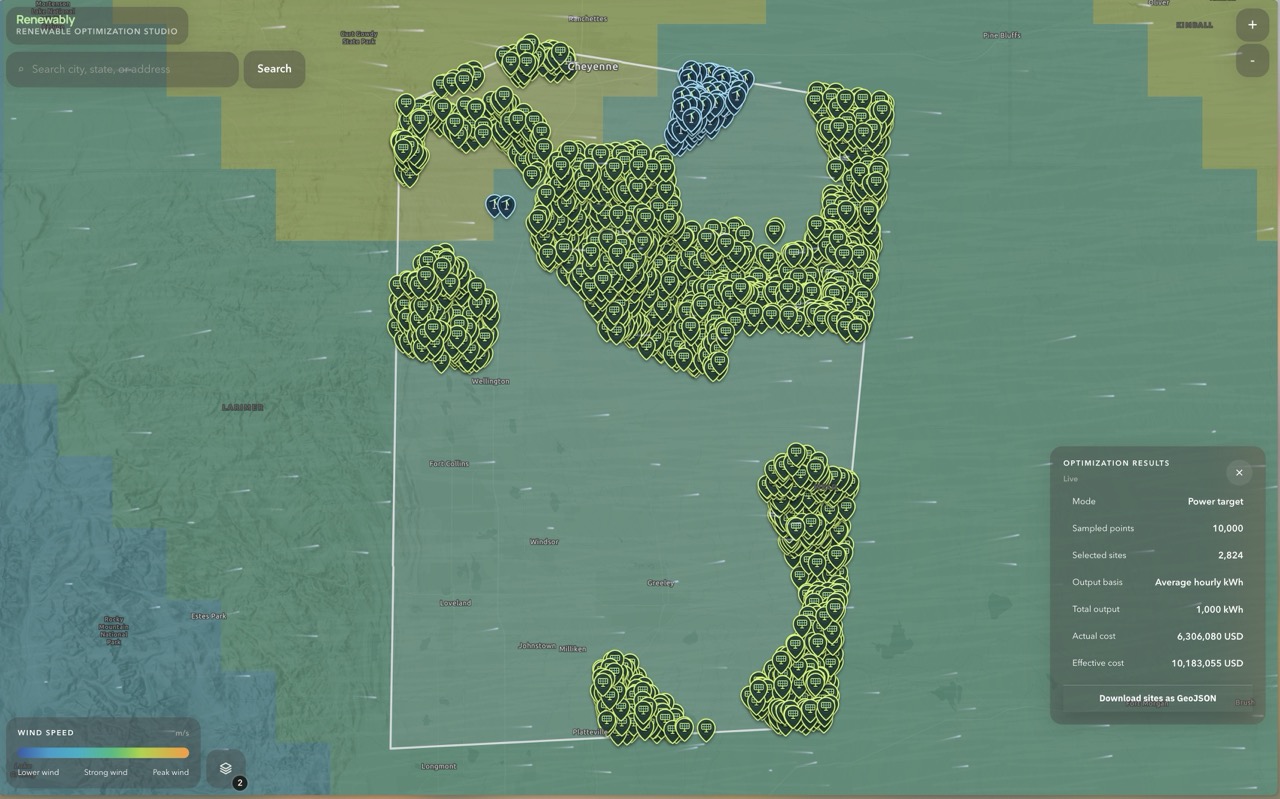
Once a region is selected, users can run an optimization based on either budget or target power output. The platform samples candidate locations inside the selected area, predicts solar irradiation and wind speed with ML models, converts those predictions into power estimates, and uses a third siting model to estimate the probability that a given point is appropriate for solar, wind, or neither based on factors like terrain, distance to the power grid, and proximity to residential areas. Those signals are combined to recommend the most promising sites, which are then displayed directly on the map.
How we built it
We built the frontend with React and Vite and centered the entire experience around an embedded ArcGIS map. Instead of treating the map as just a visualization, we designed the UI so search, layer controls, optimization, and results all happen directly as map overlays.
On the backend, we used Python and Modal to serve our machine learning models. We trained separate models for solar irradiation and wind speed, added a third model for site suitability probabilities, converted model outputs into comparable power values, and built an optimization pipeline that evaluates thousands of candidate points within a user-selected region.
Challenges we ran into
A major challenge was making sure the optimization was grounded in correct geospatial and physical assumptions. We had to debug coordinate system issues between frontend map selections and backend model inputs, fix deployment and model-serving issues, and carefully validate our unit conversions so solar and wind outputs could be compared meaningfully.
Another challenge was balancing technical realism with usability. We wanted the optimizer to work at both small and large scales, which meant normalizing costs and outputs into comparable build units rather than relying on unrealistic one-panel-versus-one-turbine comparisons.
We also spent a lot of time refining the interface so that it felt like a polished geospatial product rather than a simple dashboard.
Accomplishments that we're proud of
We’re proud that Renewably is already a full workflow, not just a map demo. A user can explore resource layers, define a project area, run an optimization, and immediately see recommended solar and wind sites placed back onto the map with contextual information.
We’re also proud of how much technical depth we connected in one system: geospatial UI, multiple ML models, optimization logic, deployment infrastructure, and a workflow that keeps everything understandable to the user.
What we learned
We learned that geospatial products demand precision. Small mistakes in coordinates, units, or assumptions can create huge downstream errors in optimization results.
We also learned that model quality alone is not enough. The framing of the decision problem matters just as much. To make recommendations useful, resource models need to be combined with siting-probability and infrastructure-aware constraints.
Most importantly, we learned how valuable it is to iterate quickly across frontend UX, backend ML, and optimization logic at the same time.
What's next for Renewably
Next, we want to expand the siting model with even richer features and improve the optimization engine so it can handle more realistic infrastructure tradeoffs. We also want to add more layers for land use, policy, and interconnection constraints, and make the recommendations more explainable so users can understand why a site was chosen.
Long term, we see Renewably becoming a practical planning tool for renewable development that helps users move from “where is the resource strong?” to “where can a project actually succeed?”


Log in or sign up for Devpost to join the conversation.