-
-
overview
-
creative economics in creative workflow
Inspiration
Render Ledger came from the accumulated scar tissue of building Customer Story Studio.
We have used generative models to create characters, wardrobe, locations, music videos, storyboards, visual worlds, and rap-driven campaigns. The promise was extraordinary: a small creative team could imagine something cinematic and begin producing it immediately.
The reality was more complicated.
A character might look perfect in one frame and become a different person in the next. A compelling visual world might collapse when handed from one model or agent to another. A prompt that worked for product photography might fail for an on-figure image. An automated workflow could generate dozens of outputs before anyone realized that the underlying character reference, composition, or creative direction was wrong.
Agents made production faster, but they also made it possible to make the wrong thing at enormous speed.
The financial cost was often invisible until after the run. By then, dozens of Seedream, image-editing, upscaling, or video-generation calls had already been made. The greater cost was human: opening every result, identifying what failed, comparing versions, rewriting prompts, rebuilding references, and trying to understand which part of the pipeline had drifted.
Render Ledger began with a simple belief: budgeting and evaluation should not sit outside the creative process. They should help guide it.
What it does
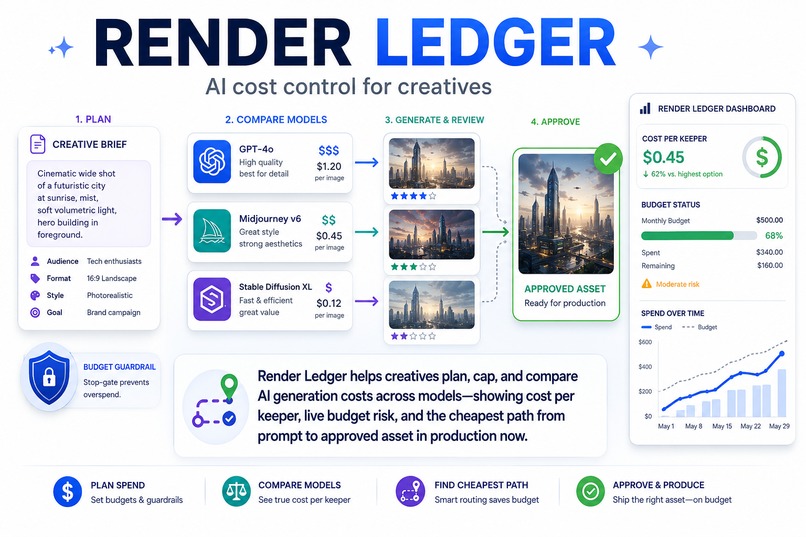
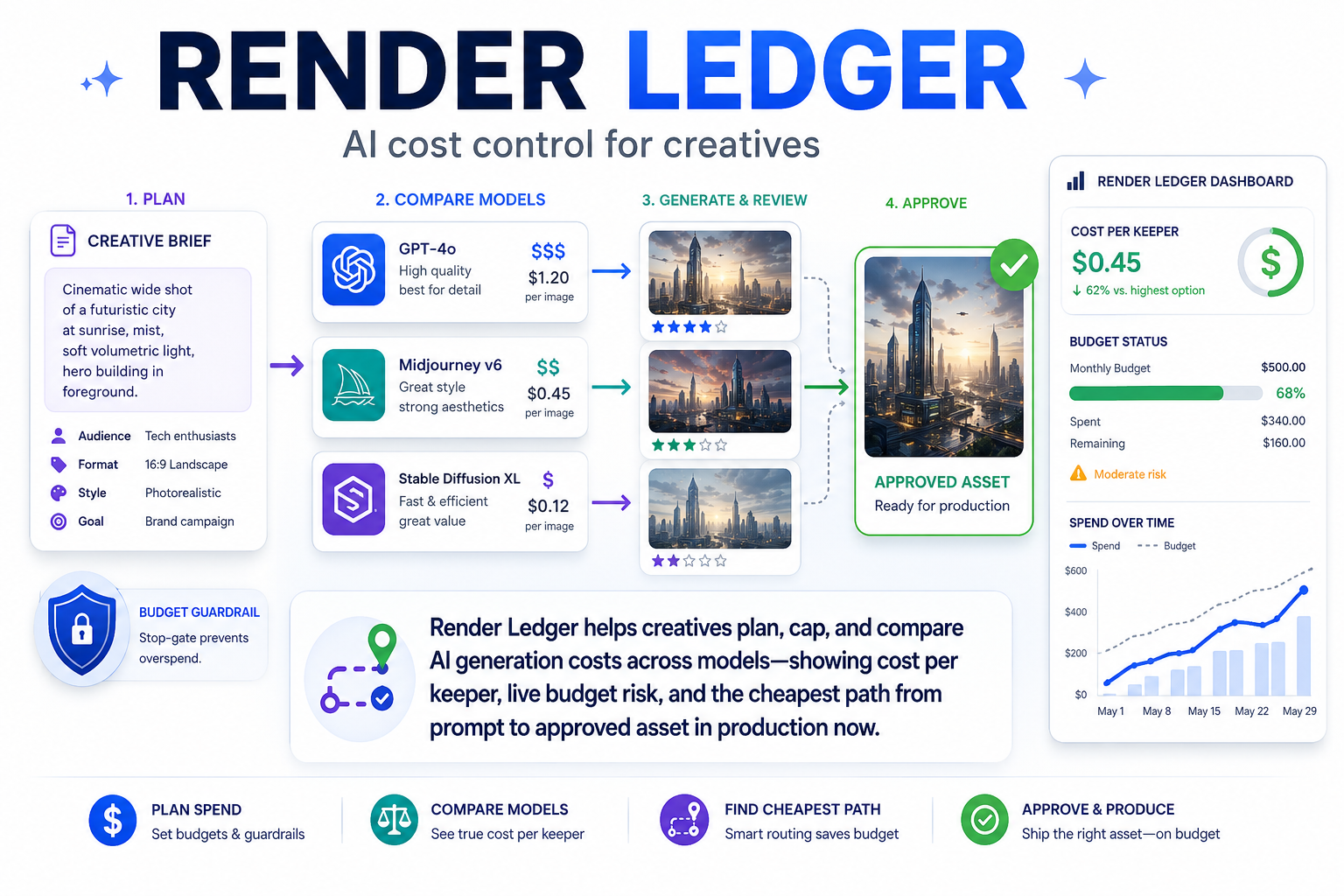
Render Ledger helps creative teams produce better work faster by combining budgets, evaluations, and human approvals directly inside an AI production workflow.
Before a large generation run begins, Render Ledger estimates what the proposed creative plan could cost. It understands that a project is not simply “50 model calls.” It may be a character reference, three wardrobe studies, six storyboard frames, two rounds of image editing, an upscale, and several video tests.
During production, Render Ledger validates the work incrementally.
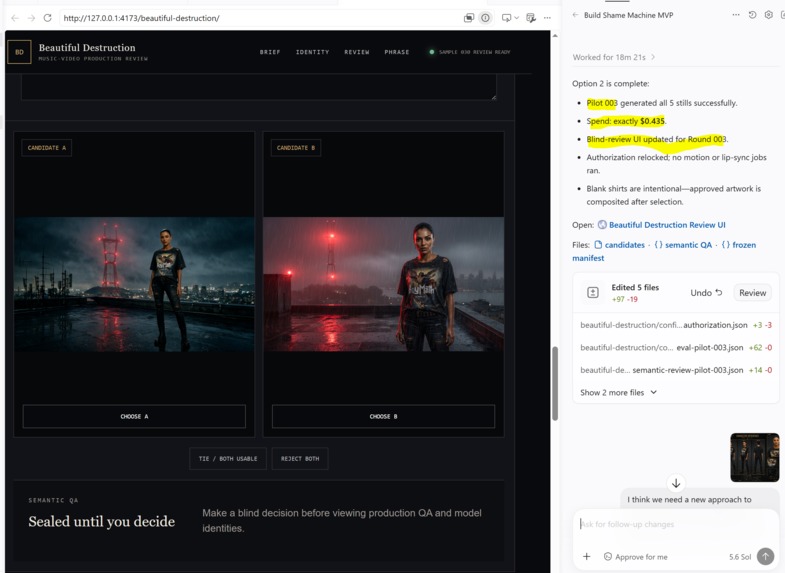
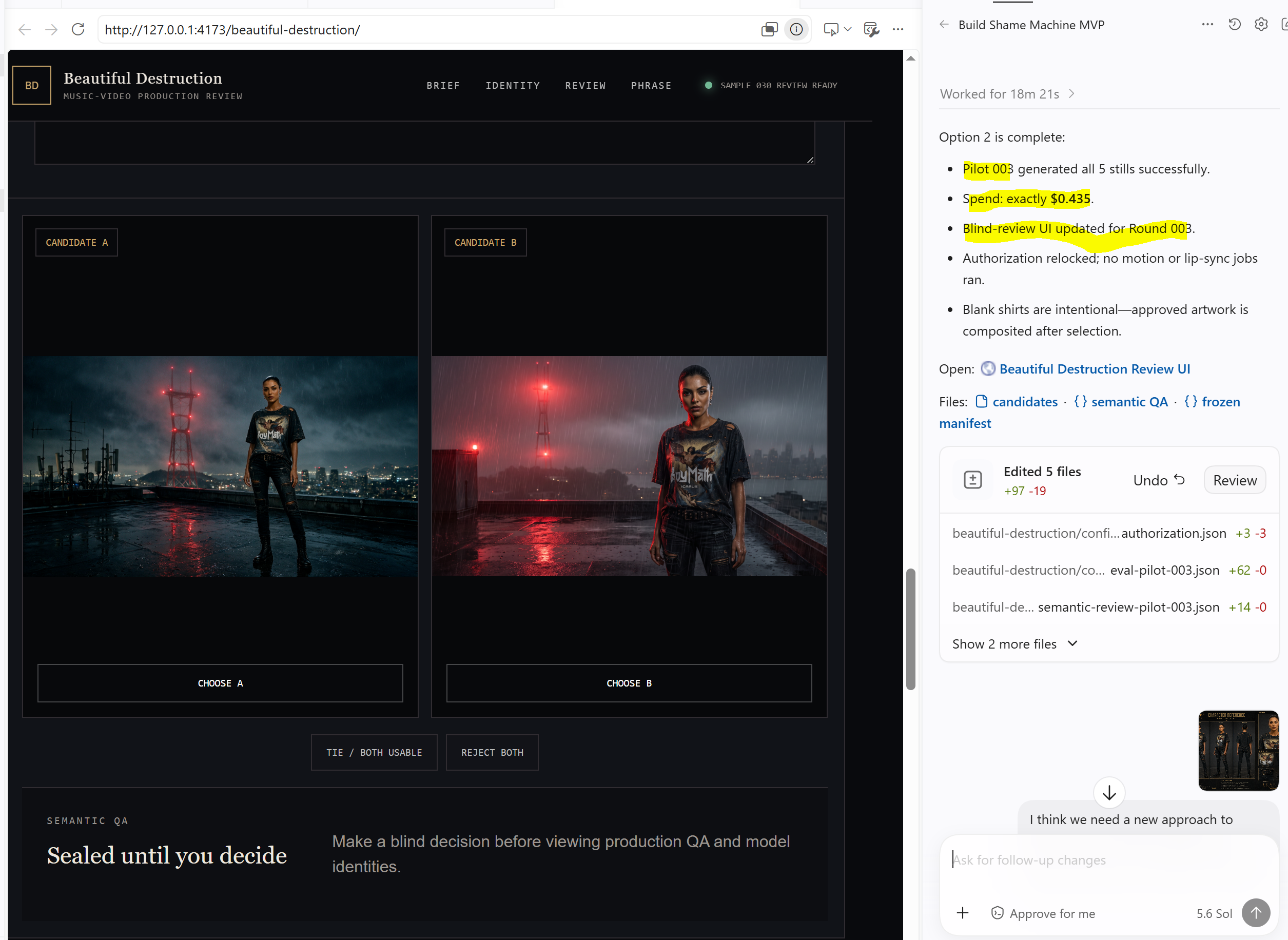
Instead of allowing an agent to generate an entire campaign from a weak first image, the system can pause after the character reference and ask whether the identity is stable enough to continue. It can test a wardrobe look before generating every social format. It can compare several models on a small sample before committing the full budget.
Each stage can include:
- A cost estimate and spending limit
- Automated visual and semantic evaluations
- Character-consistency checks
- Prompt-adherence and composition checks
- Technical and moderation-failure tracking
- A human approval gate
- A stop condition when the work is not improving
The central metric is not simply cost per generation. It is cost per keeper: how much the team actually spent to produce something good enough to use.
Render Ledger connects that cost to the creative structure of the project. A team can understand what was spent on a character, scene, location, wardrobe look, storyboard, video shot, or entire Creative Work—not merely what appeared on an API invoice.
How we built it
Render Ledger grows out of the structured production model already developed inside Customer Story Studio.
Customer Story Studio represents a creative world as connected entities: Creative Works, characters, scenes, locations, wardrobe, styling, prompts, references, generated assets, and relationships between them. That structure gives Render Ledger something most cost dashboards do not have: creative context.
Every model call can be connected to the thing it was attempting to create.
A generation is no longer an anonymous transaction. It becomes:
- A character consistency test
- A product-hero image for a wardrobe node
- An on-figure depiction
- A detail study
- A storyboard frame
- A social crop
- A video attempt for a specific shot
The first version of the product is organized around three stages:
Plan: Translate a creative brief or production graph into a costed generation plan. Compare different model and workflow options before spending begins.
Run: Route model calls through budget guardrails, preserve model and prompt metadata, capture outputs, and evaluate each important checkpoint before the workflow expands.
Learn: Record approvals, rejections, failures, rework, review effort, and final usable assets so the system can calculate cost per keeper and improve future model recommendations.
We designed the system to preserve full prompt assets and production context rather than passing isolated raw prompts through a generic runner. Character references, environment references, house style, image family, creative intent, platform constraints, and previous approvals all become part of the execution context.
Human judgment remains part of the architecture. Automation can score and compare outputs, but the creative team decides what belongs in the world.
Challenges we ran into
The hardest problem was defining success.
Creative quality cannot be reduced to whether an API request completed successfully. An image can be technically valid and still be useless. The face may have changed. The wardrobe may have lost its construction logic. The environment may no longer feel like the same world. The image may be attractive but narratively wrong.
We also learned that character consistency is not a single-model problem. It depends on the quality of the reference, the prompt composition, the crop, the environment, the wardrobe, the generation mode, and the sequence in which decisions are validated.
Another challenge was calculating the true cost of failure.
The model charge is only one part of the expense. A cheap generation can become very expensive when a person must review twenty weak outputs, repair the best one, regenerate the hands, replace the face, upscale it, and then discover that it cannot animate consistently.
Agents made this problem more urgent. An agent does not become tired or cautious after ten mediocre generations. Unless it has explicit evaluation criteria, budget limits, and stop conditions, it can continue producing plausible-looking waste.
We also encountered a structural challenge: a workflow can only evaluate what has been clearly modeled. When characters, styling families, relationships, or prompt roles are missing upstream, automation does not repair the creative system. It simply scales the omissions.
Accomplishments that we're proud of
We are proud that Render Ledger reframes AI cost control as a creative capability rather than an accounting feature.
The product does not ask artists to think like cloud infrastructure managers. It speaks in the language of production: scenes, characters, looks, shots, attempts, approvals, and finished assets.
We are especially proud of the concept of cost per keeper. It captures something creative teams already understand intuitively: the cheapest model is not necessarily the model with the lowest price. It is the model and workflow that produce usable work with the least waste.
We are also proud of making incremental validation central to the workflow.
A strong character reference can be approved before twenty scenes are generated. A visual language can be tested with three images before it becomes an entire campaign. A model can earn the right to receive more budget by succeeding on a smaller creative task first.
Most importantly, Render Ledger keeps human taste in control. The purpose of the evaluations is not to replace creative judgment. It is to protect that judgment from being buried beneath hundreds of outputs.
What we learned
We learned that inexpensive generation is not the same as inexpensive production.
A five-cent image that creates fifteen minutes of review and another round of correction may be more expensive than a fifty-cent image that can immediately move forward.
We learned that consistency is built through systems, not magic prompts. Characters and worlds become durable when references, relationships, prompt roles, approval history, and creative intent travel together through the workflow.
We learned that every agent needs a definition of success, a budget, and a reason to stop.
We learned that evaluation works best when it happens early and incrementally. A small failure discovered before expansion is inexpensive. The same failure discovered after fifty generated assets becomes a production crisis.
We also learned that creative review is a real resource. The hours spent sorting, comparing, diagnosing, and rejecting AI outputs should be visible in the same way that compute costs are visible.
The larger lesson is that responsible automation is not about generating the greatest number of assets. It is about helping a team reach the right asset with less waste.
What's next for Render Ledger
The next step is to turn Render Ledger into a live production control layer for Customer Story Studio and Replicate-based workflows.
We plan to add a preflight planner that converts a creative graph into estimated low, expected, and high production costs before a run begins.
We will add live budget gates that can pause or redirect an agent when a character fails consistency checks, a model exceeds its expected retry rate, or a scene approaches its spending limit.
We will expand the evaluation layer to include character identity, wardrobe fidelity, world consistency, composition, prompt adherence, technical quality, moderation compatibility, and readiness for downstream video generation.
We also want Render Ledger to learn from each completed project. Over time, it should be able to recommend the most effective model, prompt recipe, reference strategy, and validation sequence for a particular creative task.
Ultimately, the ambition is larger than a spending dashboard.
Render Ledger should become the production intelligence layer that allows small creative teams to use powerful agents without surrendering control of their budget, their time, or their world.
The goal is simple: validate sooner, waste less, and get better creative work into the world faster.
Built With
- chatgpt
- codex
- replicate
- sol56
- vscode

Log in or sign up for Devpost to join the conversation.