-
-
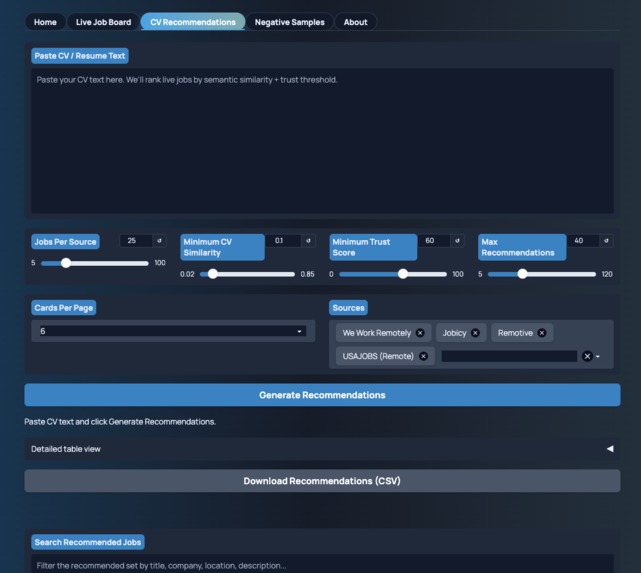
CV Recommendations
-
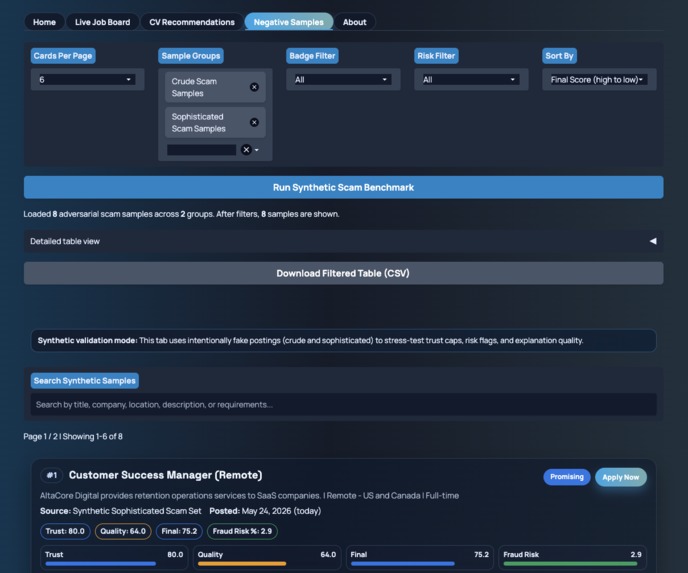
Negative Samples
-

About
-
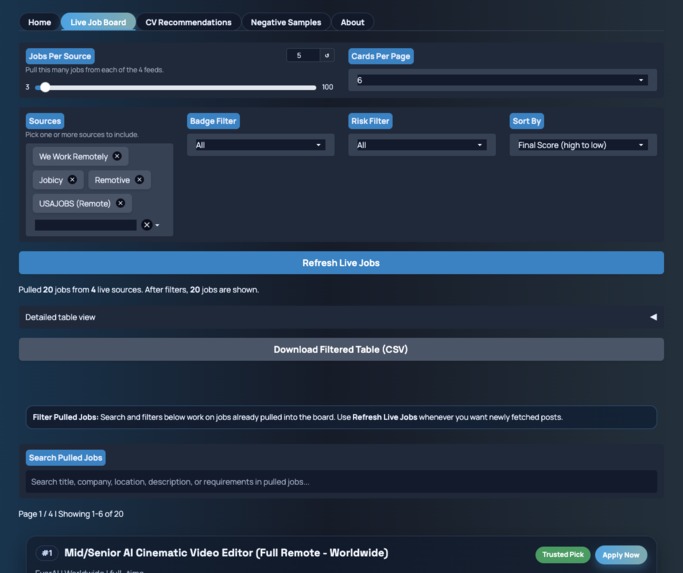
Live Job Board
-
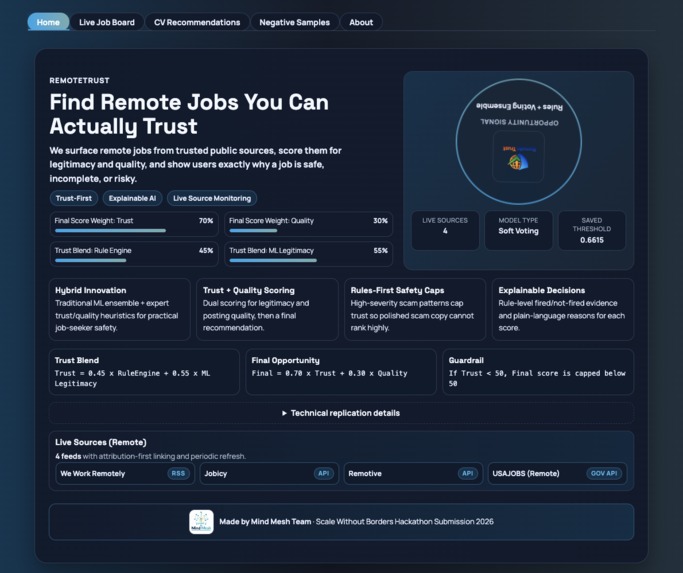
Home Page

Inspiration
Remote job scams are becoming harder to spot because many fake postings now look polished, professional, and urgent. We wanted to build a tool that helps job seekers quickly answer: “Is this opportunity safe, useful, and worth my time?”
RemoteTrust was inspired by the need for explainable job safety, especially for newcomers, students, and remote workers who may be targeted by fake-check scams, task scams, text-only interviews, and upfront-fee schemes.
What it does
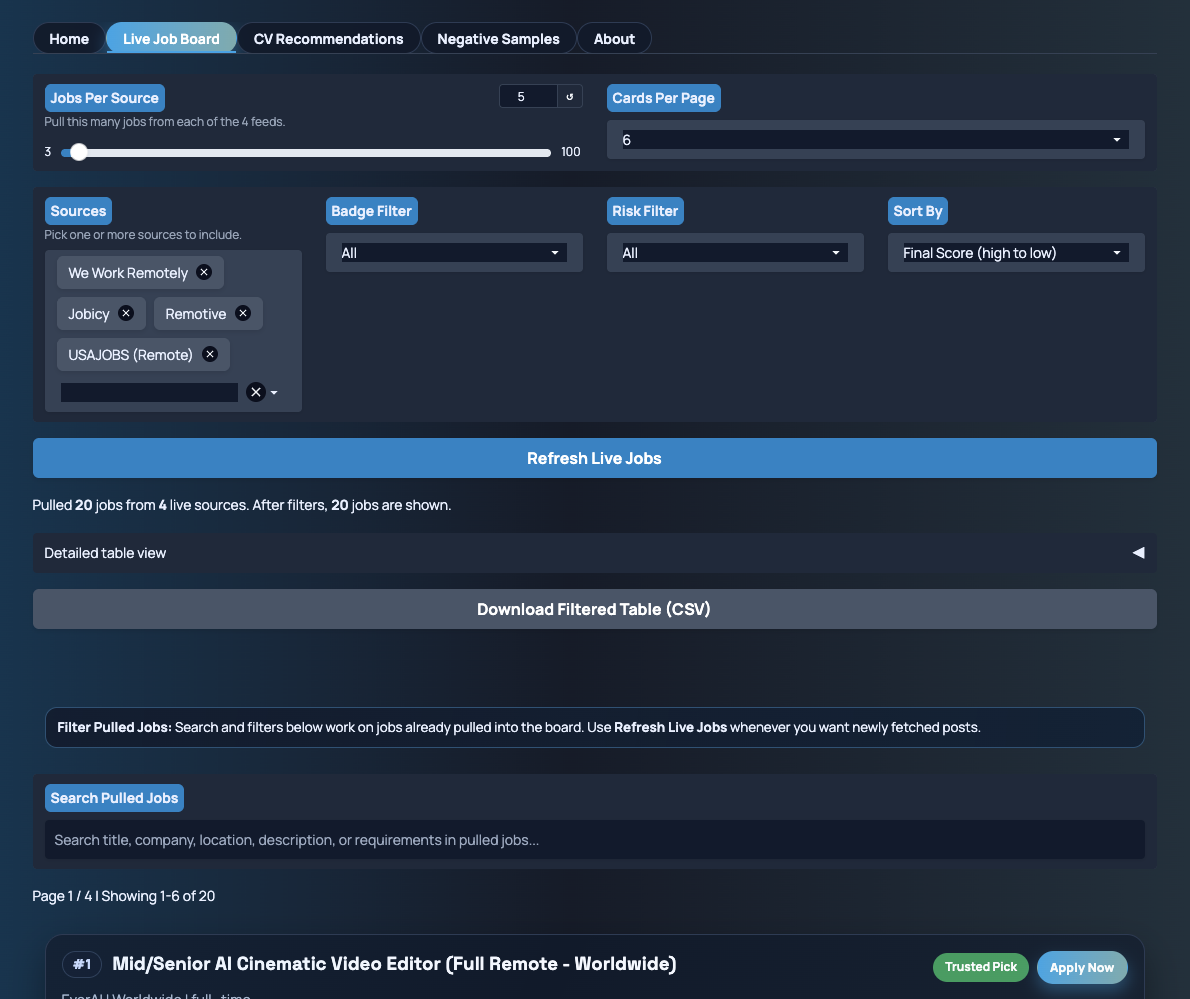
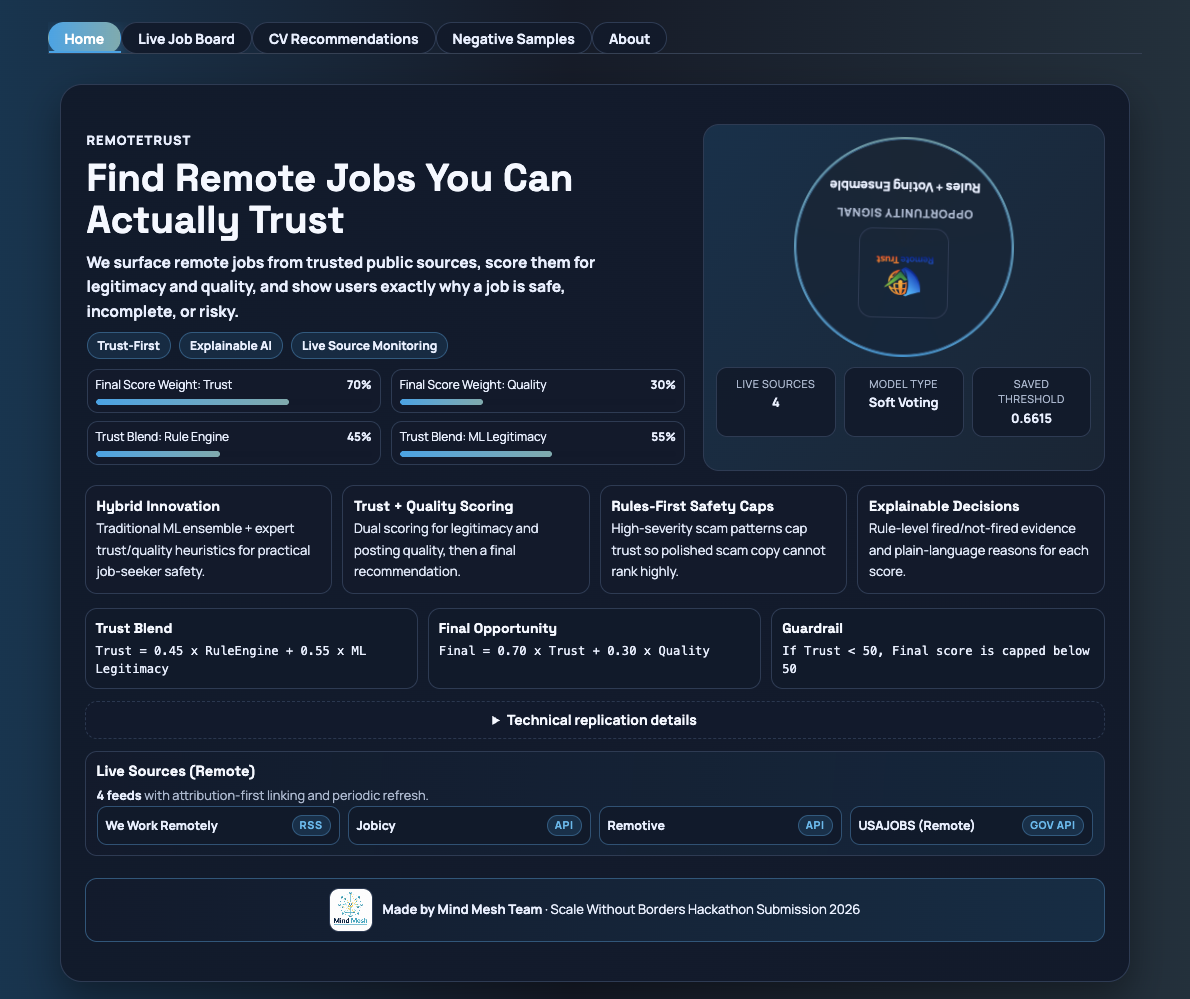
RemoteTrust pulls remote jobs from public sources like We Work Remotely, Jobicy, Remotive, and USAJOBS, then scores each posting using three user-facing signals: Trust, Quality, and Final Opportunity.
The final score is computed as:
Final Opportunity Score = (0.70 * Trust Score) + (0.30 * Quality Score)
Trust combines a rules engine and ML classifier:
Trust Score = (0.45 * Rule Engine Score) + (0.55 * ML Legitimacy Score)
We also apply a safety guardrail:
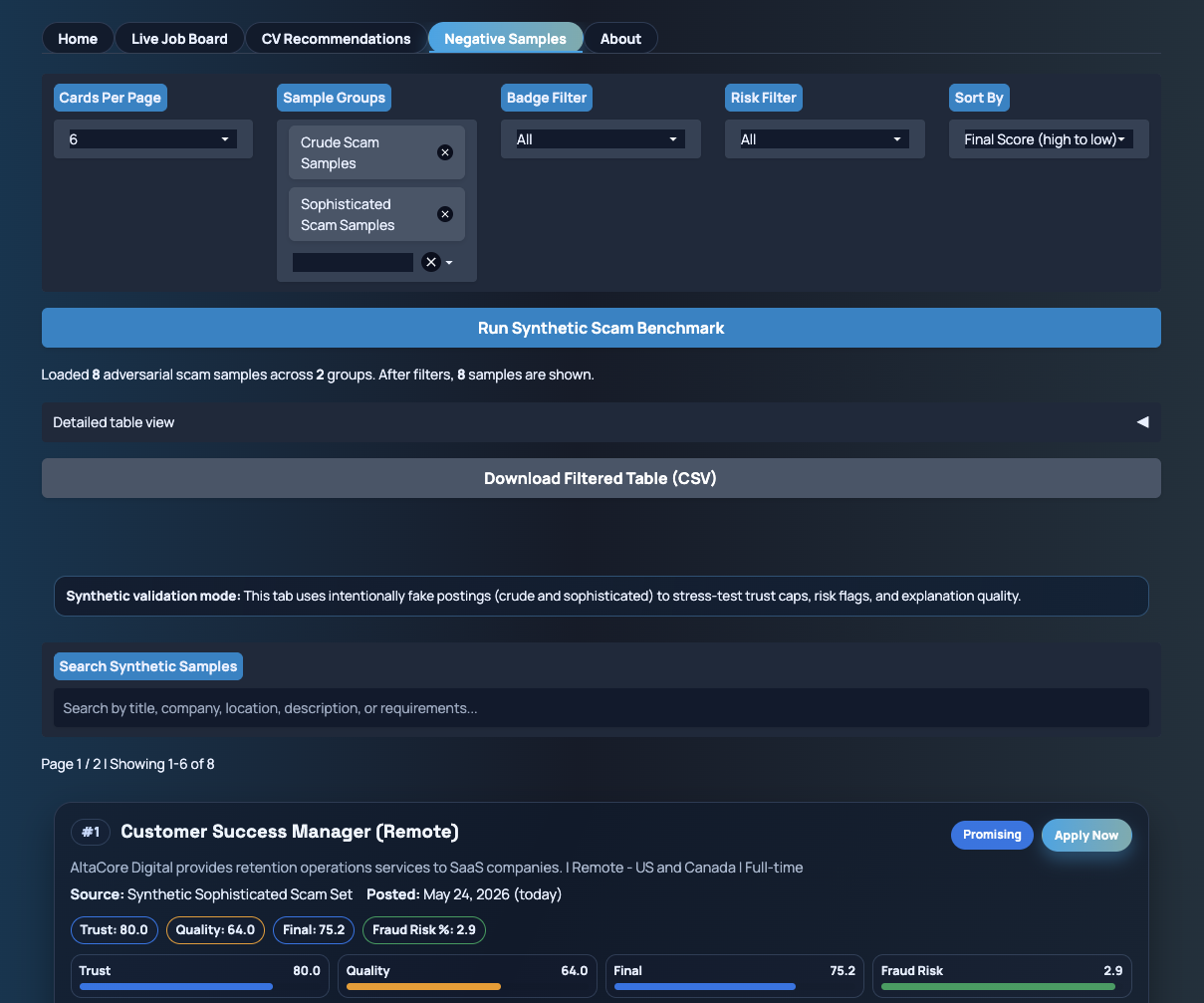
If Trust Score < 50, Final Score is capped below 50. The app also explains why each score was assigned, flags risky patterns, shows rule-level evidence, supports multilingual posts, includes synthetic scam stress tests, and recommends jobs based on CV similarity.
How we built it
We built RemoteTrust with Python, Gradio, scikit-learn, Pandas, TF-IDF features, cosine similarity, and a trained soft-voting classifier on EMSCAD fake job posting data.
The ML layer uses a voting classifier made from traditional models such as Logistic Regression, SGD, calibrated LinearSVC, and Complement Naive Bayes. We combined this with a rules engine that checks for scam indicators like upfront fees, fake-check language, WhatsApp/Telegram interviews, task-scam wording, early banking requests, and suspicious apply links.
The Quality Score uses job-posting usefulness signals such as salary clarity, employment type, location, remote clarity, benefits, role specificity, application experience, and posting freshness.
Challenges we ran into
One major challenge was avoiding a simple “fake vs real” label. Some jobs are legitimate but poorly documented, while some scams are very polished. That pushed us toward a two-part score: Trust for safety and Quality for usefulness.
We also had to handle non-English job posts, varied API schemas, incomplete source data, slow live fetching, and Gradio deployment quirks on Hugging Face Spaces.
Accomplishments that we're proud of
We are proud that RemoteTrust is explainable instead of just predictive. Users can see the exact signals behind each score, including which rules fired and whether any hard caps were applied.
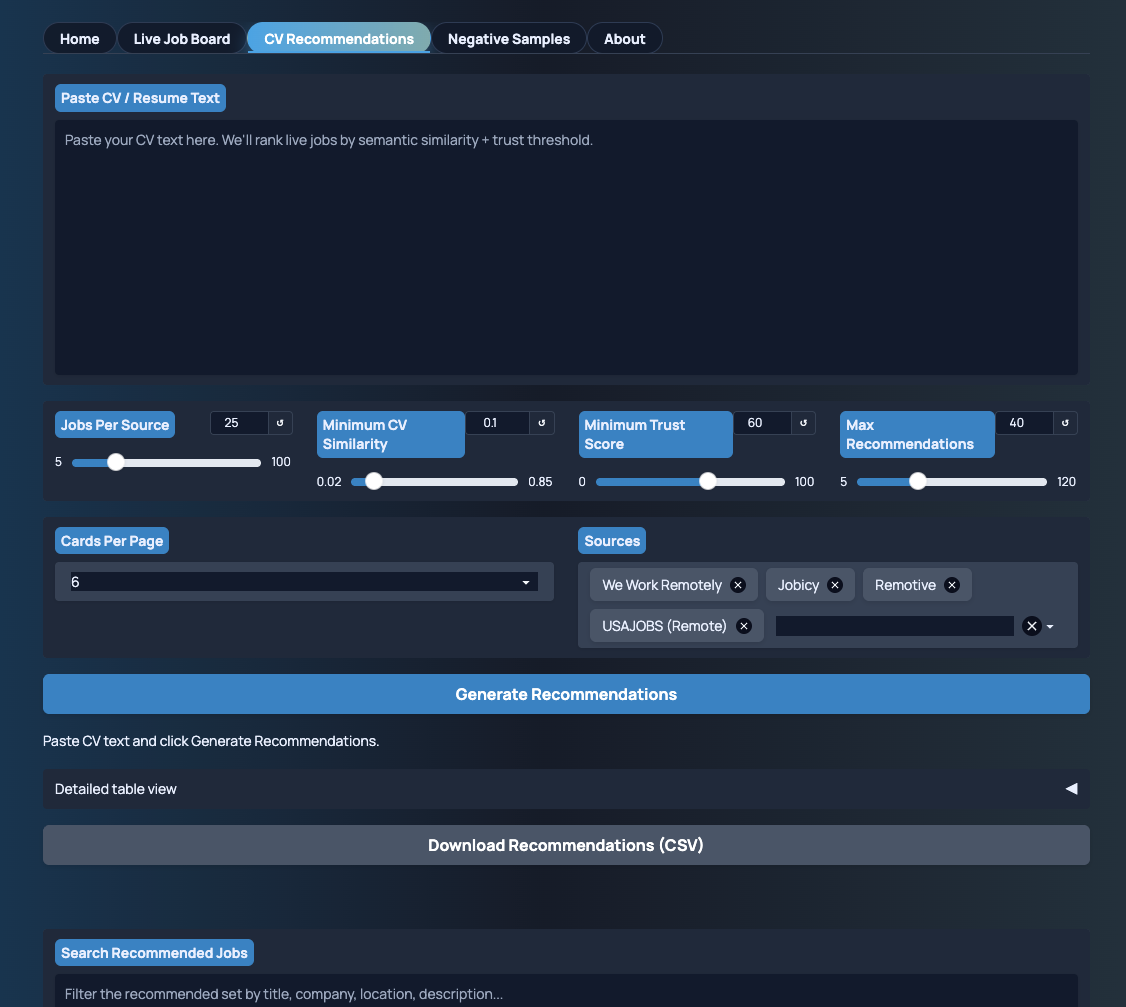
We are also proud of the live job board, multilingual support, CV recommendation tab, negative scam samples, and the scoring system that separates “safe” from “high quality.”
What we learned
We learned that trustworthy AI for job search needs both machine learning and human-readable rules. ML helps detect patterns from data, but rules are essential for high-risk scam behaviors that should never be averaged away.
We also learned that presentation matters: a fraud detector becomes much more useful when it explains risks in plain language and gives users an action-oriented badge like “Trusted Pick,” “Verify First,” or “Avoid.”
What's next for RemoteTrust
Next, we would add stronger source verification, richer company identity checks, user feedback loops, browser extension support, saved job alerts, and deeper multilingual evaluation.
We would also improve the recommendation engine with skill extraction, role clustering, and personalized thresholds so users can find jobs that are not only safer, but better matched to their goals.
Built With
- gradio
- huggingface
- python
- scikit-learn


Log in or sign up for Devpost to join the conversation.