-
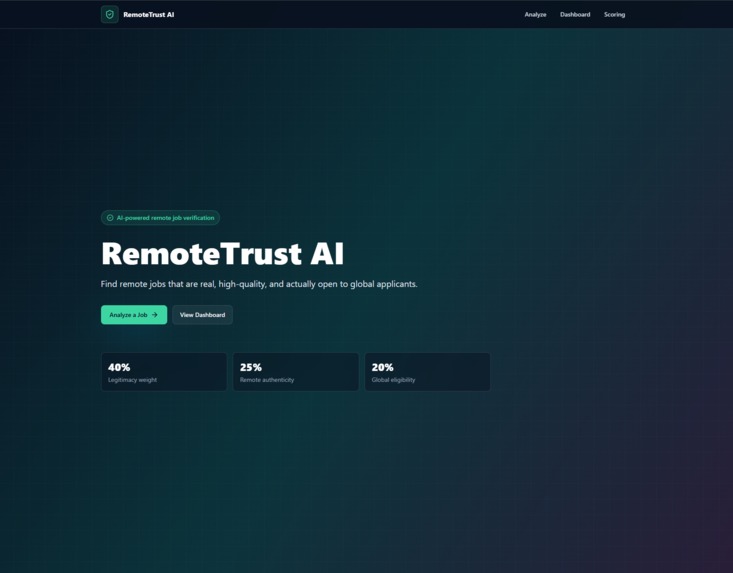
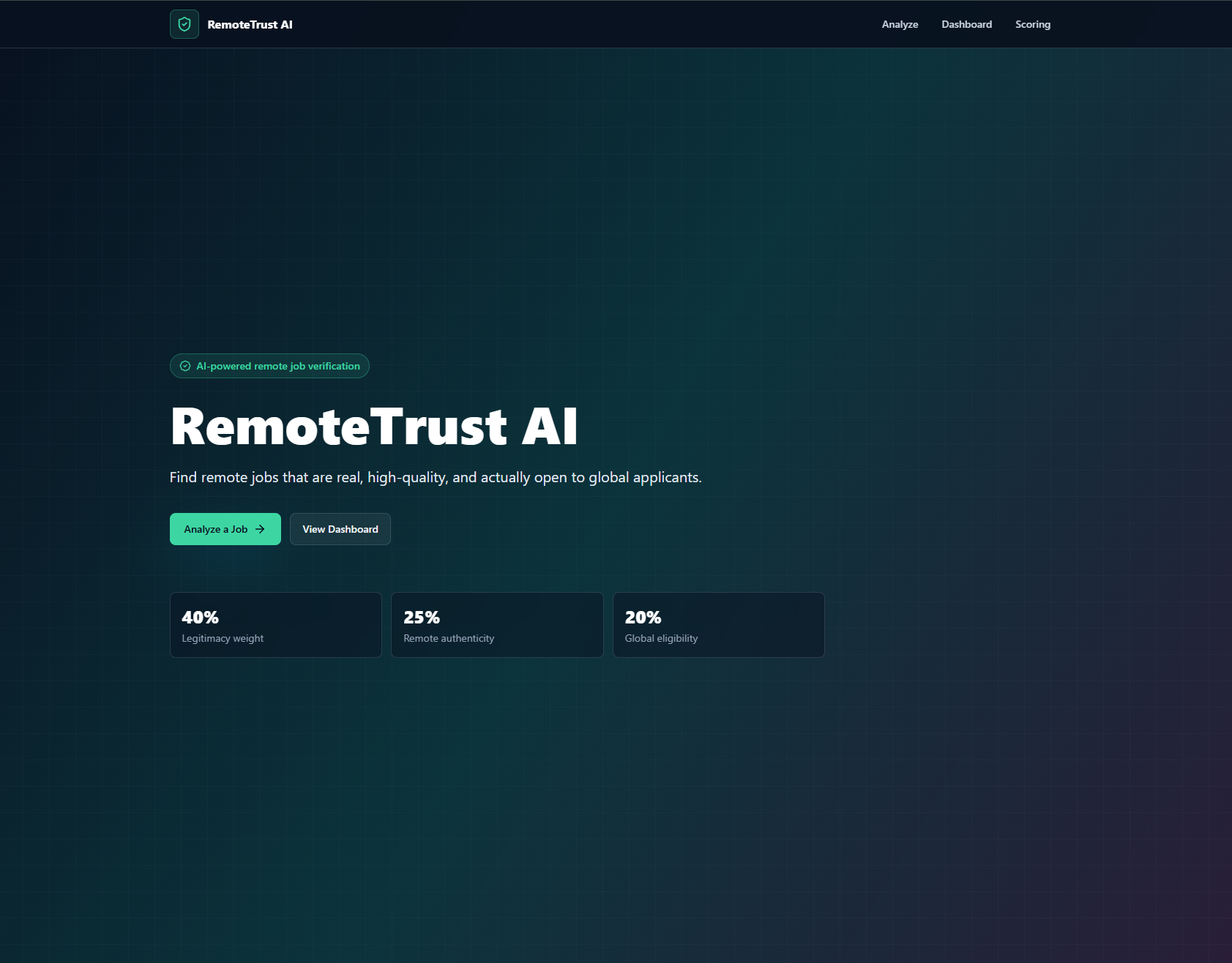
Landing Page
-
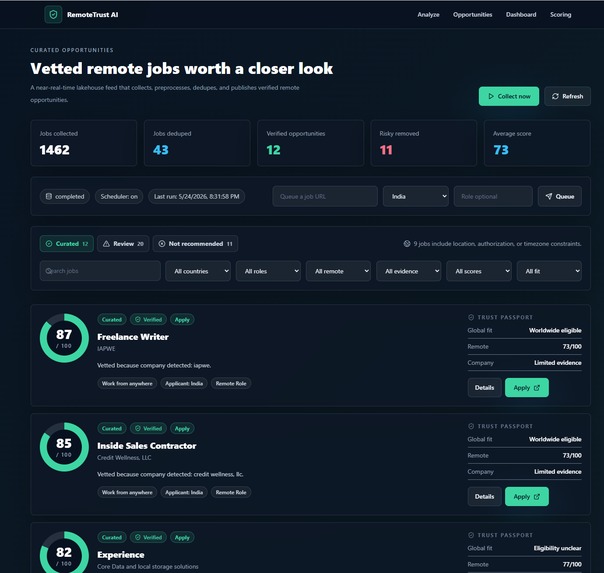
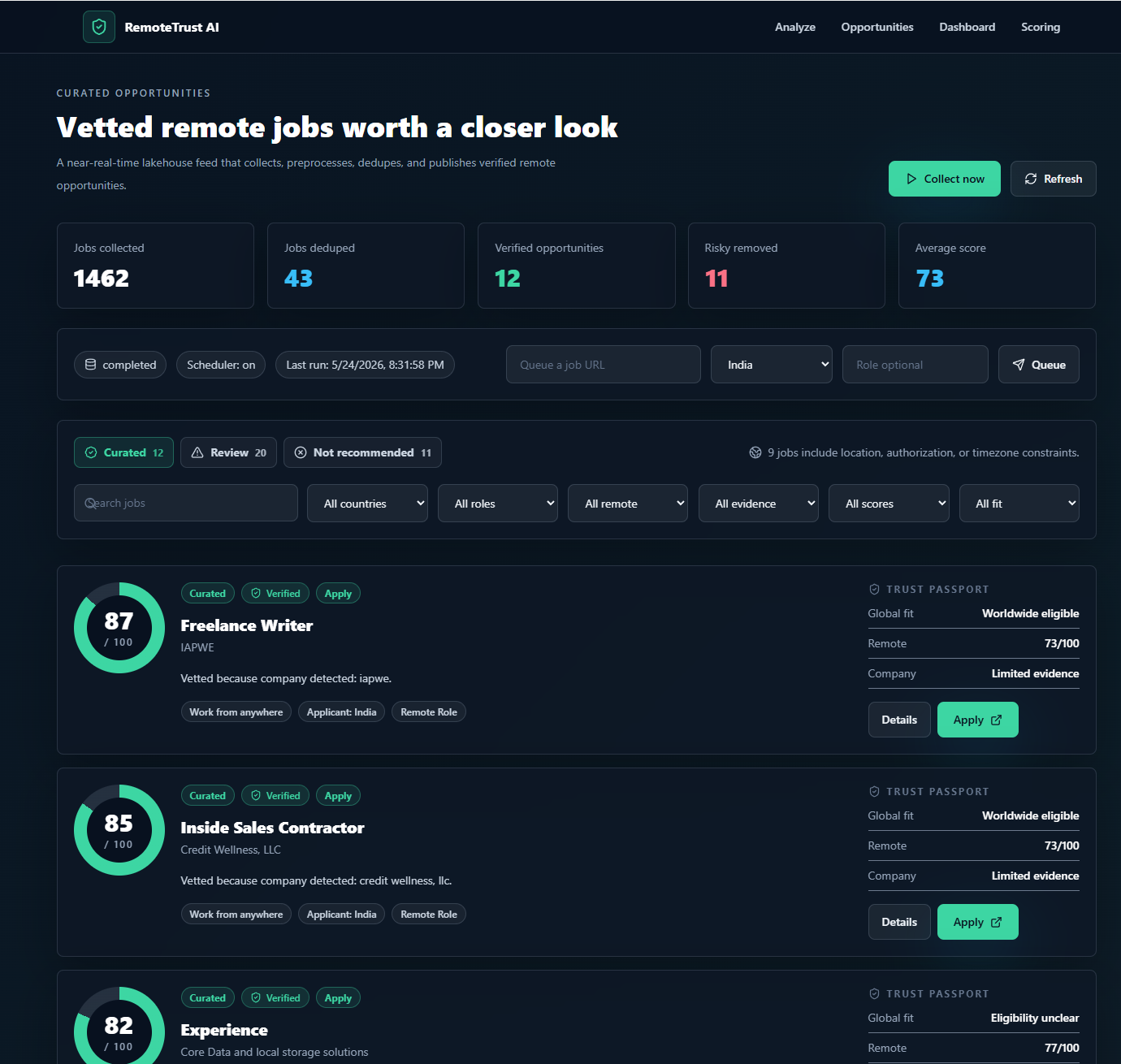
Verified Jobs
-
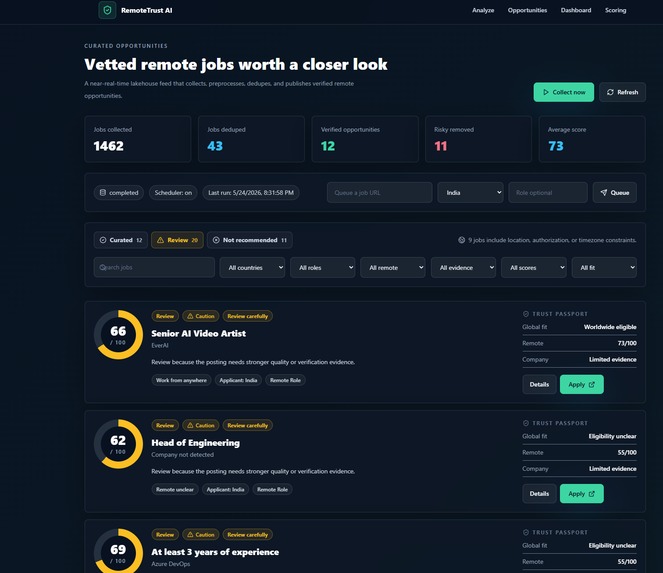
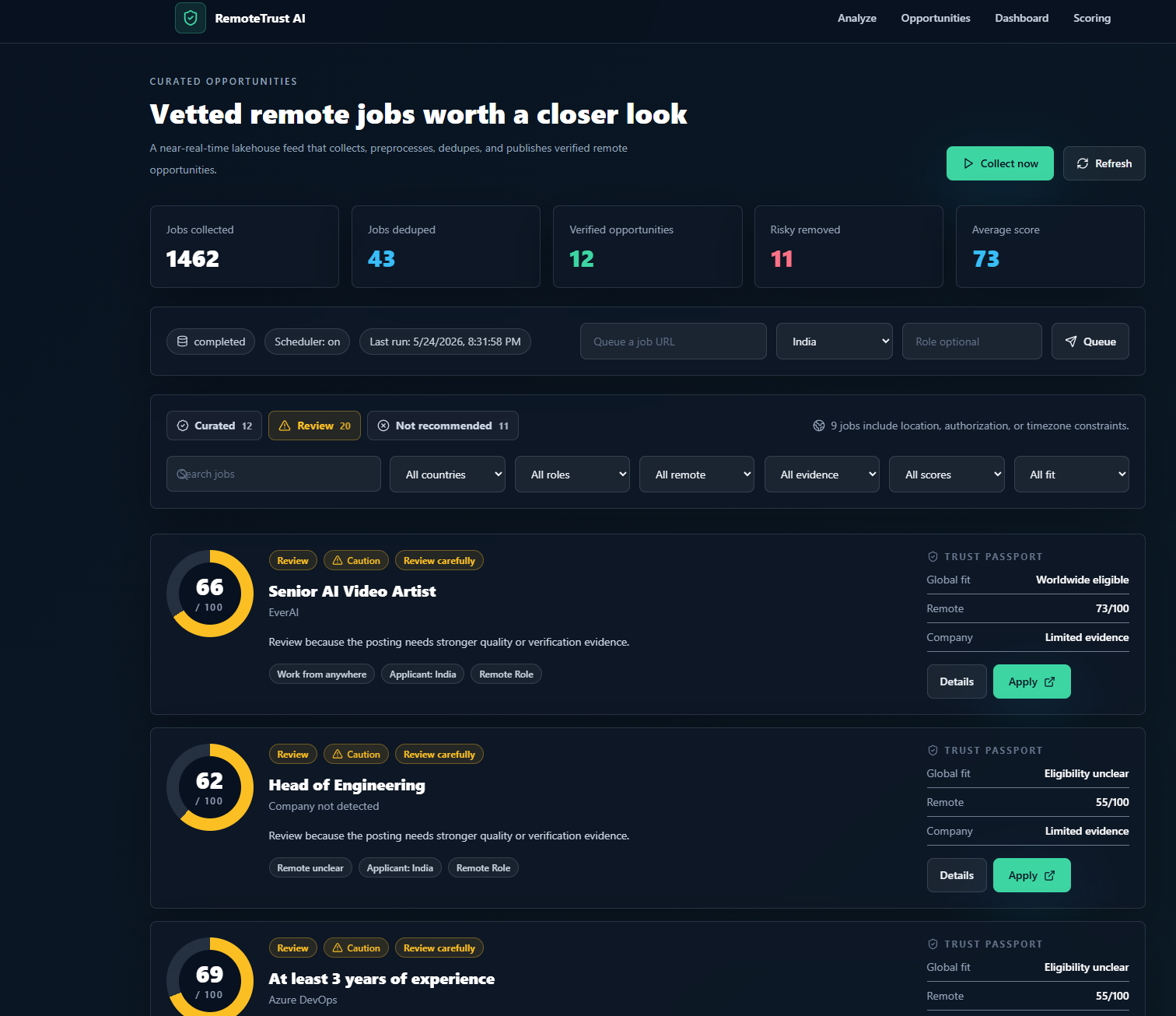
Caution
-
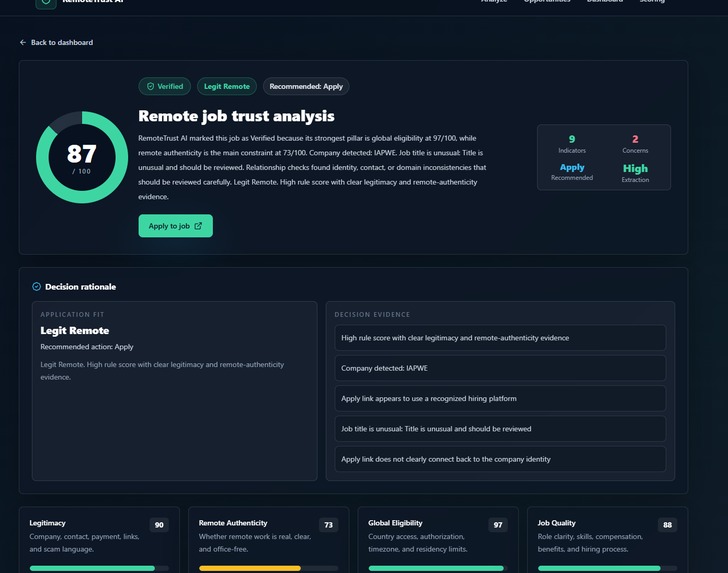
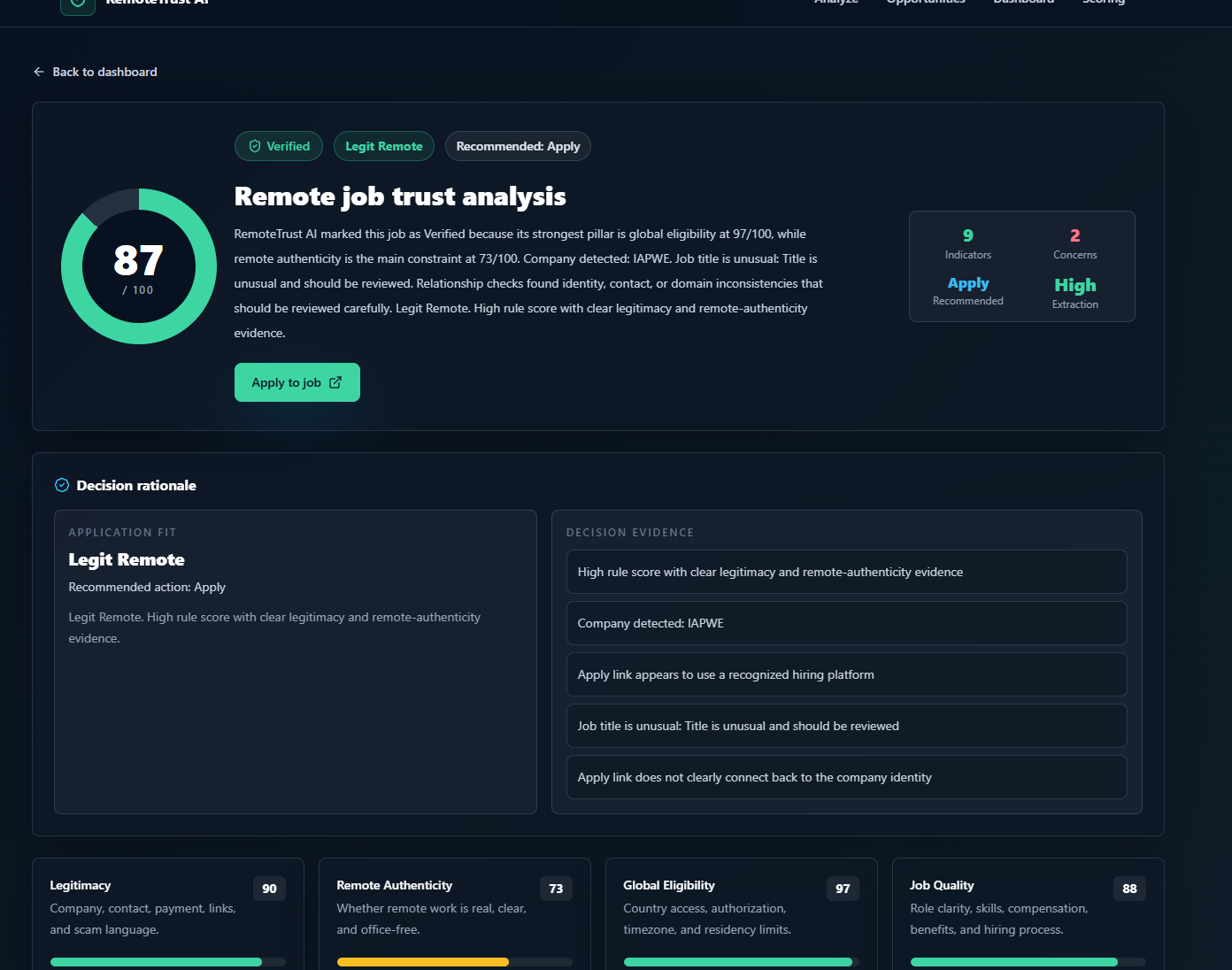
Status
Inspiration
Remote jobs should create global opportunity, but for many applicants, the process is noisy and risky. A job can say “remote” while still being country-restricted, hybrid, low-trust, or even a scam. We built RemoteTrust AI because global job seekers need more than job search results — they need confidence before they apply.
Our goal was to turn confusing remote job postings into a trusted, explainable, apply-ready shortlist.
What it does
RemoteTrust AI helps users discover and verify true remote opportunities. It analyzes job postings, checks whether they are actually remote, evaluates company and job quality signals, detects scam-like patterns, and gives each job a clear trust score, verdict, and recommendation.
Instead of only saying whether a job is “good” or “bad,” the system explains why. It separates jobs into practical buckets like Apply, Review Carefully, and Not Recommended, then surfaces vetted opportunities in a curated feed with direct Apply links.
How we built it
We built RemoteTrust AI as a full-stack product with a local-first architecture.
The frontend uses Next.js, React, TypeScript, and Tailwind CSS for the analyzer, dashboard, results pages, and curated opportunities feed. The backend uses FastAPI for analysis, saved jobs, ingestion, feedback, and opportunity APIs.
For the trust system, we combined deterministic scoring, job feature extraction, remote eligibility checks, title validation, scam-risk detection, company evidence, and classification logic. The scoring engine evaluates jobs across four main pillars:
- Legitimacy
- Remote authenticity
- Global eligibility
- Job quality
For the latest version, we added a near-real-time lakehouse feed using DuckDB + Parquet with Bronze, Silver, and Gold layers.
- Bronze stores raw collected jobs from approved feeds, demo files, and queued URLs.
- Silver cleans, normalizes, and deduplicates job postings.
- Gold publishes analyzed and curated opportunities into the web app.
We also added scheduler-ready ingestion, manual collection controls, URL queueing, ingestion status, and duplicate-safe publishing so repeated 5-minute runs do not spam duplicate job cards.
Challenges we ran into
One major challenge was defining what “true remote” actually means. A job can be legitimate but still not suitable for a global applicant because of hidden country, timezone, work authorization, or hybrid requirements.
Another challenge was making the demo reliable. Many large job boards block scraping or hide content behind dynamic pages, so we avoided fragile scraping and focused on approved feeds, public job URLs, demo files, and user-added URL queues.
We also had to make sure repeated ingestion runs were duplicate-safe. Since the system can collect jobs on a schedule, we needed to prevent the feed from publishing the same job again and again.
A final challenge was balancing AI with explainability. For a hackathon demo, we wanted judges to clearly understand why a job was recommended or rejected, so we prioritized transparent signals, scoring pillars, and visible evidence instead of a black-box-only approach.
Accomplishments that we're proud of
We are proud that RemoteTrust AI became more than a one-job analyzer. It now works like a real job discovery engine: collect jobs, clean them, deduplicate them, score them, publish them, and let users apply through trusted links.
We are also proud of the infrastructure story. The DuckDB + Parquet lakehouse, ingestion status controls, manual run endpoint, URL queue, curated feed, and Apply links make the project feel like a working product rather than just a mockup.
Most importantly, we are proud that the product is practical for global applicants. It does not only detect scams; it also identifies whether a remote job is actually accessible, trustworthy, and worth applying to.
What we learned
We learned that remote job trust is not a single classification problem. It requires combining multiple signals, including company legitimacy, remote wording, eligibility restrictions, job quality, salary transparency, apply URLs, suspicious contacts, and repeated source patterns.
We also learned that infrastructure matters in AI products. A good model or scoring engine is not enough unless there is a reliable way to collect, process, deduplicate, monitor, and publish data.
Finally, we learned that explainability is a product feature. Users should not have to trust a score blindly; they should be able to see why a job made the list.
What's next for RemoteTrust AI
Next, we want to expand the ingestion sources with more approved remote-job feeds and company career pages. We also want to improve the country-specific eligibility engine so applicants can get more personalized recommendations based on where they live.
We plan to add stronger ML models once we have enough labeled data for scam jobs, country-restricted remote roles, hybrid-mislabeled roles, and verified global remote jobs.
We also want to improve graph-based reputation tracking across companies, domains, recruiters, apply links, and repeated scam signals.
Long term, RemoteTrust AI could become a trusted job discovery platform for international students, immigrants, freelancers, and global workers who want real remote opportunities without wasting time on fake, restricted, or low-quality postings.

Log in or sign up for Devpost to join the conversation.