Inspiration
Talented developers in emerging markets — Lagos, São Paulo, Nairobi — compete for the same remote roles as everyone else, but without the network, recruiter access, or time to run a structured job search. The hunt is fragmented: one tab for job boards, another for tracking applications, a spreadsheet for skills to learn, and no feedback loop telling you why you're not getting callbacks. We wanted a single AI agent that does the multi-step work a career coach would: read your background, go find real opportunities, tell you honestly what you're missing, and keep your search organized.
What it does
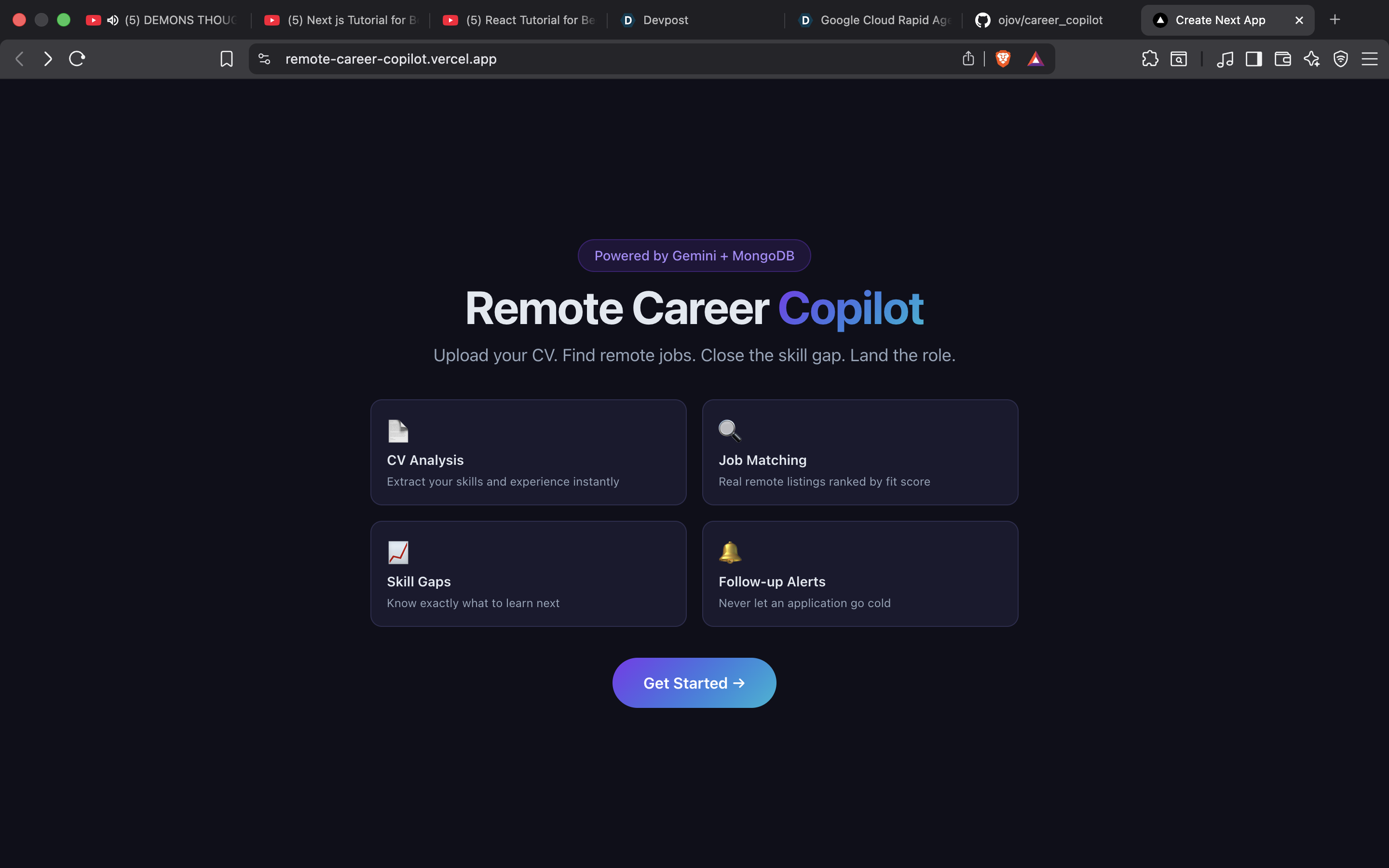
Remote Career Copilot is an AI agent that takes you from résumé to managed job search:
- CV analysis — Upload a PDF résumé and the agent extracts your skills, job titles, and experience into a structured profile.
- Job matching — It searches multiple live remote-job sources and ranks listings by how well they match your actual skills.
- Skill-gap roadmap — It compares your skills against real job descriptions and produces a prioritized list of what to learn next, with resources and time estimates.
- Application tracking — Tell the agent "I applied to Acme as a backend dev" and it logs it, flags applications that have gone cold (no response in 7+ days), and drafts follow-up emails.
- Conversational copilot — A chat agent that can search the live web for fresh roles, answer job-search questions, and take actions against your profile.
How we built it
A Next.js frontend talking to a Python agent service:
- The agent is built with Google's Agent Development Kit (ADK) running Gemini 3.5 Flash via Vertex AI. It exposes tools — retrieve profile, search cached jobs, log applications, find stale applications, analyze skill gaps — plus a dedicated web-search sub-agent (ADK's built-in Google Search, wrapped as an
AgentTool) so it can find live openings when structured sources fall short. - MongoDB Atlas stores profiles, cached jobs, and applications, integrated through MongoDB's MCP server so the agent reaches Atlas over the Model Context Protocol.
- Job data comes from a fallback chain (Remotive → RemoteOK → Adzuna) with client-side relevance scoring, since each free API has loose search.
- PDF parsing and Gemini structuring run server-side in the Python agent (pypdf + Gemini), keeping fragile dependencies out of the serverless frontend.
- Deployment: the agent runs on Google Cloud Run (containerized with uv), the frontend on Vercel, with a GitHub Actions pipeline that ships both halves on every push.
Challenges I ran into
- Model and region wiring — reaching Gemini 3.5 Flash through Vertex AI meant sorting out the right project, the
globallocation, and Application Default Credentials after org policies blocked our first attempts. - Job-data quality — free job APIs ignore search parameters or return irrelevant results, so we built a multi-source fallback chain with our own relevance filtering.
- Serverless PDF parsing — PDF libraries that worked locally failed in Vercel's serverless runtime, so we moved extraction into the Python agent where it's reliable.
- One source of truth — an early local/production dependency drift broke a deploy; we fixed it by building the container straight from the same uv lockfile we develop against.
Accomplishments that I'm proud of
- A genuinely multi-step agent that chains real actions — read CV, fetch jobs, analyze gaps, track applications — not just a chatbot wrapper.
- A relevance-filtered, multi-source job pipeline that returns roles actually matching the user's skills (our test résumé surfaced remote engineering roles in Brazil — exactly the emerging-market audience we built for).
- A fully automated deploy pipeline (push → Vercel + Cloud Run) where what we test locally is byte-for-byte what ships, built end-to-end during the hackathon.
- Shipped a complete, live, working product — CV upload to skill roadmap to application tracking — not a prototype.
What I learned
Building a genuinely agentic product is less about the model and more about giving it the right tools, reliable data, and a clean execution path. Most of our effort went into making the agent's actions trustworthy — relevant job results, accurate CV extraction, and a deploy pipeline where what we test is exactly what ships.
What's next for Remote Career Copilot
Re-enabling the full MongoDB MCP toolset for richer Atlas queries, deeper personalization of the skill roadmap, automated weekly job digests, and expanding the job-source chain with region-specific boards for emerging markets.
Built With
- fastapi
- gemini
- github-actions
- google-adk
- google-cloud-run
- model-context-protocol
- mongodb
- mongodb-atlas
- next.js
- pypdf
- python
- react
- tailwindcss
- typescript
- vercel
- vertex-ai

Log in or sign up for Devpost to join the conversation.