-
-
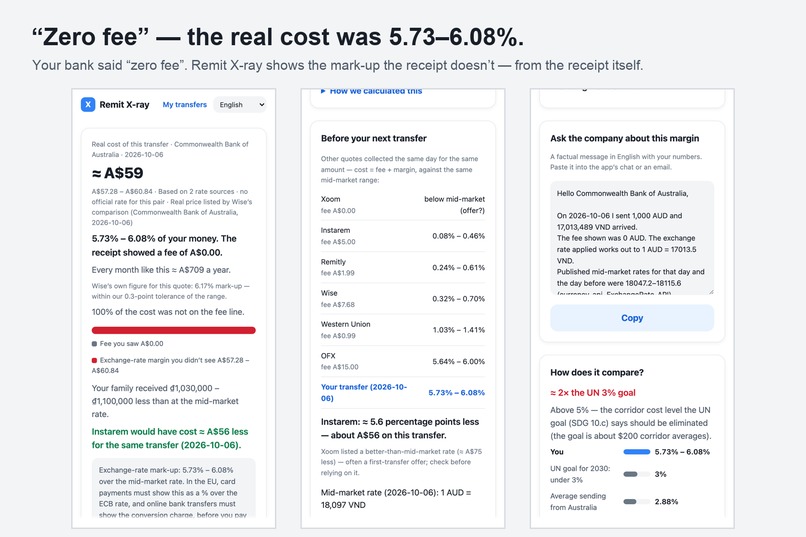
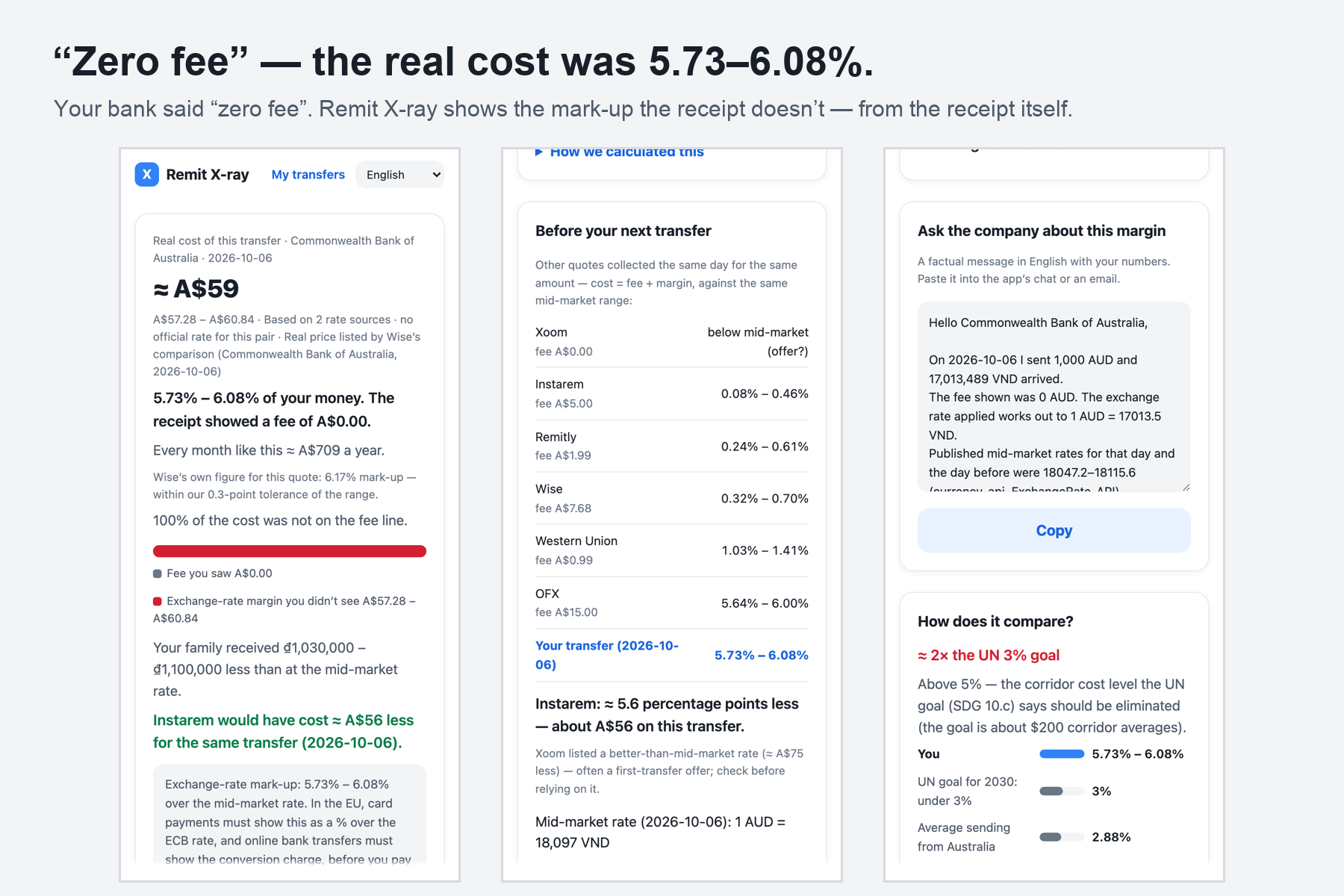
"Zero fee" — the real cost was 5.73–6.08% (real Commonwealth Bank of Australia quote, AUD→VND, 2026-10-06)
-
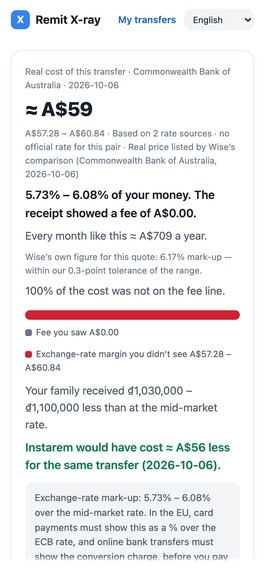
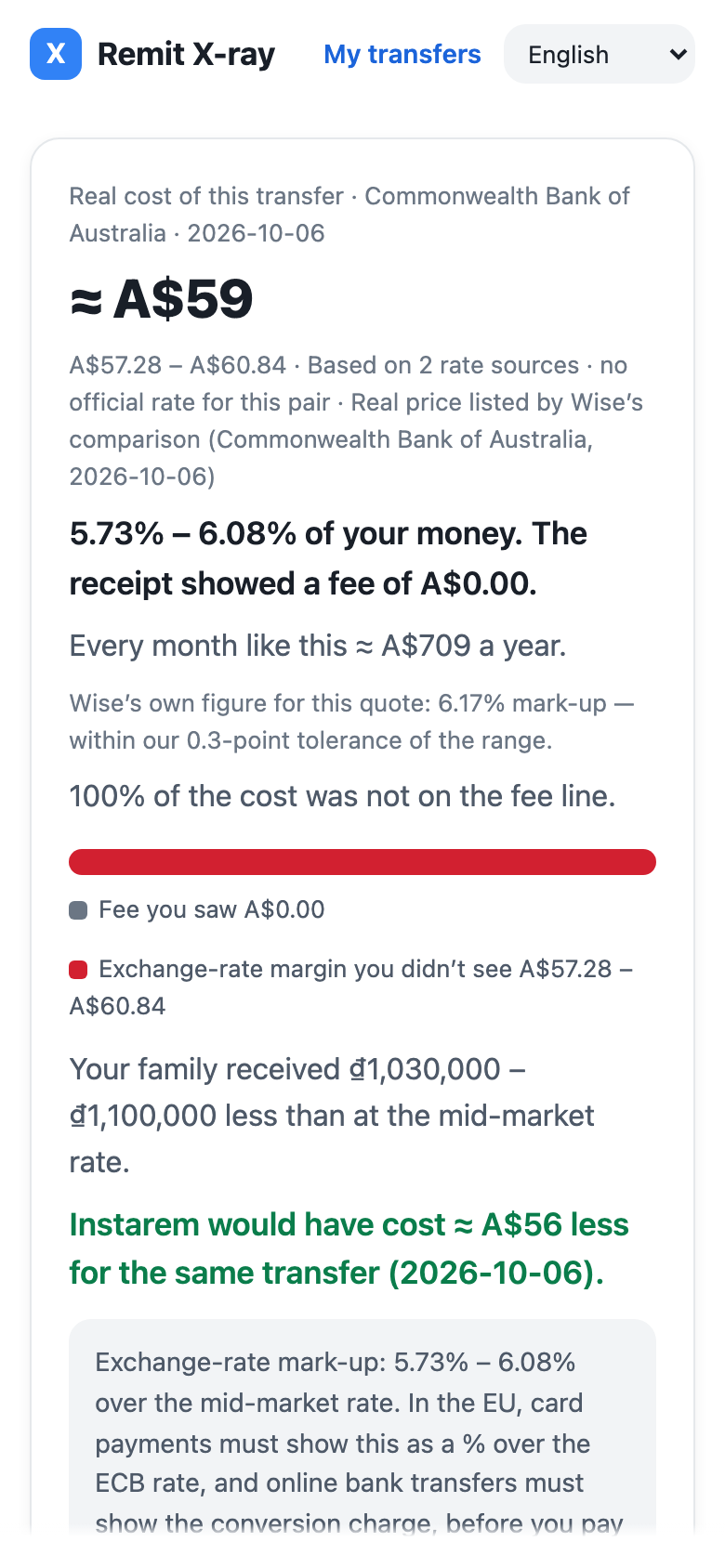
Result: ≈ A$59 hidden in the rate on a A$0.00-fee transfer — range, rate sources, and what Instarem would have cost the same day
-
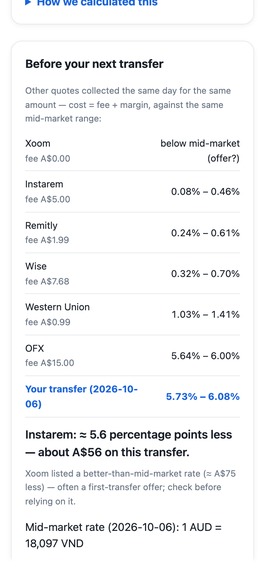
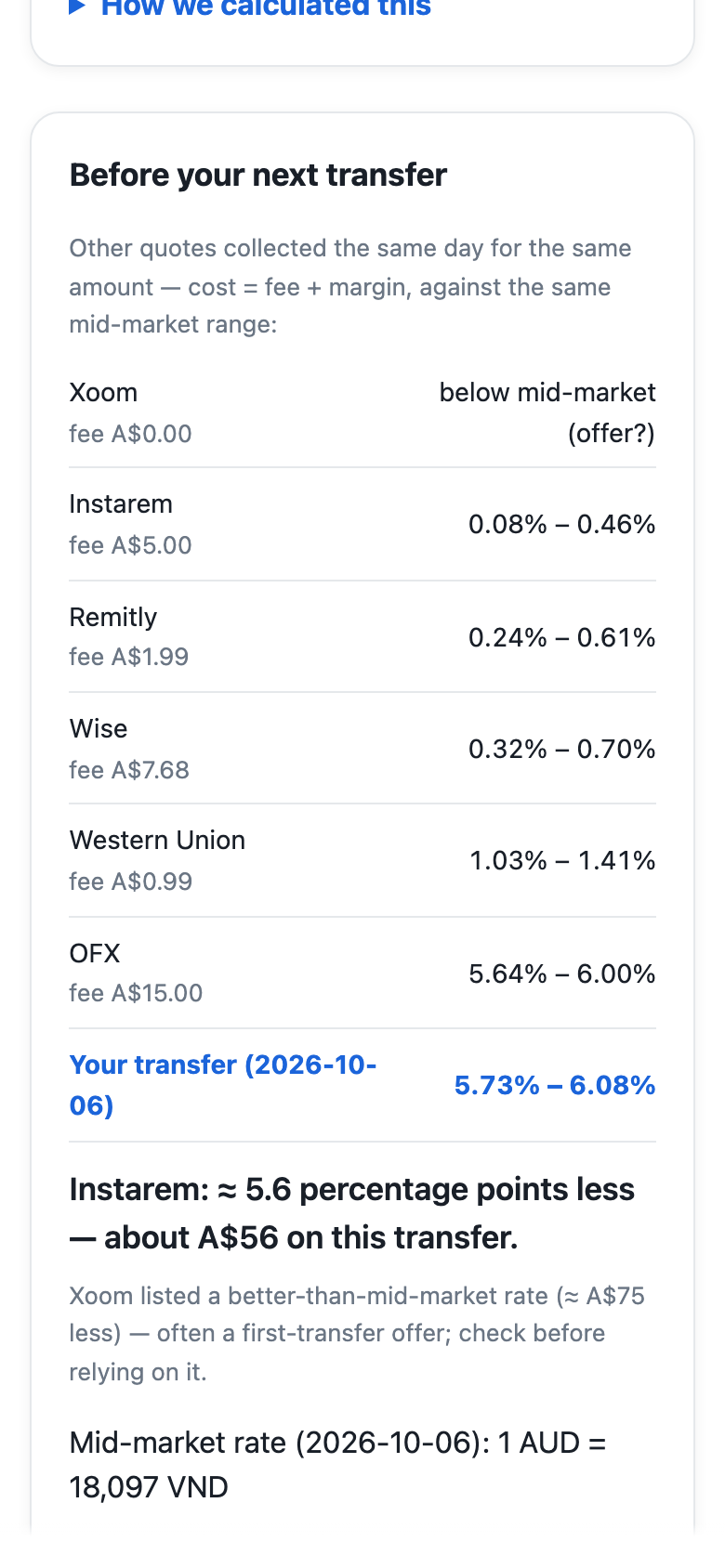
Before your next transfer: same-day quotes ranked on one cost scale (fee + margin), with your transfer in the list
-
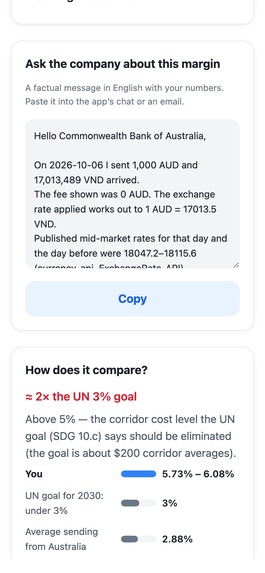
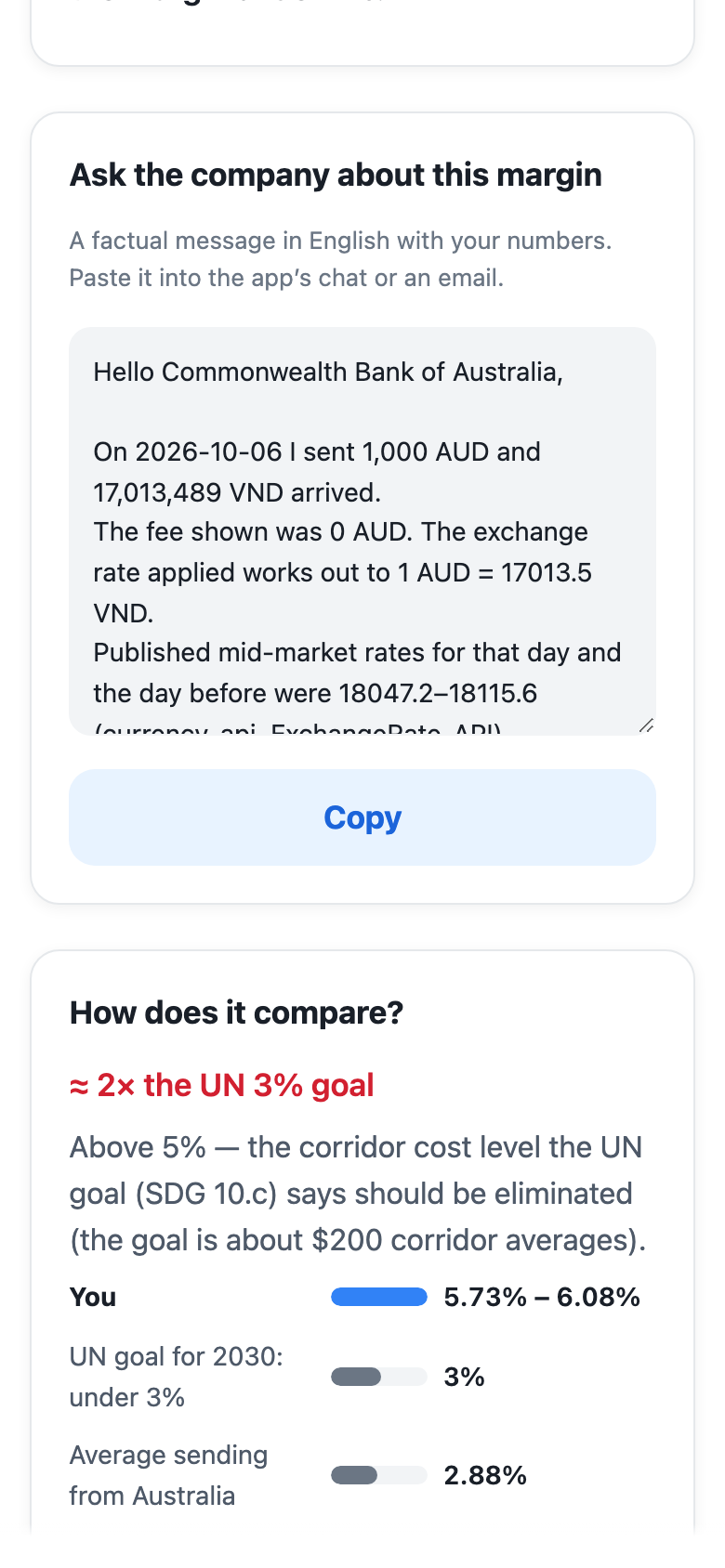
Ask the company: a ready-to-copy factual message with your numbers, plus the UN 3% goal comparison
-
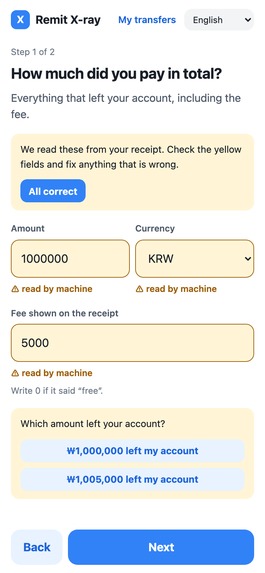
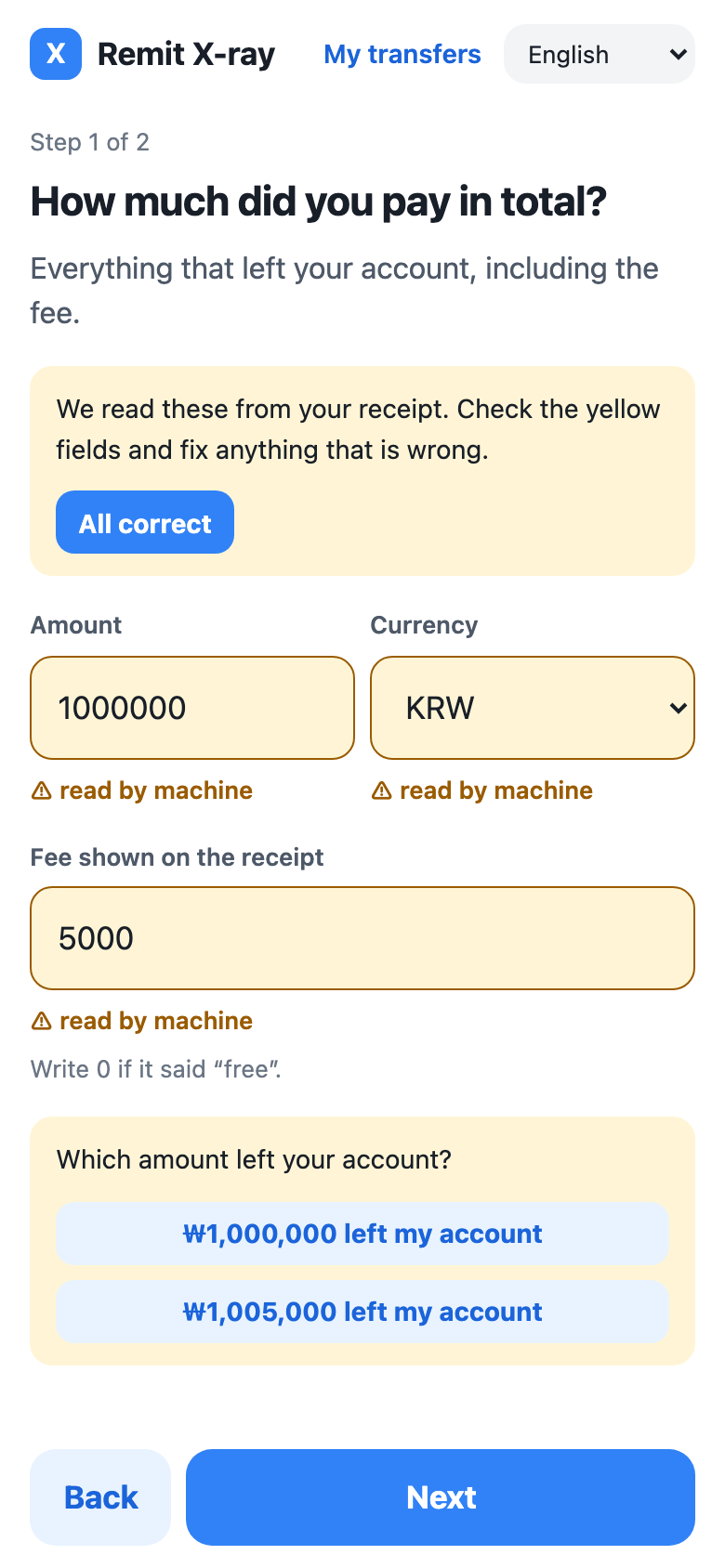
Machine-read values stay yellow until you confirm them; the fee asks which amount actually left your account
-
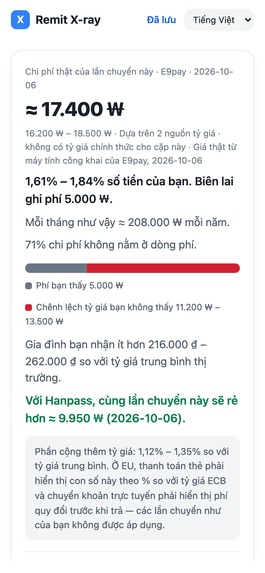
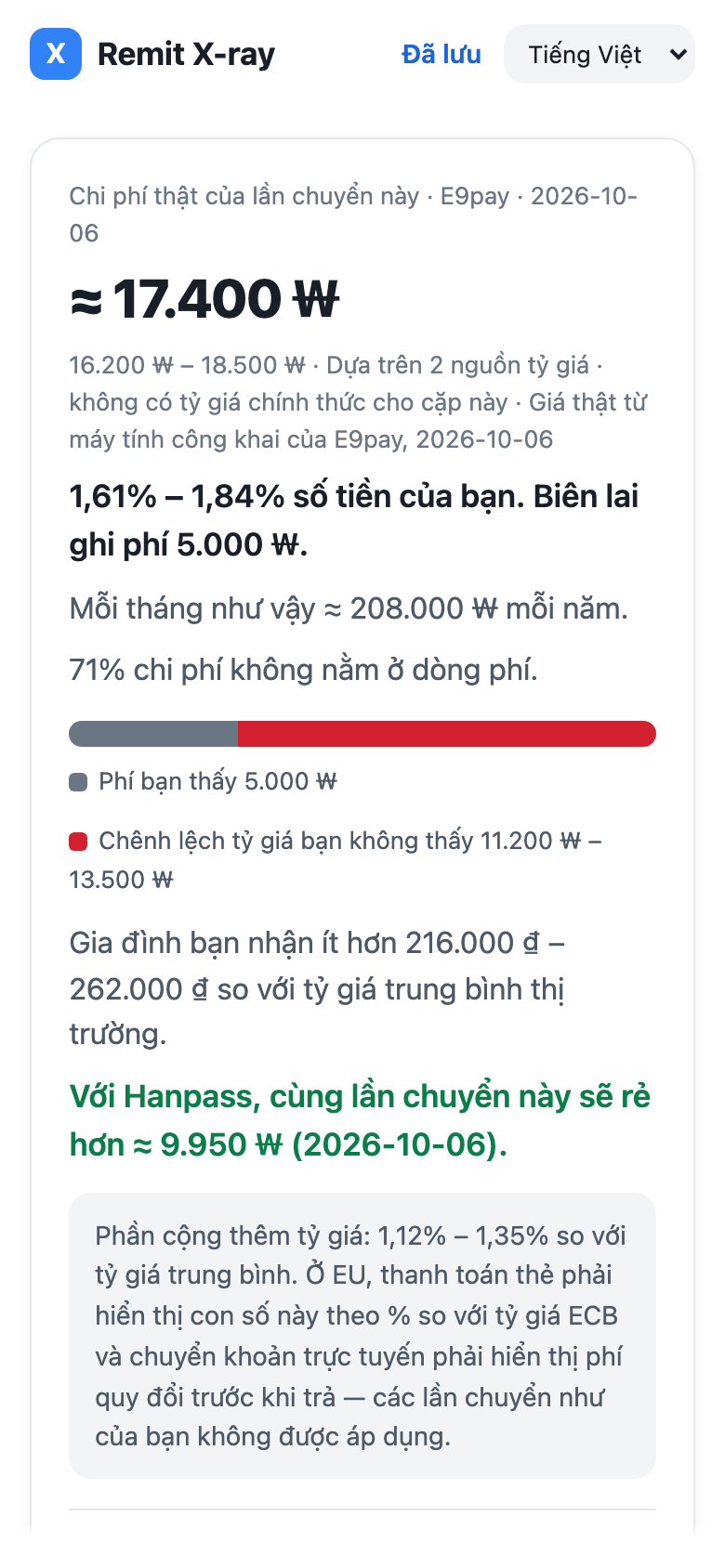
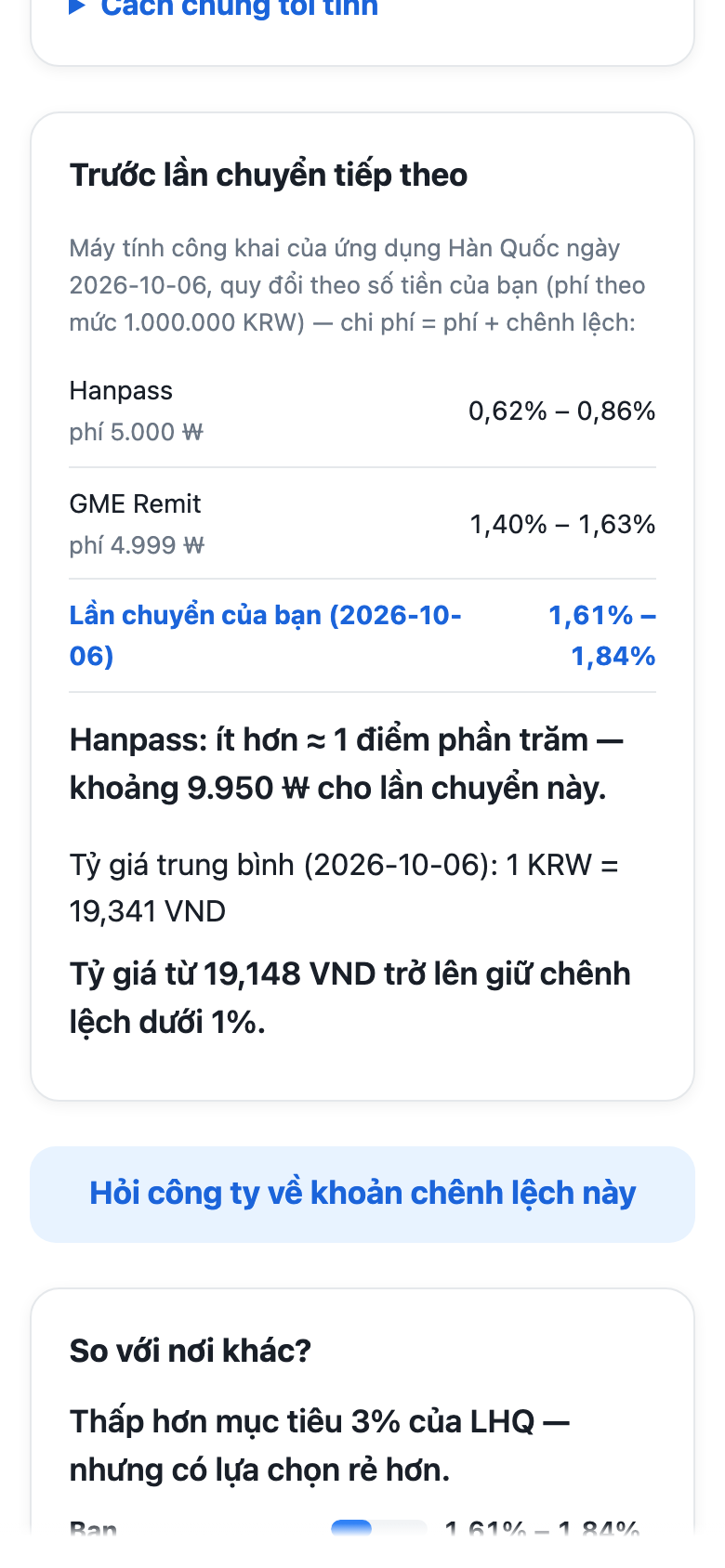
Vietnamese UI: a Korea→Vietnam transfer via E9pay cost 1.61–1.84%; Hanpass was ≈ ₩9,950 cheaper the same day
-
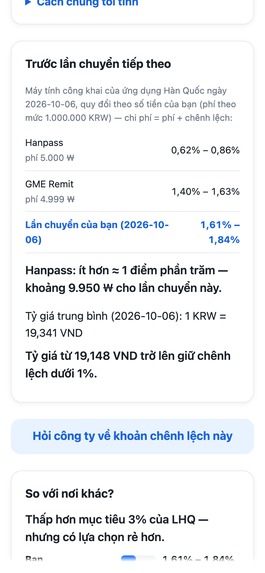
Korean apps' public calculators (Hanpass, GME Remit) compared with your transfer on the same scale
-
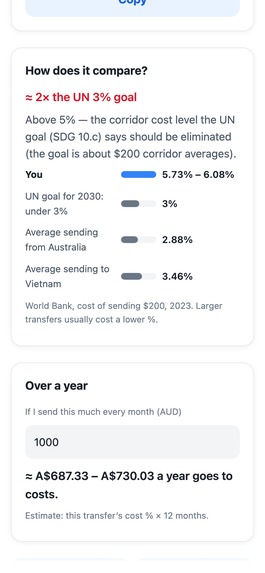
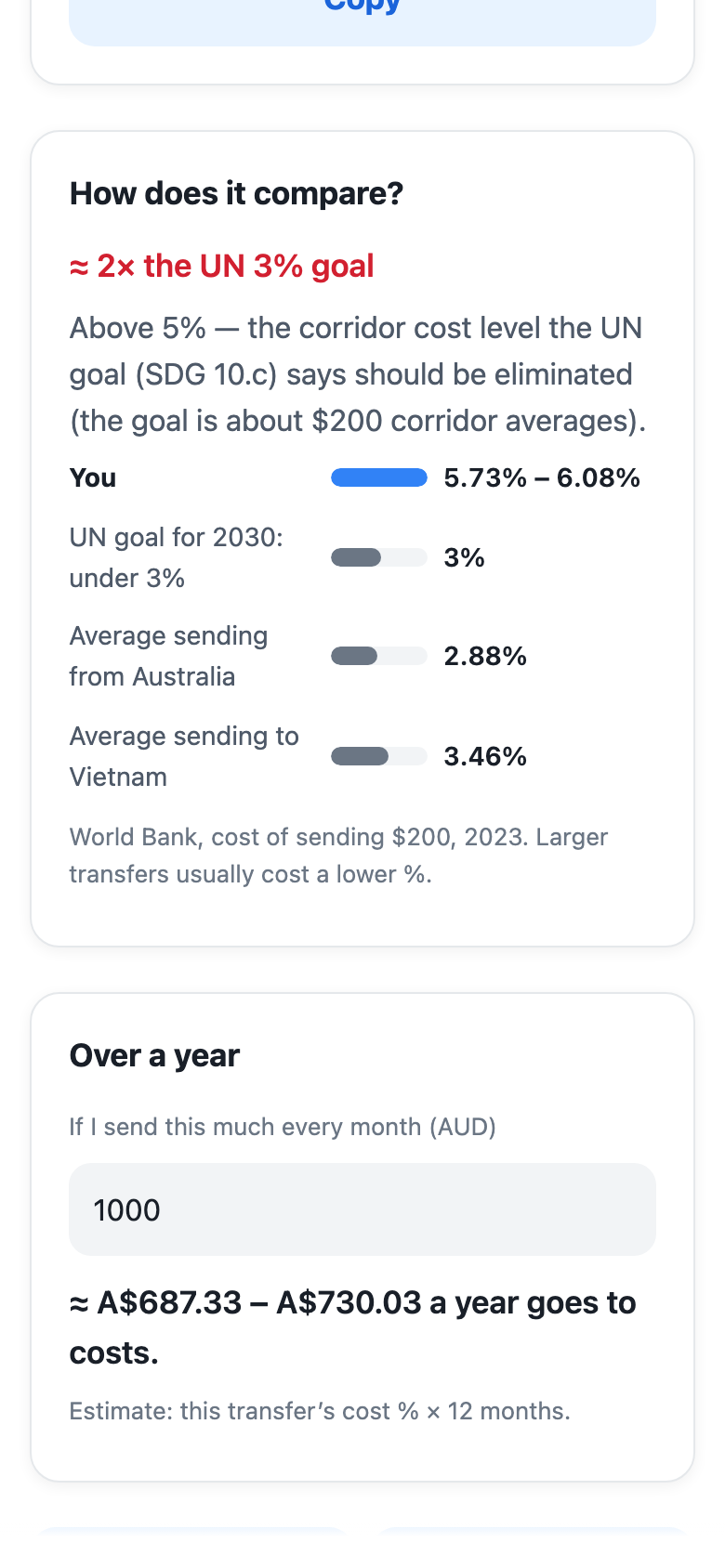
How does it compare: UN 3% goal and World Bank corridor averages, and the cost over a year
-
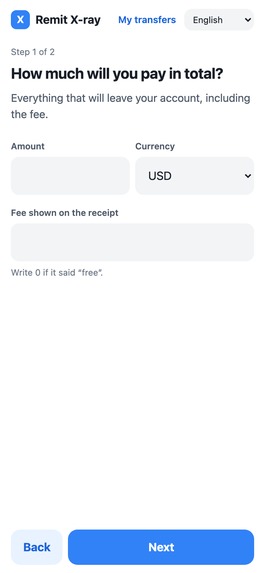
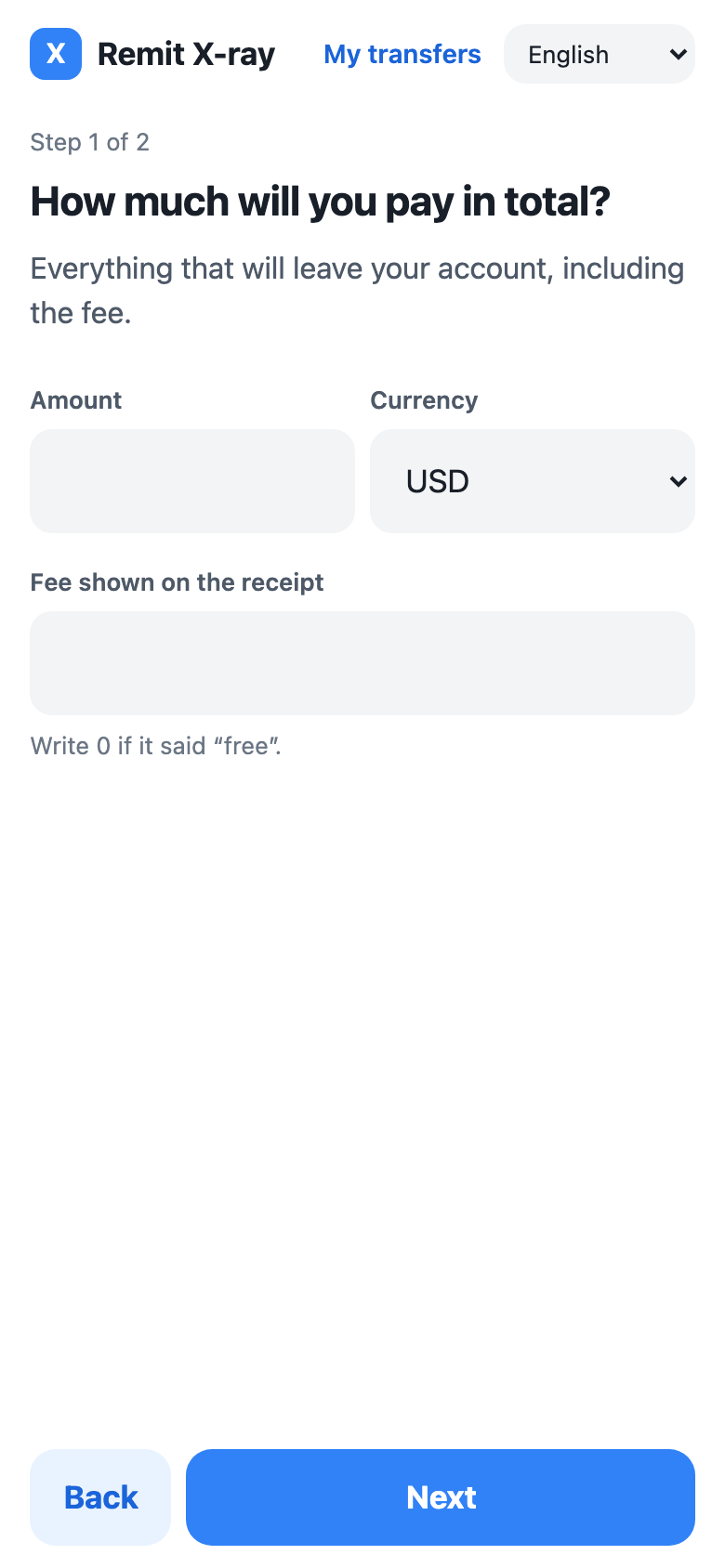
Before you send: the same check on any app's quote
-
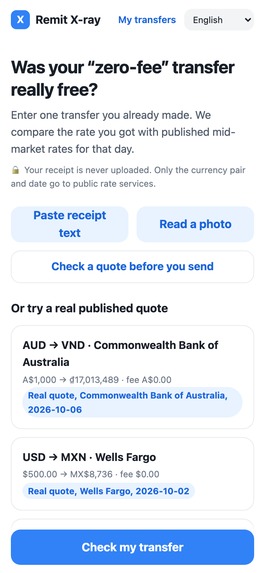
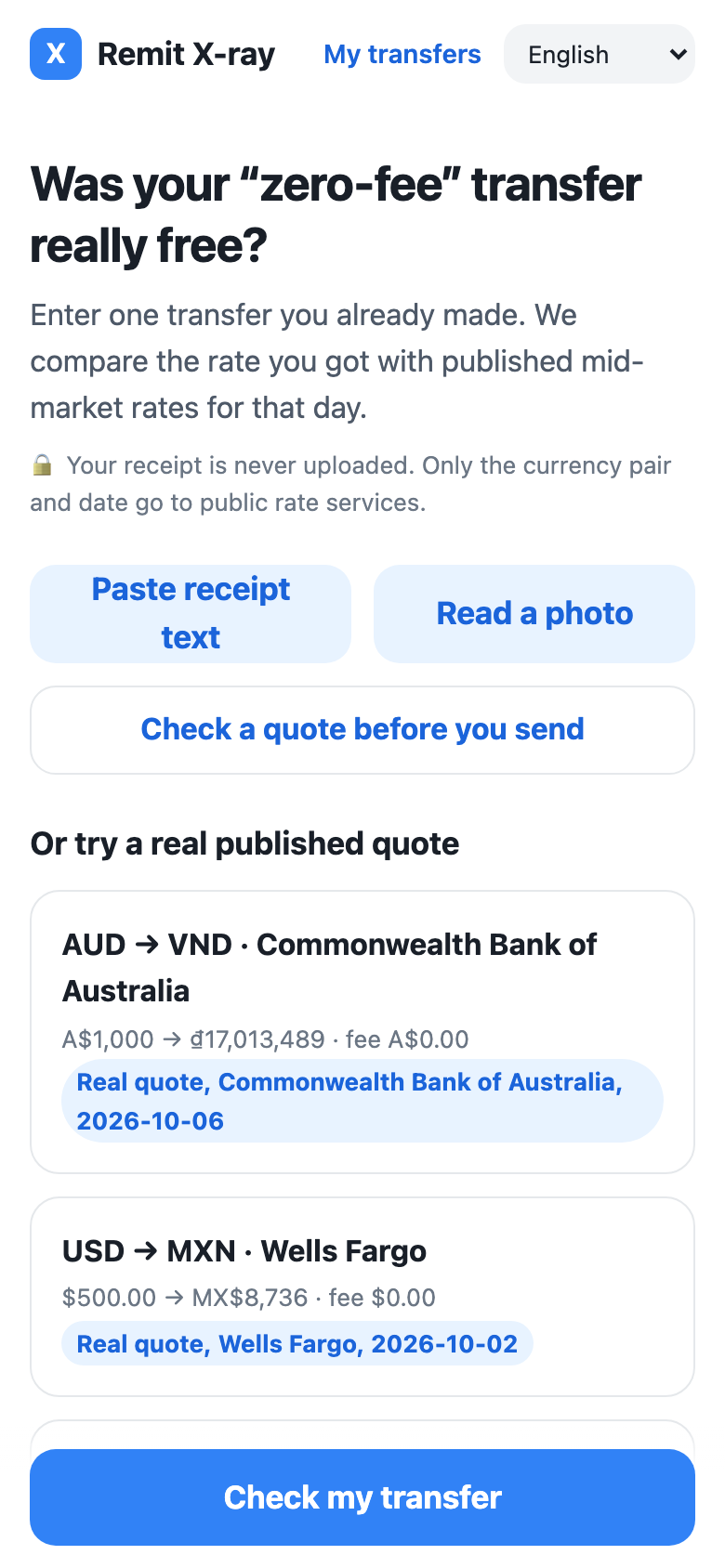
Home: paste receipt text, read a photo, check a quote before you send, or try a real published quote
Track: Economic — financial inclusion for people who send money home.
In three lines
- Problem: a remittance receipt shows one cost — the fee, often "0". The exchange-rate mark-up is never printed, so senders can't see, compare or question it.
- Hero number: a real bank quote listing a A$0.00 fee to send A$1,000 to Vietnam cost A$57–61 (5.73–6.08 %) through the rate; another provider's quote the same day cost about A$56 less.
- What you do: paste or photograph your receipt → see the mark-up in money and % → see what the cheapest listed option would have cost → copy a factual question to the company (in Korean for Korean apps) → check the next quote before you pay.
| Quote comparison (Wise's comparison, Monito) | Remit X-ray | |
|---|---|---|
| When | before you send | after you send — and before the next one |
| Whose numbers | providers' quotes for a fixed amount | your receipt |
| Who runs it | a provider / referral-funded | neutral; Wise is listed as a provider like any other |
| Your data | — | stays on your phone |
Inspiration
Two real prices from 6 October 2026 (illustrations, not a user study):
- The bank quote above (Commonwealth Bank of Australia, as listed by Wise's public comparison) — about 2× the UN's 3 % goal for remittance costs.
- Minh (an illustrative name), a Vietnamese worker in Korea, sends ₩1,000,000 home (+ ₩5,000 fee). With E9pay it cost 1.61–1.84 %; Hanpass's calculator the same day implied ≈ ₩9,950 less.
What it does
- Enter, paste or photograph a receipt (amount paid, fee, amount received, date). Machine-read values stay yellow until you confirm them; a date that wasn't on the receipt or is ambiguous (05/10) must be picked; a fee asks which amount actually left your account.
- See the mark-up: the cost hidden in the rate, as a range in money and %, against published mid-market rates for the day before and the day of the transfer — currency-api, the ECB, and the receiving country's central bank where available (Nepal Rastra Bank, Central Bank of Uzbekistan). It says how many sources it rests on, whether any is official, and says "can't tell" when the band is too wide.
- Do something with it: what the cheapest listed option would have cost for the same transfer (same day only — no money claims across days); other quotes ranked on the same cost scale with your transfer in the list (one-off "better than mid-market" offers shown, never counted as cheapest); a ready-to-copy factual message to the company (English, or Korean for receipts sent from Korea); UN goal and World Bank comparisons; saved transfers you can copy as text; a share link that carries only the receipt.
- Before you send: the same check on any app's quote, pre-filled with your usual route and amount.
- 5 languages: English, 한국어, Tiếng Việt, नेपाली, O'zbekcha. Nothing is uploaded; it runs in the browser, $0 to run.
What we found in real prices
61 real quotes (25 provider names, 9 corridors; 52 from Wise's public comparison API, 9 read from the Hanpass, GME Remit and E9pay calculators):
- 14 of 19 "zero-fee" quotes (13 of 18 distinct prices) still cost money through the rate — median 1.63 %, up to 6.08 % (Commonwealth Bank of Australia → Vietnam 5.73–6.08 %, Wells Fargo → Mexico 3.38–4.71 %).
- When a quote shows a fee and takes a margin, the margin was the bigger part in 29 of 31.
- Korean apps sat mostly at or below the median (1.95 %); Hanpass was cheapest on all three Korean routes. The fee line can't tell you which case you're in.
Who this reaches
Senders on Korea → Vietnam / Nepal / Uzbekistan first (the Korean apps' prices, the central banks of Nepal and Uzbekistan, Vietnamese/Nepali/Uzbek UI, Korean messages to Korean apps), plus any pair a public rate source covers. No install, no sign-up, nothing uploaded; a result is one link with a chat preview (KakaoTalk, Zalo, WhatsApp). Printed QR posters for migrant-worker centres are next — not distributed yet.
How we built it
- Static web app (no backend, GitHub Pages), vanilla JavaScript ES modules, Clean Architecture:
domain(receipt, reference band, audit math, parser, quote comparison) →application(audit use case with a rate-source port, draft confirmation, reports, share links) →adapters(currency-api, Frankfurter/ECB, Nepal Rastra Bank, Central Bank of Uzbekistan, ExchangeRate-API, Wise comparison, tesseract.js OCR, local storage) →ui. A test fails if a layer imports the wrong way. - Spec first (numbered acceptance criteria in SPEC.md), tests first: 169 tests in CI.
Can you trust the numbers?
- Two implementations: a separate Python
Decimalscript with its own HTTP code freezes every real quote's band and expected result; the JS engine must match to ±0.01 pp. - Calibration against an outside measurement: Wise publishes each quote's margin over its own mid-market rate. Our daily range contains it exactly in 19 of 52; all 52 are within 0.30 pp — a tolerance fitted on them, as we say plainly. Held out by route it covers 43 of 52 (USD→MXN sits 0.2–0.3 pp off in one direction). For the hero quote Wise's own figure is 6.17 % vs our 5.73–6.08 % — inside that tolerance. That is why every answer is a range and "can't tell" exists.
- The law, precisely: in the EU, Regulation (EC) No 924/2009 as amended by (EU) 2019/518 makes card payments show conversion charges as a % mark-up over the ECB rate (Art. 3a) and online credit transfers show the estimated conversion charge before you pay (Art. 3b). In the US, Regulation E (12 CFR 1005.31) makes most remittance providers print the fee, the exchange rate and the amount received — not the mark-up. Transfers from Korea, Australia or the US to Vietnam, Nepal or Mexico get no mark-up figure; Remit X-ray computes it from the receipt.
Challenges we ran into
- We don't know the minute a provider priced a transfer. Daily rates can't see intraday moves, so we show a range from several sources and measured how wrong it can be.
- Receipts are messy. Fees charged on top vs deducted, a Korean bank SMS where "출금" is the real total, "Total to recipient", "Rs" meaning Nepali or Indian rupees, "$" meaning several dollars, account numbers that look like dates — each became a test and, where the text can't decide, a question to the user.
- Honesty under a deadline. Four rounds of mock review caught a zero-margin provider called a "promotion", a wide band called "matched", and a demo video that only filled a corner of the frame; all are fixed and the first two are tested.
Accomplishments that we're proud of
- A one-tap sample that replays the rates recorded with the real quote — same answer on any day, even offline.
- Central-bank rates for Nepal and Uzbekistan straight from the browser.
- A result that ends in an action (switch, ask, keep a record), not just a number.
What we learned
The fee line is not the price. And a financial tool earns trust by showing its error bars, not by hiding them.
What's next
- Out-of-sample check on new days of quotes (the same scripts, run daily).
- A Vietnamese central-bank or bank feed for KRW→VND; more receipt formats from real users.
- Printable QR posters in Vietnamese, Nepali and Uzbek for migrant-worker centres (not distributed yet).
Limits (said plainly)
No user study yet — built solo during the hackathon window. Korean calculator quotes were read by hand (transcription log in the repo). For past KRW→VND receipts the band rests on one source and the app says "lower confidence". The UN 3 %/5 % levels are for $200 corridor averages. Information, not financial advice.
Team
Taegeol Kim — solo builder (design, engineering, data)

Log in or sign up for Devpost to join the conversation.