-
-
Cover image from landing page
-
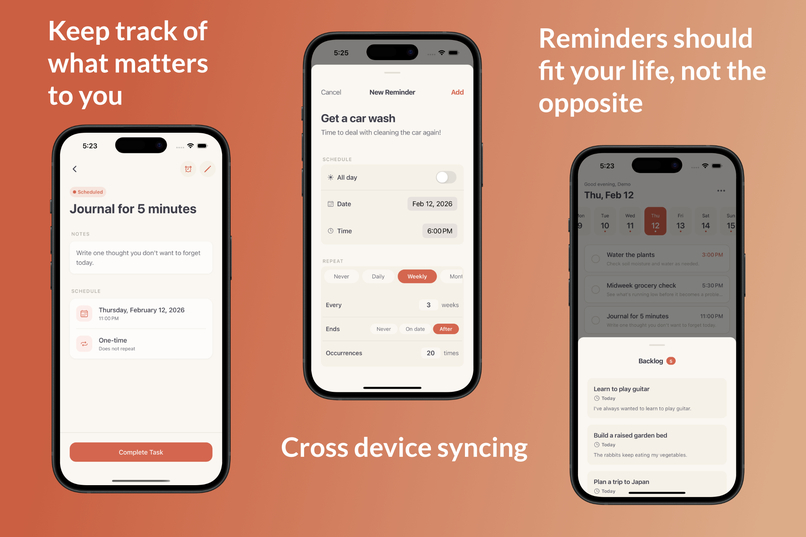
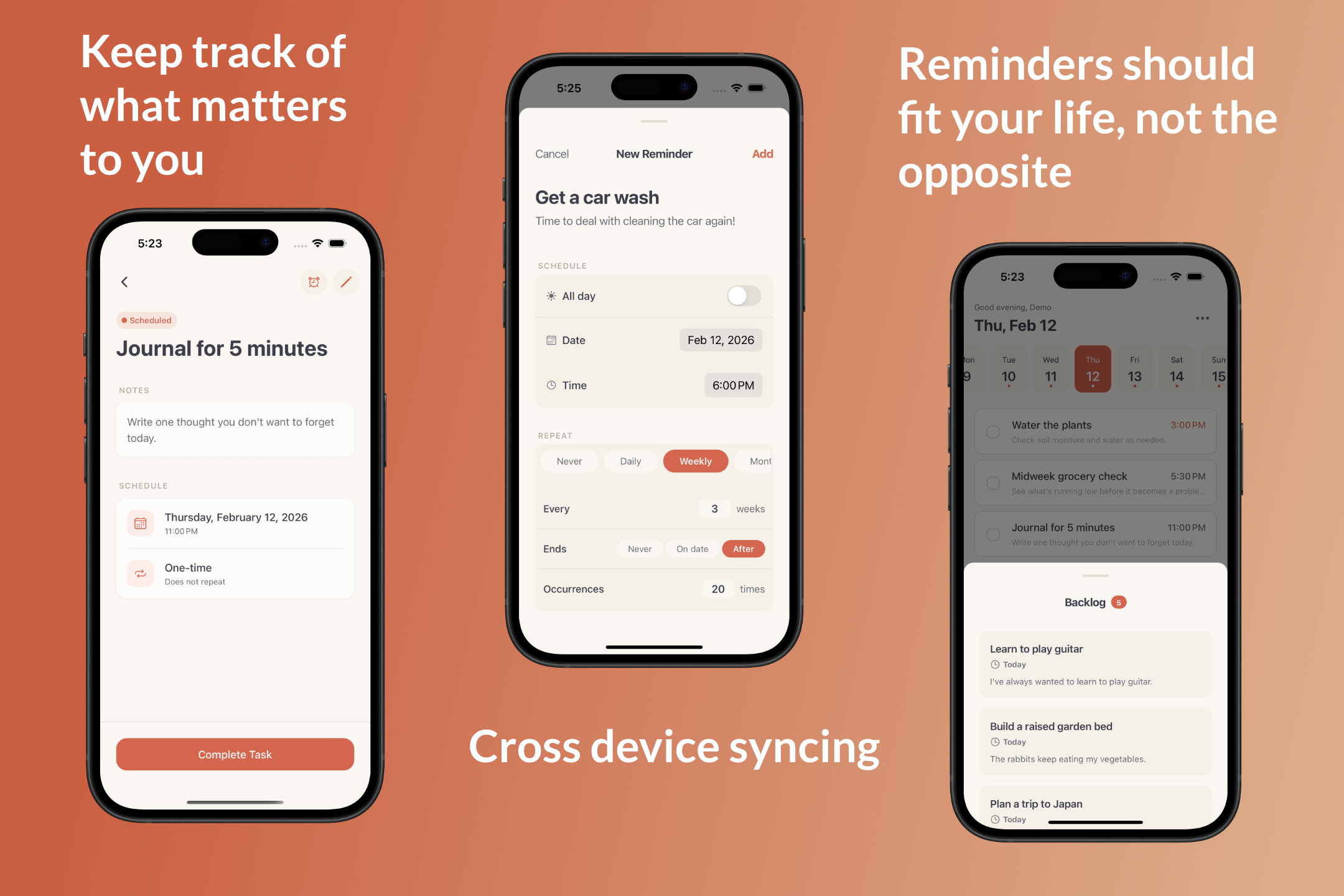
Composition of three screenshots showing: detail screen, new reminder, and backlog
-
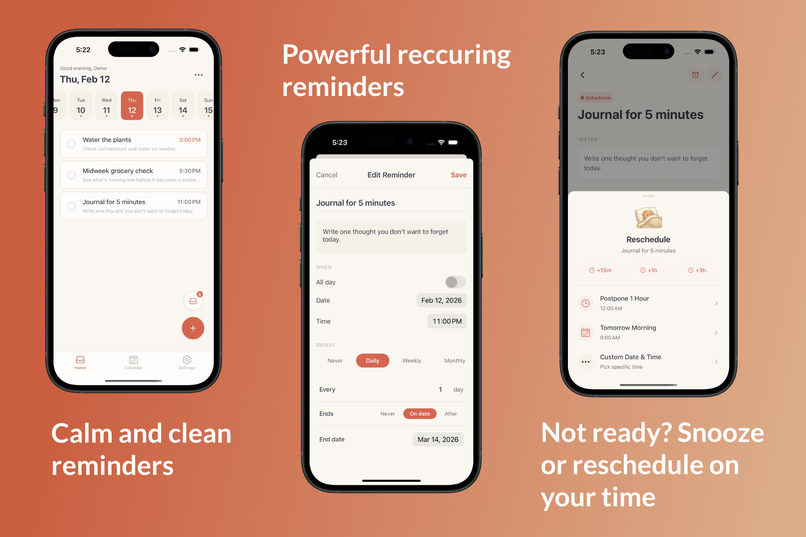
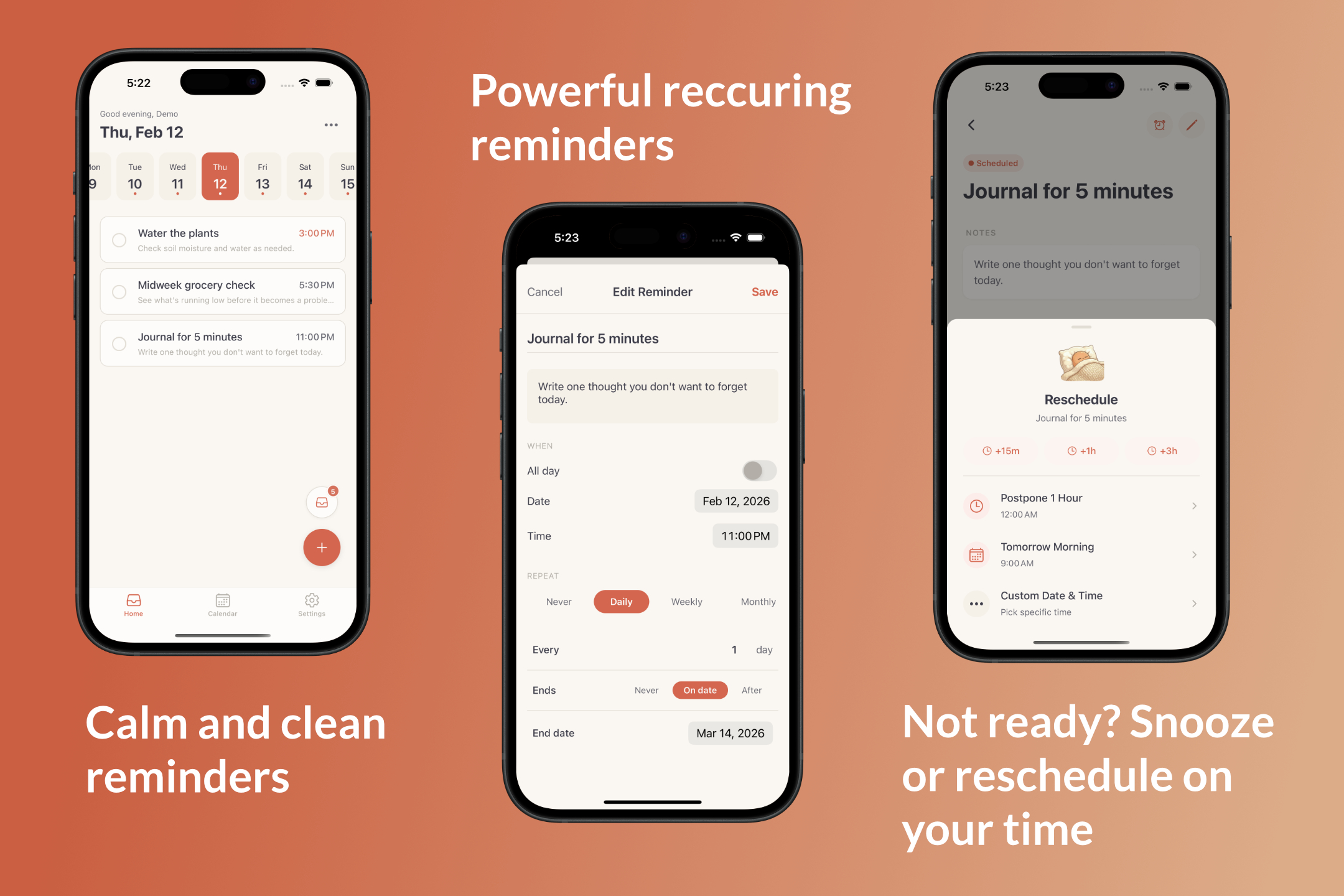
Composition of three screenshots showing: today screen, editing a reminder with recurrence, and snoozing a reminder
Inspiration
For as long as I can remember, my life has been organized by lists. Through school, my degree, and my career as a developer, reminders and TODO lists were how I survived deadlines, shipped projects, and kept complex work from falling apart. Every assignment, every feature, every bug fix started the same way: write it down, break it apart, check it off. Lists weren’t just a productivity tool, they were how I thought.
But it didn’t stop at work. Personally, I used lists for everything else too: errands, habits, reminders to follow up with people I care about, ideas I didn’t want to lose, small tasks that mattered but were easy to forget. Over time, my TODO lists stopped being just about productivity and started becoming a record of my life, what I was working toward, what I was trying to remember, and what I didn’t want to let slip through the cracks. To me, other reminder apps often felt like they were built to enforce productivity instead of support real life. I wanted to create something that reduces cognitive load and mental pressure, not adds to it.
That’s where Remio came from. I realized that most reminder apps treated tasks like emergencies (loud, urgent, and unforgiving) when real life is anything but that most of the time. I wanted something gentler. A place where reminders support you instead of stressing you out. Remio is the result of years of living inside TODO lists, and wanting a better, kinder way to remember what matters.
What it does
At its core, Remio is a simple reminders app. It lets you create reminders with fully customizable recurrence rules, manage a flexible backlog for things that aren’t due yet, and snooze tasks until they work for you with customizable snoozing options (directly from the notification). Instead of rigid deadlines and harsh notifications, Remio focuses on a calm, supportive experience that reduces cognitive load while still keeping you organized. Built to be 100% cross-platform, it works seamlessly across devices so your reminders are always with you, wherever you are.
How we built it
Remio was built in four weeks for the hackathon, powered by countless coffees at my local Starbucks.
On mobile, it’s built with React Native and Expo, using Zustand for local state management and TanStack Query for network state, optimistic updates, and refetching. RevenueCat handles subscriptions and beautiful paywalls, while Better Auth manages user authentication.
The backend is built with Hono, using Neon as the database and Drizzle as the query builder. It integrates with RevenueCat webhooks to keep subscription data in sync and uses Better Auth for secure authentication. The server runs on Cloudflare, and the mobile app is fully ready for both iOS and Android.
Challenges we ran into
The first major challenge I ran into was handling recurrence rules. There are a couple common approaches when building apps with recurring reminders. The most intuitive is to generate every occurrence upfront as soon as the user creates the reminder. While simple, this approach quickly becomes inefficient, it consumes unnecessary storage and doesn’t handle reminders without an end date very well.
Instead, I chose a more complex but ultimately more flexible solution: generating virtual occurrences on demand (expanding the recurrence just-in-time) and layering exceptions on top. This approach was significantly more challenging at the beginning and caused its fair share of headaches. But now that it’s working smoothly, I’m incredibly glad I invested the time upfront. It’s scalable, more efficient, and far more adaptable.
The next challenge was less technical and more personal. Remio is the first app I’ve fully committed to and actually shipped. I’ve built many other apps before, but they often stalled in the testing phase because I would get stuck chasing perfection. Learning to push through that perfectionism was something I had to work on intentionally. Letting go of "perfect" and focusing on "shipped" is what allowed me to build the product I’m most proud of so far. I’ll dive deeper more into this in the next section though.
Accomplishments that we're proud of
Before diving into what I’m most proud of, I want to recognize the smaller wins along the way. Taming recurrence rules was a major technical hurdle, and seeing that system now working smoothly feels incredibly rewarding. Building and shipping an app in just four weeks is no small task, especially without years of mobile experience behind me, and I’m genuinely proud of what I was able to accomplish within that timeframe.
But beyond the technical milestones, this project means something deeper to me.
Since I was about 12 years old, I’ve wanted to build my own apps. That dream actually came before my interest in engineering, design, or business. I’ve always wanted to create something that brings other people joy - the same kind of joy I feel when I’m building. While I’m fortunate to do meaningful work as a software developer in my professional career, there’s something entirely different about creating and shipping something that’s your own.
I see Remio as a starting point, my true entry into independent app development. I’m proud of the product itself, proud that it fulfills my interpretation of what Sam Beckman pitched for this hackathon, and proud of the lessons and growth that came with it. Most of all, I’m excited for what comes next. Maybe one day, this path will even lead me to step away from my day job and pursue app development full-time.
What we learned
I learned to let go of perfection and prioritize shipping. I learned not to get bogged down in the small details and to stay focused on the timeline. I learned the value of starting with an MVP before expanding it into a full product. While I’ve always enjoyed thinking in terms of systems rather than individual features, I learned how to apply that mindset specifically to app development. And most importantly, I learned that I can keep going - even when things get challenging.
What's next for Remio: Gentle Reminders
The Android and iOS versions of Remio are planned to launch in the app stores, hopefully sometime in March, with additional platforms coming later.
I already have a detailed vision and roadmap for the next two major versions, including features like natural language input, task lists, history tracking, task analytics, smart resurfacing, tagging, a web version, widgets, and more.
Ultimately, the path forward will be guided by user feedback, testing, and opportunities for collaboration. I’m personally very excited to see where this journey takes Remio!
Built With
- android
- better-auth
- cloudflare
- hono
- ios
- javascript
- neon-database
- react
- react-native
- resend
- revenuecat
- typescript
- web
- zustand

Log in or sign up for Devpost to join the conversation.