Inspiration
Startup events are a firehose. In one hour at a mixer you meet a dozen founders and investors, and by the next morning most of it is gone. Who was raising, who was hiring, who wanted the deck, who you promised an intro to. Taking notes mid-conversation kills the rapport, and trying to remember it all later is a losing game. We wanted the remembering to happen on its own, without ever looking down at a phone.
What it does
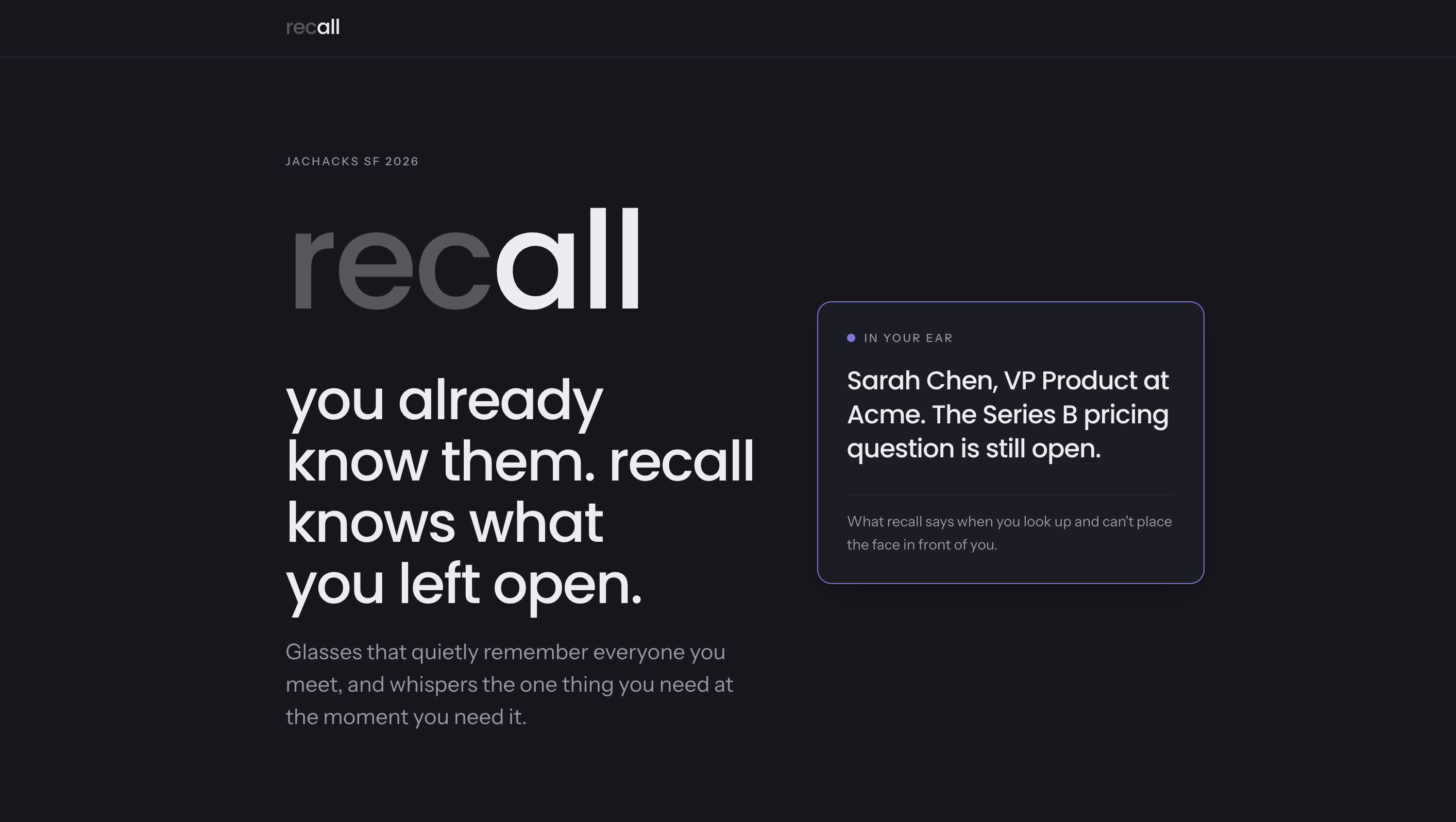
Recall is a networking memory that runs on Meta Ray-Ban Display glasses. While you talk to someone, it captions and translates what they say on the in-lens display. In the background it builds a graph of everyone you meet: their name, role, company, what they are raising or looking for, and what you owe them. When you run into that person again, facial recognition pulls up their card so you know exactly who they are and where you left off. You can also ask it things like "who was raising a seed round" and get the answer hands-free through a Neural Band gesture.
How we built it
The brain of Recall is a Jac Cloud backend. We modeled the whole network as a Jac graph, with people, companies, intents, and conversations as nodes connected by typed edges. Walkers traverse that graph to ingest new contacts and to recall old ones, and we used Jac's by llm() abilities to pull structured details out of raw speech with no prompt engineering. Every walker becomes an API endpoint on its own, so the glasses and phone just call it.
The client stays thin on purpose. An Android app captures audio, runs speech to text, and handles facial recognition, then sends everything to Jac and renders the results on the glasses display. Keeping the intelligence in Jac is why most of our codebase ended up being Jac.
Challenges we ran into
The glasses are a brand new developer preview, so getting text onto the display and reading gestures reliably took real trial and error. Latency was the next hurdle. We had to keep the live captions fast while the heavier extraction ran in the background, so one never blocked the other. Facial recognition was the trickiest part. Matching a face in a noisy, crowded room, fast enough to feel instant and without false matches, took a lot of tuning. And we had five hours to do all of it.
What we learned
None of us had written Jac before today. Its graph model turned out to be a natural fit for a memory product, since a network of people really is a graph. Learning to let by llm() handle the messy language work instead of writing parsers saved us hours. We also learned how much care a heads-up display needs. Text has to be short, well timed, and never in the way.
What's next for Recall
Better privacy controls so people opt in before they are remembered, smarter follow-up reminders, and a way to sync your Recall graph into the tools you already use once the event is over.

Log in or sign up for Devpost to join the conversation.