-
-
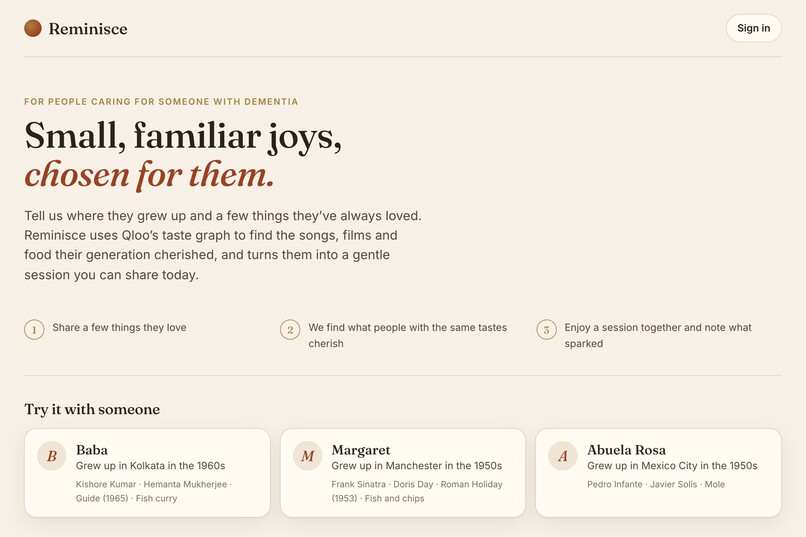
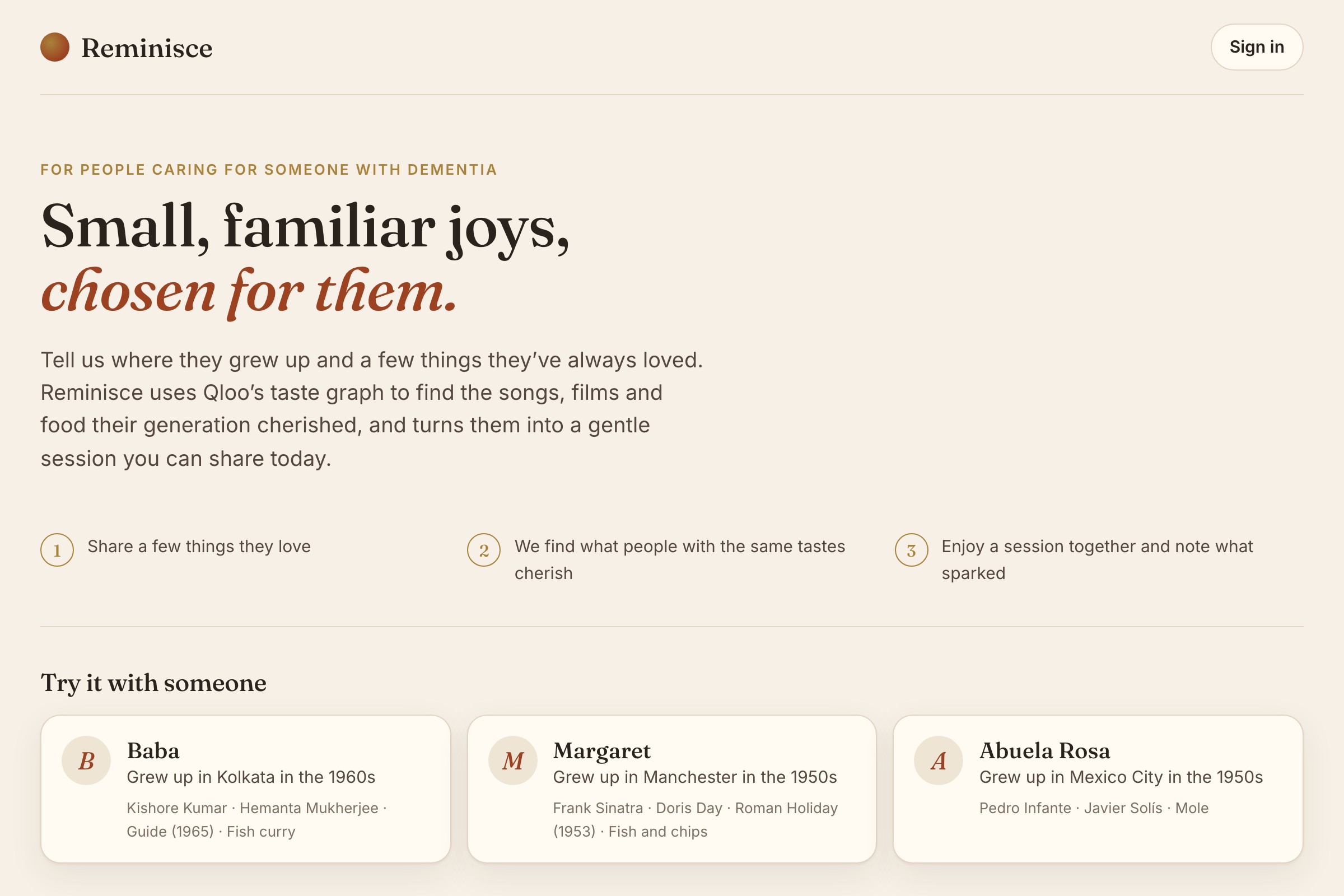
Tell us where they grew up and a few things they love. Try it as a guest with a sample person, no sign-up.
-
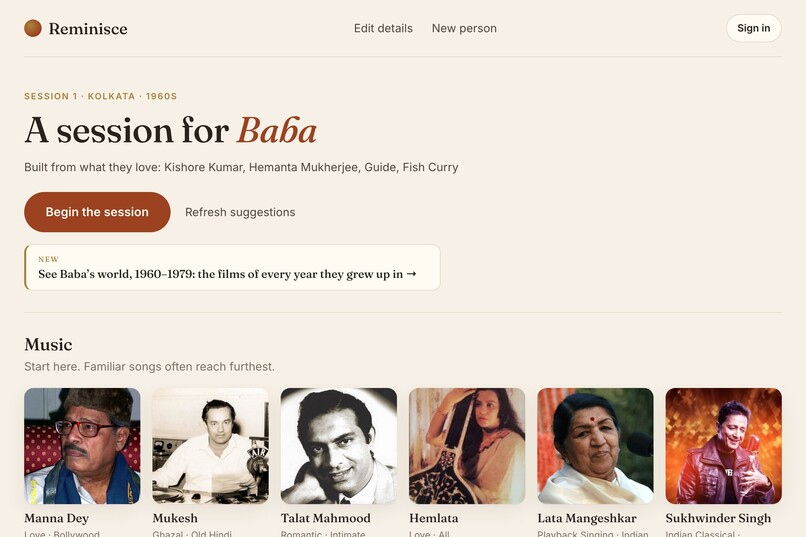
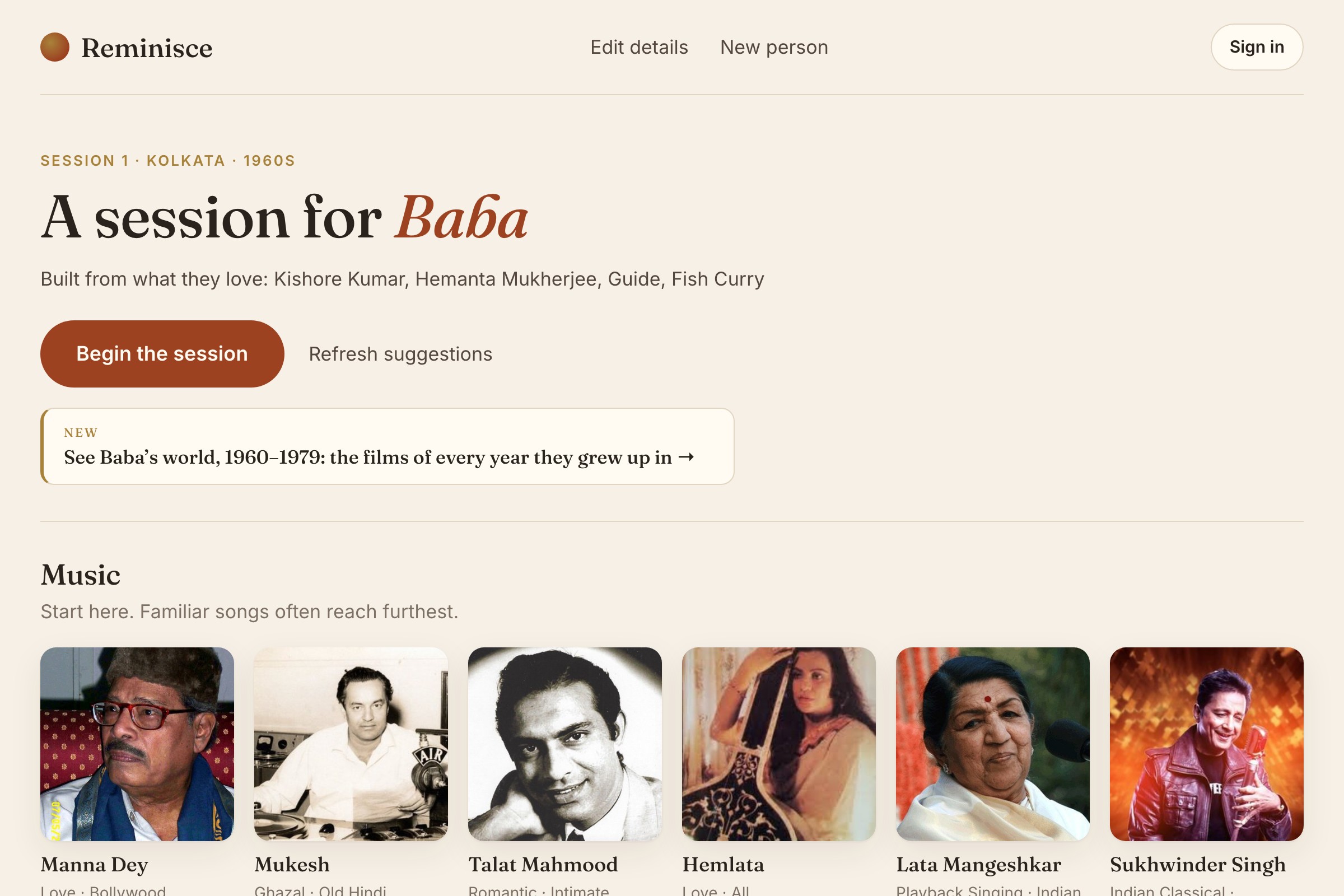
A session kit for Baba (Kolkata, 1960s), built from Kishore Kumar, Hemanta Mukherjee, Guide and fish curry.
-
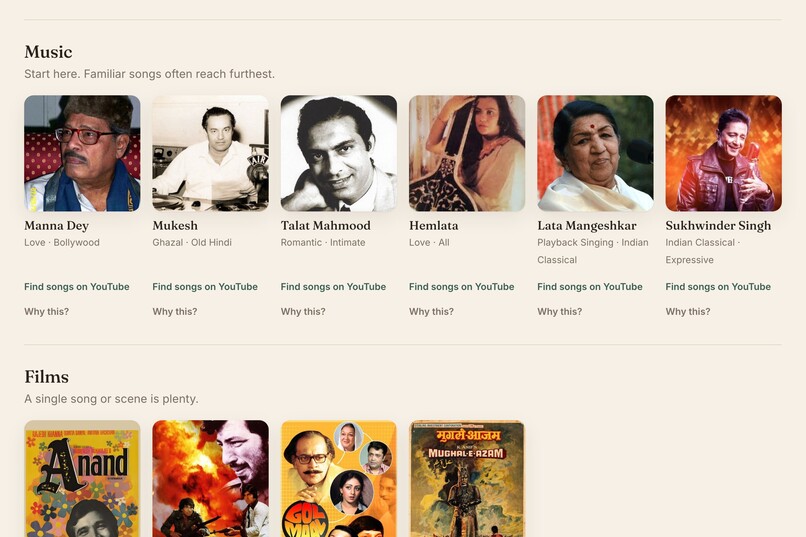
A session kit for Baba (Kolkata, 1960s), built from Kishore Kumar, Hemanta Mukherjee, Guide and fish curry.
-
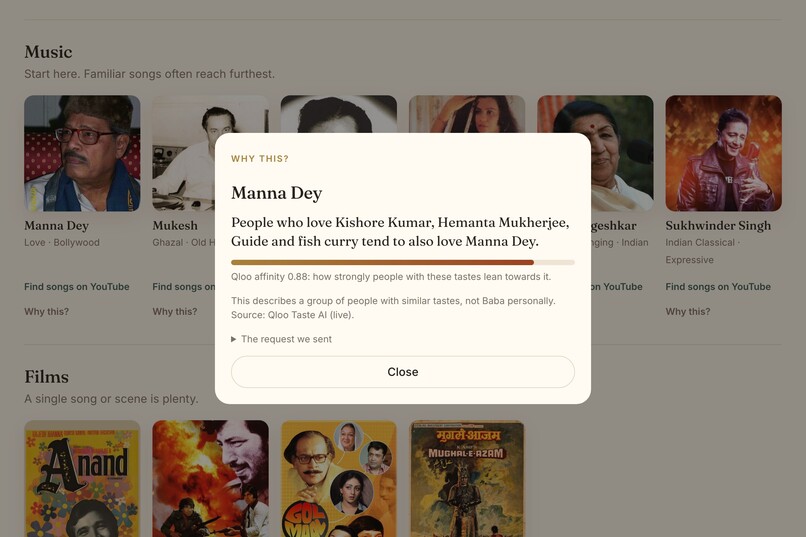
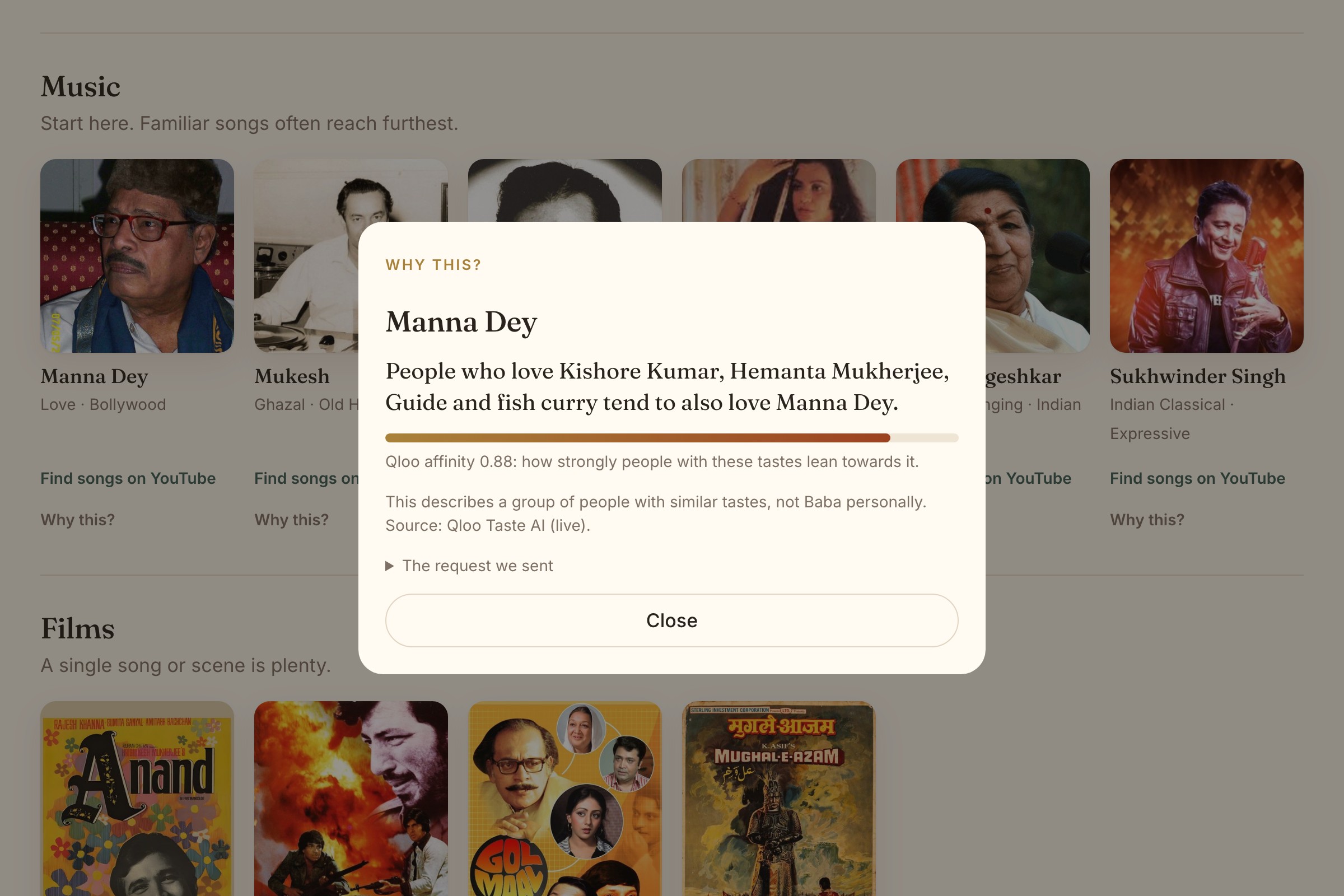
Why this? Every pick shows its Qloo affinity score and the exact request the agent sent, never a claim about the person.
-
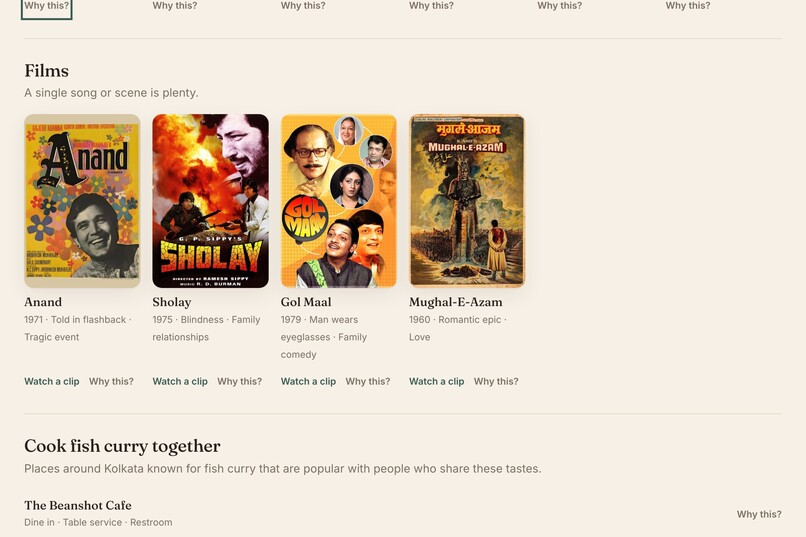
Why this? Every pick shows its Qloo affinity score and the exact request the agent sent, never a claim about the person.
-
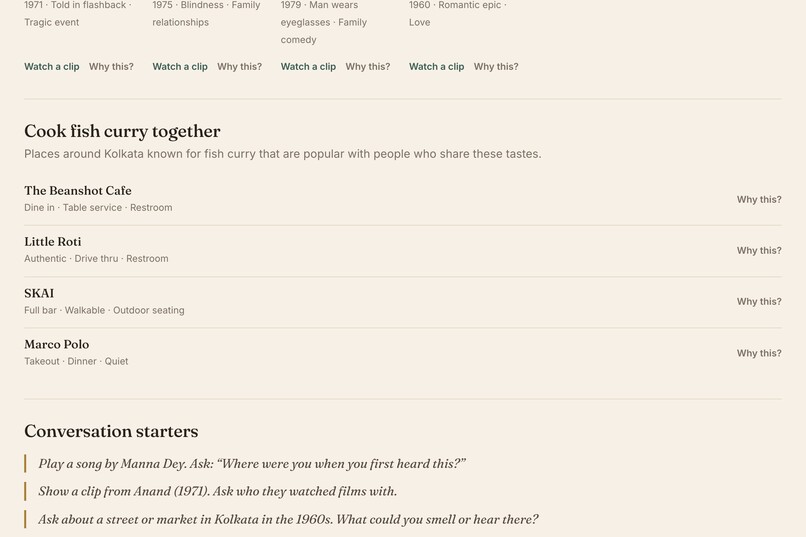
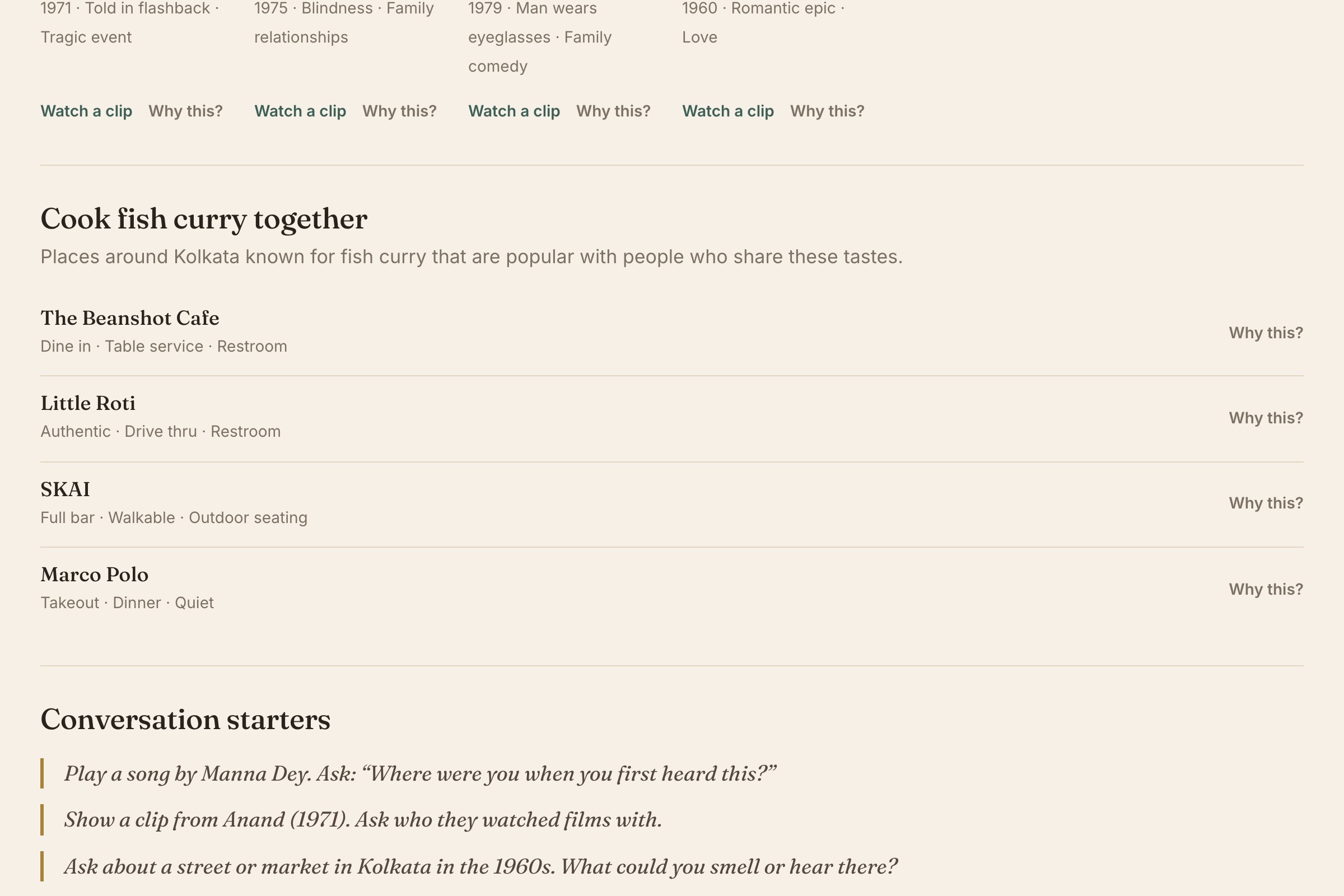
A dish to cook together, places around Kolkata known for it, and conversation starters built from the picks.
-
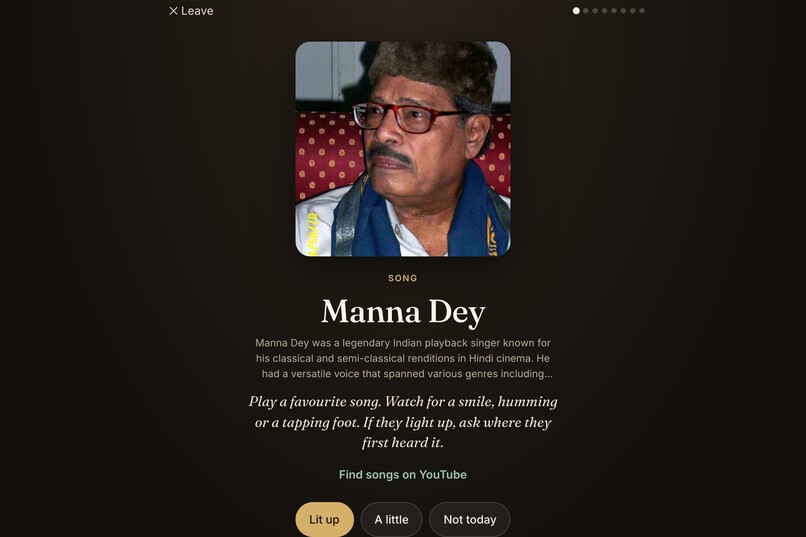
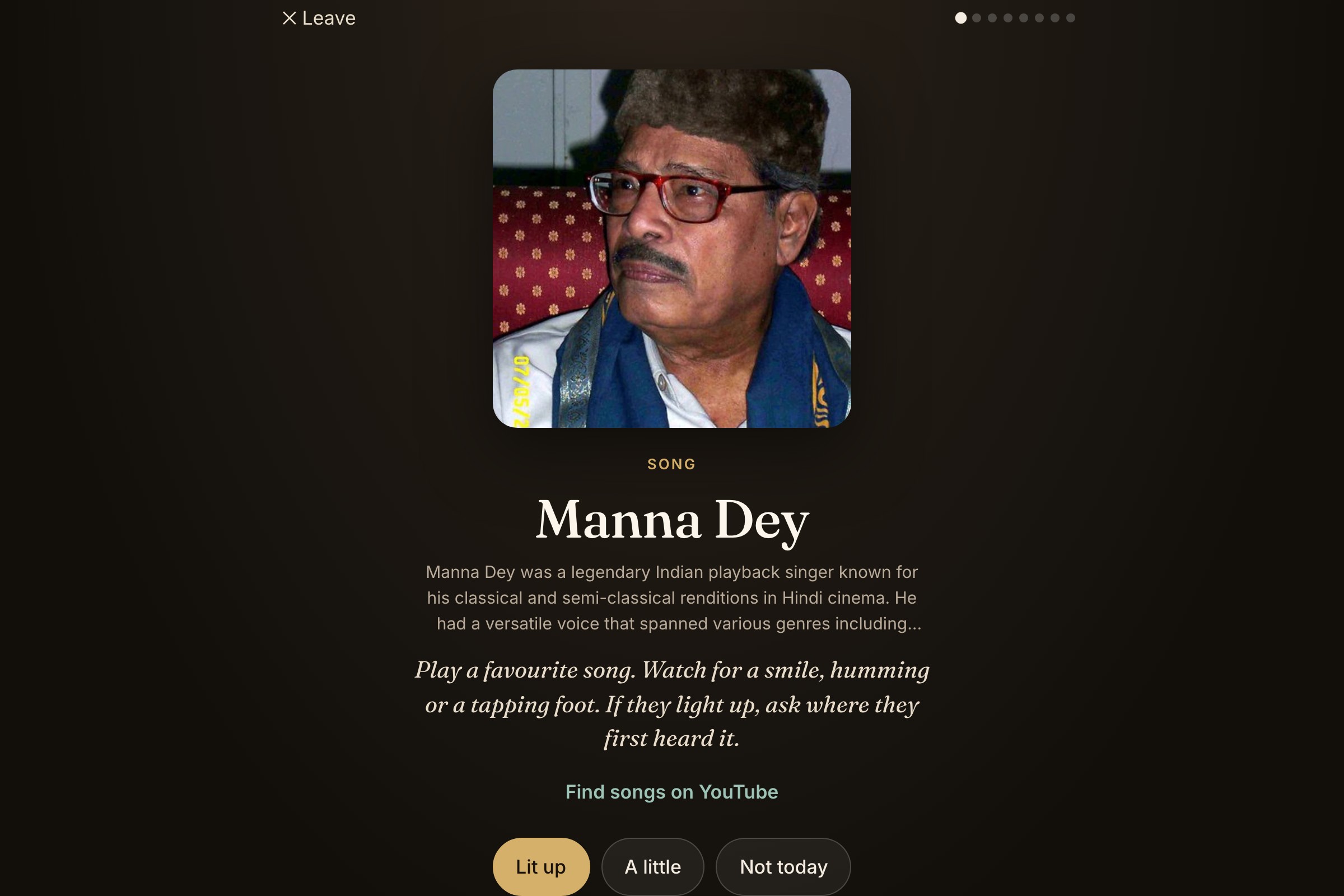
Session mode: one big card at a time. The carer taps Lit up, A little or Not today.
-
The learning loop: what lit them up becomes Qloo signals and a taste portrait that shapes next week's kit.
-
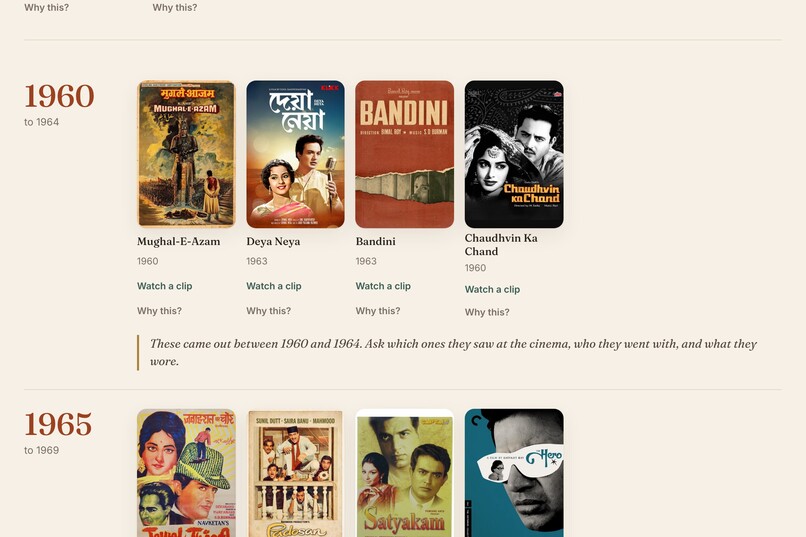
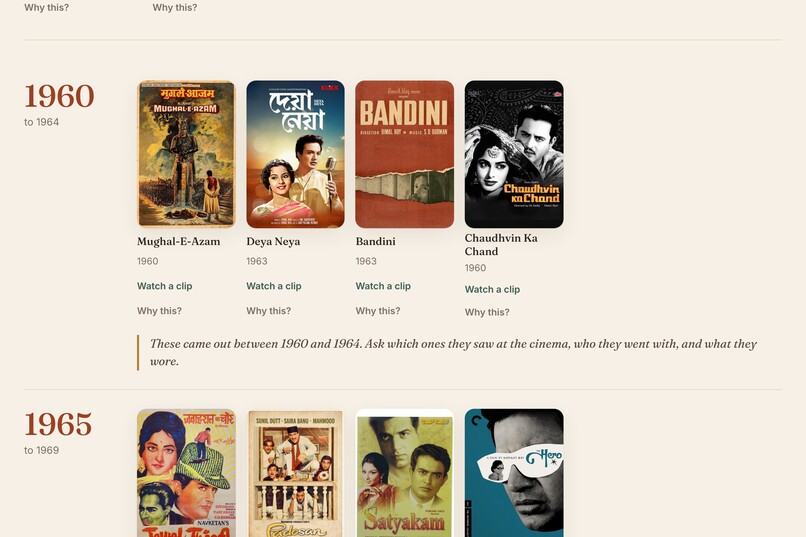
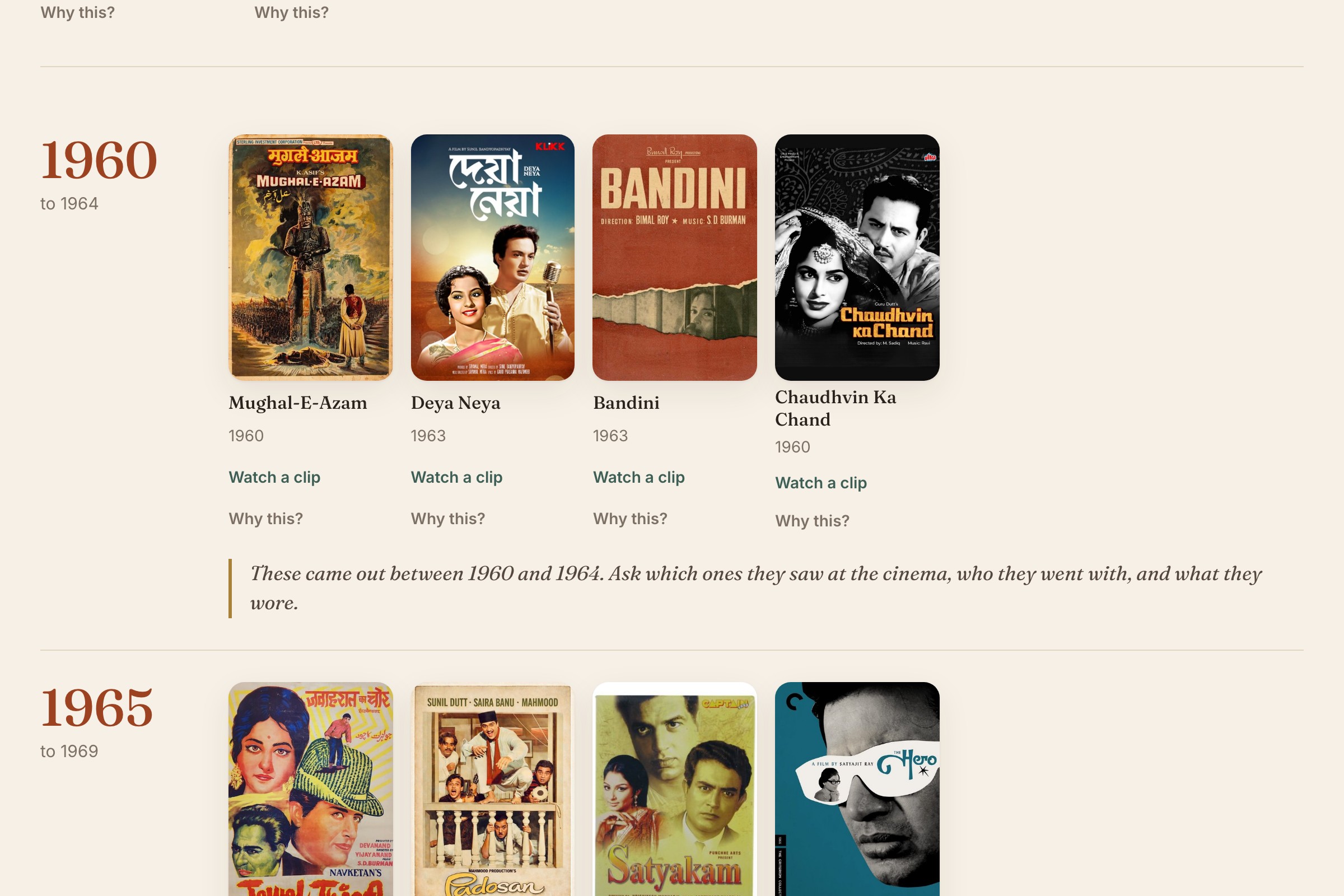
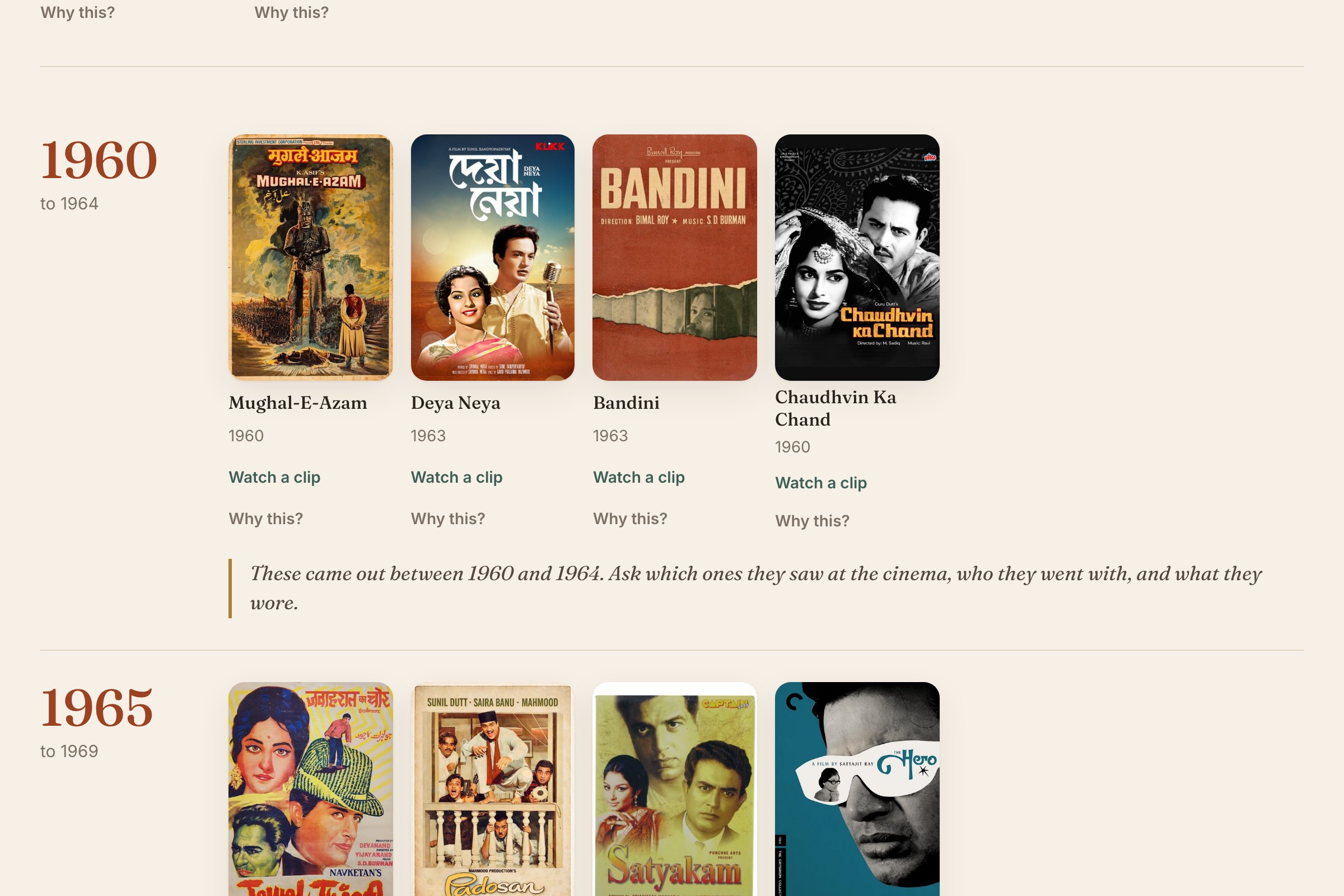
Their world: the films of the years they grew up in, five years at a time.
-
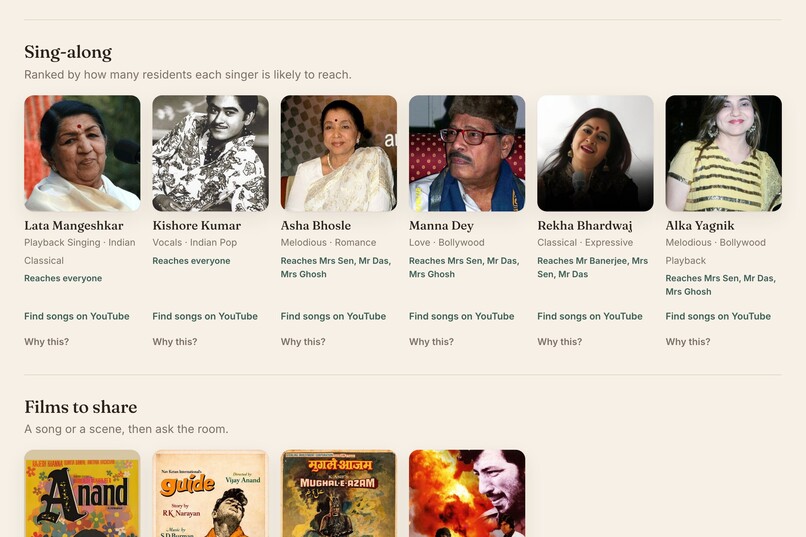
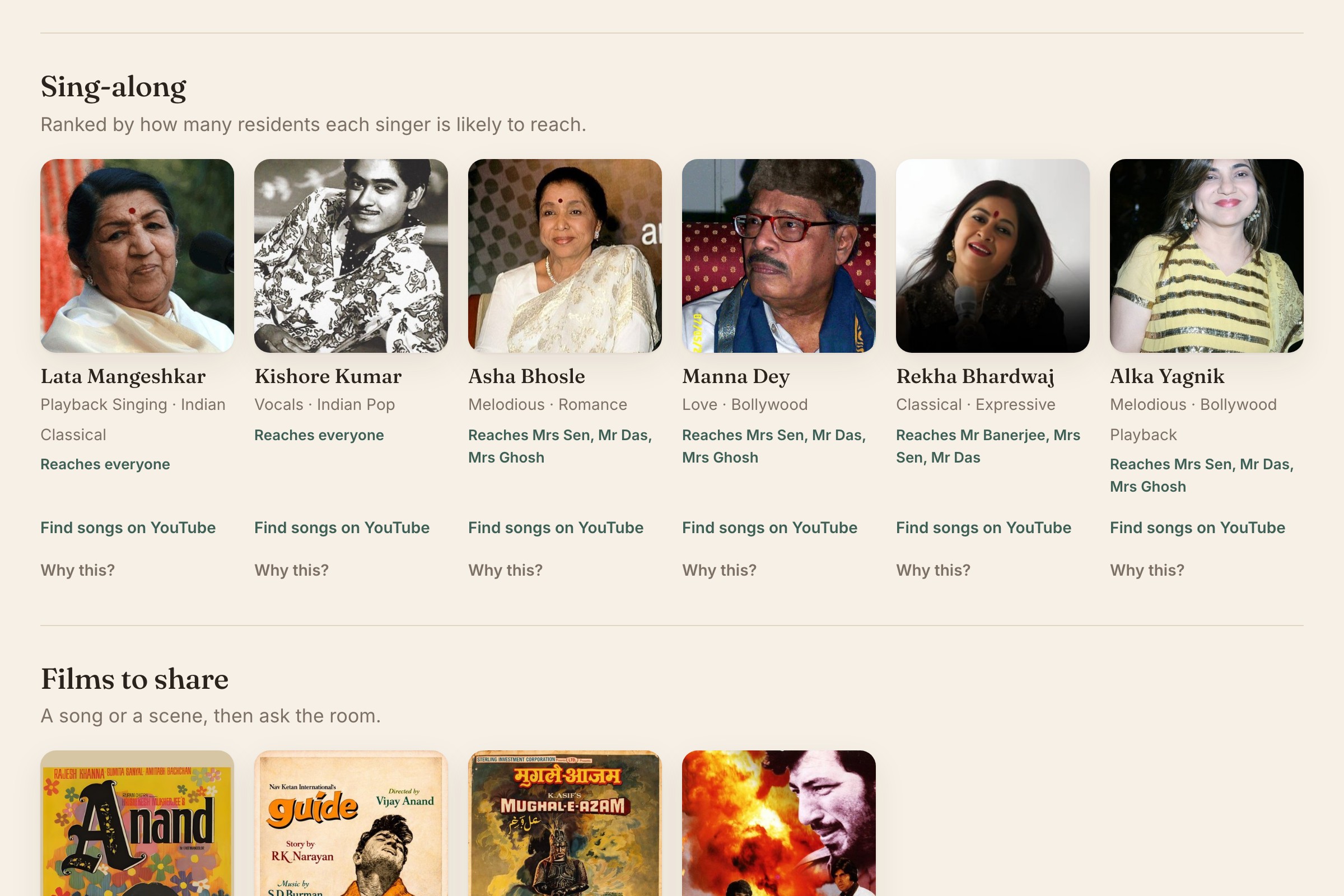
Group sessions for care homes: singers ranked by how many residents each one is likely to reach.
-
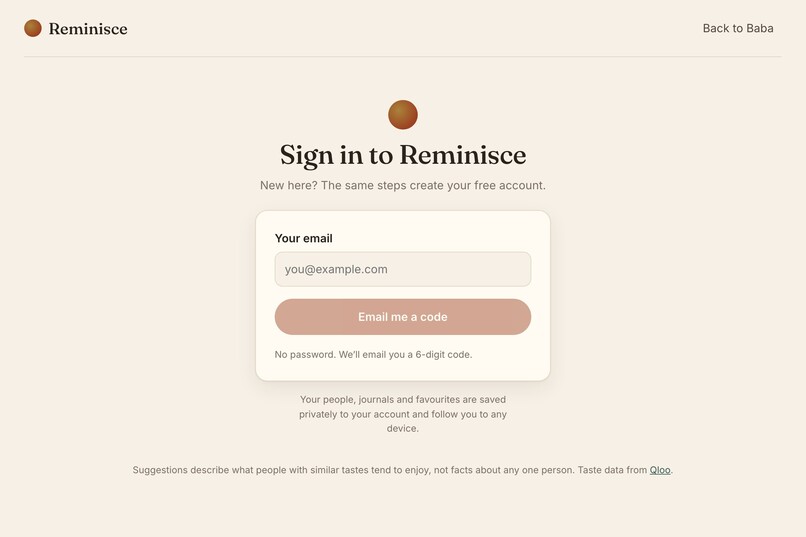
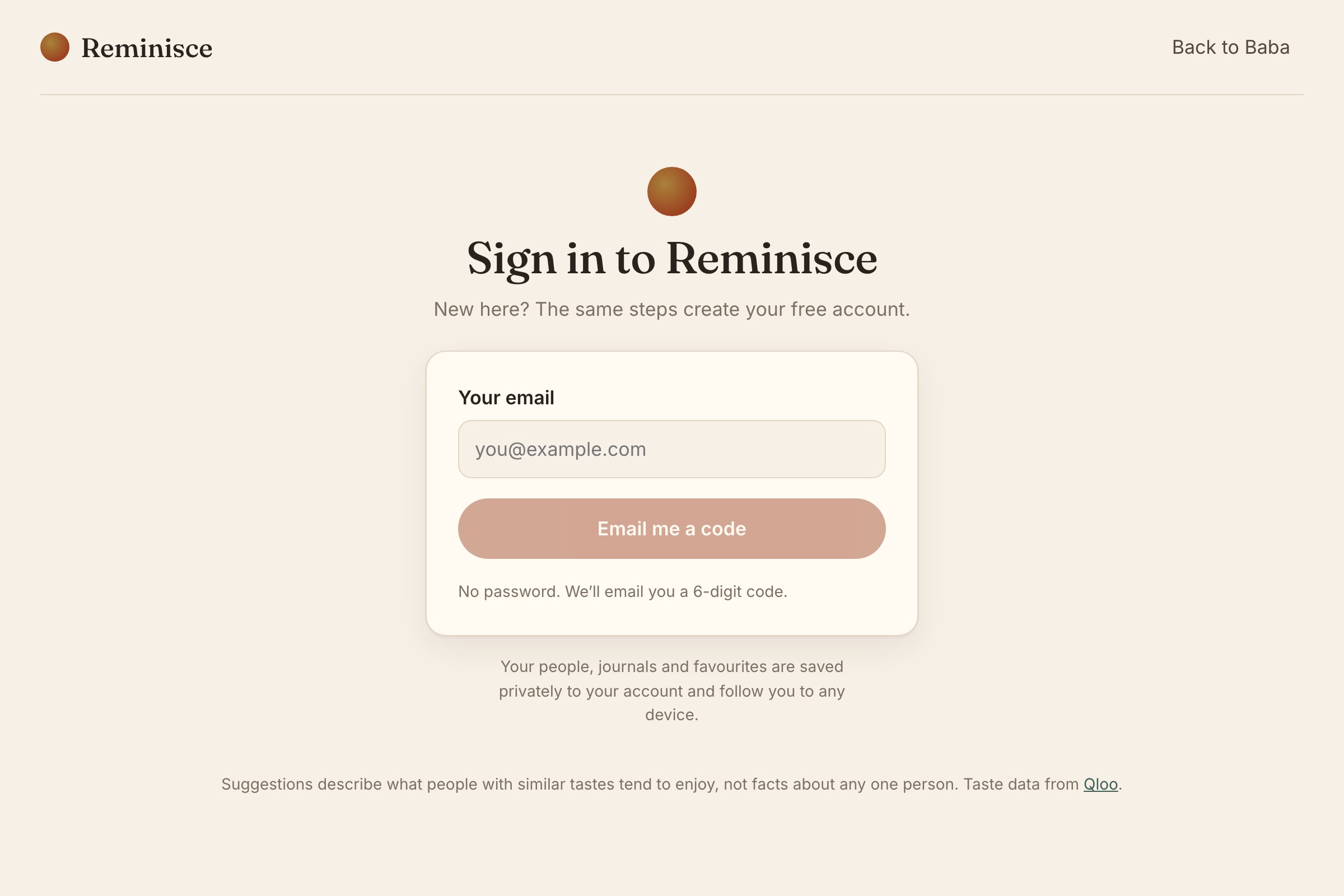
Optional sign-in with email and a 6-digit code, no password, to keep people and journals across devices.
Inspiration
People living with dementia often lose recent memories first and keep the oldest ones longest. Reminiscence therapy uses that: a song from someone's teens, a film they saw with friends, the smell of a dish from home can bring back a person who seems far away. Carers, whether family or care-home staff, rarely know those details. What they usually have is fragments: "she grew up in Kolkata in the 60s, loved Lata Mangeshkar and fish curry."
Turning fragments like that into a full afternoon of the right songs, films and food is exactly what a taste graph is for.
What it does
Reminisce is a web app for dementia carers. The carer enters a few seeds:
- where the person grew up
- roughly when
- 3–5 things they love (a singer, a film, a dish)
An agent expands those seeds through Qloo into a session kit:
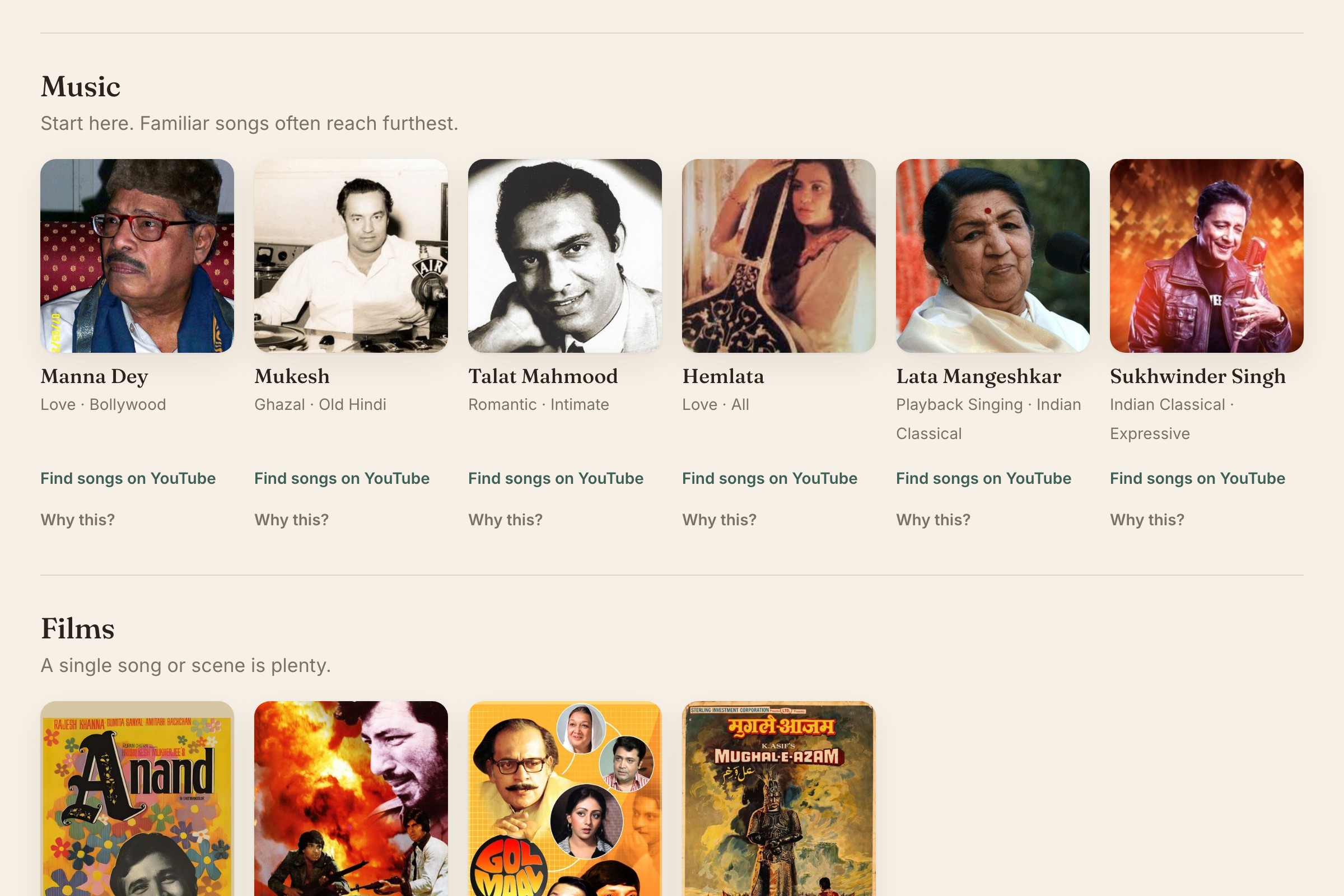
- Playlist: singers from their era, found through Qloo's own era genres (for example old Hindi), with links to find their songs on YouTube
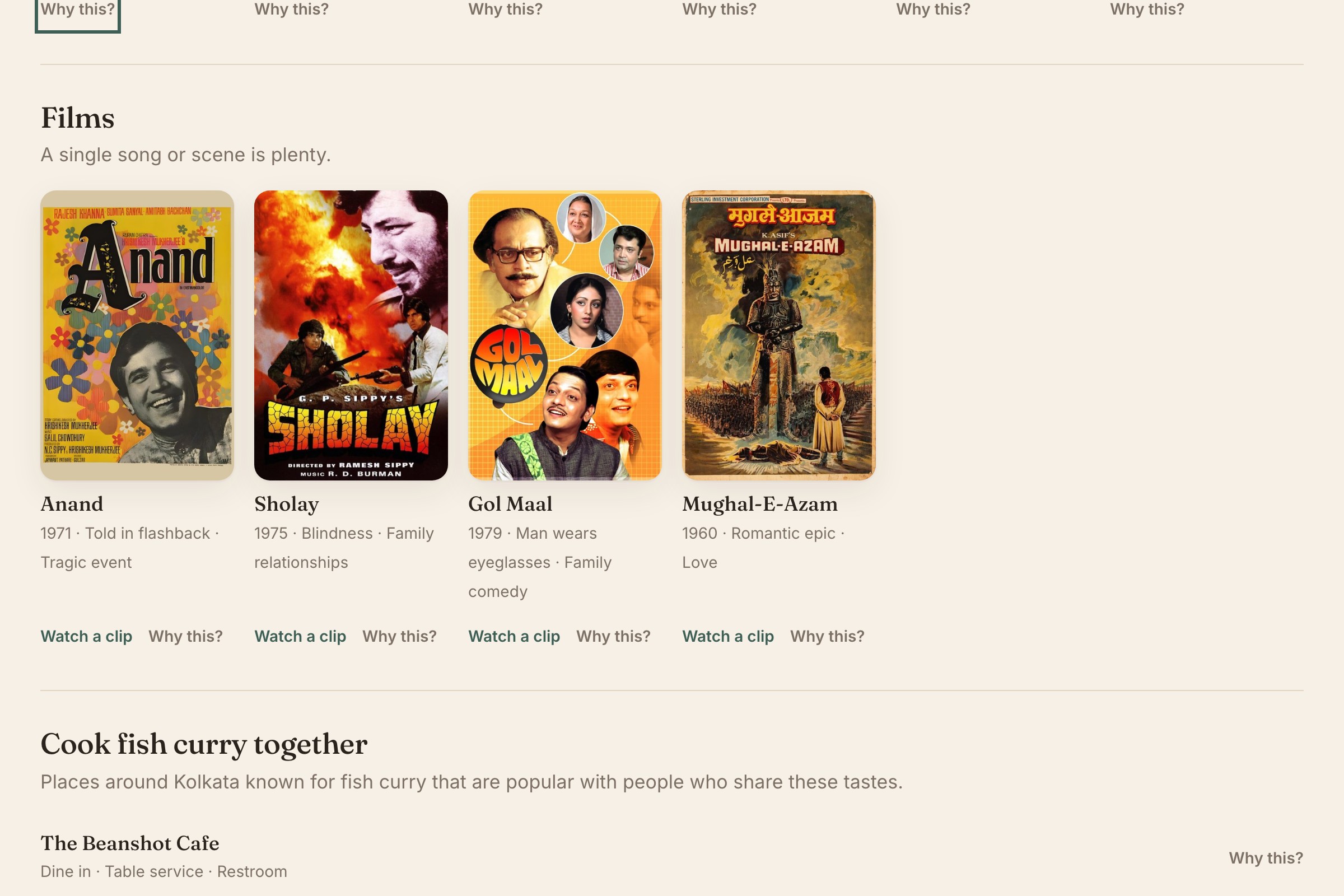
- Films: kept to the years around their youth
- Food: a dish to cook together, plus places around their home region known for it
- Conversation prompts: built from the picks
Every pick has a "Why this?" view showing its Qloo affinity score and the exact request the agent sent. Results are worded as aggregate affinities ("people who love X tend to also love Y"), never as claims about the person. The person's name is never sent to Qloo.
It also has:
- Session mode and journal. During the session the carer taps how each item landed (Lit up, A little, Not today).
- A weekly learning loop. The next kit uses those reactions. Hits become Qloo signals, what didn't land and films already shown are left out, and the mood and genre tags on what they responded to form a taste portrait that steers future kits.
- Memory timeline. "Their world": the films of the years they grew up in, five years at a time.
- Group sessions for care homes. Picks are ranked by how many residents they reach, so one playlist works for the whole room.
- Use as a guest, or sign in if you like. As a guest there's no sign-up and everything stays in the browser. Optional sign-in is by email plus a 6-digit code, with no password. Your people, journals and favourites then sync across devices. Care homes get a residents list with CSV bulk import.
How Qloo powers it
Reminisce wouldn't work without Qloo. An LLM alone can guess "famous songs from the 1960s". It can't take three personal fragments and find what people with that same taste also love, across music, film and food, with evidence behind each pick.
The agent:
- Resolves the free-text seeds. It runs Qloo entity search and tag search in parallel, and dish names are detected as specialty-dish tags.
- Finds Qloo's era genres for the singers' genres. These are used as filter tags for music from that decade, and the list is topped up from wider results only when the era genre is small.
- Calls Insights per category, using the seeds and the taste portrait as signals:
- artists: era-genre filter
- films: release-year window around their youth
- places: location filter for their home region, dish tags, and the older age group
- Learns each week. Past hits become signal entities, what didn't land becomes an exclusion, and the portrait's tags become signal tags.
- Builds group sessions by expanding each resident, then running a combined "room" query, then ranking by reach.
Things we learned from Qloo's results and built around:
- Qloo's age signal pulled music and films towards what older people watch today, not what they grew up with. So media uses the era window instead, and the age signal is used only for places.
- Unknown towns return a location error. The agent retries without location and says so in the trace.
- Generic tags are left out of the taste portrait so it reflects what's distinctive about the person.
How we built it
- Frontend: A React + Vite web app that runs in any browser, on a laptop or a phone, with light and dark themes.
- Backend: AWS Amplify Gen 2.
- AppSync custom operations with a real-time progress subscription, so the carer watches the agent's steps live.
- An SQS-driven worker Lambda that runs the Qloo harness CLI from a Lambda layer.
- DynamoDB for jobs and a 7-day Qloo response cache.
- Auth: Cognito custom-auth triggers that generate and verify a 6-digit email code, sent through Amazon SES with DKIM. Owner-only data models for people, groups and accounts. Guest data migrates into the account on first sign-in.
- Hosting: CloudFront + S3 on a custom domain.
- Privacy and resilience: the Qloo key stays server-side, results are cached, parallel Qloo calls are capped, and failed calls are retried. If one category fails, the rest of the kit is still delivered.
Challenges we ran into
- Getting era-correct results rather than currently-popular ones (see the age-signal finding above).
- Places for small towns Qloo doesn't know.
- Names that mean two things: "Sholay" is both a 1975 film and a dish in Qloo, while "fish curry" is a dish and also a restaurant's name. An exact film or singer match now wins over a dish, but a place never does.
- Keeping long agent runs reliable over a subscription, solved with progress events plus polling as a fallback.
- Passwordless sign-in that works for brand-new and returning carers in one step.
Accomplishments we're proud of
- A complete product rather than a proof of concept: guest use, session mode, the learning loop, timeline, group sessions, accounts and bulk import.
- Explainability: every recommendation can be traced back to the Qloo calls that produced it.
- Careful wording and privacy for a vulnerable audience.
What we learned
Taste graphs are about more than "what to watch next". Run in reverse, from fragments to a whole cultural world, they can rebuild the context of someone's youth.
What's next
- Printable session sheets for care-home activity coordinators.
- Sharing a person's profile between family members and care-home staff.
- More regional depth, such as local radio-era genres and festival foods.
Try it
- Live app: https://reminisce.revenuerush.in. Pick a sample person (Baba, Margaret or Abuela Rosa) or enter your own, no sign-up needed.
- Code: https://github.com/ramudevhub-90/REMINISCE (MIT)
Built With
- amazon-cloudfront
- amazon-cognito
- amazon-dynamodb
- amazon-route-53
- amazon-ses
- amazon-sqs
- amazon-web-services
- aws-amplify
- aws-appsync
- aws-lambda
- javascript
- node.js
- qloo
- react
- typescript
- vite

Log in or sign up for Devpost to join the conversation.