-
-

Your back office never clocks out
-
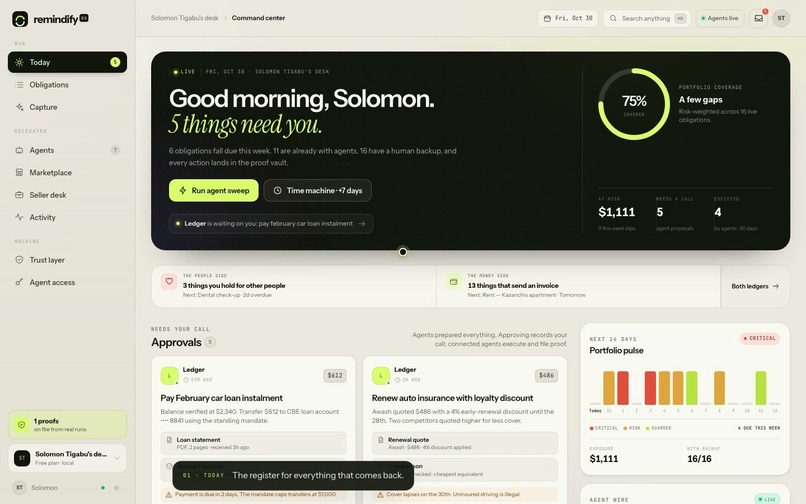
Today: what needs you next
-
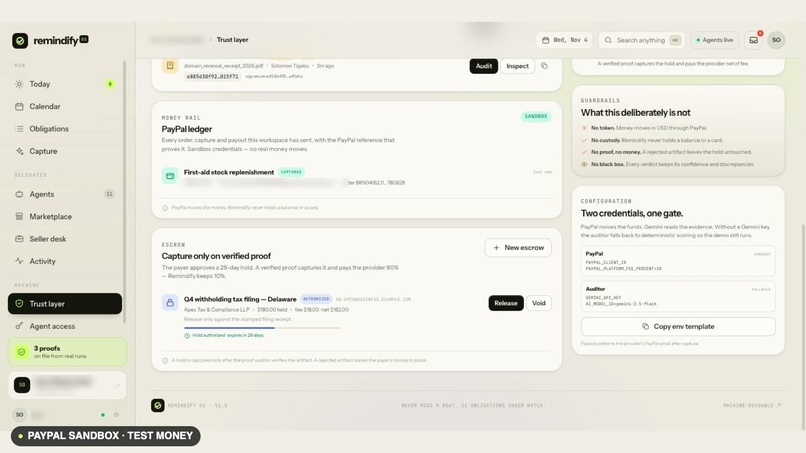
Trust ledger: proof gate and PayPal references (sandbox)
-
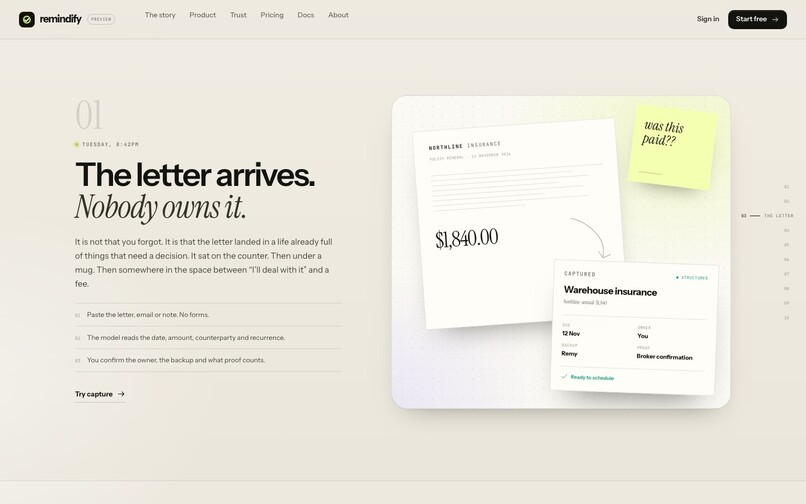
An invoice arrives; the register already owns it
-
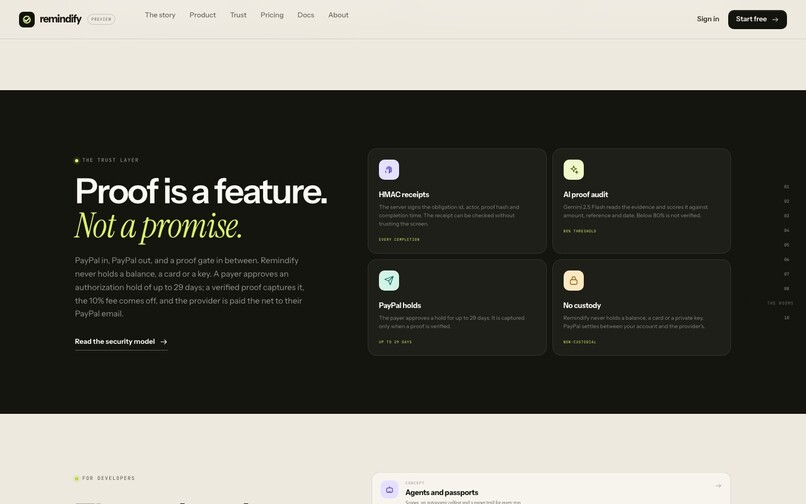
Proof is a feature, not a promise
-

One calm surface for the whole back office


Inspiration
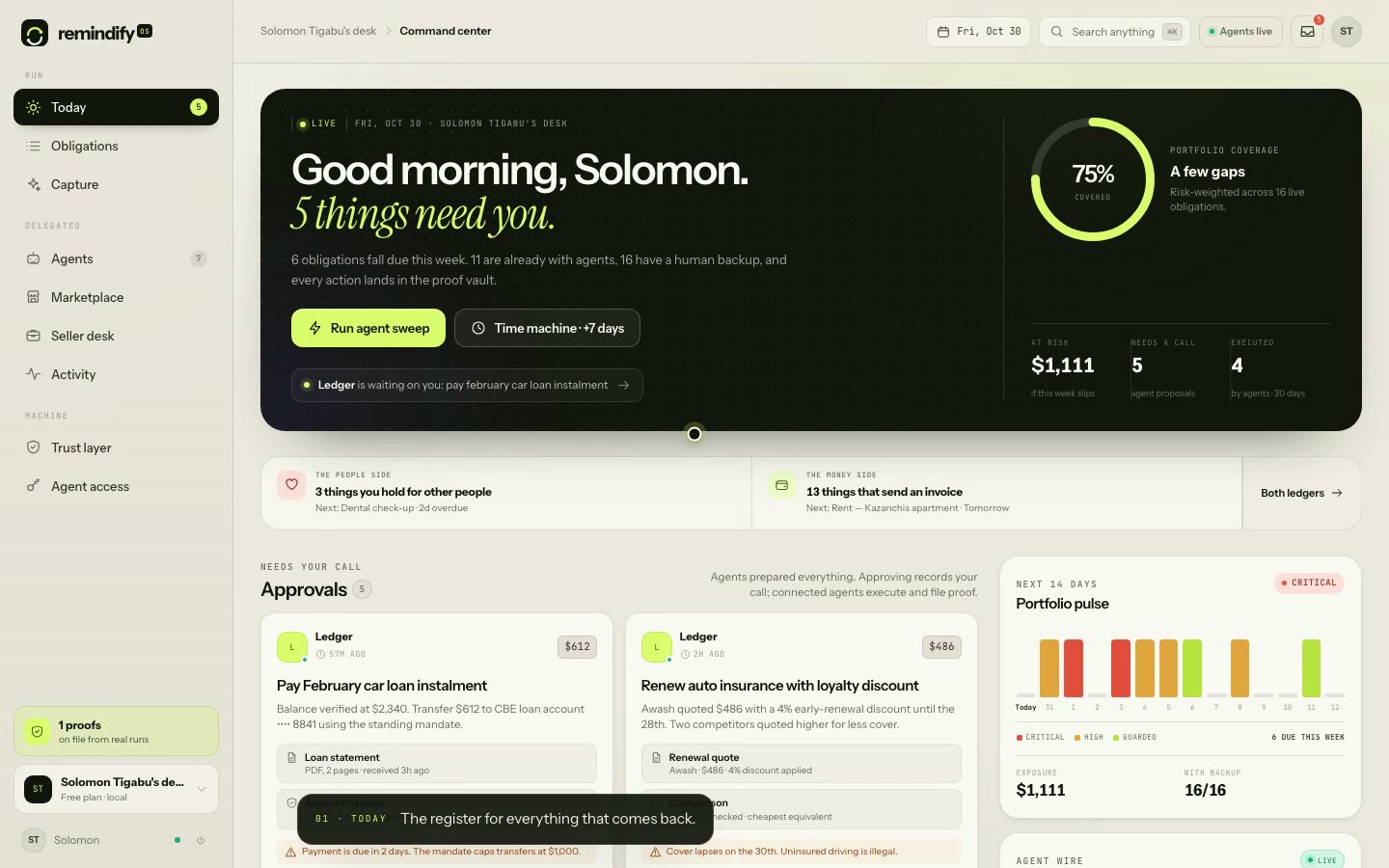
Every small business runs a back office of recurring obligations — the licence that expires, the contractor whose W-9 is missing, the invoice that goes out late. Agents can now do the work, but no one trusts an agent with the money. Remindify lets a business delegate the work and still control the payment: the agent prepares, a human approves within a ceiling, and PayPal releases funds only after AI-audited proof.
What it does
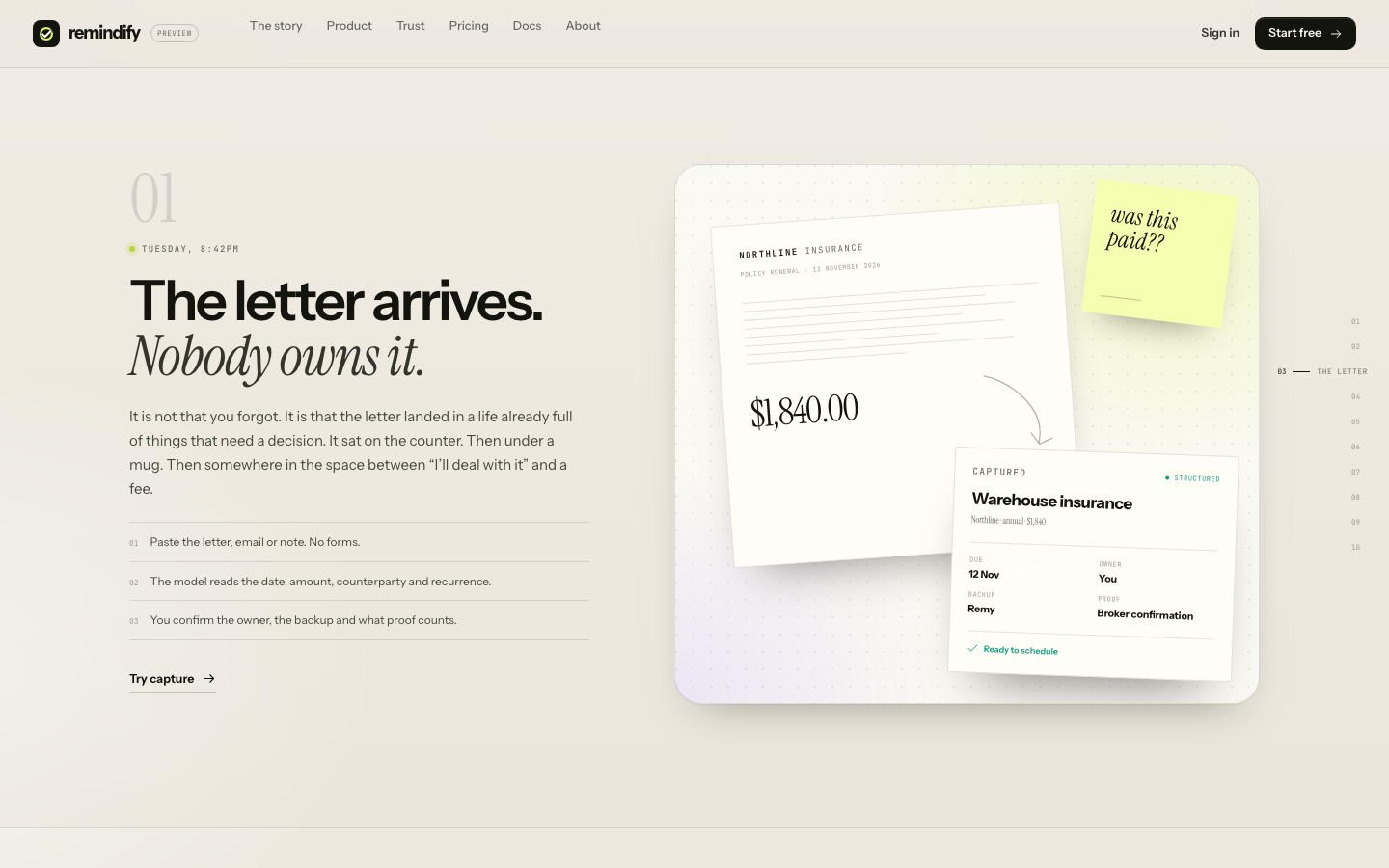
Remindify turns vendor renewals, compliance filings, invoices, and contractor deliverables into a shared register with a named owner, backup, deadline, risk score, and proof requirement. Gemini 2.5 Flash can extract obligations from notices into drafts for a person to review, then audit filed evidence against the obligation.
Agents operate through scoped passports with autonomy limits and per-run spending ceilings. People and agents share the same workspace through the web app, REST API, and MCP. The AG Grid-based Agent Studio makes risk, ownership, autonomy, and payment state visible together.
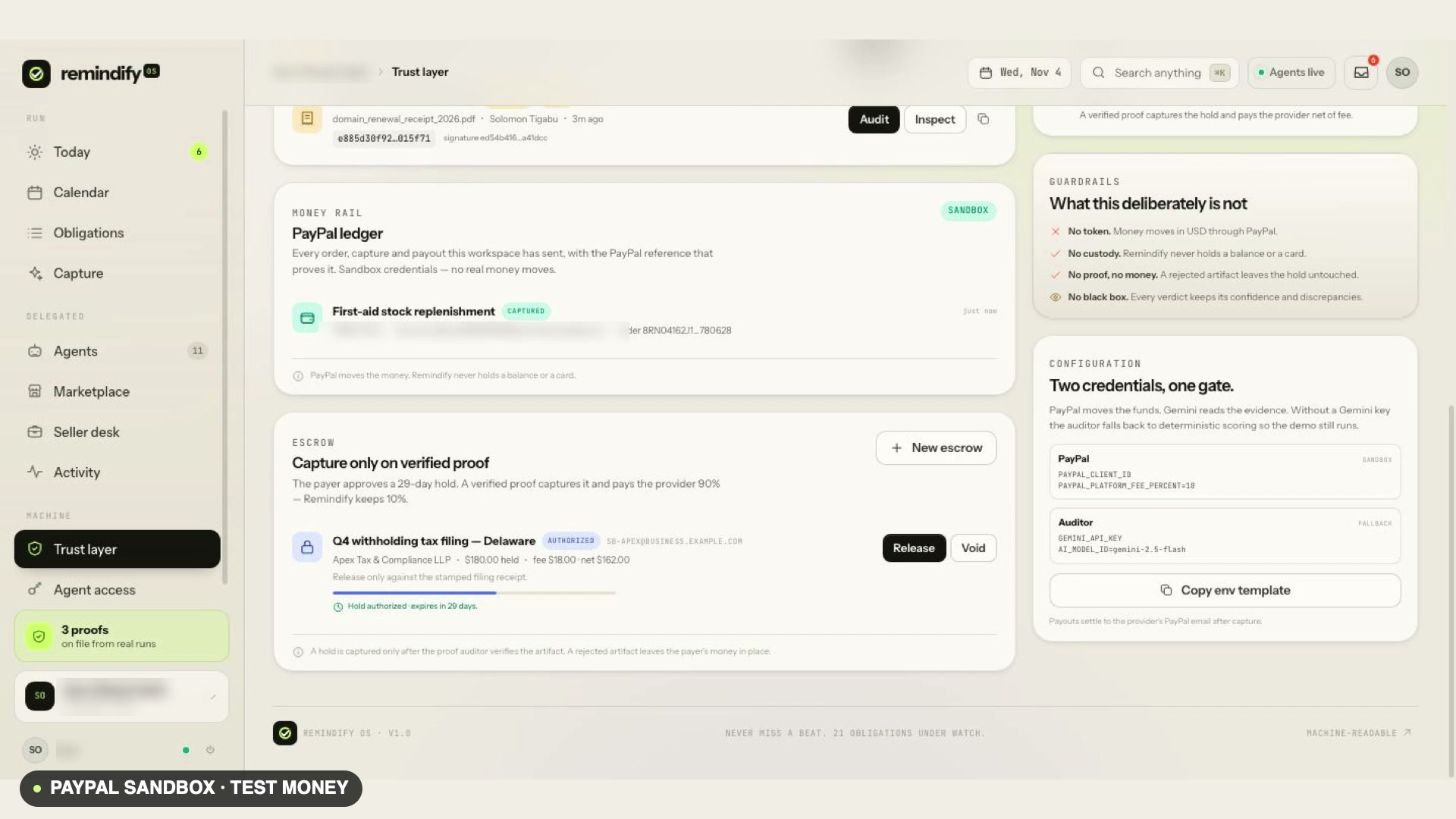
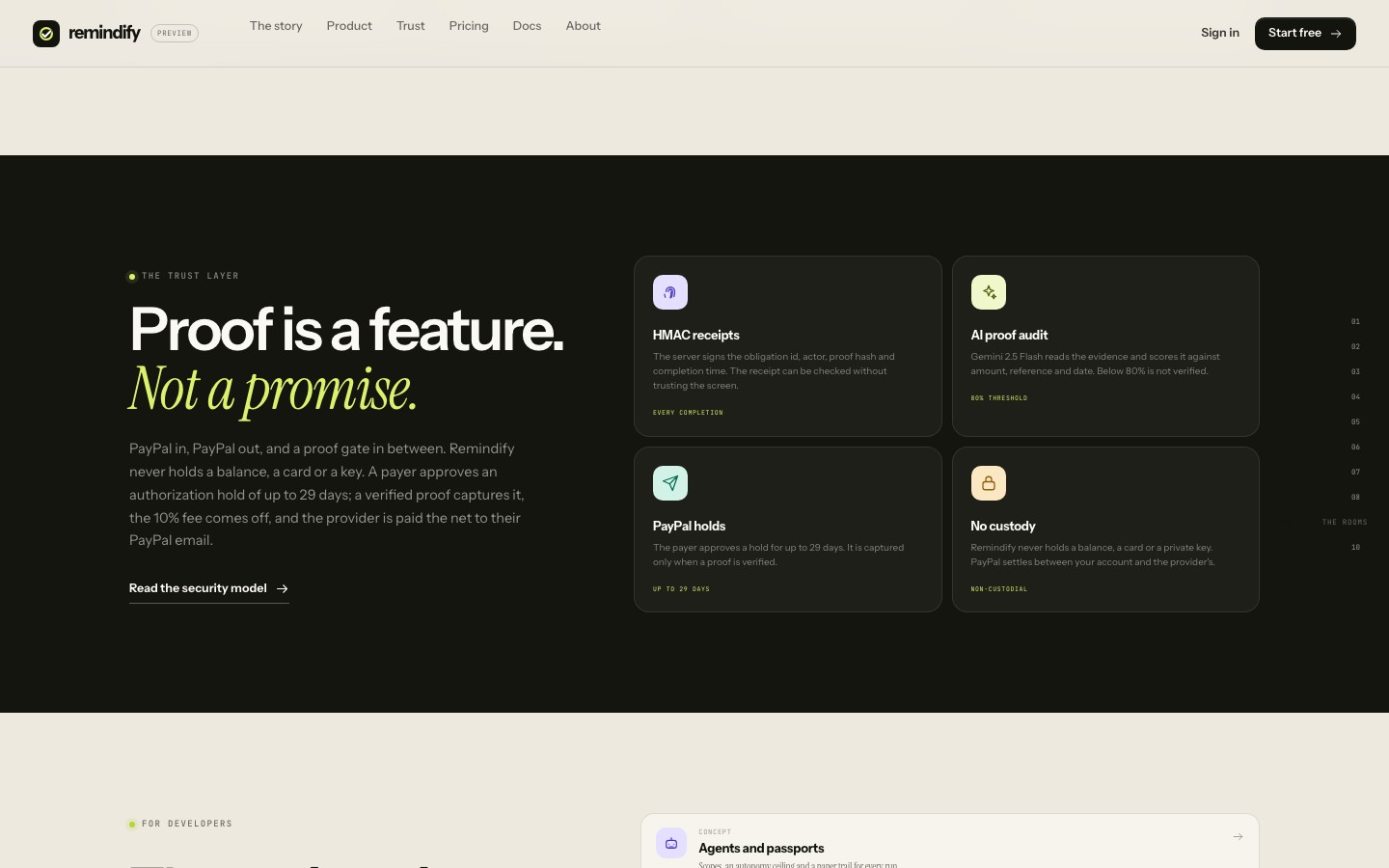
PayPal is the payment rail: the app creates sandbox authorization holds, keeps them pending until evidence is verified, then captures the hold, deducts a 10% application fee, and pays the provider the net through PayPal Payouts. It also supports PayPal invoices and records orders, captures, payouts, and references in a ledger. Remindify does not hold a balance or card. The demo video uses sandbox test money.
A concrete run
A $180 Delaware filing hold is authorized. The agent attaches a receipt; the auditor rejects a $1,800 draft as the wrong amount, then clears the stamped $180 receipt. PayPal captures $180, keeps $18, and pays $162 to the provider — with the backup owner and audit trail visible in the register.
Procurement. A quarterly restock is due. The sweep has @procurement-bot search Channel3 for toner and a backup drive under its $150 passport ceiling: it normalises every offer, drops the ones without a purchasable https:// merchant link or with no stock, dedupes by SKU and quotes the cheapest verified survivor — a $64.50 Brother TN-450 at Staples Business. The quote (SKU, merchant, listing URL, price) is filed on the obligation, not in a chat log. A human presses Pay $64.50 in PayPal; the server — never the agent — creates the Orders v2 order, the capture lands, and the row closes as Paid with the capture id while the quote and its source listing stay on the record. Lower the ceiling to $50 and the same request answers 409 no_quote instead of buying over budget.
Why it’s different
Reminder apps stop at notification, AP automation stops at matching invoices, and agent payment rails move money on intent. Remindify moves it on verified proof, with a named owner and a reversible handover.
How we built it
The application uses a React web client and Node.js API, with Postgres in production and SQLite for local development. Gemini 2.5 Flash powers structured capture and multimodal proof auditing, with deterministic local fallbacks. Orders and the authorize/capture primitives run through the APIMatic-generated PayPal Server SDK; Payouts v1, Invoicing v2, and webhook signature verification use PayPal's REST endpoints. We added signed webhooks, idempotent payment requests, a durable audit trail, and an MCP server for agent access.
Challenges we ran into
The hardest part was treating authorization, capture, and payout as distinct states rather than a single “paid” flag. We built the workflow so evidence must pass before capture, retries can be safe, and a failed payout is not reported as settled. We also had to make AI useful without making it the final authority: people review extracted drafts, while the proof check and payment gate remain explicit.
What we learned
Delegating work is not the same as handing over unrestricted authority. Clear scopes, spending ceilings, named backups, and verifiable proof make agents more useful—and make their actions easier to trust.
Sponsor Integrations (AG Grid & APIMatic)
- AG Grid (
ag-grid-react): Powers our Agent Studio register view (/obligations), combining custom cell renderers for composite risk meters, inline autonomy controls (notify→prepare→approve→autopilot), scoped Agent Passports with per-run spend caps, and live PayPal Escrow status badges (AUTHORIZED_HOLD,VERIFIED,SETTLED). - APIMatic (
@paypal/paypal-server-sdk& APIMatic Context): We used APIMatic's PayPal Context specification and the APIMatic-generated@paypal/paypal-server-sdkto power our core PayPal Orders v2 (intent: "AUTHORIZE") and Authorization Capture flows with strict schema validation and idempotency (PayPal-Request-Id), preventing payload hallucinations across both our Node.js executor and MCP server. - Channel3 (api.trychannel3.com). Powers @procurement-bot, the agent that spends money. The agent searches Channel3 (POST /v1/search, x-api-key, filters.price.max) for its obligation's line items, normalises every offer into one shape (SKU, title, price, currency, merchant, https:// merchant URL, availability), and keeps only verified offers: a product id, a positive price, a purchasable link and stock that is not explicitly out of stock. Offers are de-duplicated by SKU, filtered to USD and at or under the lesser of the agent's $150 passport cap and the obligation budget, then ranked by price with rating as the tie-break. The cheapest survivor becomes the quote and the proof text (Channel3 · · $<price> at <merchant> · <url>); the app — not the agent — creates the PayPal order for that exact amount, and a human approves it. When nothing fits the ceiling the call returns 409 no_quote instead of overspending, and without CHANNEL3_API_KEY the same flow runs against a clearly labelled fixture catalog, so judges can exercise it with no credentials. The agent reaches Channel3 over REST (GET /api/v1/procurement/search) and MCP (search_products, request_restock_order).</li> </ul>
Built With
- ag-grid
- apimatic
- channel3
- gemini-2.5-flash
- mcp
- node.js
- paypal-authorizations-api
- paypal-invoicing-api
- paypal-orders-api
- paypal-payouts-api
- paypal-server-sdk
- paypal-webhooks
- postgresql
- react
- sqlite
- typescript
- vite
