Summary
As the U.S. population ages, older adults are facing not just physical decline but also loneliness, emotional distress, and memory loss. Studies show that worse physical health is strongly associated with worse psychological well-being (Steptoe et al., 2022). Aging is also linked to stressors like isolation, grief, and financial insecurity, which raise the risk of depression and cognitive decline (World Health Organization, 2025). At the same time, strong emotional connection and psychological well-being act as protective factors that support healthier aging and resilience (RTam W, et al., 2021).
Reminiscence therapy is an evidence-based approach in elder care: guiding someone to revisit meaningful life events using photos, music, voices, and storytelling. Research has shown that this kind of guided recall can strengthen long-term memory, elevate mood, and rebuild a sense of identity — especially for people living with dementia or mild cognitive impairment (Meléndez J.C., et al., 2017). But traditional reminiscence therapy usually requires trained facilitators or in-person sessions. Most families do not have daily access to it.
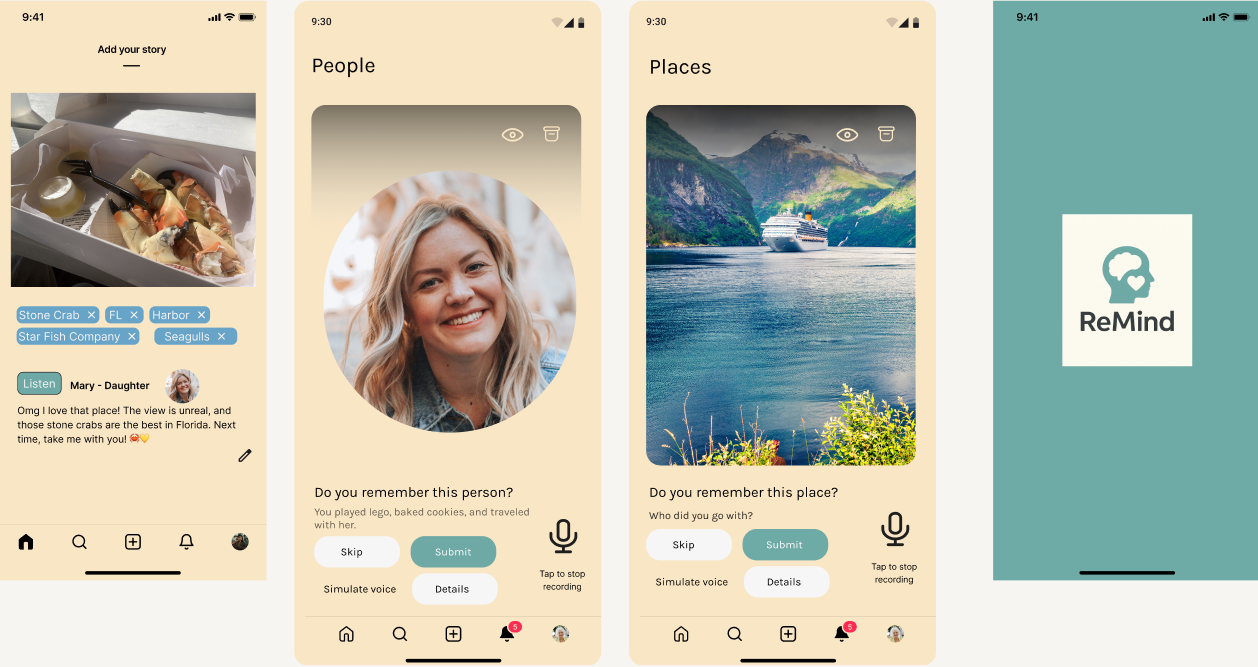
ReMind turns that therapy into a calm, digital, voice-enabled experience that families can use at home.
Target Audience Definition
- Primary: U.S. adults aged 65+ with mild to moderate memory loss and their family caregivers.
- Secondary: Senior-living communities and healthcare providers offering digital cognitive engagement.
Inspiration
ReMind was inspired by our own families’ experiences with dementia and the emotional strain of caregiving.
We envisioned a solution that could combine compassion, technology, and evidence-based therapy to make memory care more human.
Market Opportunity
Over 11 million people in the U.S. provide unpaid care for loved ones with Alzheimer’s or other dementias. Together, they contribute an estimated 18+ billion hours of support per year — work that is economically valued at roughly \$346 billion annually (Alzheimer’s Association, 2024). This represents not only a massive care gap but also emotional exhaustion for families.
At the same time, consumers are already investing in the protection of their memories: the global consumer cloud-storage market — where most family photos and videos live — was valued at \$16.5 billion in 2024 (Credence Research, 2024). In short, people are both emotionally motivated to preserve memory and financially accustomed to paying for it.
ReMind sits precisely at this intersection:
- It serves caregivers who need tools to ease disorientation, loneliness, and repetitive reminders.
- It leverages an existing digital habit — saving and sharing photos — by adding a therapeutic, voice-guided memory layer.
Total Addressable Market (TAM)
$$ \text{TAM} = \$16.5\,\text{B} $$
Serviceable Addressable Market (SAM) & Serviceable Obtainable Market (SOM)
SAM: Focusing solely on U.S. older-adult caregivers who use smartphone/cloud photo storage and are willing to pay for cognitive support and memory coaching. For example, if 10% of the 11 million caregivers adopt the service at an average spend of ~$20/month (~$240/year)
$$ \text{SAM} = 0.10 \times 11{,}000{,}000 \times \$240 = \$264{,}000{,}000 $$
SOM: In the first 1–3 years, capturing perhaps 1% of that SAM (~110,000 users) would result in ~110,000 × $240 = ~USD 26.4 million/year
$$ \text{SOM} = 0.01 \times \$264{,}000{,}000 = \$2.64\,\text{M} $$
Competitive Cost Comparison
| Competitor | Model Type | Hardware Cost | Subscription | Focus | Limitation |
|---|---|---|---|---|---|
| ElliQ | Robot companion | \$250–\$300 device | \$39–\$59/mo | Companionship, wellness | Hardware cost, limited photo memory |
| Alexa Together | Voice assistant service | Requires Echo device | \$19.99/mo | Safety monitoring | Not memory- or photo-focused |
| MindMate / Memory Lane Games | Mobile apps | None | \$5–\$10/mo | Brain games | Not personalized, no family sharing |
| Storyworth / Remento | Keepsake platform | None | \$99/yr | Legacy storytelling | Not interactive or voice-guided |
| ReMind | Digital reminiscence app | None | \$20/mo | Cognitive & emotional recall | Voice-first, cloud-integrated, caregiver-shared |
ReMind Cost Structure
| Cost Type | Description | Annual Estimate (USD) |
|---|---|---|
| Development (Fixed) | Engineering, design, hosting | \$275,000 |
| Acquisition (Variable) | Ads, caregiver outreach | \$375,000 |
| Infrastructure (Variable) | API usage, data storage | \$60,000 |
| Total Operating Costs | \$710,000 |
Revenue Projection (Year 1)
Assumptions:
- 5,000 paying families
- \$20/month = \$240/year per family
Gross Revenue:
$$ 5{,}000 \times \$240 = \$1{,}200{,}000 $$
Net Revenue:
$$ \$1{,}200{,}000 - \$710{,}000 = \$490{,}000 $$
Break-even Users:
$$ \frac{\$710{,}000}{\$240} \approx 2{,}958\ \text{users} $$
What it does
- Voice-activated recall: “Show me my granddaughter’s birthday.”
- AI-guided memory prompts to reinforce recognition and calm.
- Family voice notes attached to photos for multi-sensory reminiscence.
How we built it
- Design: Figma prototype with large-type, minimalist UX for accessibility.
- Tech Stack: Copilot-assisted Python backend, photo metadata indexing, speech-to-text APIs, SQLite storage.
- AI: Natural language understanding for photo search and memory summaries.
Challenges we ran into
- Synchronizing photo metadata and voice annotations.
- Simplifying the interface for users with cognitive decline.
- Ensuring secure storage and ethical handling of personal data.
Accomplishments that we're proud of
What we learned
- Simplicity and empathy matter more than features.
- Voice interaction feels natural for seniors.
- Design for calmness reduces anxiety and encourages engagement.
What's next for ReMind
- Pilot partnerships with senior-living centers.
- Clinical validation with dementia-care researchers.
- Expand to multilingual and multicultural voice models.
- Extend use cases to travelers, international families, and emotional storytelling.
References
- Steptoe A., et al. (2022). Psychological wellbeing and health in older age. Journal of Aging Studies, 56.
- World Health Organization. (2025). Mental health of older adults.
- Tam W, et al. (2021). The effectiveness of reminiscence-based intervention on improving psychological well-being in cognitively intact older adults: A systematic review and meta-analysis. International Journal of Nursing Studies, 114, 103847.
DOI: 10.1016/j.ijnurstu.2020.103847
ScienceDirect link - Meléndez J.C., et al. (2017). Effectiveness of follow-up reminiscence therapy on autobiographical memory in pathological ageing. International Journal of Psychology, 52(4), 283–290.
DOI: 10.1002/ijop.12217
Wiley Online Library link - Alzheimer’s Association. (2024). 2024 Alzheimer’s Disease Facts and Figures.
- Credence Research. (2024). Consumer Cloud Storage Services Market Report.
Built With
- autoprefixer
- custom-utils-(tts
- github
- github-actions
- javascript-(react-18)
- local-json-+-image-assets
- localstorage
- node.js-/-npm
- postcss
- storage
- tailwind-css
- vite
- vitejs/plugin-react
- web-speech-api-(speechsynthesis-&-speechrecognition)


