-
-
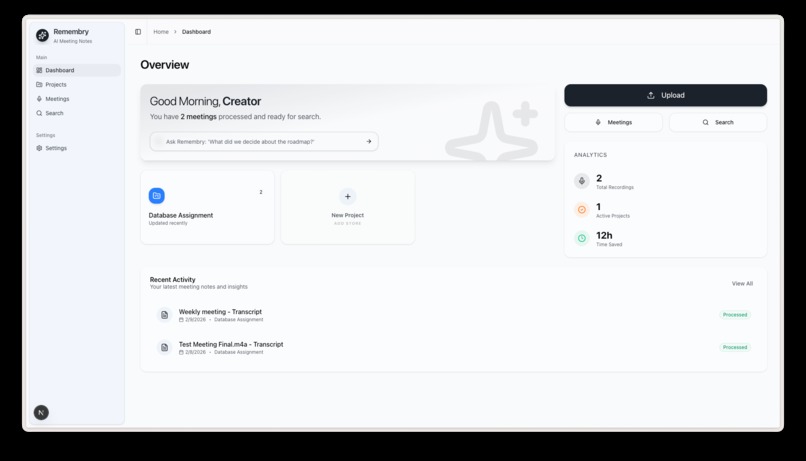
Home page
-
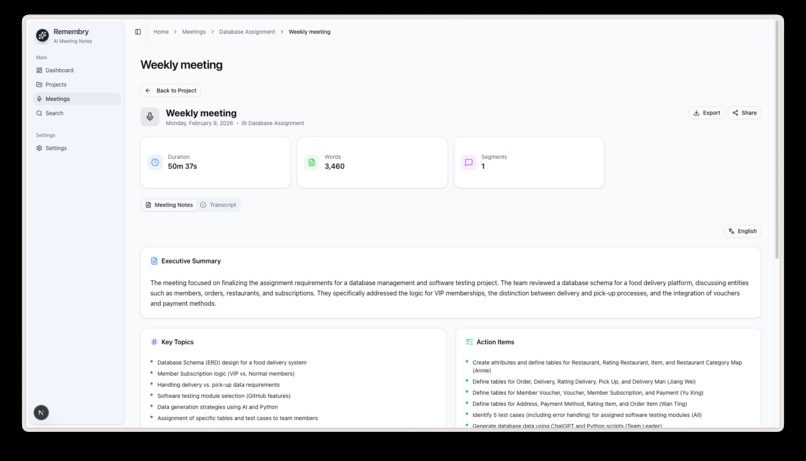
Meeting notes 1
-
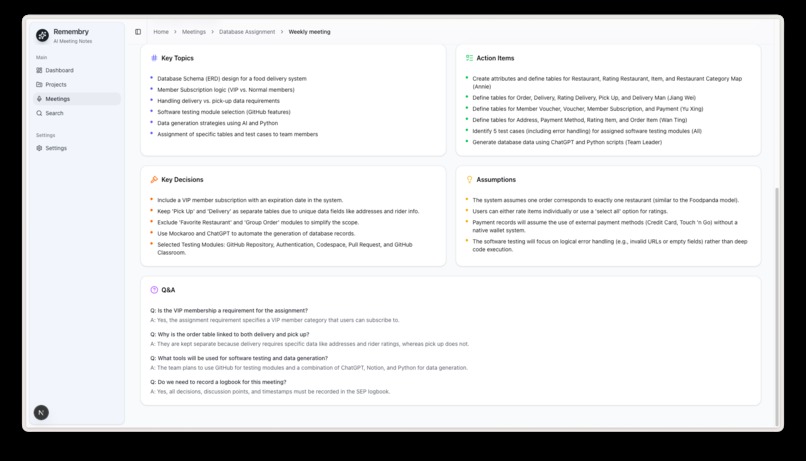
Meeting notes 2
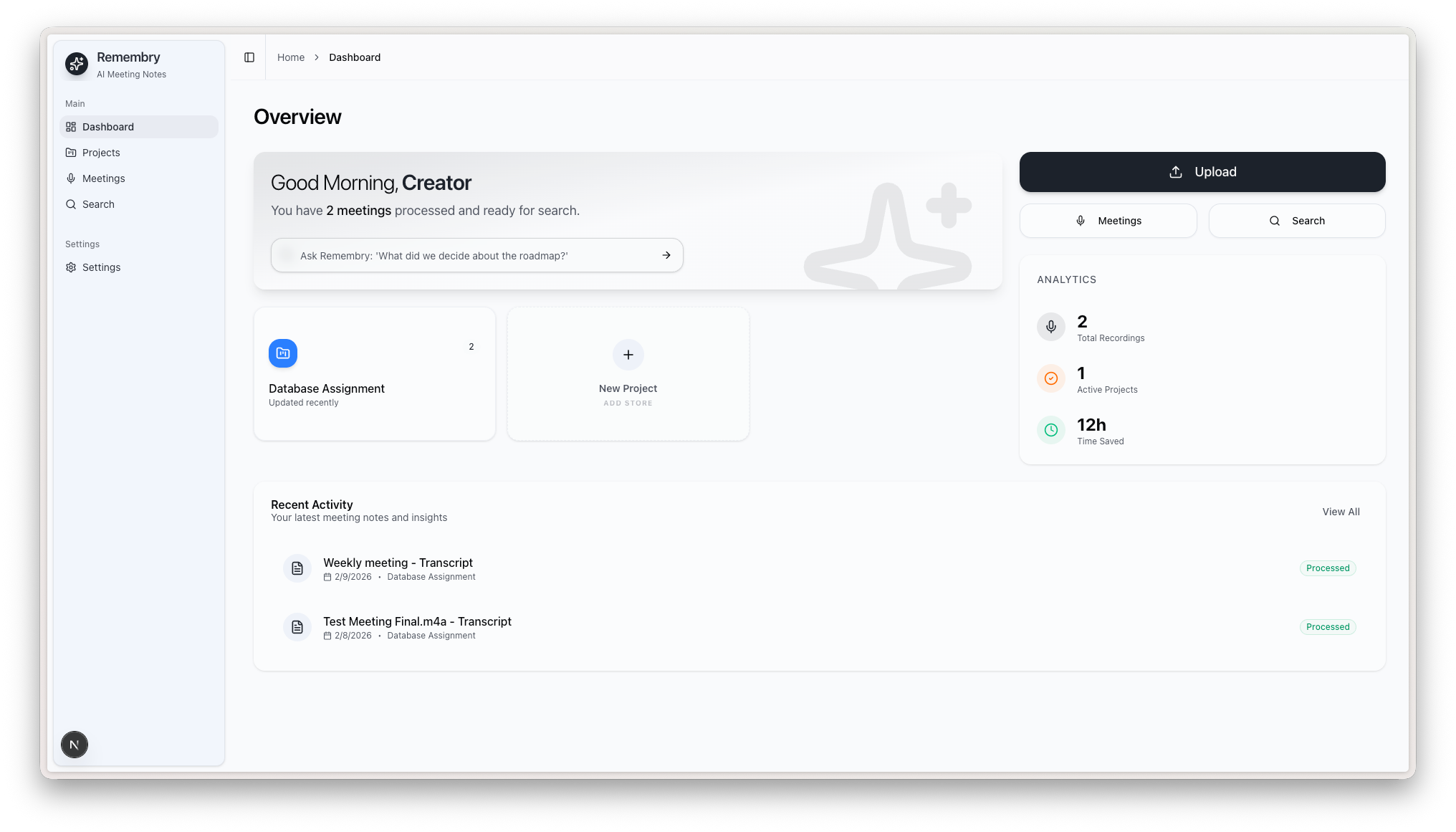
Inspiration
Every productive meeting traditionally requires a designated note-taker—someone tasked with capturing every nuance while sacrificing their own ability to fully participate in the discussion. We were inspired to reclaim that human focus. Remembry was born to step into that role, serving as a tireless AI scribe that not only perfectly documents everything discussed but also transforms those conversations into a searchable, living archive where every past insight is just a query away.
What it does
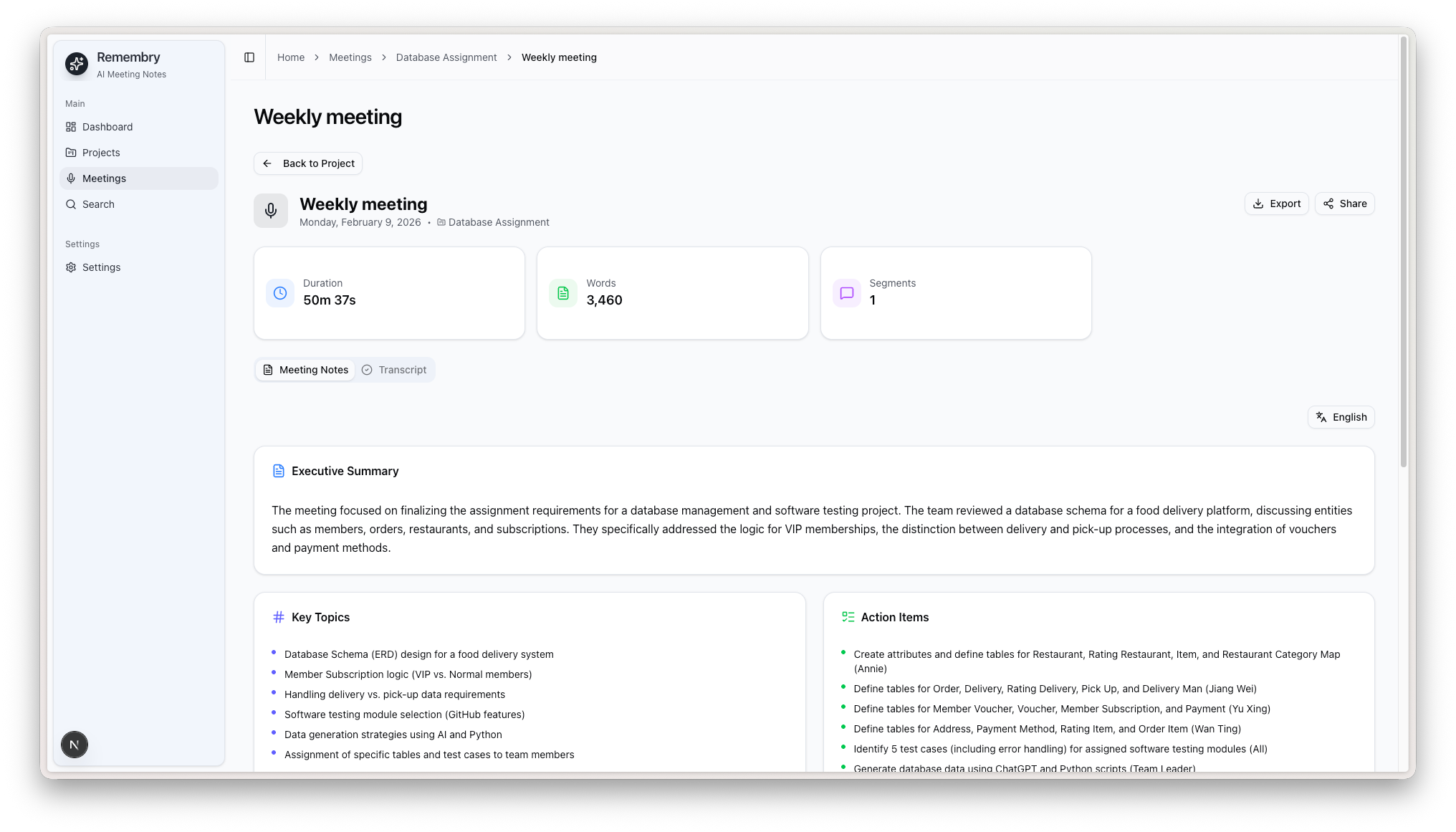
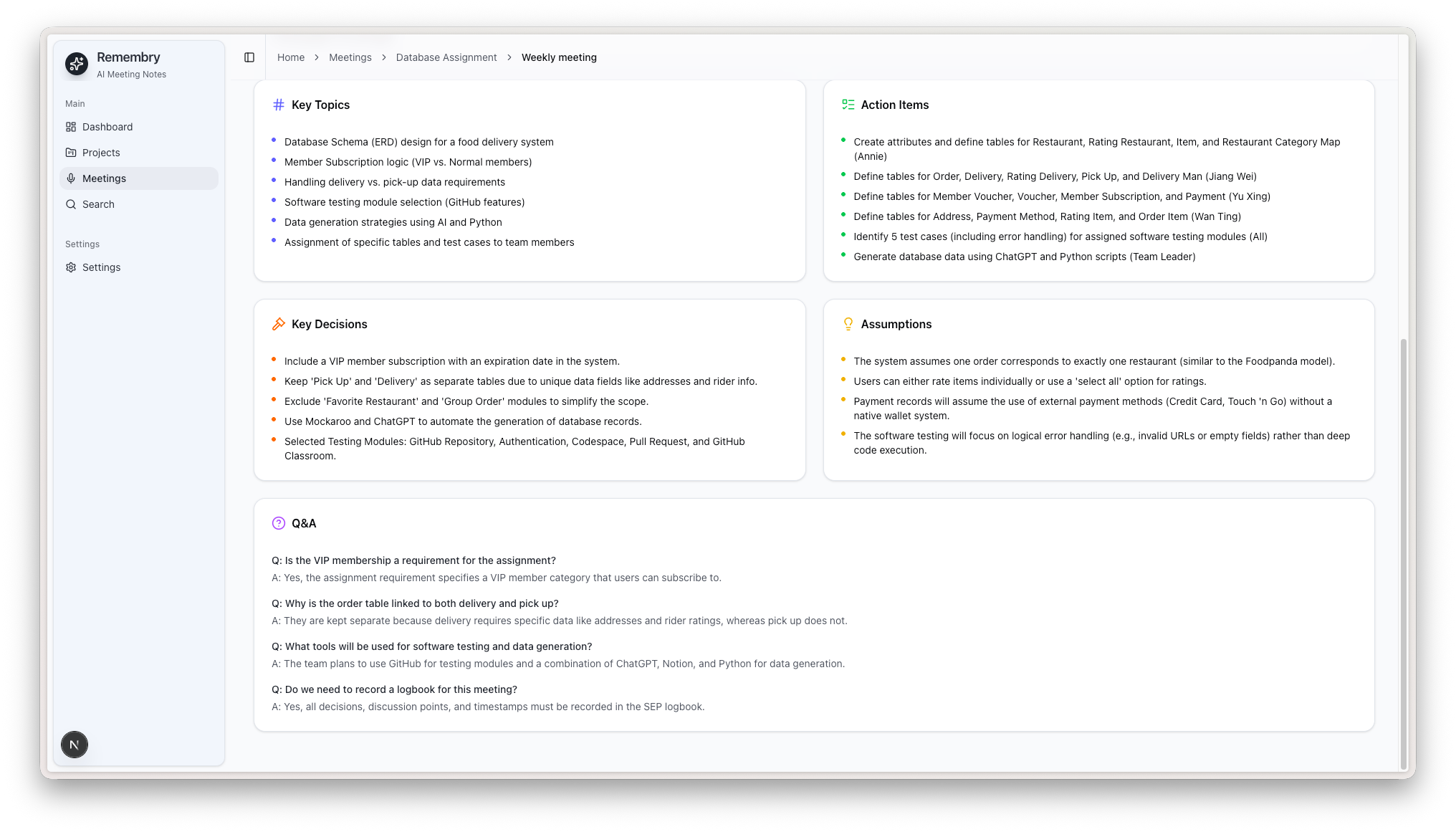
Remembry is an AI-powered meeting intelligence platform that turns audio into action. It ingests recordings or live audio, uses Gemini 3 Flash to perform unified transcription and reasoning, and extracts precisely structured data:
- Automatic Scribing: Replaces the manual note-taker with high-accuracy transcription.
- Decision & Action Item Extraction: Automatically identifies agreements and tasks.
- Multilingual Support: Generates comprehensive notes in 12+ different languages.
- Semantic Search: A RAG-powered "Ask My Meetings" interface that retrieves specific answers from your history with cited timestamps.
How we built it
We built Remembry using a modern, high-performance stack:
- Frontend: Next.js 16 (App Router) with Tailwind CSS for a responsive, dashboard-centric user experience.
- AI Engine: Gemini 3 Flash, chosen for its massive 1M+ token context window and superior reasoning capabilities.
- Search Architecture: A Retrieval-Augmented Generation (RAG) pipeline built on the Google AI File Search API for highly relevant semantic search across documents.
- Data Engineering: We used advanced prompt engineering to enforce structured JSON outputs, ensuring that raw audio is converted into a clean, predictable database schema.
Challenges we ran into
One of the primary challenges was maintaining context consistency in long, complex meetings. Discussions often circle back to earlier points, and traditional AI approaches often lose that thread. By leveraging Gemini’s large context window, we were able to process the entire meeting as a single entity, ensuring that decisions mentioned at the end are correctly linked to the context established at the beginning without the fragmentation issues found in smaller models.
Accomplishments that we're proud of
- Robust RAG Implementation: We are incredibly proud of our semantic search system, which leverages the File Search capabilities of the new Google GenAI SDK to enable users to treat months of meetings as a single, searchable brain.
- Unified Pipeline: Successfully bridging the gap between raw audio recording and actionable markdown notes in one seamless flow.
- Professional Multi-Language Output: Achieving the ability to generate meeting notes in multiple languages while perfectly preserving technical domain-specific terminology.
What we learned
Building Remembry was a massive learning experience in the world of modern AI:
- Architecting RAG with File Search: We learned how to efficiently manage vector stores using the Google AI File Search API, specifically handling file upload states and querying against custom schemas.
- JSON Structured Output: We mastered the technique of using LLMs to generate valid, structured JSON. This was critical for turning conversational "noise" into a structured "signal" that a database can actually use.
- Multimodal Workflows: We deepened our understanding of handling audio data and the complexities of real-time browser-based recording.
What's next for Remembry
Our vision for Remembry is global. We plan to evolve this from a tool into a comprehensive application accessible to the whole world, so every meeting—regardless of language or location—can be captured perfectly.
Furthermore, we are excited to introduce Customizable Intelligence Schemas. We want users to move beyond fixed templates like "Action Items" or "Key Points." Our next step is to allow users to define their own output formats—whether that's a SWOT analysis, a technical risk assessment, or a custom project status report. Remembry will dynamically adapt its extraction logic to provide the specific insights you need in exactly the structure you define.
Built With
- filesearch
- gemini
- lucide-react
- mermaid
- next.js
- node.js
- react
- shadcn/ui
- tailwind
- typescript
- web


Log in or sign up for Devpost to join the conversation.