-
-
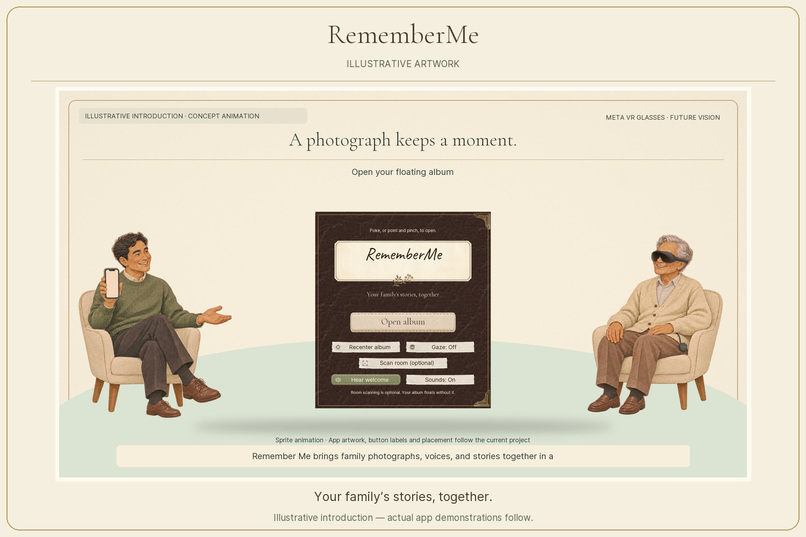
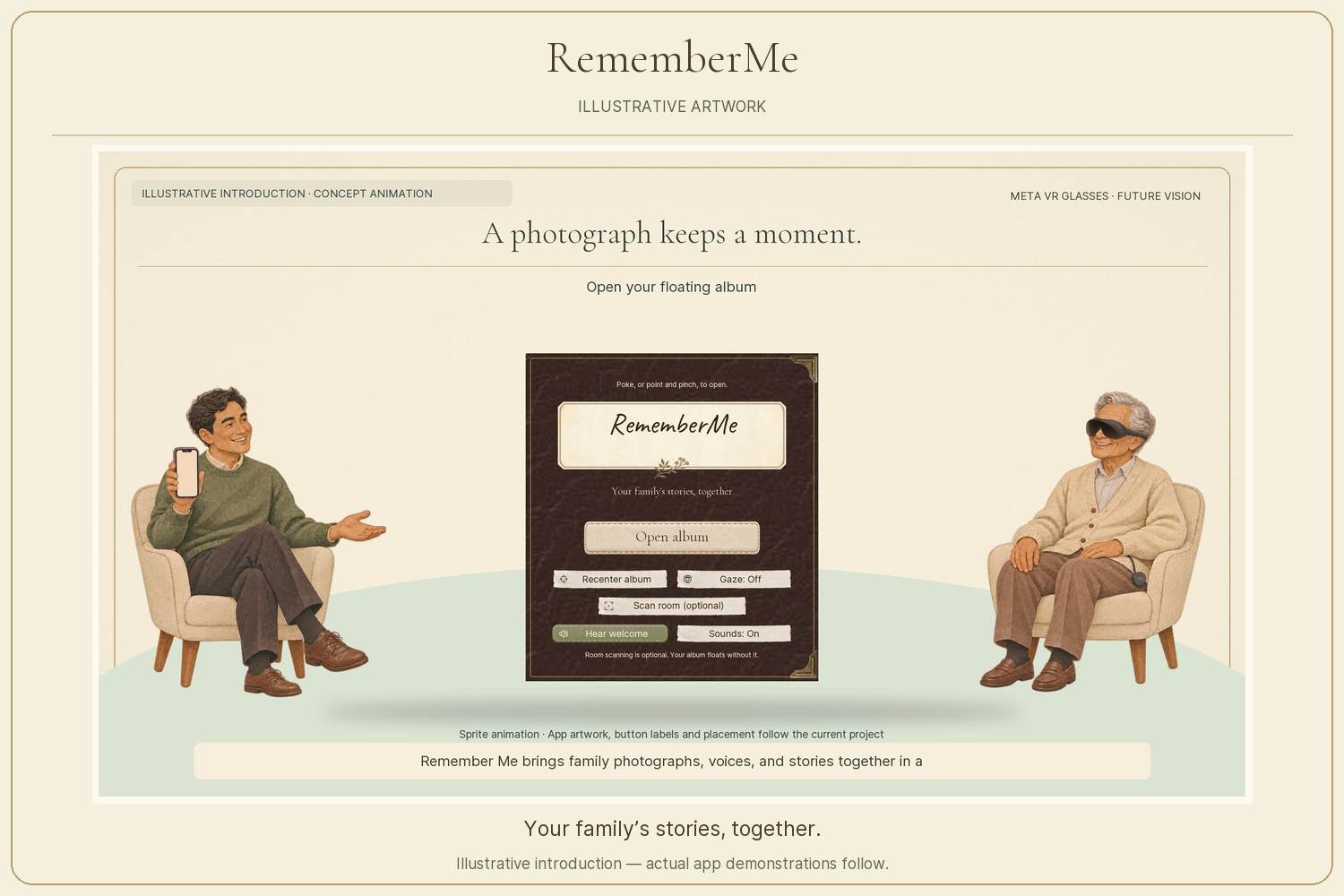
RememberMe Your family’s stories, together. Illustrative introduction — actual app demonstrations follow.
-
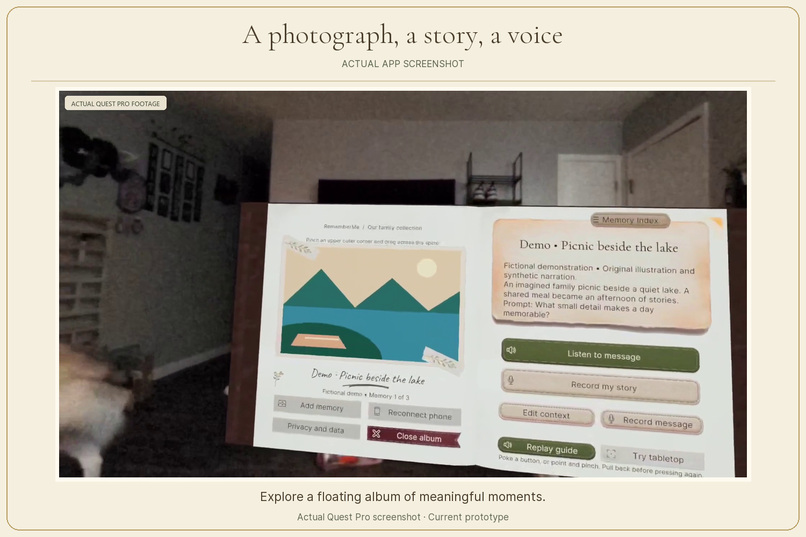
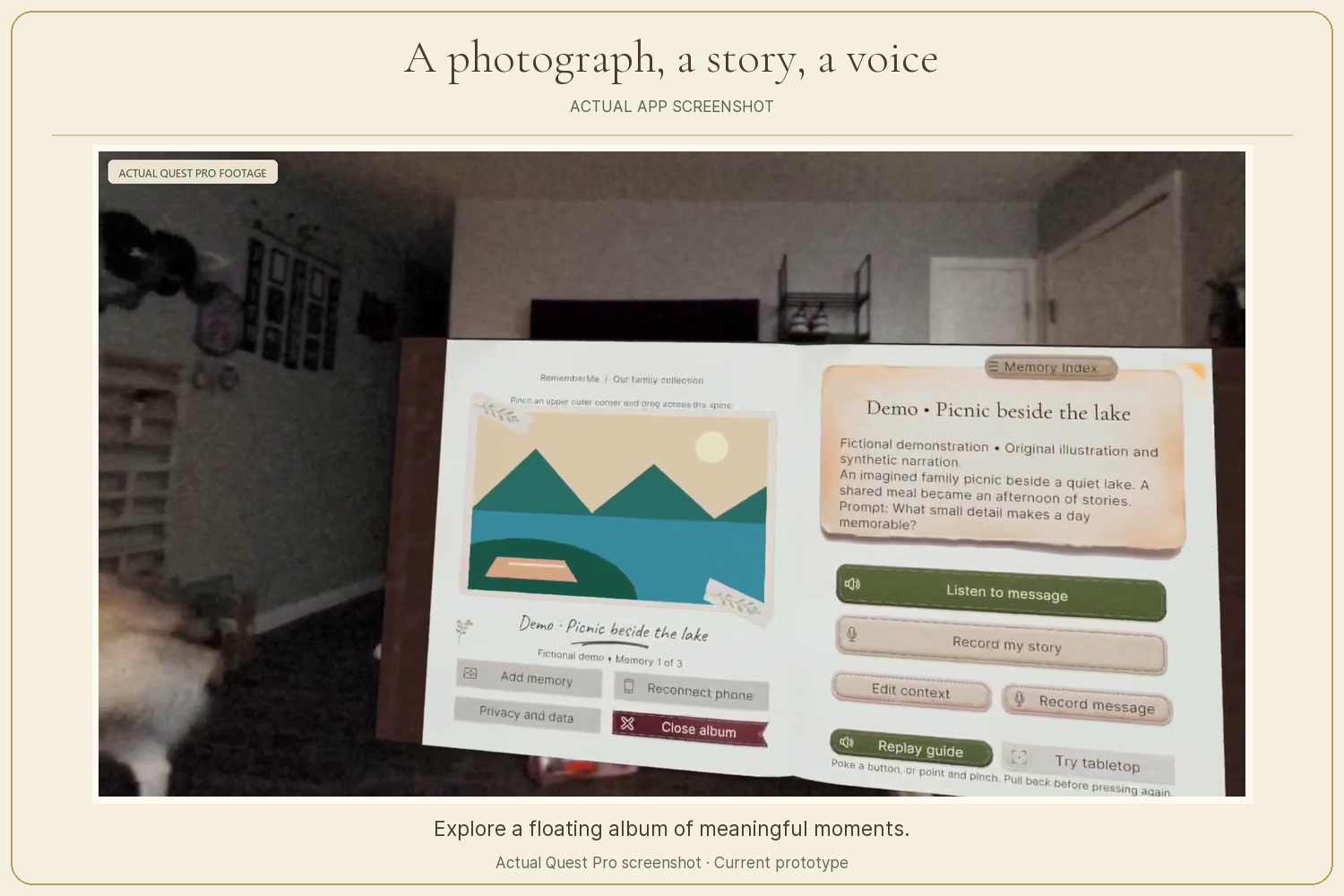
A photograph, a story, a voice Explore a floating album of meaningful moments. Actual Quest Pro screenshot
-
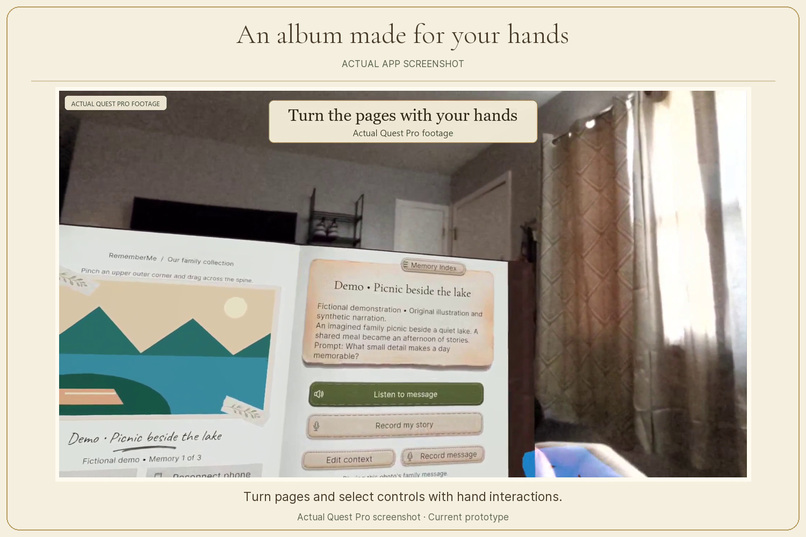
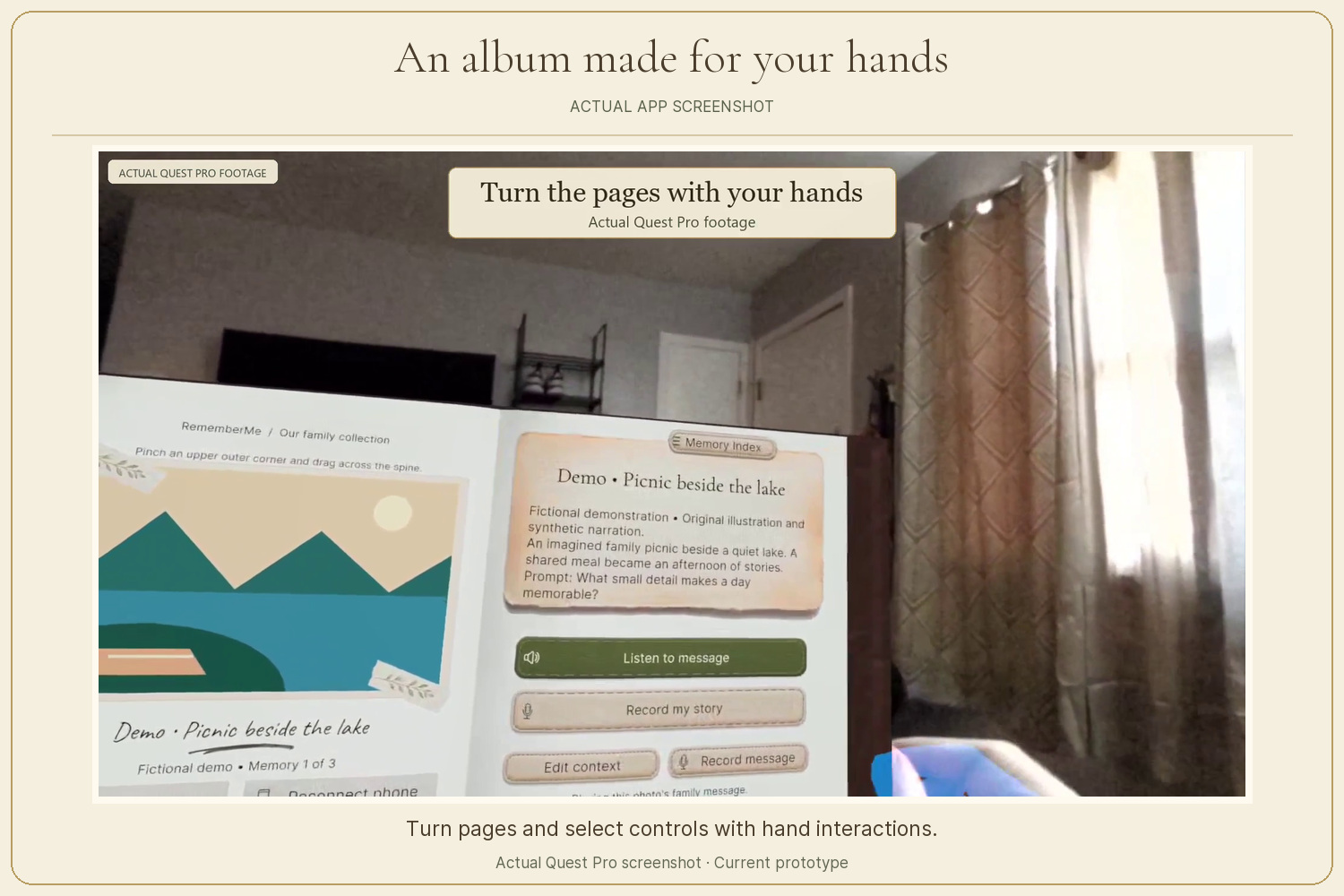
An album made for your hands Turn pages and select controls with hand interactions. Actual Quest Pro screenshot
-
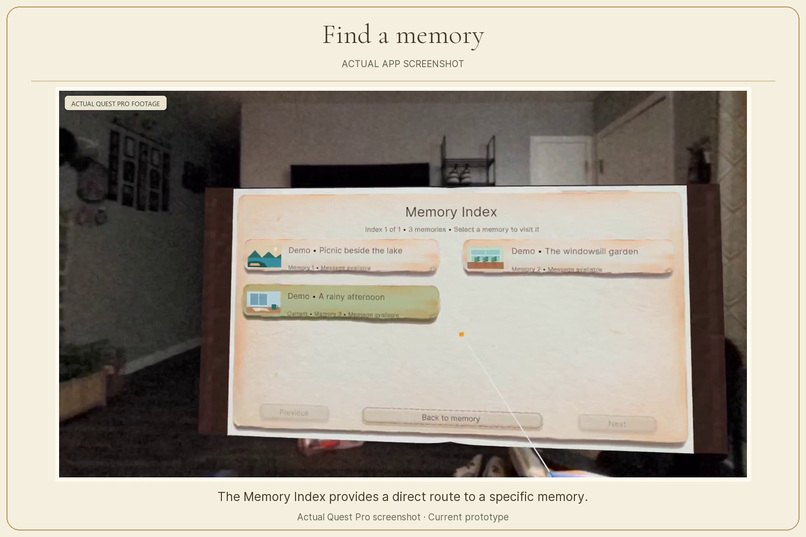
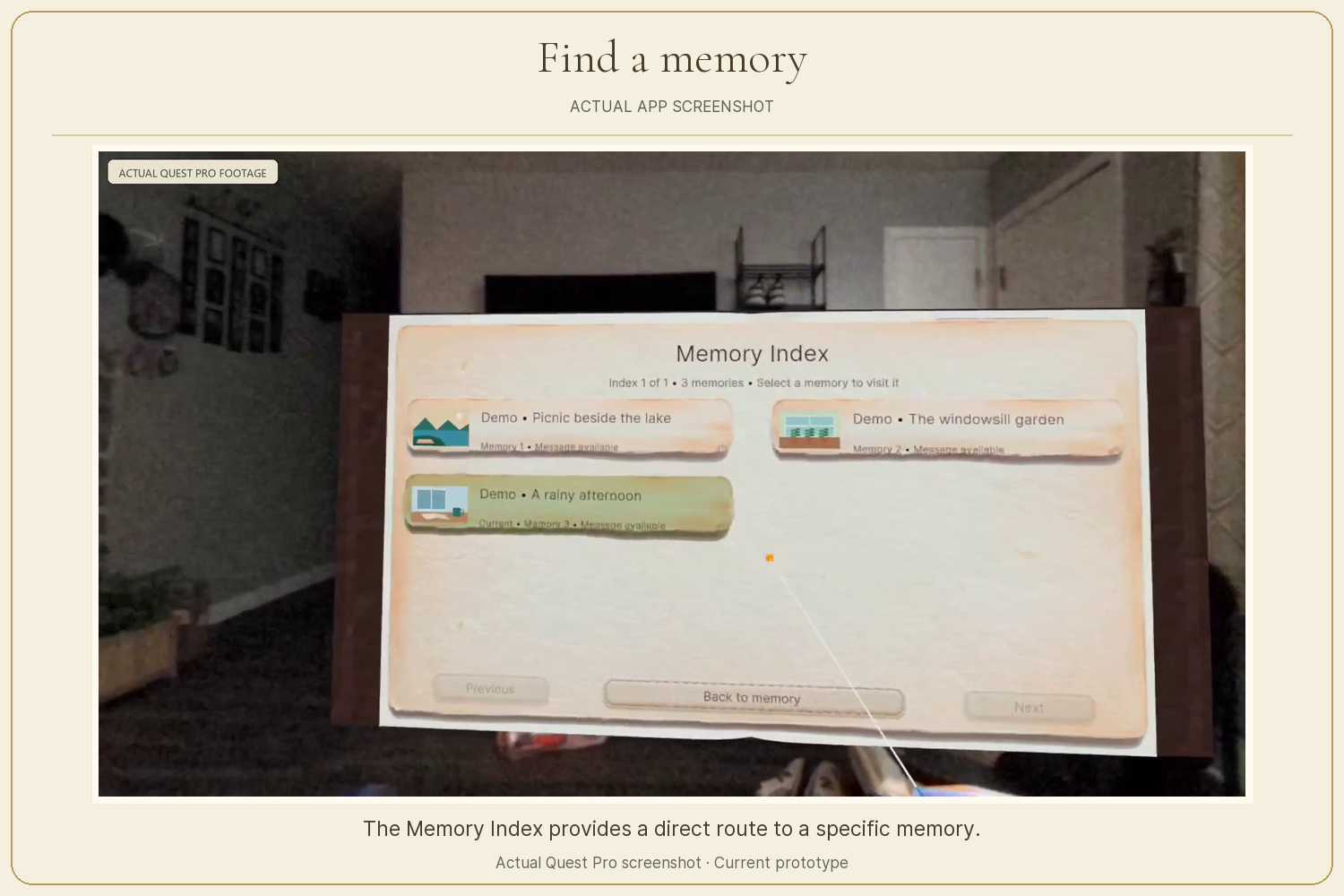
Find a memory The Memory Index provides a direct route to a specific memory. Actual Quest Pro screenshot
-
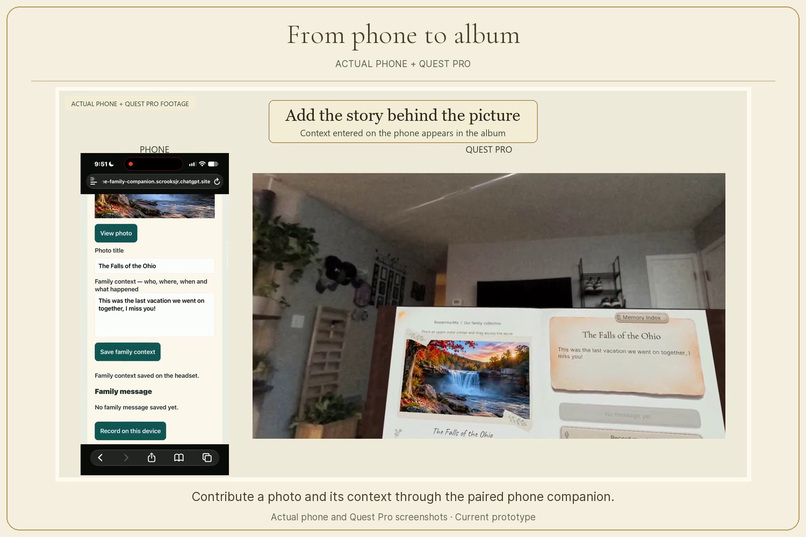
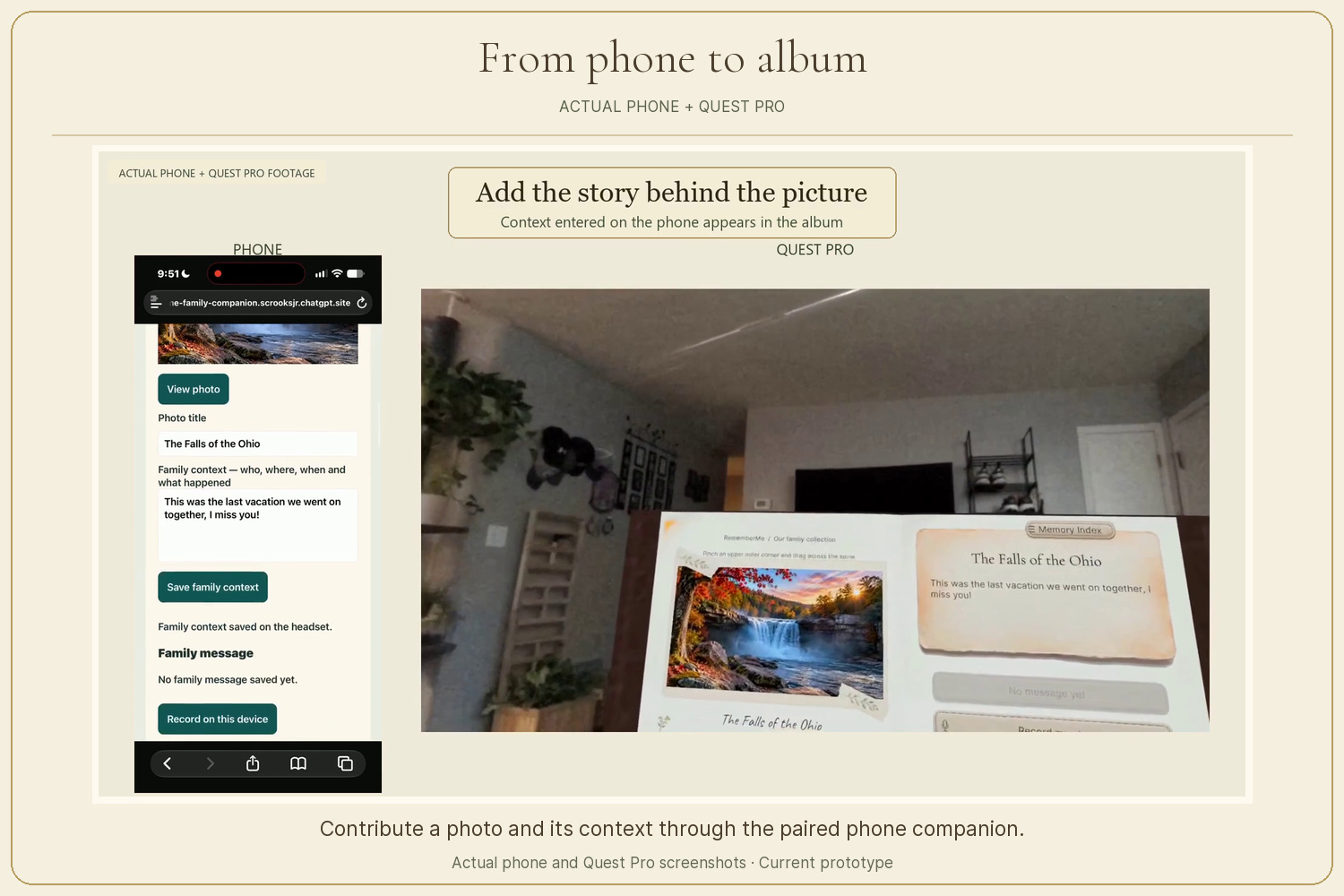
From phone to album Contribute a photo and its context through the paired phone companion. Actual phone and Quest Pro screenshots
-
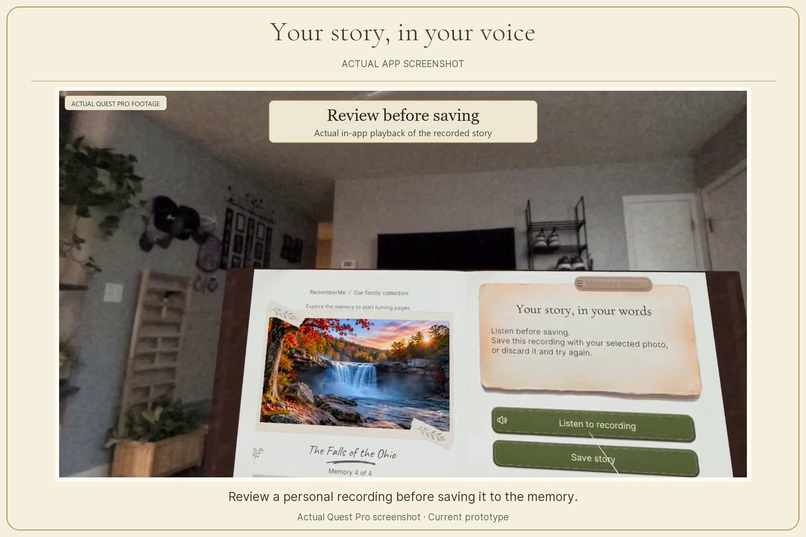
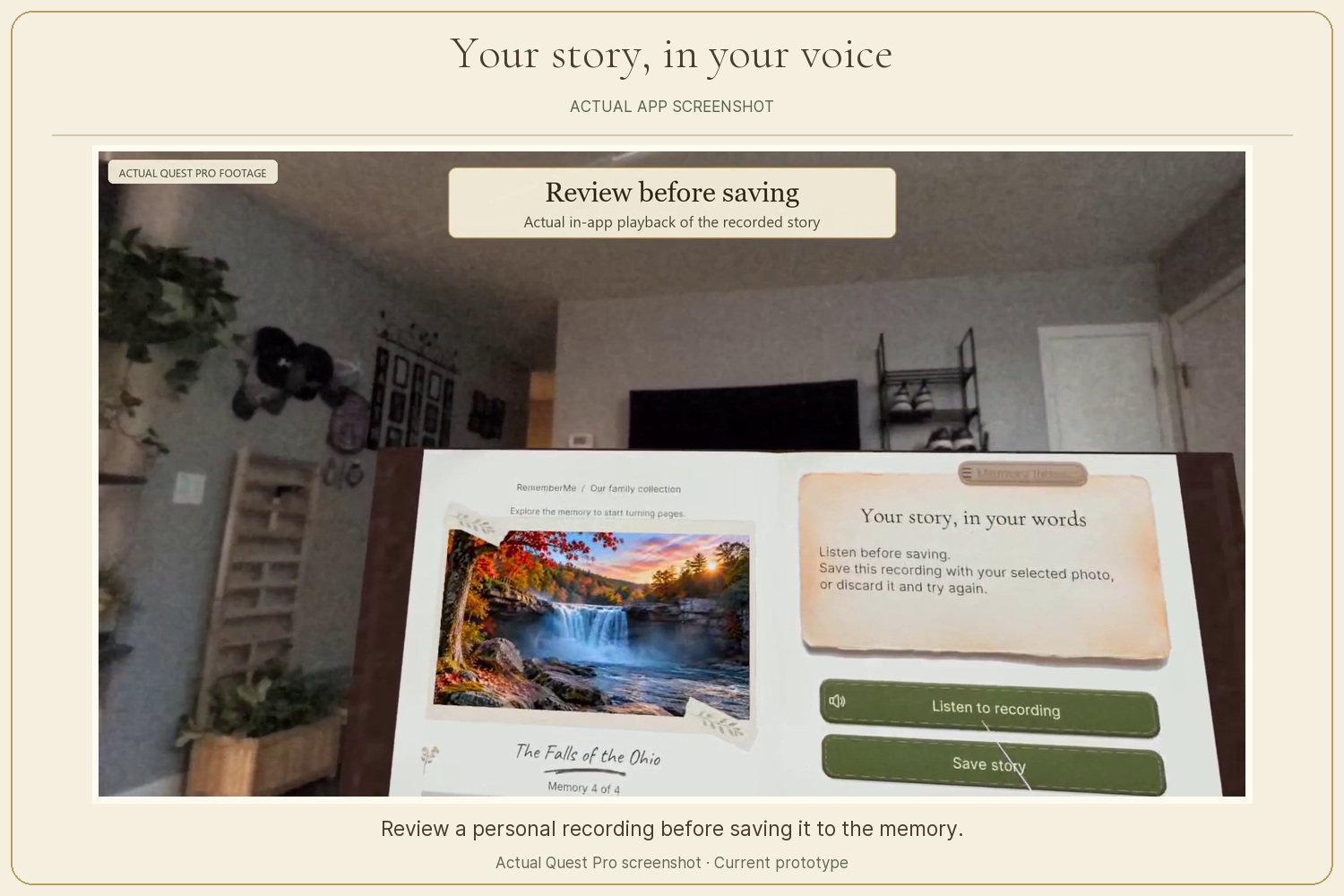
Your story, in your voice Review a personal recording before saving it to the memory. Actual Quest Pro screenshot
-
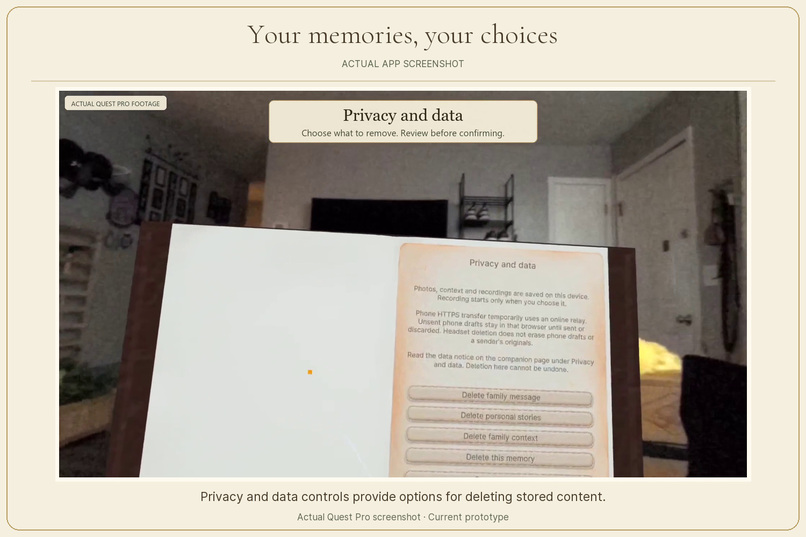
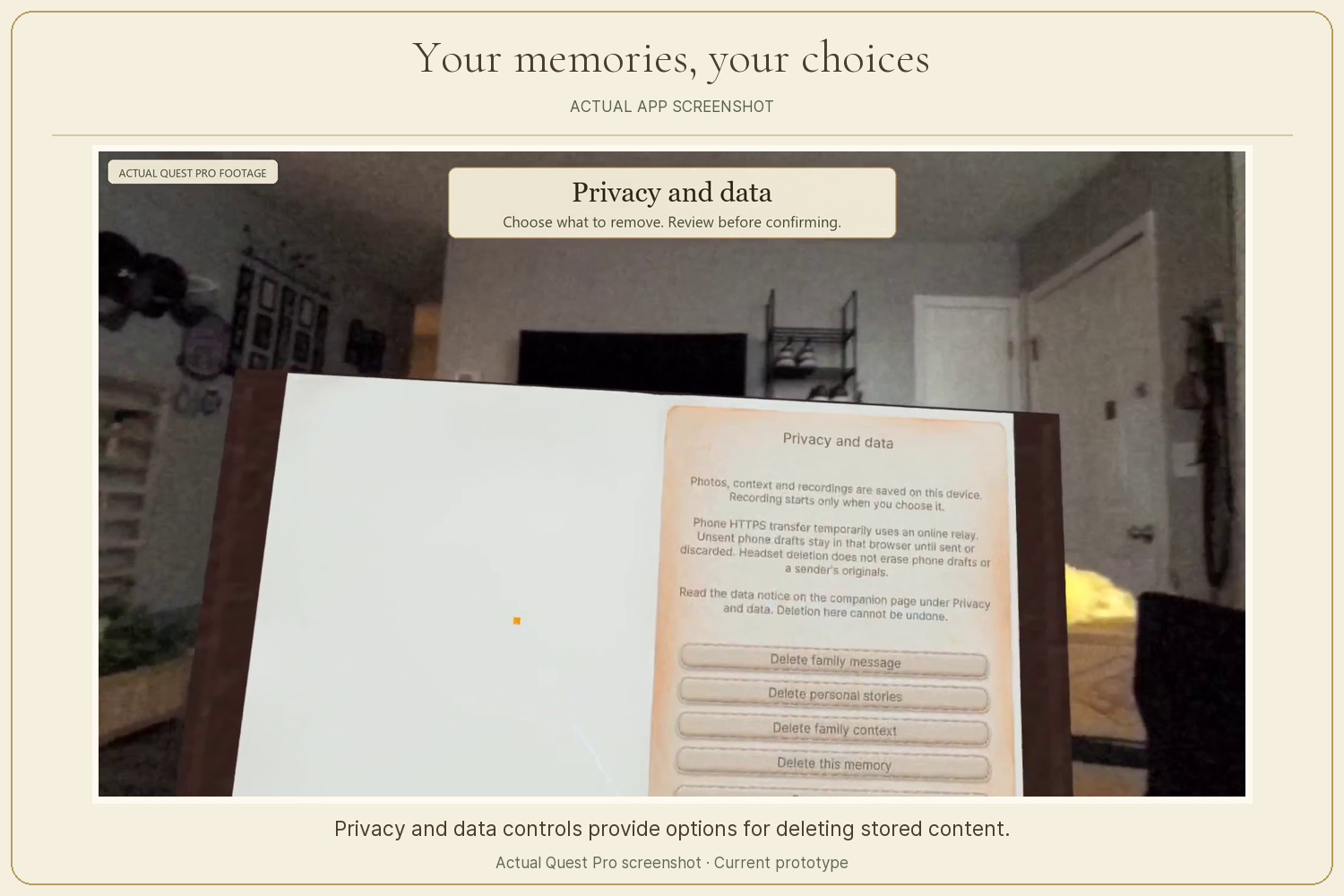
Your memories, your choices Privacy and data controls provide options for deleting stored content. Actual Quest Pro screenshot
-
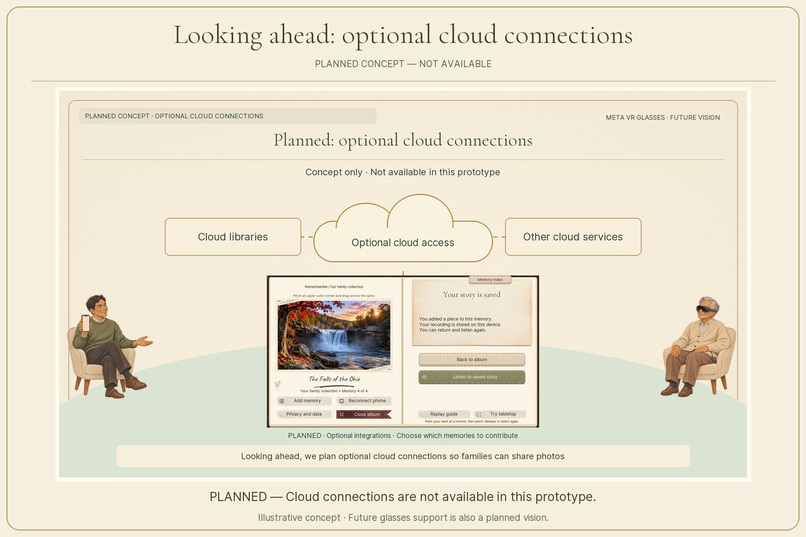
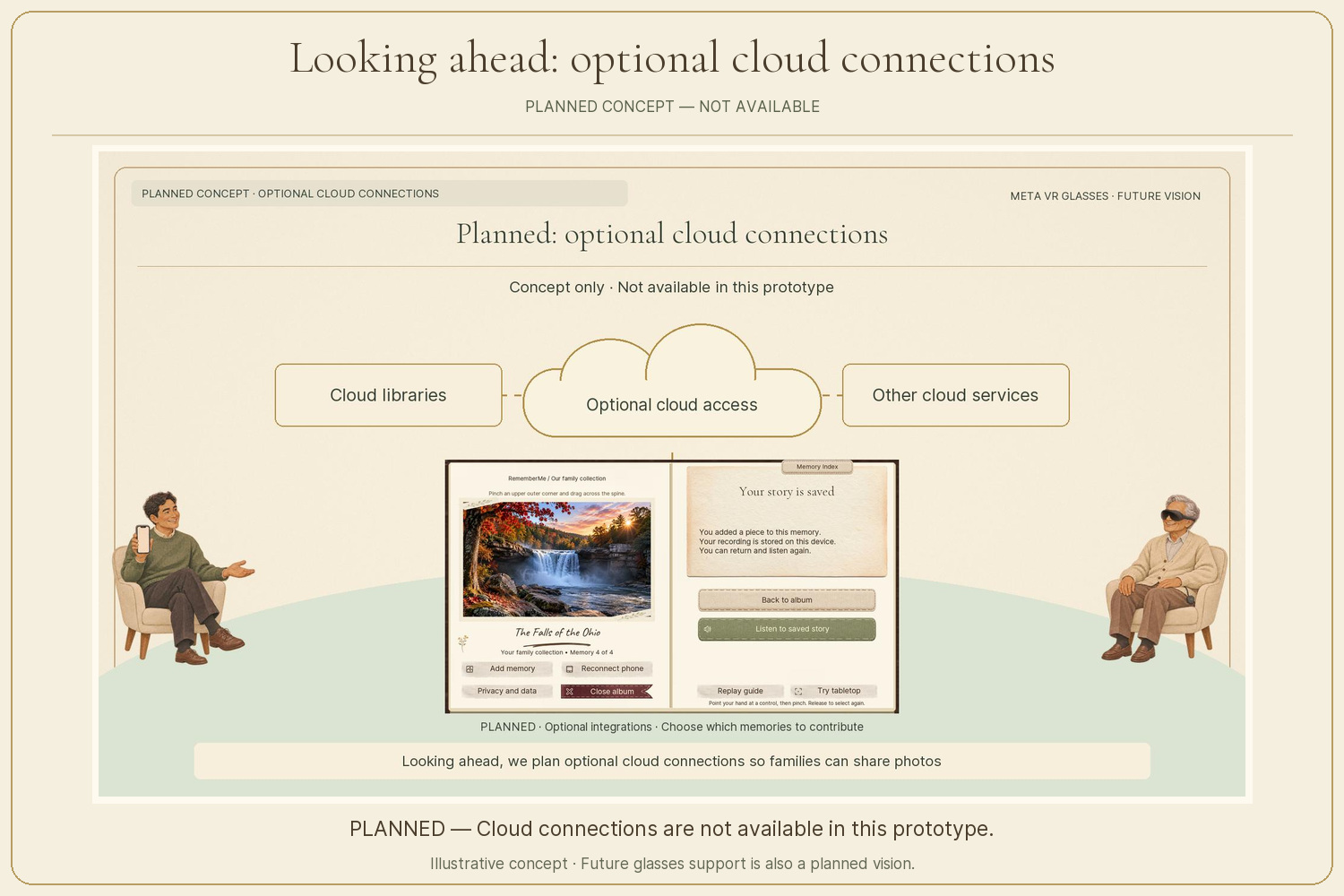
Looking ahead: Cloud connections are not available in this prototype. Illustrative concept · Future glasses support is also a planned vision
Inspiration
Family photos capture a moment, but the stories behind them can fade. Who was there? Why did that day matter? What would a loved one say about it now?
RememberMe grew from the desire to keep those connections alive. We wanted to bring photos, family context, and familiar voices together in an experience that feels like spending time with a family album. Using hand interactions in mixed reality, we set out to make exploring and contributing memories feel personal and approachable.
What it does
RememberMe is a mixed reality family album designed for Meta Quest. A floating album lets users explore memories using their hands, with support for pointing and pinching, poking buttons, and turning pages.
Each imported photo becomes its own memory spread with family context and an optional recorded family message. Users can listen to that message and record their own story in response.
An HTTPS phone companion page lets family members pair with the headset, upload photos, enter context, and record messages directly from their phone. Unsent context and completed recordings can be restored after refreshing or reopening the page, helping users continue when a connection is interrupted.
The experience also includes guided first-use instructions, three fictional demo memories, and controls for deleting individual memories, family context, family messages, and personal stories.
How we built it
We built RememberMe in Unity using Meta XR tools, developing and testing with the XR Simulator and a Quest Pro.
The album connects each photo to its own context, family message, and personal stories. We implemented hand interactions for both nearby controls and controls selected at a distance, alongside hand-driven page turning.
For the phone companion, we built an HTTPS web application with temporary pairing codes and a transfer service. Browser microphone access enables family members to record messages without installing another app. Local browser storage preserves unsent drafts, while the headset stores transferred memories and recordings.
We used GitHub and Git LFS to share the Unity project, companion source, and setup documentation across the team.
Challenges we ran into
One challenge was making hand interaction consistent. Early testing showed that users needed both pointing and pinching and direct poking. Supporting these alongside page turning required careful iteration on how controls respond.
Another challenge was moving from a small demonstration album to a growing collection. Each photo needed a distinct spread, and its context and recordings had to stay associated with the correct memory.
Phone-to-headset transfer introduced additional challenges. Expired pairing sessions could interrupt a contribution, so we added clearer connection states, a reconnect option on the current memory, and draft restoration.
We also encountered Android build and upload configuration issues, reinforcing the importance of checking platform requirements throughout development.
Accomplishments that we're proud of
We brought together a working flow from importing a photo to exploring its context, hearing a family message, and recording a personal story.
Successful phone, simulator, and Quest Pro playtests helped us improve the experience through direct feedback. Those iterations shaped practical features such as unique memory spreads, floating album placement, multiple hand interaction methods, and reconnecting without creating a new page.
We are also proud of building privacy and deletion controls into the experience and creating fictional demo content so the project can be demonstrated without relying on personal family material.
What we learned
We learned that the small details around an interaction can determine whether the whole experience feels comfortable. Album placement, button reach, selection feedback, and reliable page turning all matter.
We also learned that preserving a contribution is part of caring for the user. Family context and recordings take thought and effort, so recovering unsent work became an important part of the design.
Most of all, we learned the value of testing on the headset early and repeatedly. Simulator testing helped us move quickly, while Quest Pro playtests revealed issues that were harder to recognize on a desktop.
What's next for RememberMe
Our next priorities are further Quest Pro testing, performance measurement, and refinement of the guided introduction and album presentation.
We also plan to validate deletion and recovery behavior across more scenarios, improve feedback during recording and transfer, and make the experience easier for first-time users.
Our longer-term vision is a shared family collection where photos, voices, and personal stories stay connected—giving families a meaningful way to revisit memories and contribute new perspectives over time.