-
-
app_mockup_1
-
app_mockup_2
Inspiration
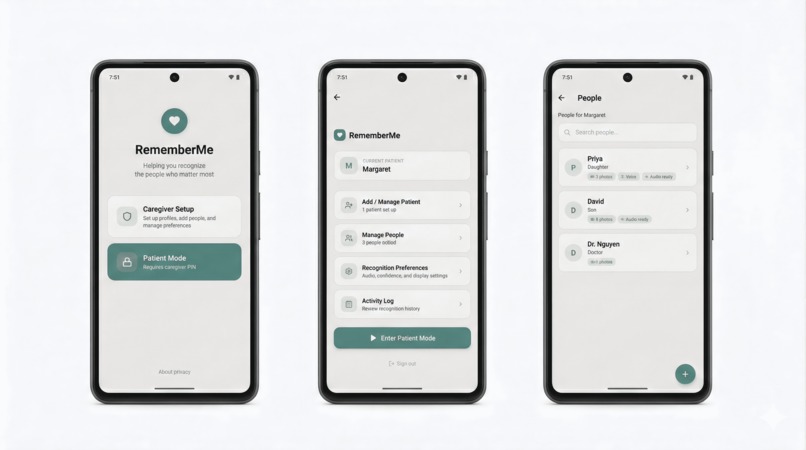
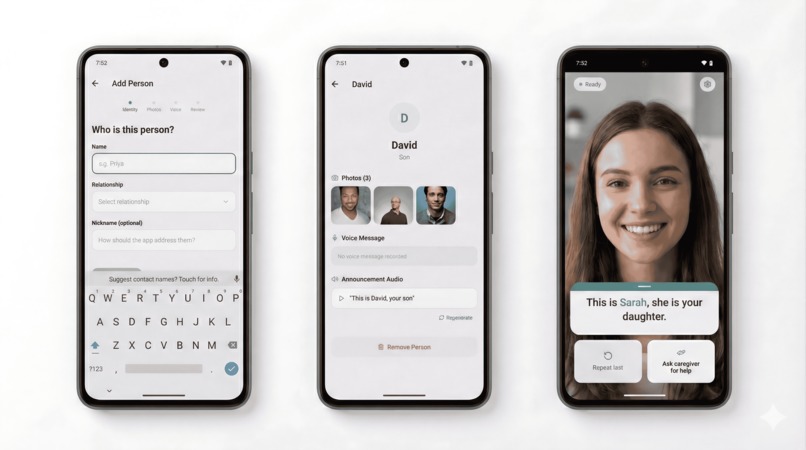
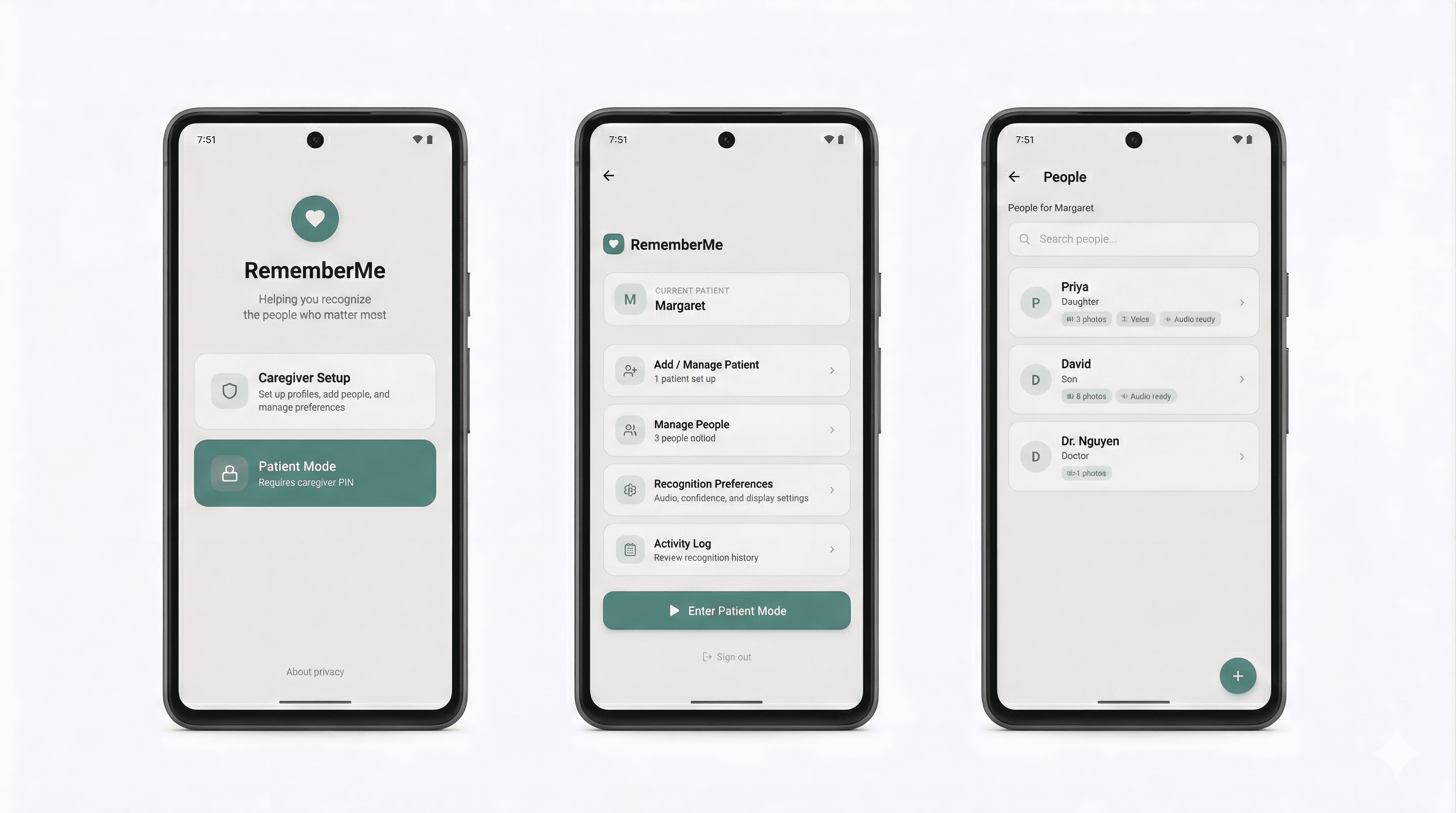
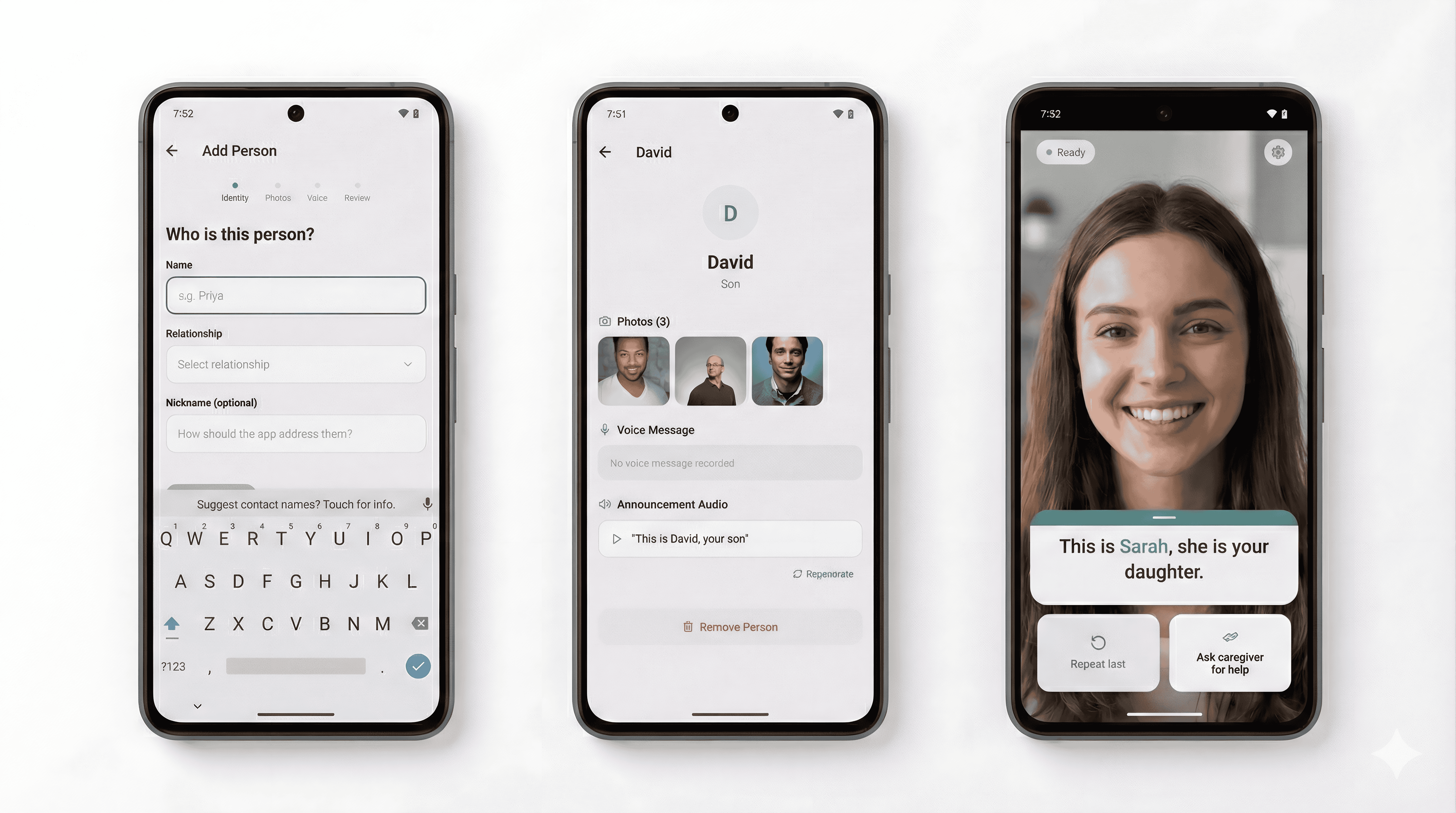
We built Remember Me for people living with Alzheimer’s and other memory-related conditions, and for their caregivers. The core inspiration was emotional: forgetting familiar faces, names, and recent conversations can be stressful and isolating. We wanted to create a gentle assistive tool that helps users feel more confident in daily social interactions.
What it does
Remember Me is a memory-support companion (not a diagnostic tool) that helps with day-to-day recall:
- Recognizes familiar faces and links them to saved profiles.
- Captures and processes conversation audio.
- Generates transcripts with speaker labels (who said what).
- Stores conversation/audio embeddings for semantic retrieval later.
- Helps users and caregivers review recent interactions and context.
How we built it
We built the project with a mobile + backend architecture:
- Mobile app for capture and user-facing memory prompts.
- InsightFace deployed on the backend for face recognition inference.
- Supabase for backend workflows and storage.
- Supabase Postgres + pgvector for storing and querying audio embeddings.
- Text diarization pipeline for speaker-labeled transcripts.
- Tight backend-mobile integration focused on very low latency so support feels near real-time.
Challenges we ran into
- Audio upload issues in Supabase: Larger files and unstable network conditions caused retries/failures we had to handle.
- Latency pressure: We needed fast responses for a smooth assistive experience.
- Diarization quality: Speaker labeling is harder in noisy/overlapping speech.
- Sensitive use case requirements: Since this is for vulnerable users, reliability, clarity, and privacy mattered even more than usual.
Accomplishments that we're proud of
- Delivered an end-to-end prototype tailored to memory support use cases.
- Integrated face recognition + speaker-aware transcripts + vector retrieval in one flow.
- Deployed InsightFace backend inference with mobile integration.
- Built a foundation that can support both patients and caregivers in practical daily scenarios.
What we learned
- Assistive AI must be dependable and simple, not just technically impressive.
- Real-world performance depends heavily on integration and error handling.
- Speaker-aware transcripts are much more useful than plain transcription for memory recall.
- Privacy, consent, and data handling are critical when working with health-adjacent experiences.
What's next for Remember Me
- Improve robustness for audio uploads and weak-network/offline scenarios.
- Further optimize recognition and diarization accuracy in real-life environments.
- Add caregiver-focused features (shared memory summaries, reminders, care notes, remote access).
- Strengthen privacy controls (consent flows, retention controls, encryption).
- Run user testing with caregivers/patients to improve accessibility and usability.
Built With
- asyncstorage
- bun
- elevenlabs
- eslint
- fastapi
- gemini
- insight-face
- native
- openai
- python
- query
- react
- router
- sqlite
- supabase
- typescript

Log in or sign up for Devpost to join the conversation.