-
-
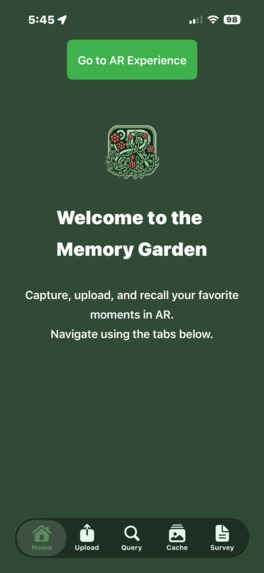
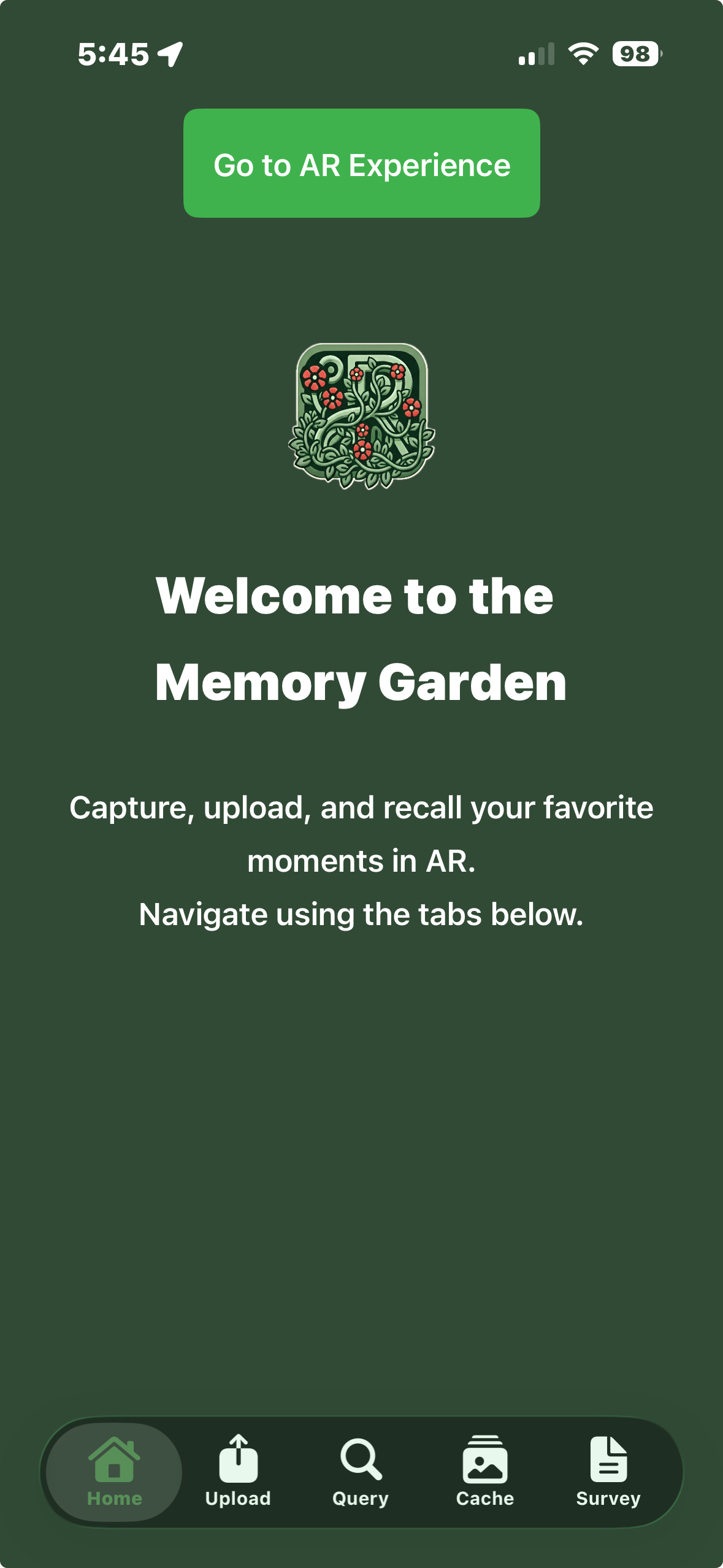
Landing page
Inspiration
Our team was inspired to create this application after learning that one of our members’ grandparents is living with Alzheimer’s. Additionally, several of our friends in the medical field use the concept of a memory garden to study and retain complex information. We developed Rememb-AR to extend this idea, empowering individuals with Alzheimer’s to access and engage with their own personalized memory gardens.
What it does
Our application allows caretakers to share meaningful memories from the lives of individuals with Alzheimer’s disease. These memories are represented as flowers containing personal images that are placed throughout an augmented reality space, allowing patients to explore and interact with them. The system also monitors memory recall patterns, identifying which memories are fading and dynamically prioritizing them to reinforce retention through personalized engagement.
How we built it
Our technology stack consists of Swift for the frontend, enabling the development of an iOS mobile application that leverages Apple’s ARKit for advanced augmented reality experiences. Images are securely stored in Google’s Firebase cloud service, ensuring reliable access and data protection. We also integrate Gemini and user-provided captions to generate contextual insights for each uploaded image, allowing the system to identify which memories a patient may be forgetting and to dynamically prioritize displaying those photos.
Challenges we ran into
Working with Swift presented significant challenges. Many libraries are internal to the Apple ecosystem, limiting cross-compatibility with non-Swift applications. Additionally, Apple imposes strict restrictions on certain functionalities, such as HTTP requests under specific conditions. As a result, our team invested considerable time learning the intricacies of Swift, troubleshooting issues, and refining our implementation through extensive debugging and experimentation.
Accomplishments that we're proud of
The most notable achievement for our team was developing a dynamic image selection system that adapts to each patient’s memory history. We designed this feature to feel natural by adjusting the probability of an image appearing based on the patient’s survey responses. This approach required extensive mathematical modeling and algorithmic design to ensure the selection process accurately reflected the patient’s evolving recall patterns.
What we learned
Through this project, we gained valuable experience with augmented reality technologies. Beforehand, none of our team members had worked with AR, so we learned about concepts such as mesh generation, distance calculation, and spatial mapping, among other key technical foundations.
What's next for Rememb-AR
We plan to expand the application's functionality by exploring wearable devices to create more immersive environments for users. Additionally, we aim to integrate agentic AI that is capable of managing dynamic, asynchronous tasks, thereby enhancing the system's responsiveness and personalization capabilities.


Log in or sign up for Devpost to join the conversation.