-
-
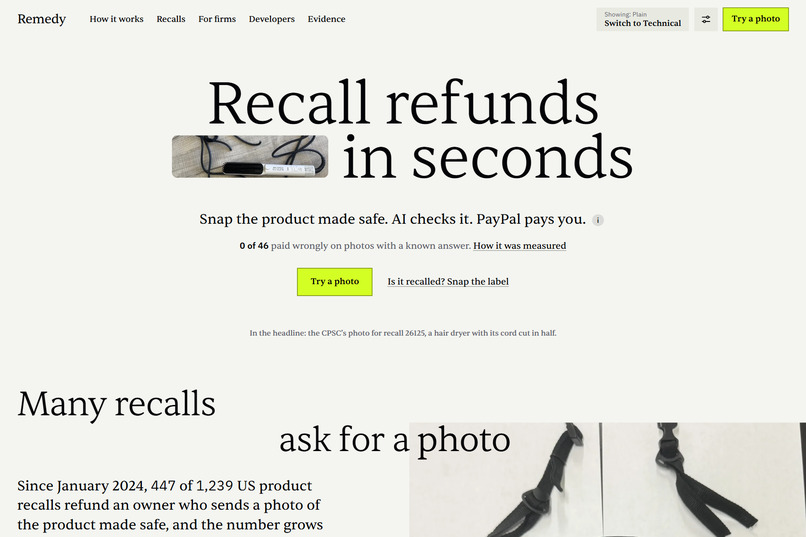
Remedy: recall refunds in seconds. Snap the product made safe, AI checks it, PayPal pays you.
-
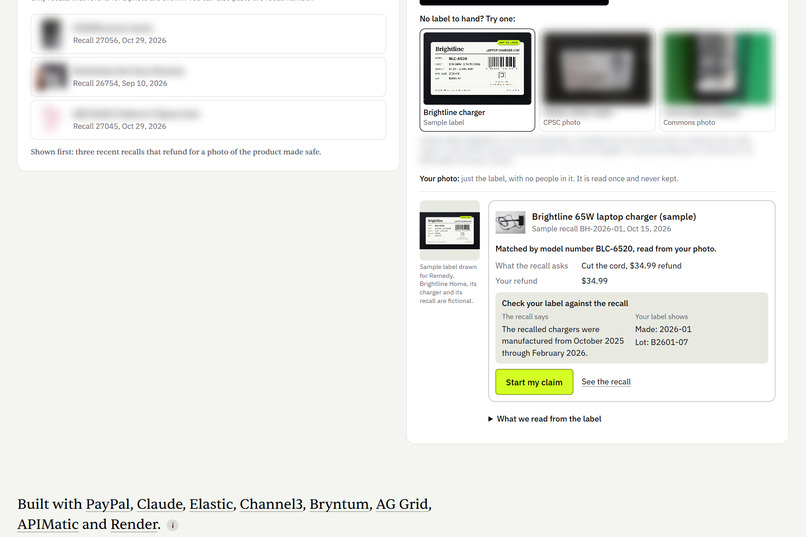
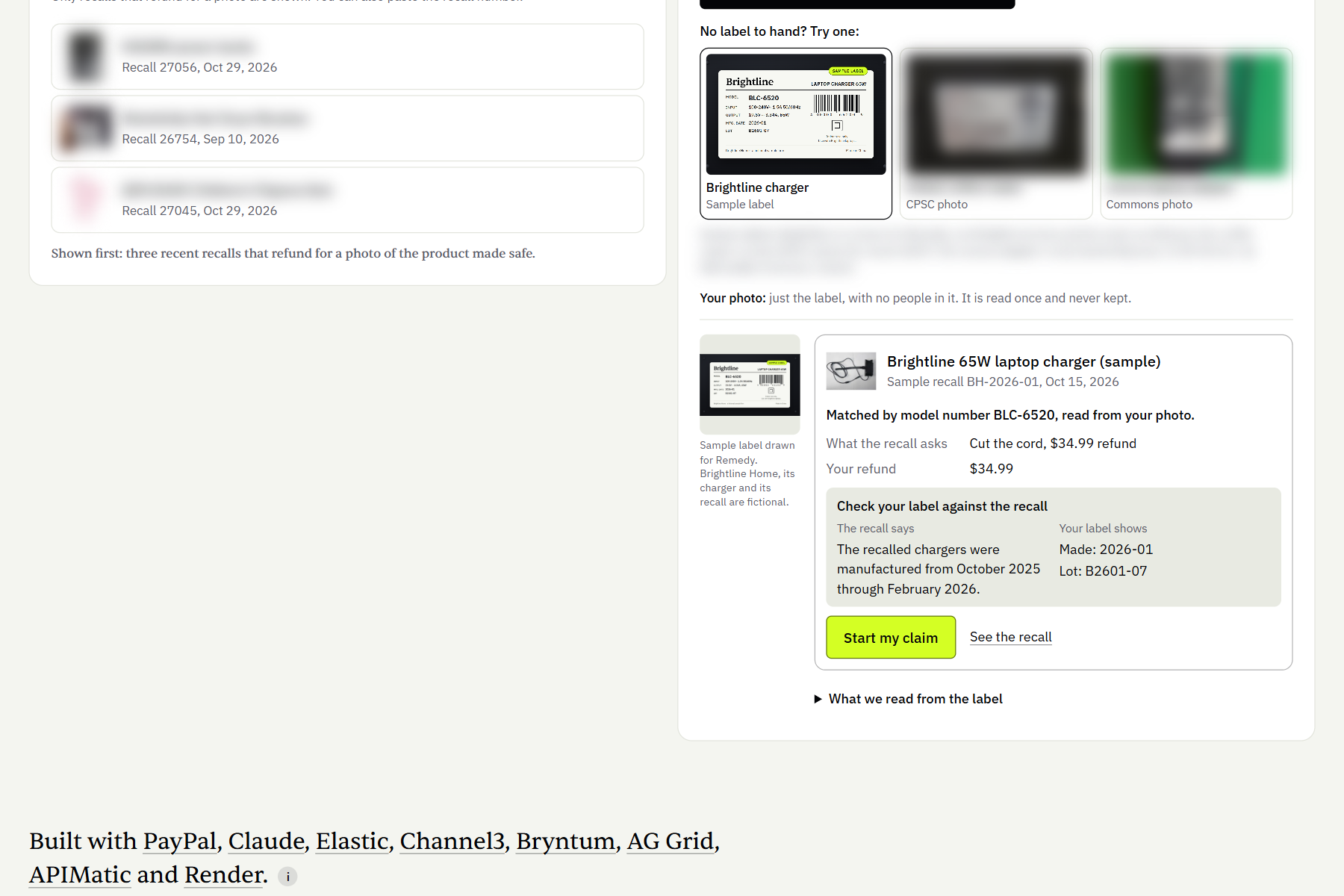
Is it recalled? Snap the label: Claude reads the model number and code finds the recall. (Sample label drawn for Remedy.)
-
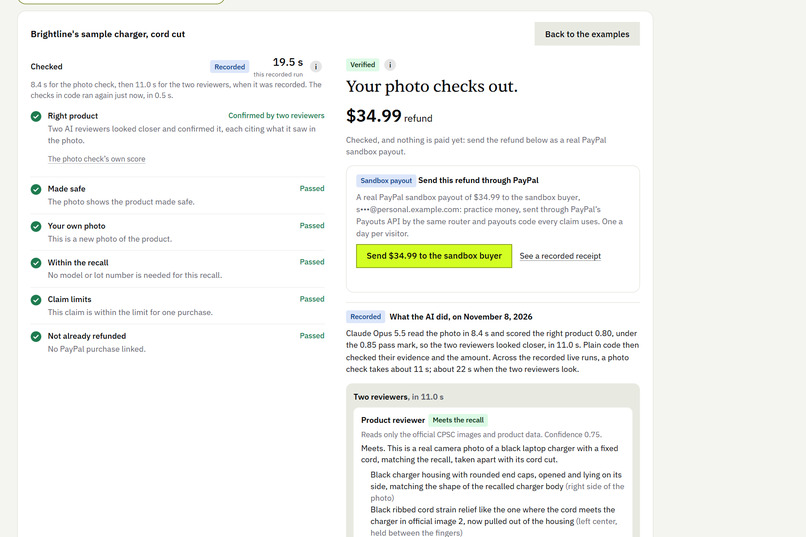
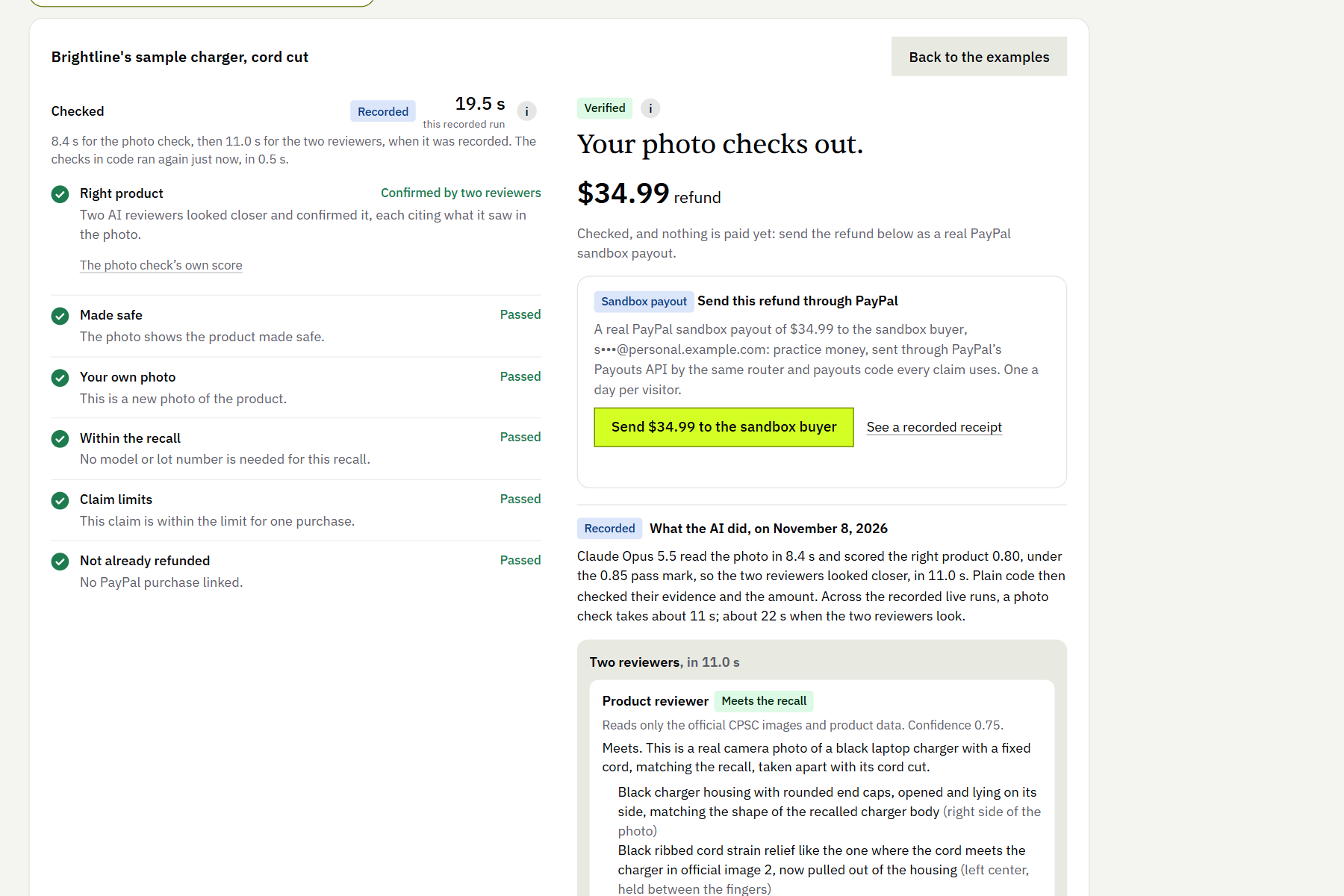
Six checks in plain words, and two Claude reviewers on close calls: Verified, $34.99 refund.
-
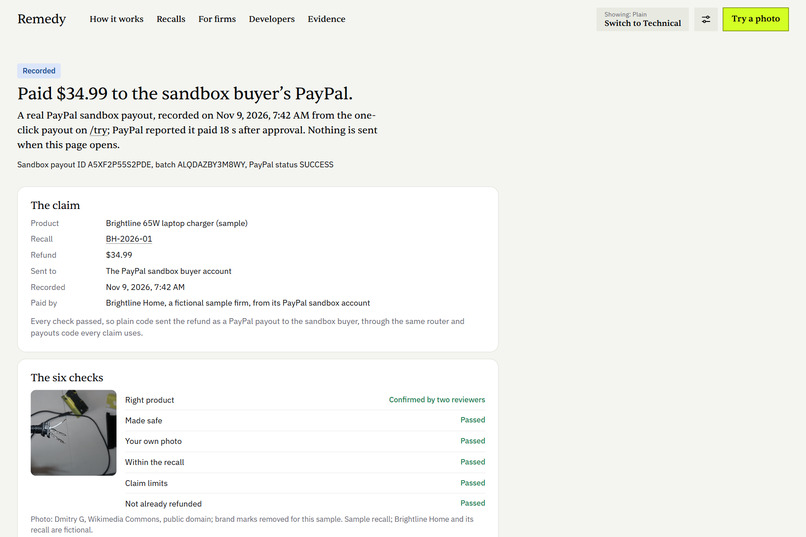
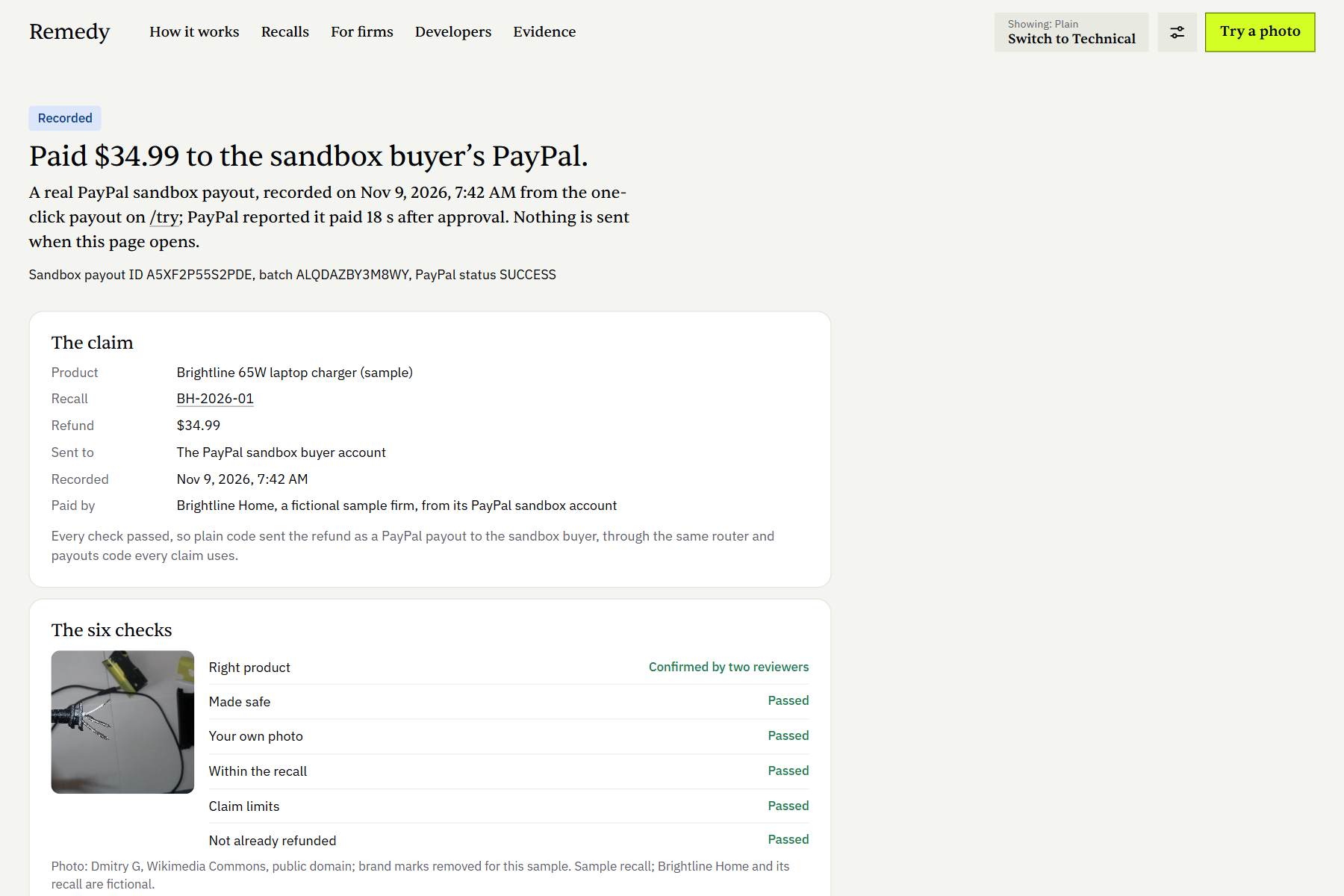
A real PayPal sandbox payout: paid $34.99, with PayPal's payout ID and status SUCCESS.
-
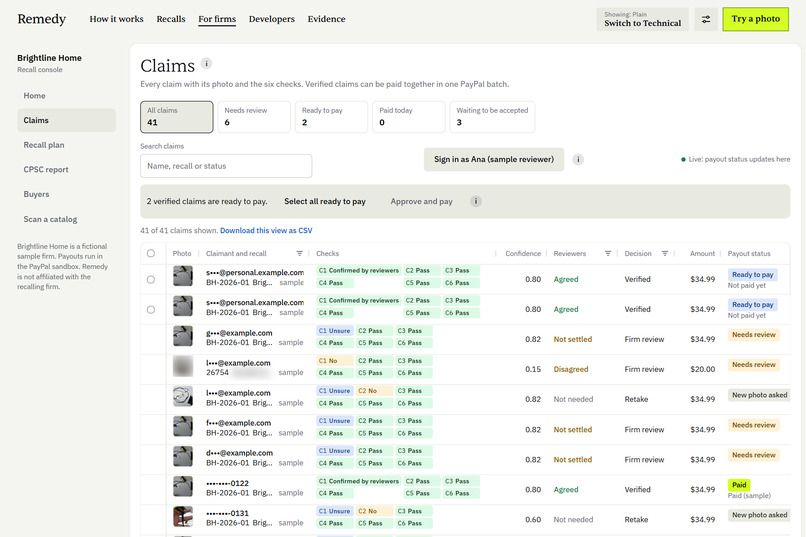
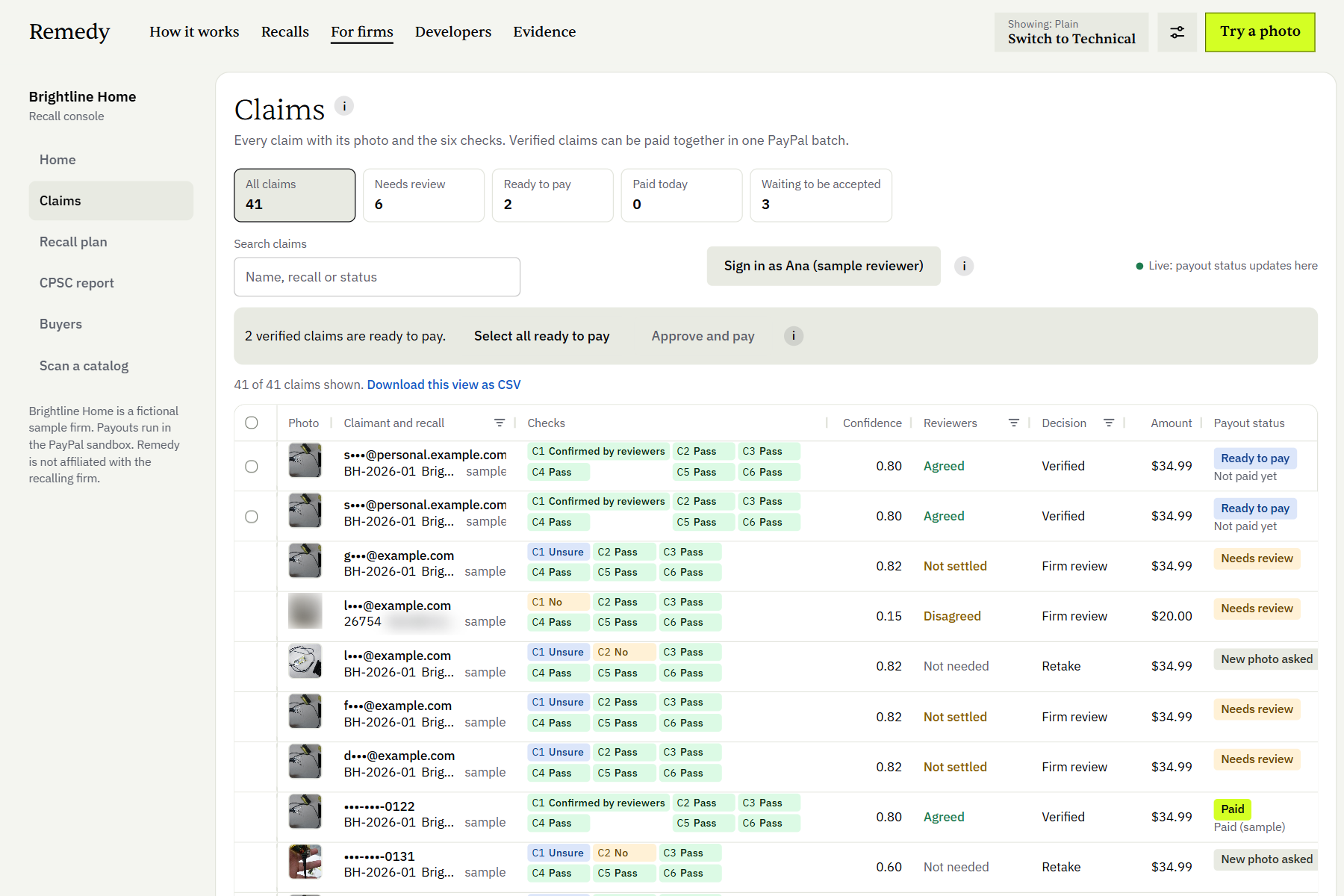
The firm's claims queue (AG Grid): every claim, its photo and checks. Ready claims are paid in one PayPal Payouts batch.
-
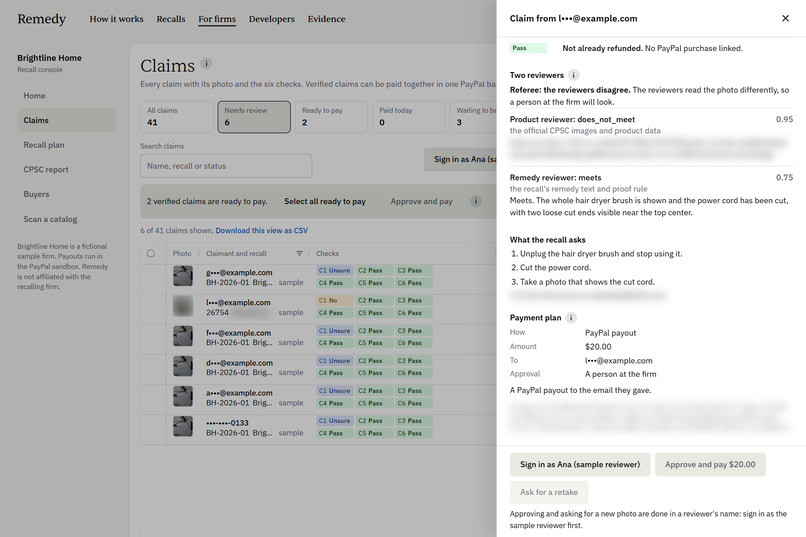
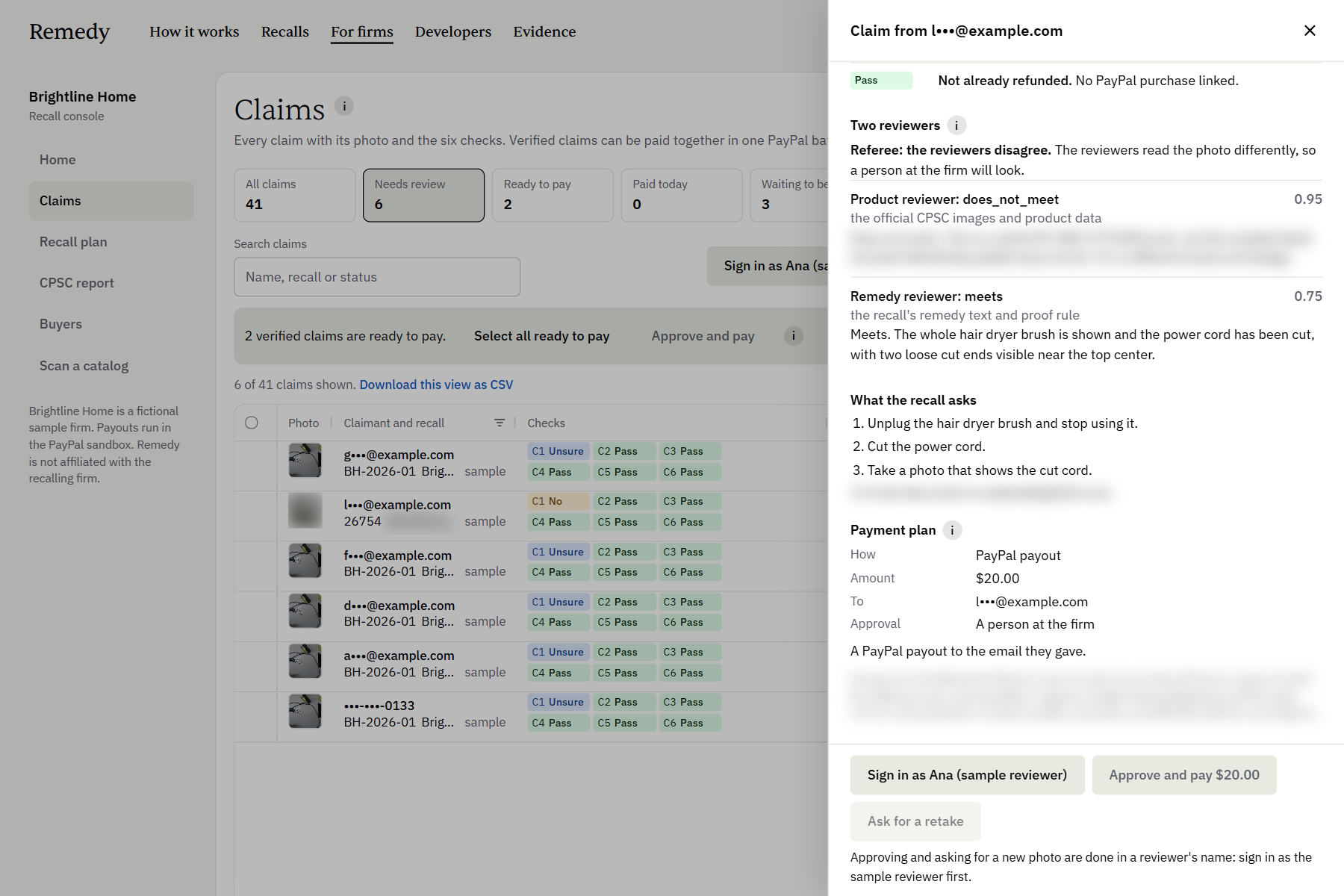
When the two AI reviewers disagree, the claim waits for a person, and nothing is paid until they decide.
-
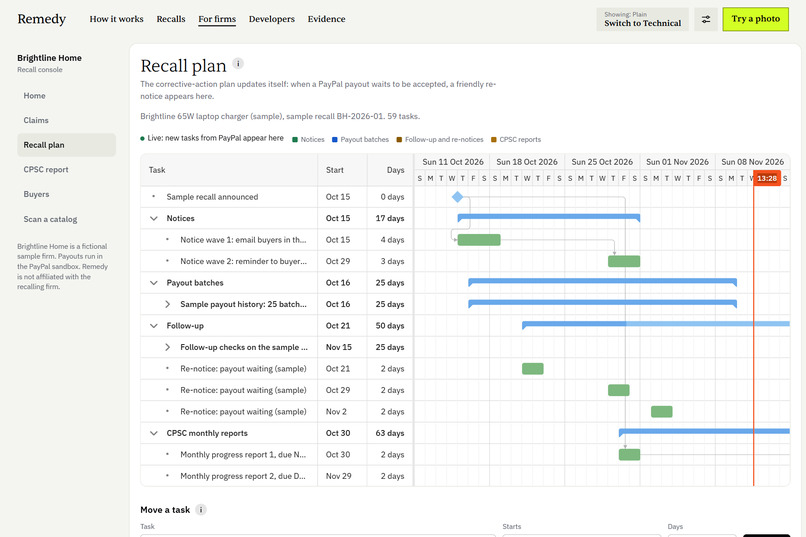
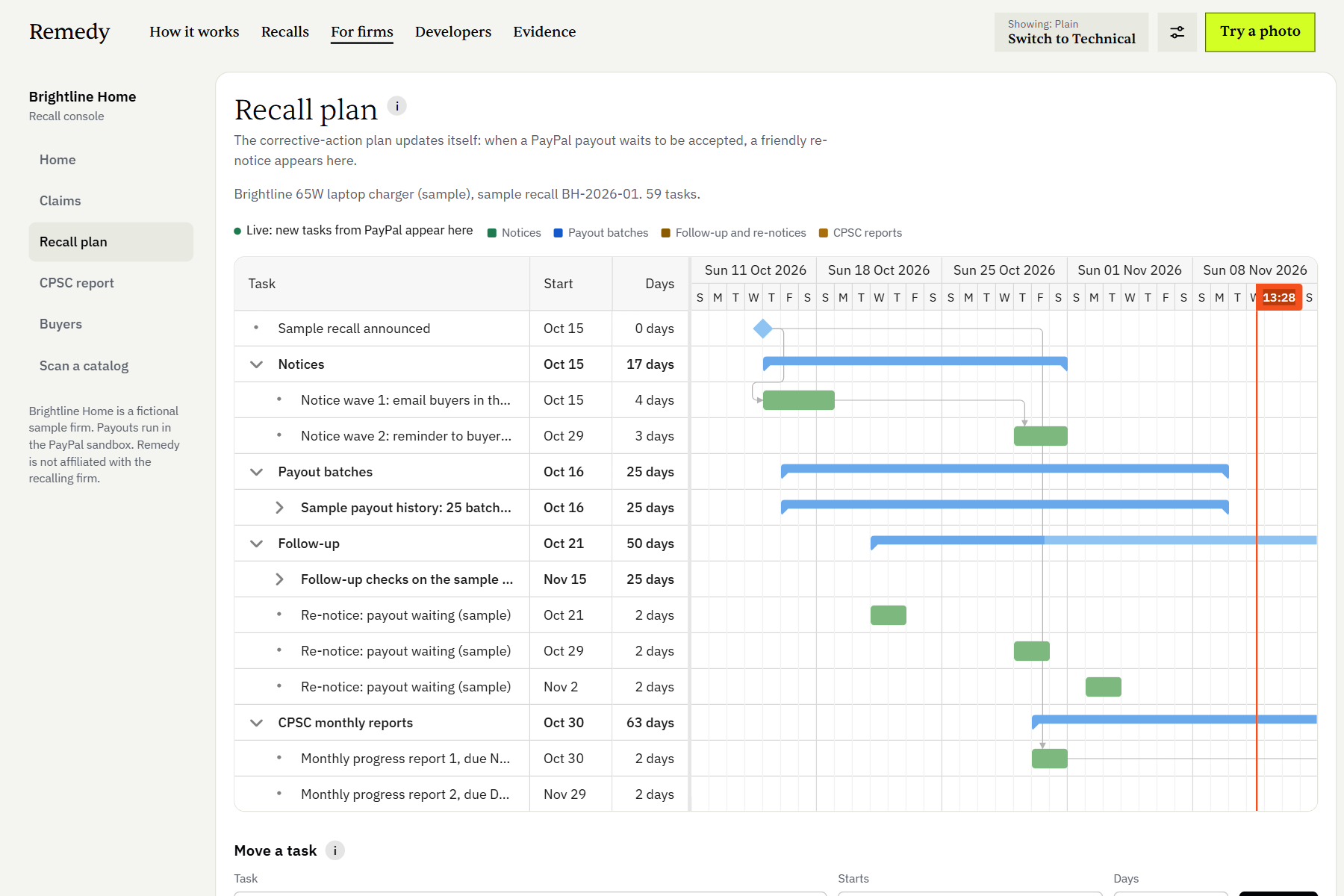
The recall plan (Bryntum Gantt): a PayPal payout nobody claims becomes a re-notice task automatically.
-
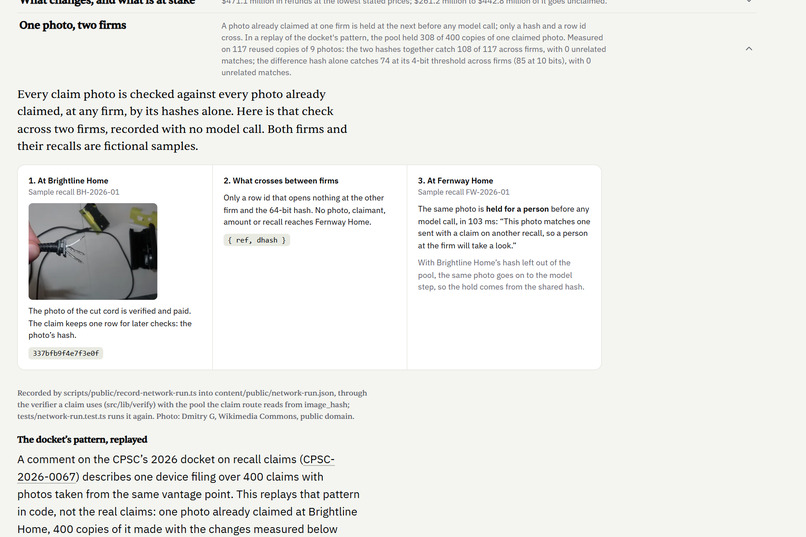
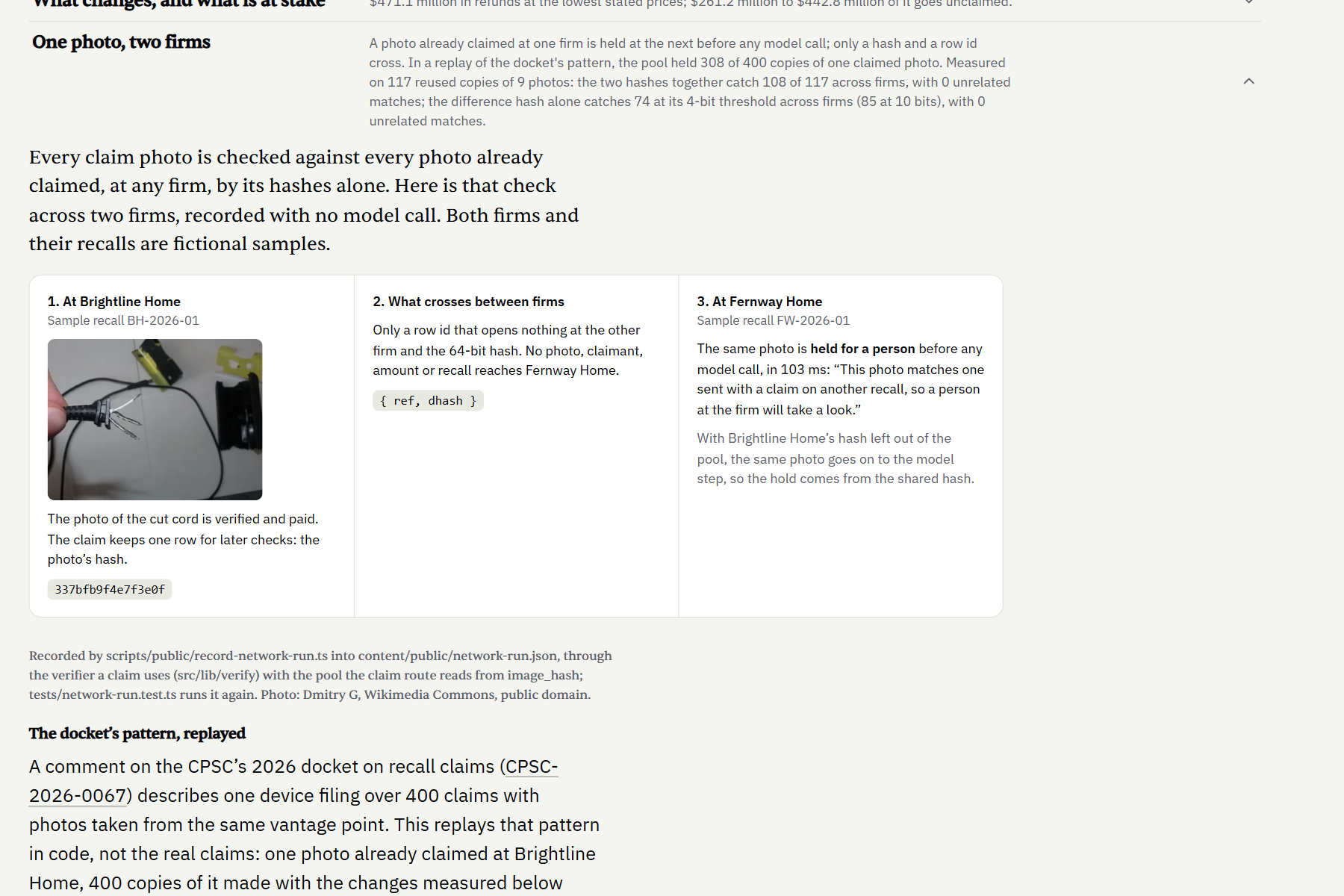
One photo, two firms: firms share only a photo's fingerprint, so a reused photo is held before any AI call.
-
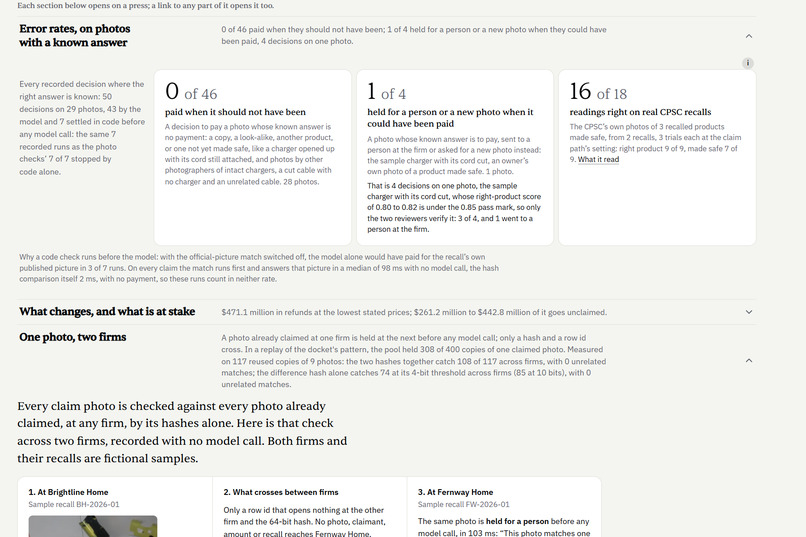
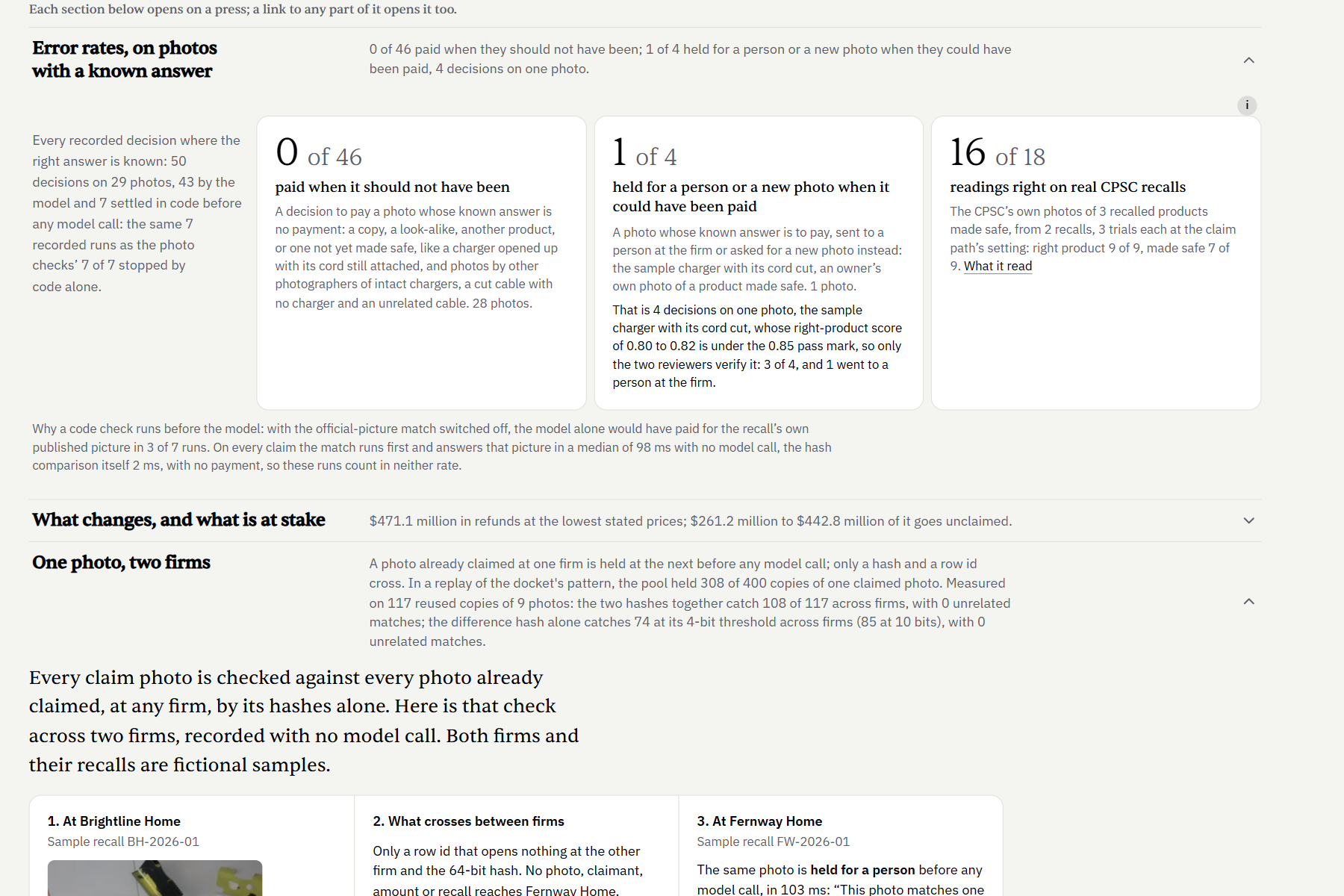
Measured: 0 of 46 decisions paid wrongly, on 28 photos with a known answer.
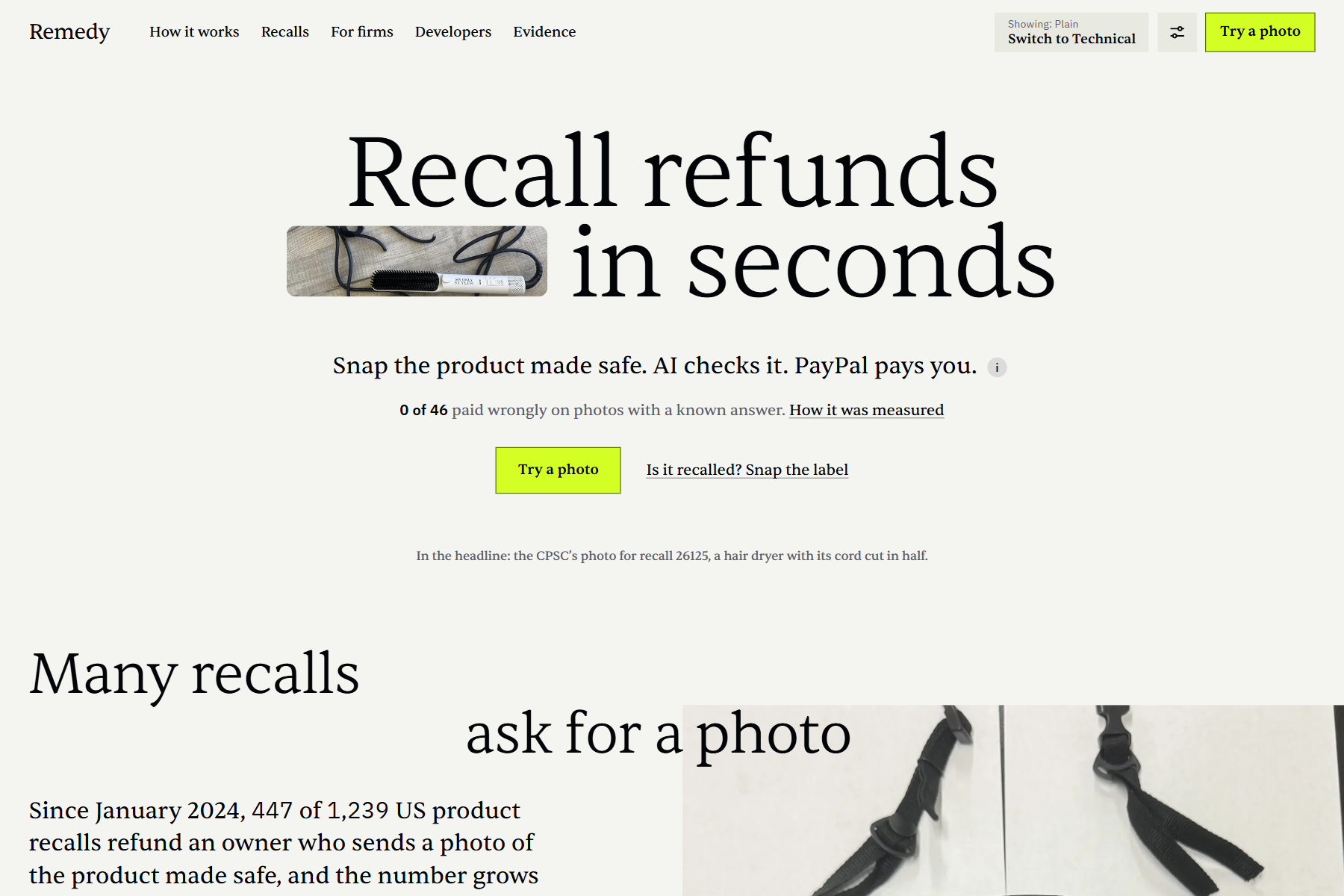
Remedy pays recall refunds through PayPal in seconds, once one photo shows the recalled product made safe. It is for the owners of recalled products and the firms that recall them.
Try it in 30 seconds: on the live site, press Try a photo, then Run it on the first photo, then Send $34.99 to the sandbox buyer: a real PayPal sandbox payout, with its receipt.
Inspiration
Many product recalls ask owners to make the product safe, for example by cutting the cord, and send one photo to get their money back. Since January 2024, 447 of 1,239 US consumer product recalls work this way, offering $471.1 million in refunds at the lowest listed price (CPSC Recalls API).
The process lets owners down:
- It is slow. One large recall claim portal says it pays by check in 10 to 15 business days.
- Few owners hear about it. Almost 70% of Americans had not heard of a recall for anything they own in five years (Consumer Reports).
- Photos are easy to reuse. Comments on the CPSC's April 2026 request for information on recall claims (91 FR 20138) describe 767 registrations under one name and one device filing over 400 claims.
Research says a full, simple remedy gets more people to act. Across 338 CPSC recalls, correction rates were 11.4% higher with a full remedy than a partial one (Raithel, Hock and Mafael, 2024). A simpler notice raised claiming of a tax credit from 14% to 23%, and to 31% when it showed the amount (Bhargava and Manoli, 2015).
We wanted recall refunds to move at PayPal speed, with checks a recalling firm can trust.
What it does
For owners
- Is it recalled? Snap the label. Photograph the product's label. Claude reads the brand, model number and UPC, and code finds the recall in the official list.
- Make it safe, snap one photo. The claim page shows the recall's steps in plain words. No account needed.
- Six checks, in plain words: right product, made safe, your own photo, within the recall, claim limits, not already refunded. Code catches copied photos first, Claude vision compares the photo with the official CPSC pictures, and two Claude reviewers look when it is close.
- PayPal pays. The refund goes back to the original PayPal purchase when possible, otherwise as a PayPal payout. The receipt shows PayPal's payout ID and status.
For recalling firms
- A claims queue: every claim, its photo and its checks. Ready claims are approved together and paid in one PayPal Payouts batch. Hard cases wait for a person, and nothing is paid until they decide.
- A recall plan and the CPSC monthly report. A payout nobody claims becomes a re-notice task automatically.
- Fraud stopped across firms. Firms share a fingerprint of each claimed photo, never the photo itself, so a photo reused at another company is caught before any AI call.
For agents and retailers: an MCP server with eight tools, a catalog scan API and a recall badge for product pages.
Brightline Home and Fernway Home are fictional sample firms. On real CPSC recalls, a PayPal sandbox account stands in for the recalling firm, so no real money moves.
How we built it
PayPal (sandbox)
- Payouts, single and in batches, and Refunds back to the original capture.
- Orders v2 and the JavaScript SDK v6 for the sample shop.
- Transaction Search to find buyers who paid the firm with PayPal, and Disputes checked before any refund.
- Webhooks: an unclaimed payout becomes a task in the firm's plan.
- PayPal's MCP server to read the purchase's order, and the PayPal Server SDK generated by APIMatic for every Orders and Payments call.
AI
- Claude Opus 5.5 read all 583 photo-refund recall notices into proof rules in one Message Batches run, for $14. It checks each photo with vision, runs two reviewers that read different sources, and reads product labels.
- Claude Haiku 5.5 writes the firm's monthly report summary from numbers counted in SQL.
- Plain code decides the money: who is paid, how much and by which route.
Also: Elastic for recall search (with Jina embeddings), AG Grid for the claims queue, Bryntum Gantt for the recall plan, Channel3 for safe replacement products, and Render for the web service, worker, cron job and Postgres. Built with Next.js and TypeScript on the public CPSC Recalls API.
Challenges we ran into
- The recall's own picture. Without a check in code first, the model alone would have paid for the recall's own published photo in 3 of 7 runs. So a fingerprint match runs first on every claim, in milliseconds.
- Close calls. Our sample photo scores just under the pass mark. Instead of lowering the bar, two Claude reviewers look, and if they disagree a person decides before anything is paid.
- Photos reused across companies. One fingerprint caught 74 of 117 reused copies. Adding a second raised it to 108 of 117, with no false matches.
Accomplishments that we're proud of
- 0 of 46 decisions paid wrongly, on 28 photos with a known answer.
- 16 to 19 seconds from approval to a PayPal payout in 12 sandbox runs, against 10 to 15 business days by check.
- In a simulated attack of 400 altered copies of one photo at two firms, 308 were stopped before any AI and none was paid.
- Snap the label finds the right recall for 2,201 of 2,216 label readings, and no recall for 511 of 511 products that are not recalled.
- Both sides of a complete product: the owner's claim to receipt, and the firm's queue to report.
What we learned
- Put the cheap check first. A fingerprint comparison takes milliseconds and stops copies a model might accept.
- Split reviewers by source, not by model. Our two reviewers read different evidence: the official pictures and the remedy text.
- Pay back the way it was paid. PayPal's refund window makes the original purchase the natural first route.
- An unclaimed payout is a task, not a dead end.
What's next for Remedy
- A 30-day pilot with one small firm on an open photo-refund recall, measuring the claim rate and the time to refund.
- Onboard firms through PayPal Partner Referrals and go live.
- A fee per finished claim, proposed at $1.00. With PayPal's $0.25 payout fee, a refund would cost the firm $1.25, against $2 to $4 for a paper check.
Built With
- ag-grid
- anthropic
- apimatic
- bryntum
- channel3
- claude
- claude-vision
- elastic
- jina-ai
- message-batches-api
- model-context-protocol
- next.js
- paypal
- paypal-disputes
- paypal-javascript-sdk
- paypal-mcp-server
- paypal-orders-v2
- paypal-payouts
- paypal-refunds
- paypal-server-sdk
- paypal-transaction-search
- paypal-webhooks
- postgresql
- render
- typescript
