-
-
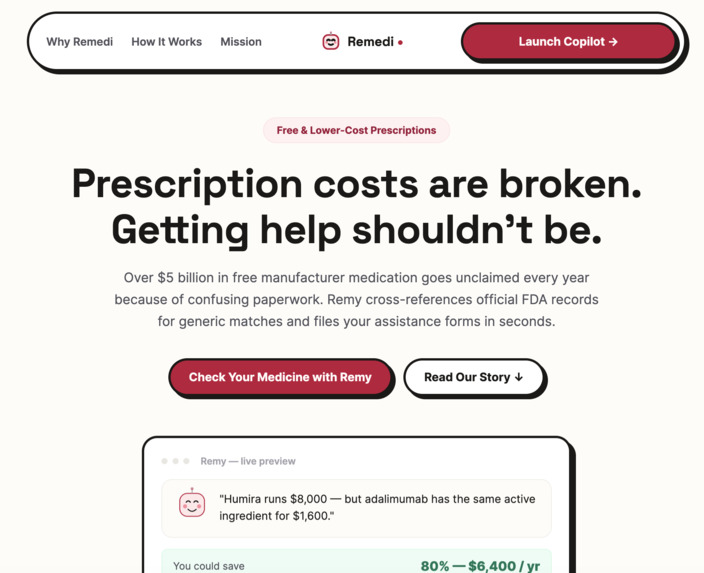
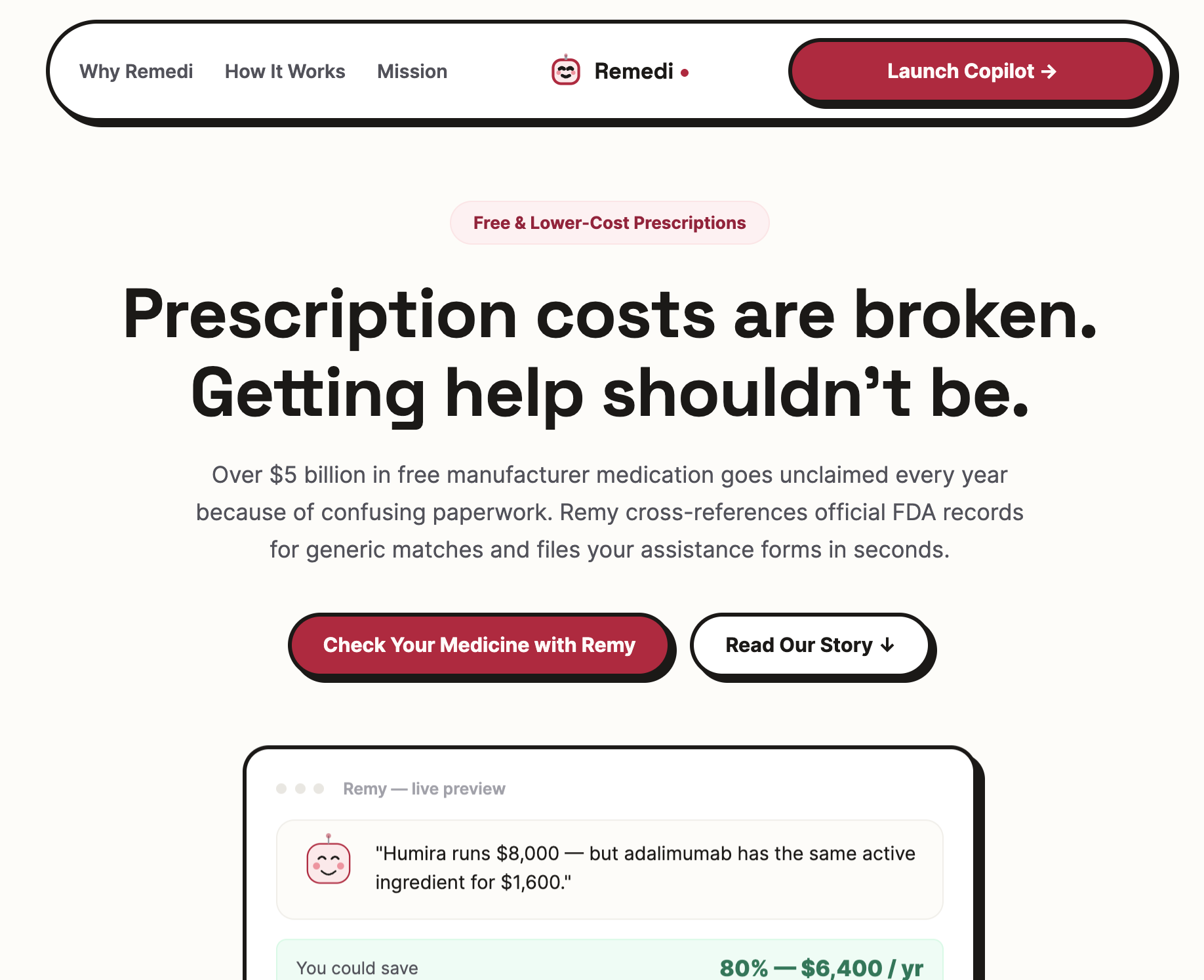
Landing Page
-
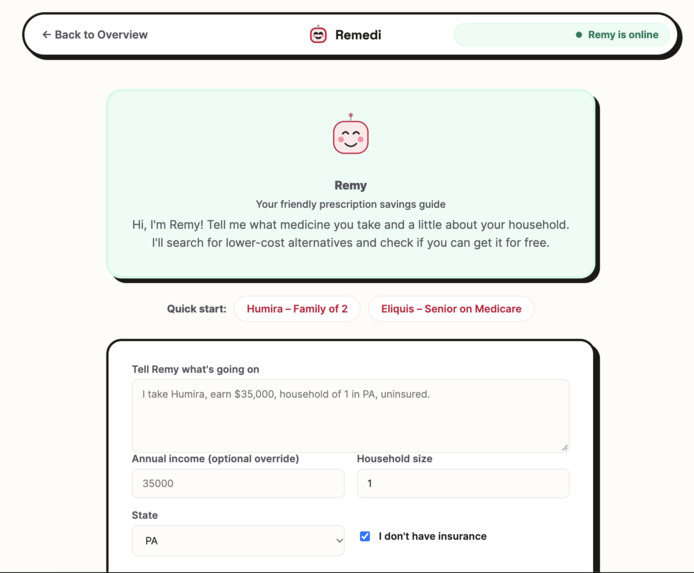
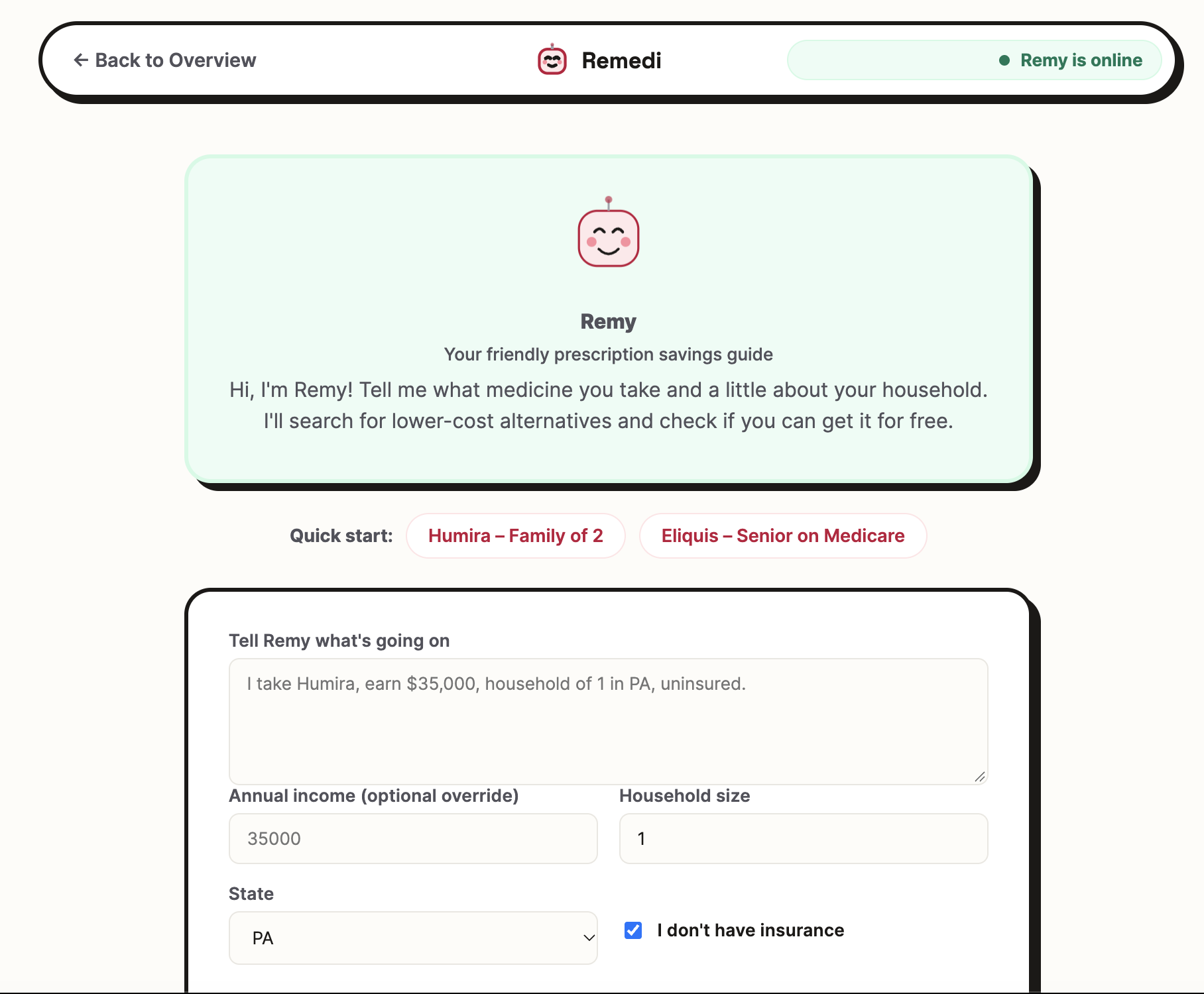
Chatbot Page
Inspiration
Prescription costs are personal to me. My family spends a significant amount on prescriptions each year, so medication affordability has always felt like a real household concern.
That made me wonder how many people are paying more than they need to because finding help is so complicated. Lower-cost alternatives and assistance programs exist, but accessing them can mean searching medication databases, interpreting income requirements, and working through unfamiliar paperwork.
I built Remedi to make that process easier. I wanted someone to be able to say, “I’m struggling to afford my medication,” and get help understanding their options, checking potential eligibility, and preparing their next step, all through one conversation.
What it does
Remedi is an AI-powered medication assistance copilot that helps users explore lower-cost alternatives, screen for assistance programs, and prepare application paperwork through one conversation.
Users explain their medication and household situation to Remy in everyday language. Remy retrieves relevant catalog information, runs savings and eligibility calculations, and translates the results into an actionable explanation.
The conversation continues beyond the first answer. Users can ask what to discuss with their doctor or how a change in household income could affect their screening. Remedi carries that context forward and can generate a prefilled assistance document for review with a healthcare professional.
The result is a connected workflow from an initial question to a downloadable document.
How we built it
I built Remedi around a three-stage LangGraph workflow: structured extraction → tool execution → grounded response generation.
The OpenAI API, integrated through LangChain, supports natural-language understanding and conversational explanations. Dedicated Python tools perform medication-savings comparisons and Federal Poverty Level calculations, including state-specific guidelines and household-size adjustments.
That separation is central to the architecture. I implemented guardrails that keep financial calculations outside the language model and instruct it to explain the data returned by its tools. Pydantic validates structured requests, while automated tests check calculations, graph transitions, and expected figures in generated action plans. These controls make the numerical results traceable and reduce reliance on unconstrained model output.
FastAPI exposes the triage, contextual chat, program-catalog, and PDF-generation endpoints. SQLAlchemy manages medication and assistance-program relationships in SQLite, supported by database migration and idempotent seeding logic. An asynchronous OpenFDA integration retrieves medication records and supports upserts without duplicating existing entries.
The frontend uses HTML, CSS, and JavaScript. ReportLab generates assistance PDFs in memory, allowing users to download and preview a document without writing temporary PDFs into the application directory.
Challenges we ran into
The hardest engineering problem was balancing conversational flexibility with numerical consistency.
A user can describe income, insurance status, and household details in many different ways. Remy needs to interpret that language, but the same underlying facts must lead to the same calculations. I addressed this by separating extraction, computation, and explanation into distinct stages with testable responsibilities.
Context introduced another challenge. A follow-up such as “What if my income increases?” needs to retain the relevant household details while recalculating the changed value. That information also needs to stay consistent across the conversation, eligibility results, and generated document.
It was equally important to communicate the limits of the results. Catalog prices are comparisons rather than personalized pharmacy quotes, eligibility is preliminary screening, and the generated PDF is a preparation document rather than an official manufacturer application.
Accomplishments that we're proud of
I’m proud of building a complete experience where the conversation leads to a useful output. Remedi connects medication lookup, savings analysis, assistance screening, contextual follow-up, and document generation in one interface.
The implementation is backed by 40 passing automated tests covering financial calculations, database behavior, agent workflows, chat responses, API endpoints, and PDF generation.
I also verified the browser journey from submitting a medication scenario to reviewing savings, asking follow-up questions, and downloading a populated PDF. A live OpenFDA lookup succeeded as well.
Beyond the interface, I’m proud of the architectural decisions that make the project inspectable: explicit workflow stages, validated inputs, deterministic calculations, and tests that connect tool outputs to user-facing explanations.
What we learned
I learned that the strongest role for AI in this project is helping people navigate complexity while relying on software tools for precise calculations.
Building Remedi required thinking beyond individual responses. The medication data, screening logic, conversation context, and generated paperwork all need to agree. A helpful explanation loses its value if the next step uses different information.
I also learned that trust comes from making the reasoning understandable. Showing how household income relates to a program threshold gives users something they can question, update, and discuss with a professional.
What's next for Remedi
My long-term goal is to grow Remedi into a medication-access platform that supports people beyond the initial search.
The first step is broader, maintained coverage: more medications, more assistance programs, source-linked eligibility rules, and clear timestamps showing when information was last verified. I want to investigate pharmacy-pricing and coverage integrations so recommendations can reflect a person’s actual options more closely.
Next, I want to build an application workspace where users can save progress, identify missing documents, track deadlines, and receive reminders. Where permitted and technically supported, Remedi could help populate official program forms and guide users through submission requirements.
I also see an opportunity for a companion workspace for pharmacists, clinics, and patient advocates. With appropriate consent, privacy controls, and access permissions, they could help patients review options and coordinate applications.
Multilingual conversations and accessible mobile experiences would make the platform useful to more people. Before expanding into those settings, I want to validate it with patients and healthcare professionals and measure outcomes such as completed applications, time saved, and successful connections to assistance.
The ambition is to help people follow through until they reach the support they need.
Built With
- css3
- fastapi
- html5
- javascript
- jinja
- langchain
- langgraph
- openai
- openfda
- pydantic
- pytest
- python
- reportlab
- sqlalchemy
- sqlite
