-
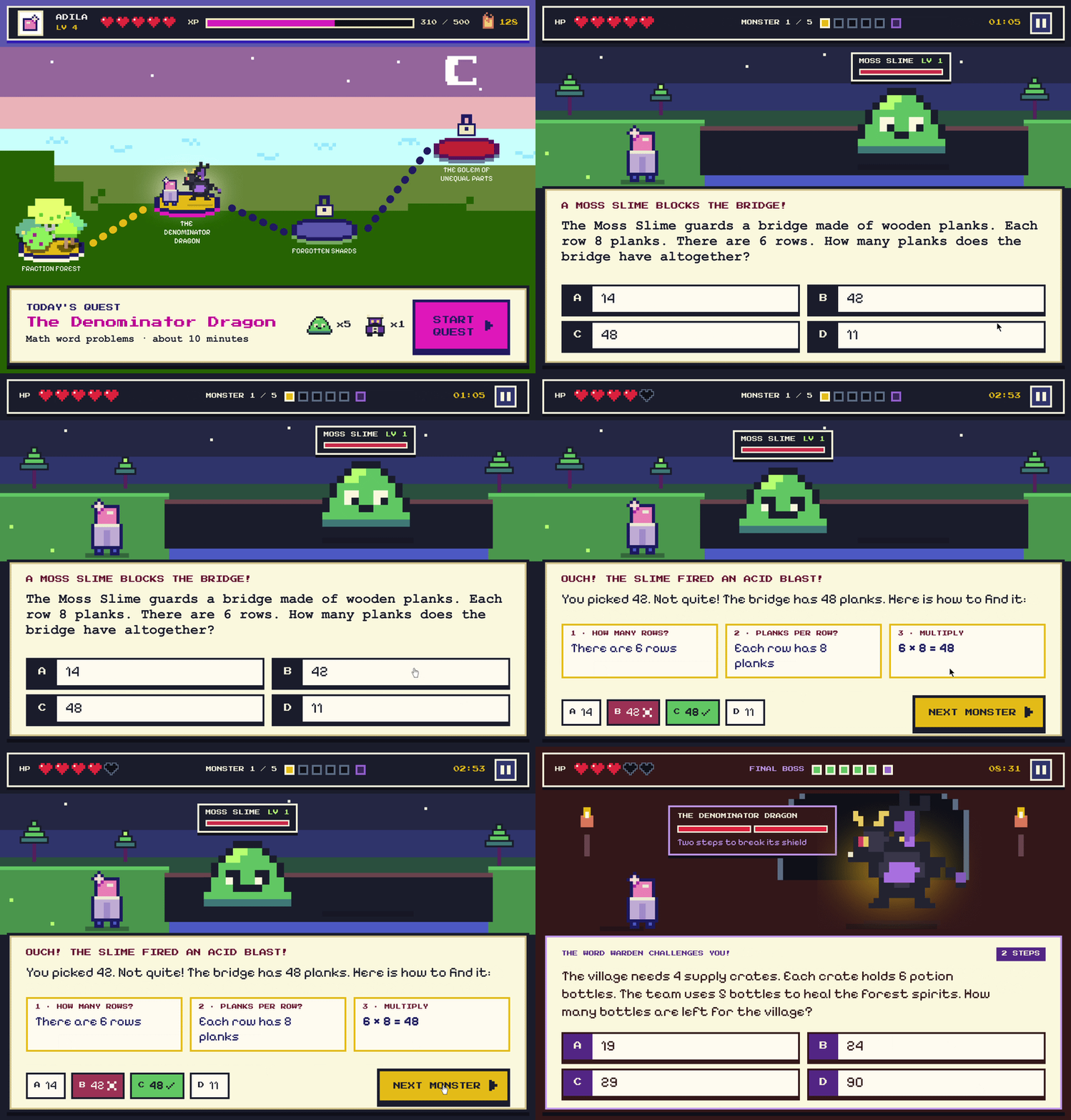
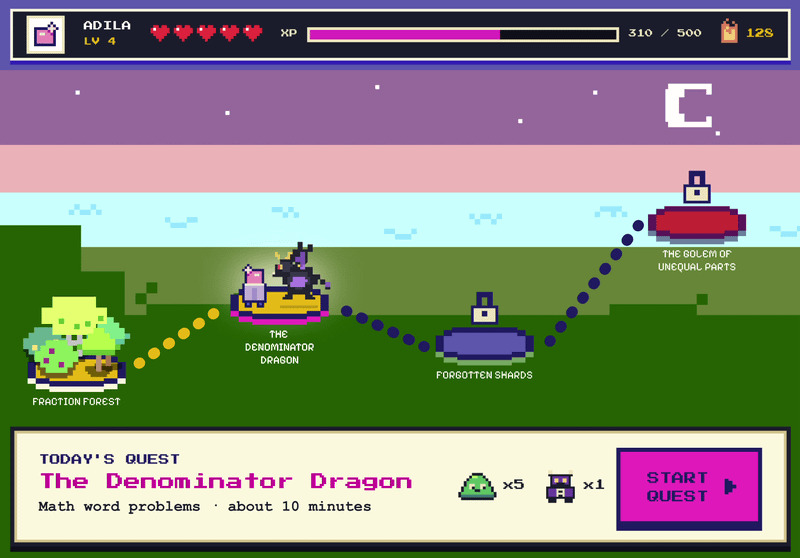 GIF
Student gameplay demo
-
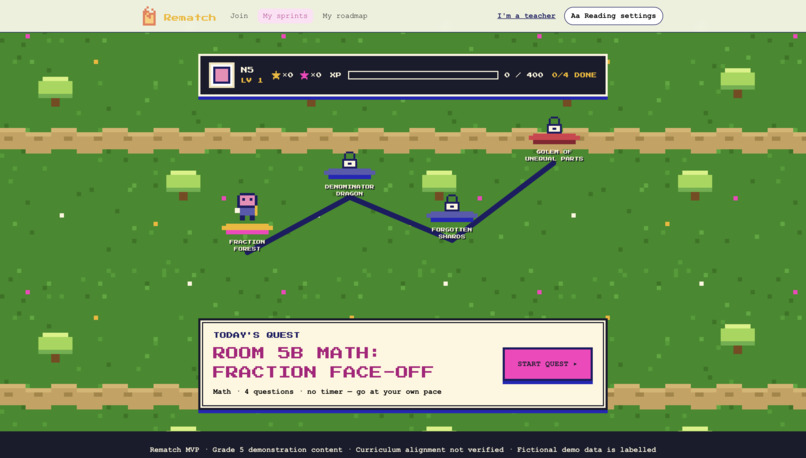
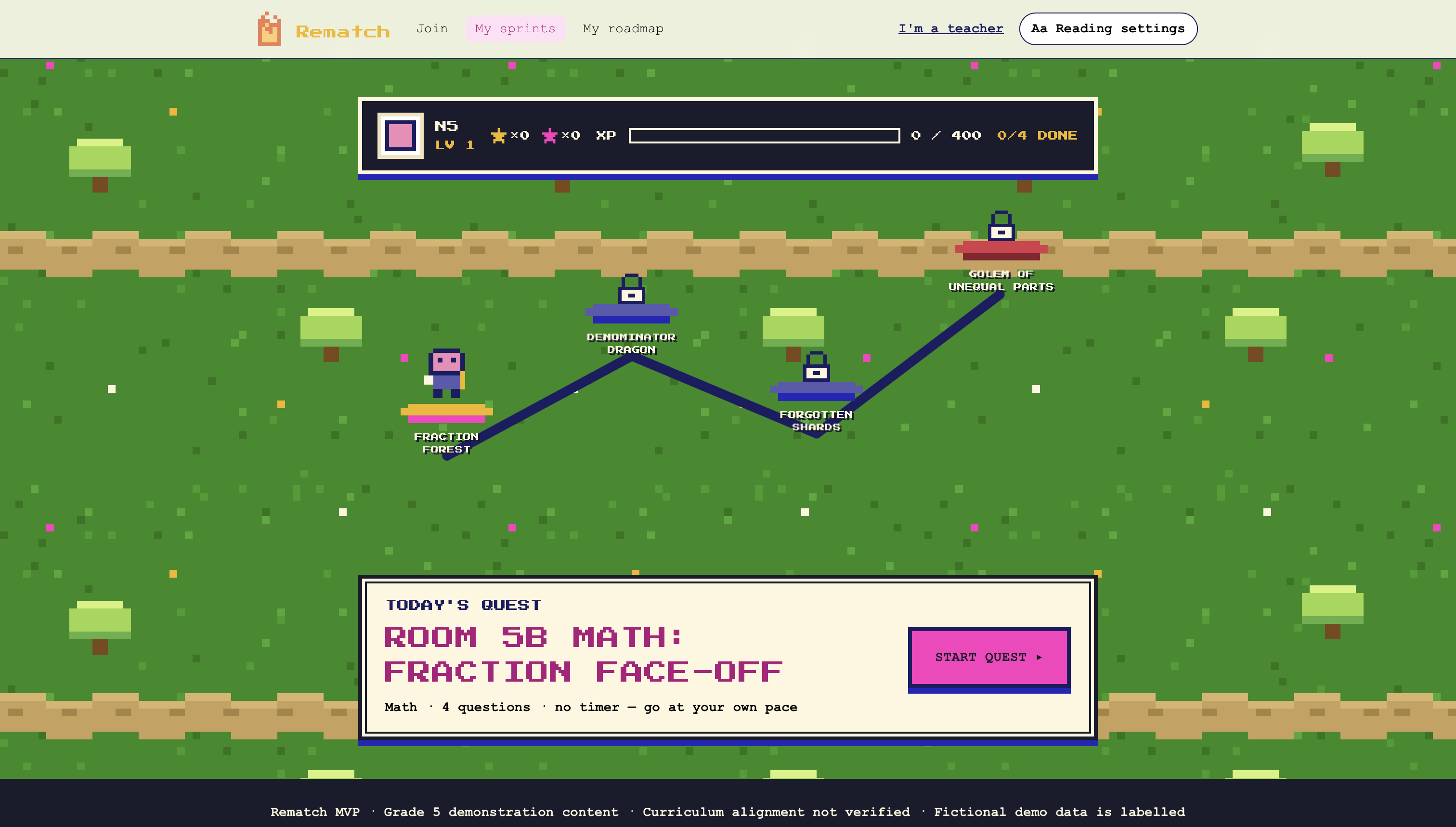
Student landing page
-
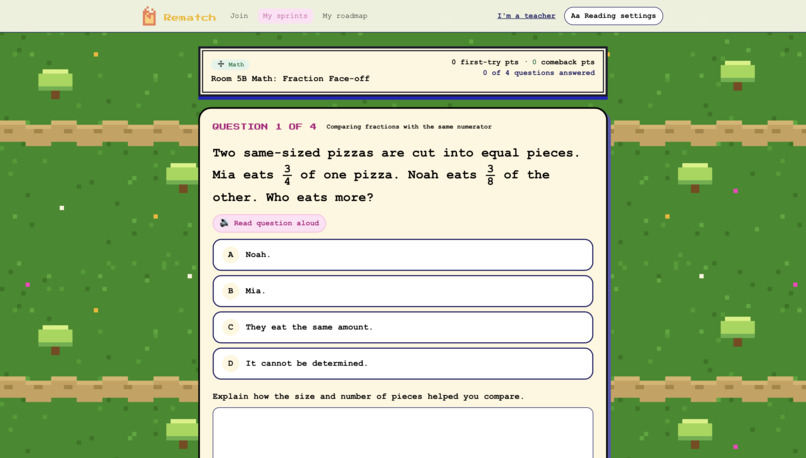
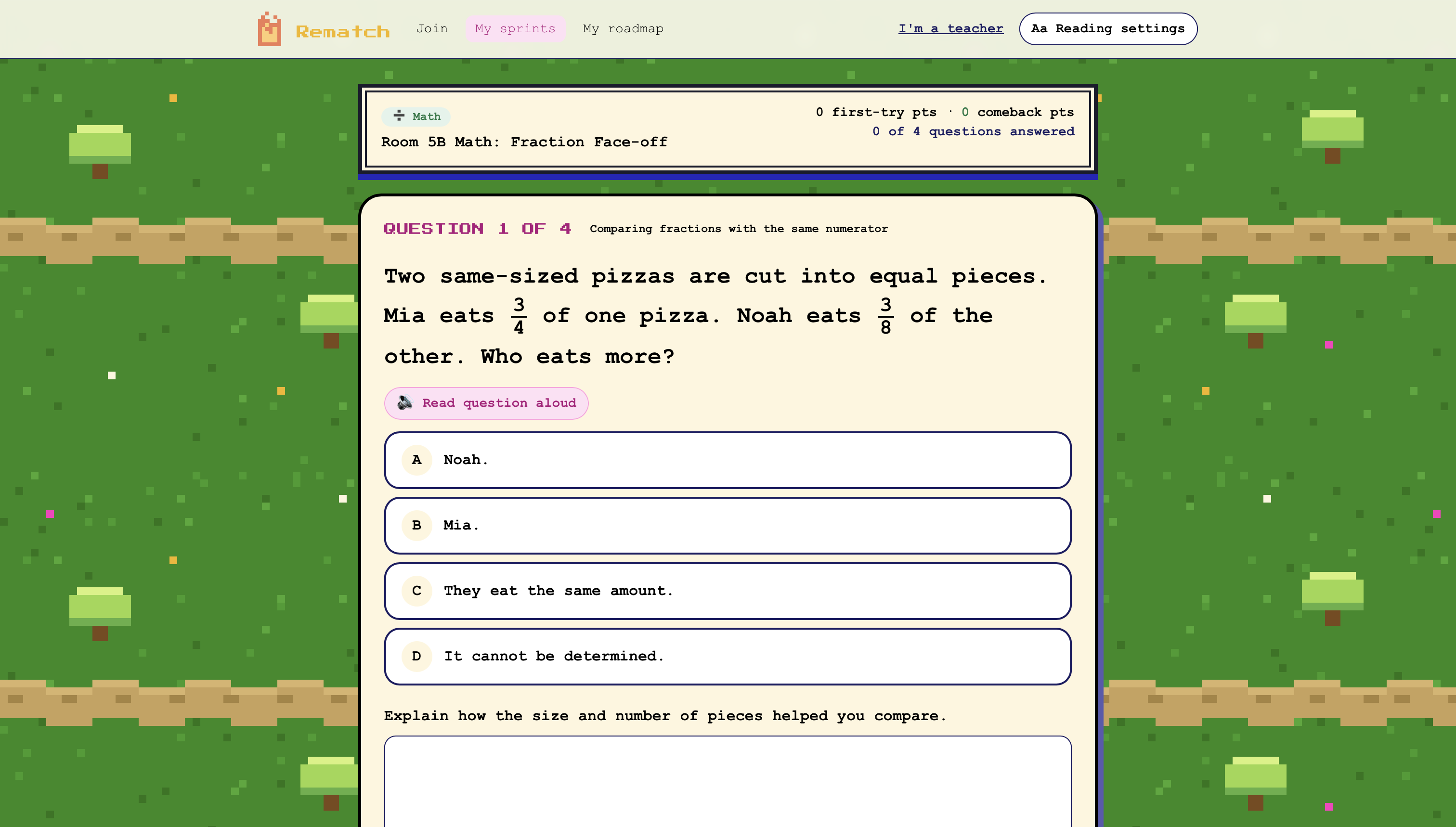
Example Question
-
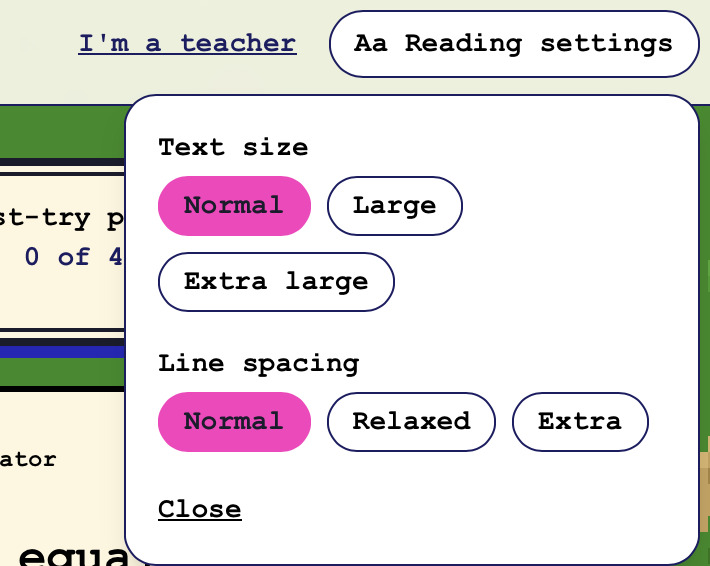
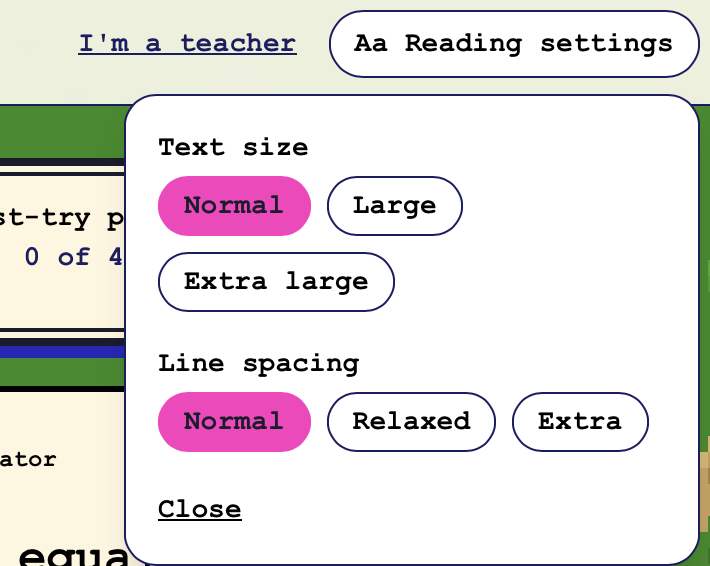
Accessibility settings!
-
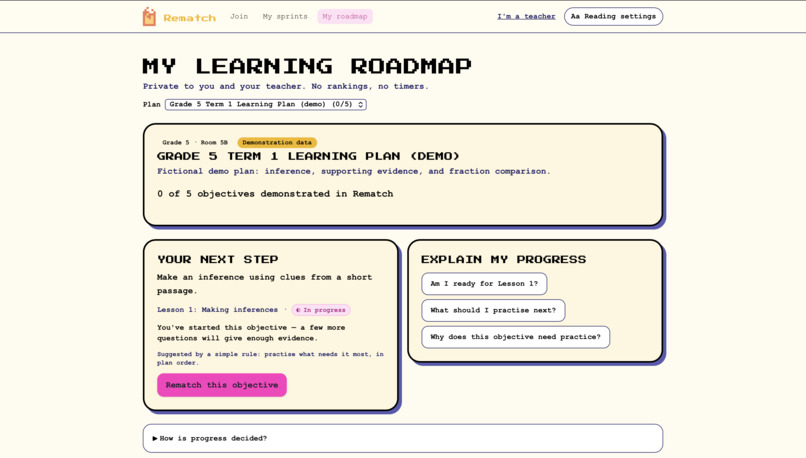
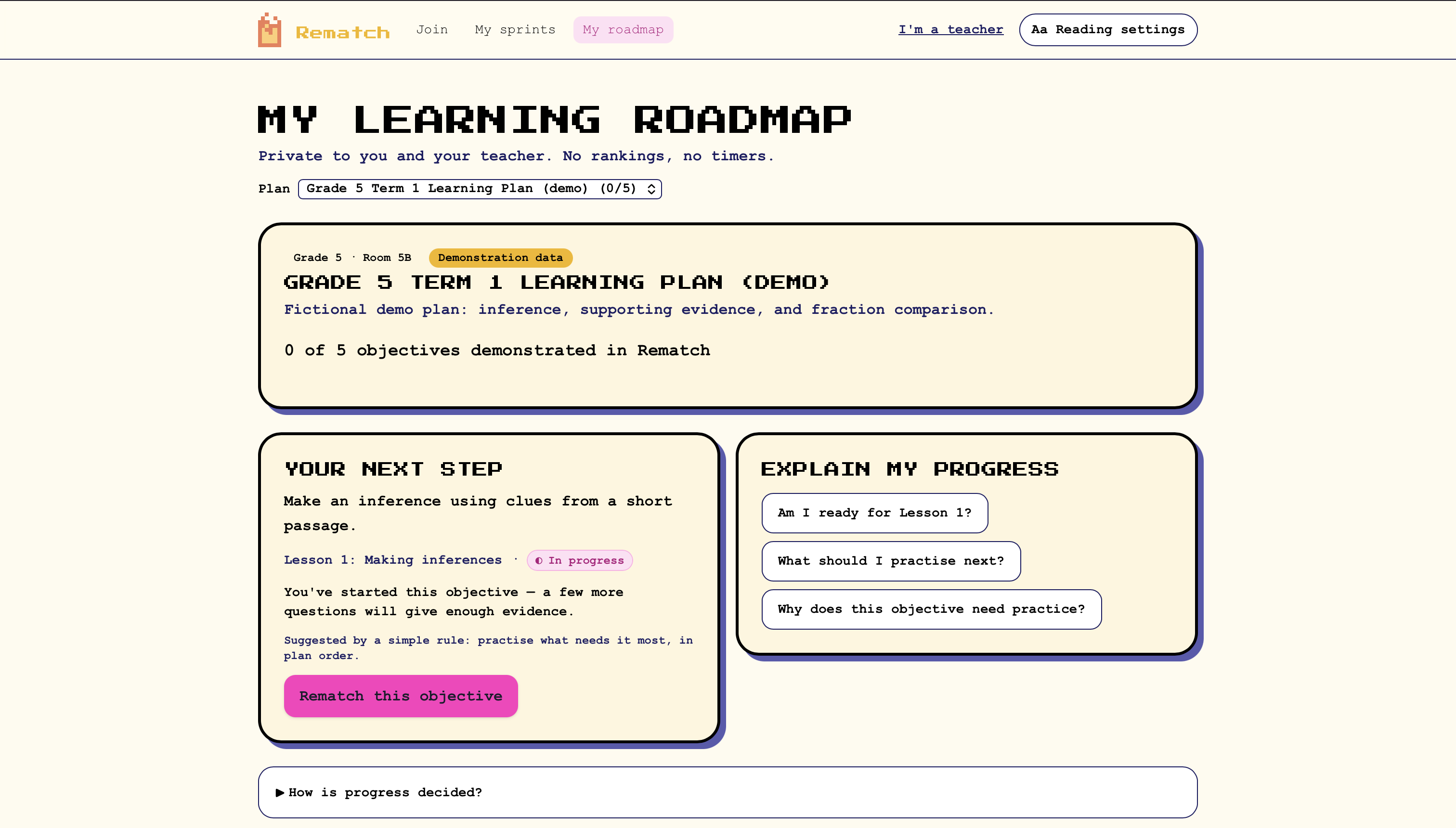
Student-first learning plan with AI tools measuring their learning
-
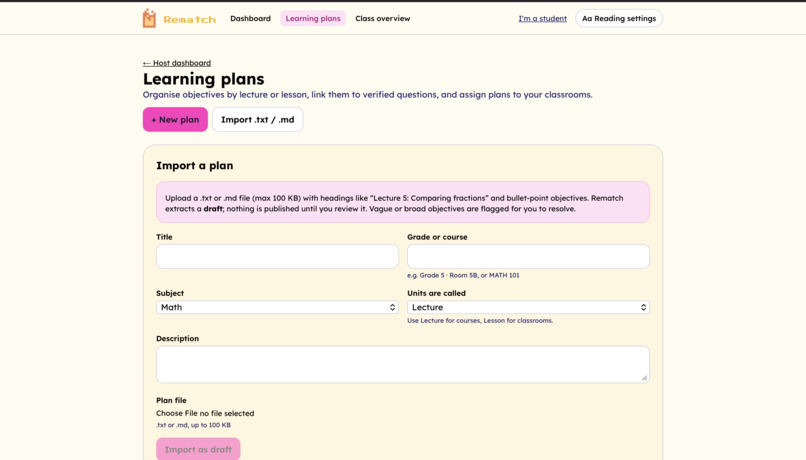
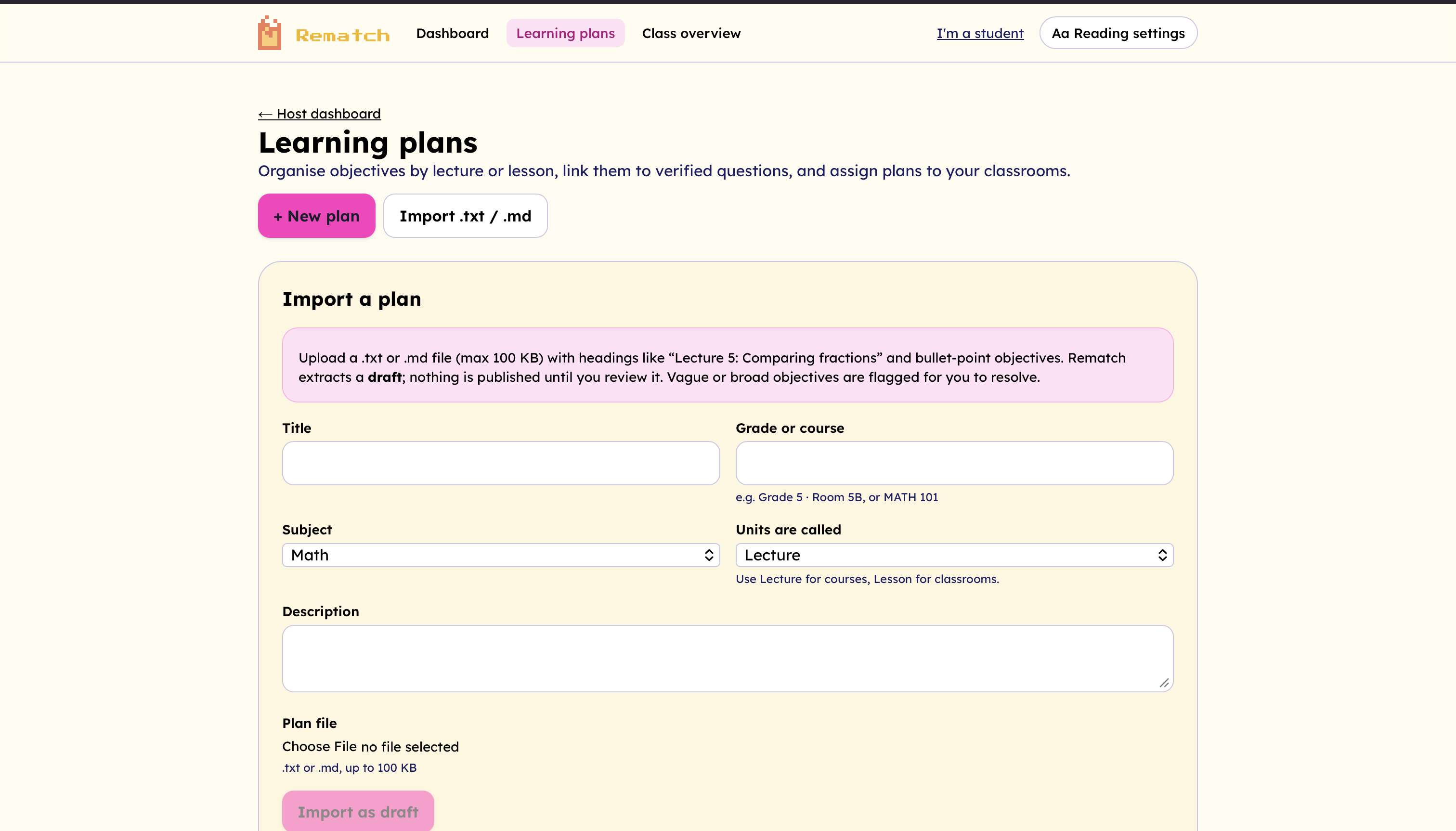
Teachers can upload their lesson plans for students to measure their progress against
-
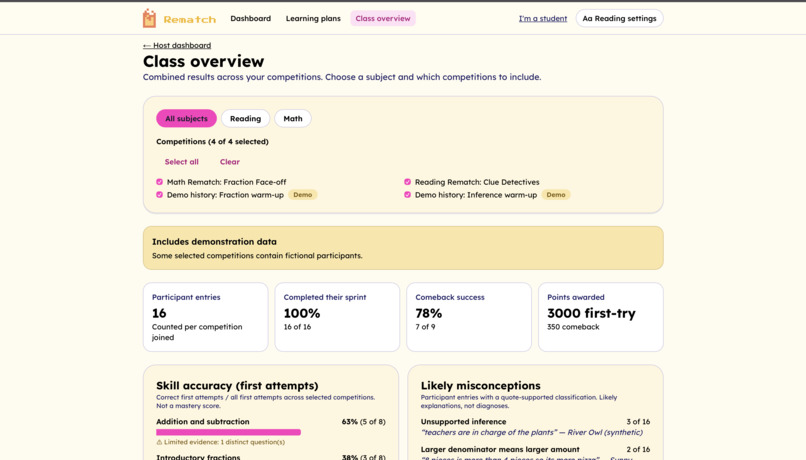
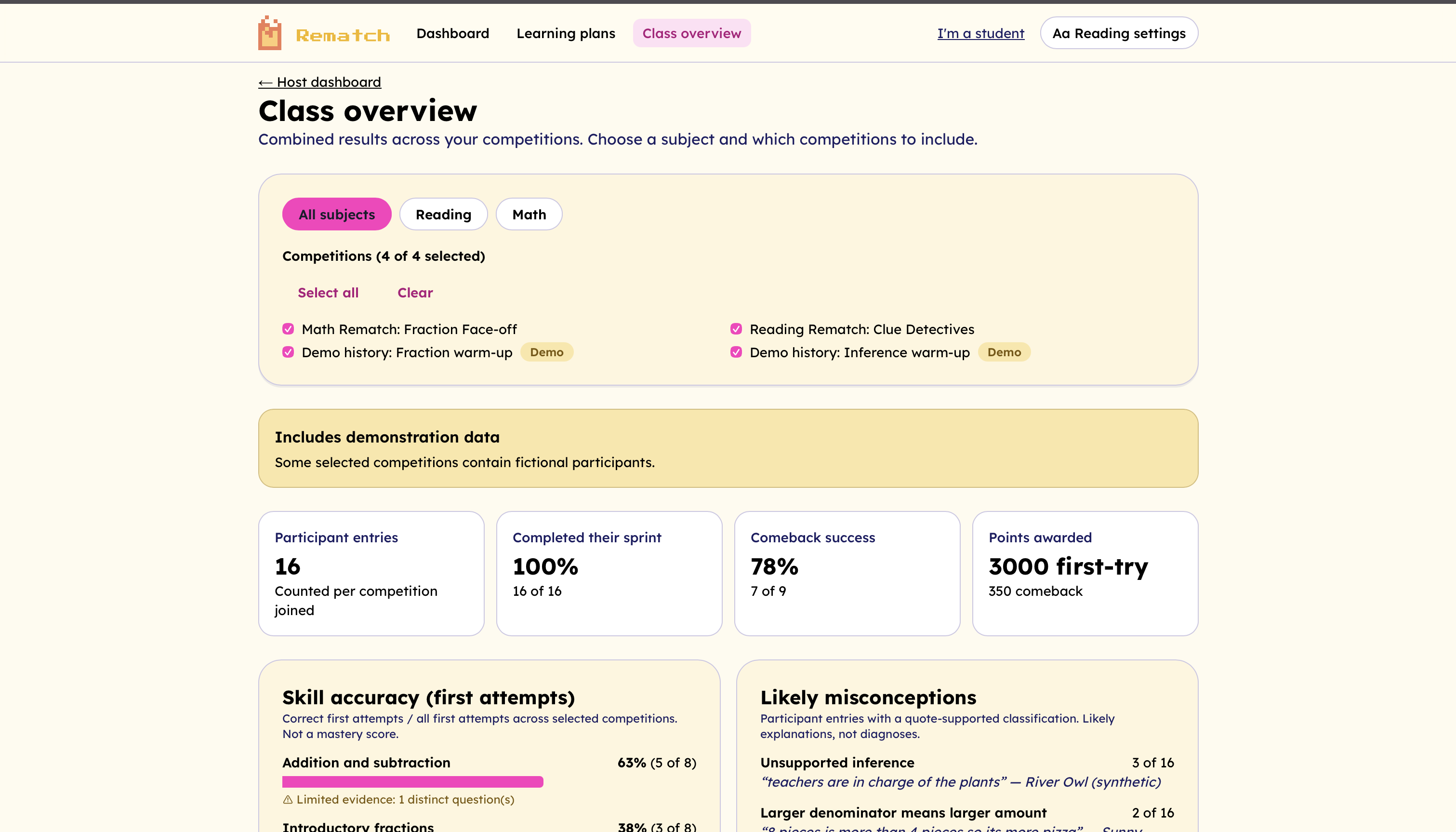
Teacher side class summary
-
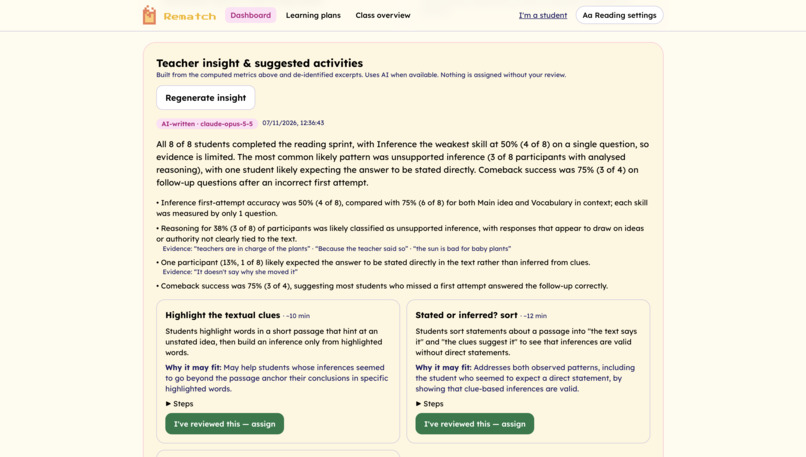
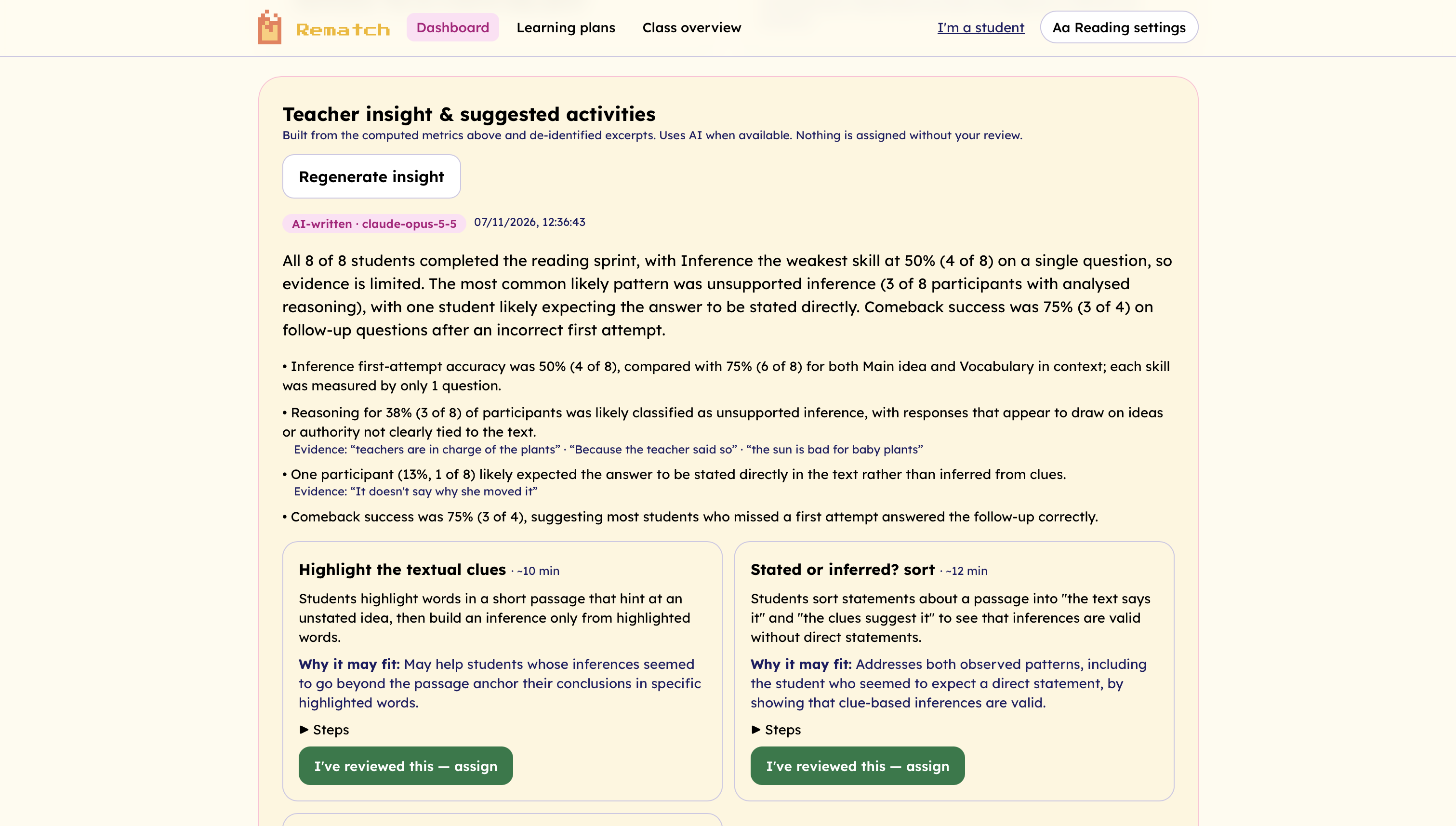
Teacher side AI generated feedback for each class
Inspiration
As students, we know what it feels like to get an answer wrong without understanding what to do next. A score tells you whether you succeeded, but it rarely explains where your thinking went off track.
Our experience organizing educational competitions through CTPC also showed us how engaging challenges can bring students together. We wanted to connect that excitement with something that lasts beyond the competition: meaningful feedback, targeted practice, and a clearer understanding of progress.
That became Rematch: a platform where every mistake deserves another chance.
What it does
Rematch turns short reading and math competitions into a learning loop:
Attempt → Explain → Diagnose a likely misconception → Practise → Rematch.
Students answer a question and explain their reasoning. Rematch checks the answer against a verified key, then uses AI to interpret the explanation. When there is enough evidence, it identifies a likely misconception and provides relevant practice followed by a fresh comeback question.
If the reasoning is unclear, Rematch asks a clarification question rather than guessing.
Our Grade 5 demonstration includes 24 verified multiple-choice questions across reading comprehension and math. Students earn points for correct answers and separate comeback points for successful retries.
Teachers receive classroom insights, supporting student-response excerpts, and suggested activities they can review before assigning.
Students also have My Learning Roadmap. Teachers publish learning plans organized by lecture or lesson and map questions to specific objectives. Students can see what they have demonstrated, inspect the evidence behind their status, and rematch objectives that need practice.
AI at the heart
We designed Rematch to be AI-first without requiring students to learn how to prompt a chatbot.
AI works behind the scenes to interpret reasoning, ask clarification questions, and support personalized feedback. Teachers can click Generate insight to explore classroom patterns and suggested interventions.
We deliberately separate interpretation from measurement:
- AI interprets explanations and communicates insights.
- Conventional code determines correctness, points, routing, analytics, and progress.
- Teachers review recommendations and retain control over instructional decisions.
A specific misconception classification must include a quote that actually appears in the student’s explanation. AI cannot change scores.
How we built it
We built Rematch with Next.js, React, TypeScript, and Tailwind CSS, using server-side API routes to connect the learning experience with our backend.
Supabase provides our PostgreSQL database and host authentication. Our relational schema connects competitions, participants, attempts, AI analyses, teacher insights, and intervention assignments.
Original attempts and comebacks are stored separately, preserving the distinction between initial performance and successful follow-up practice. Versioned learning plans connect progress to explicit question-to-objective mappings.
Vercel hosts the application, with deployments connected to GitHub.
We integrated Claude through the Anthropic TypeScript SDK, using subject-specific classification rubrics. Zod validates inputs and structured AI outputs, while Vitest supports automated testing.
Challenges we faced
One challenge was distinguishing a misconception from a simple mistake. Two students can select the same wrong answer for different reasons, so answer choices alone were not enough. Capturing reasoning, checking supporting quotes, and allowing uncertainty became central to our design.
Another challenge was defining progress responsibly. We implemented a transparent, configurable evidence rule using distinct questions and independent comeback performance. Students see “Demonstrated in Rematch,” rather than an unsupported claim of mastery.
Connecting competitions, teacher analytics, and persistent student roadmaps also required careful data modelling. We needed each experience to reflect the same stored evidence while keeping student records private.
Accomplishments we’re proud of
We built a connected experience spanning student practice, teacher insights, and learning-plan progress.
Our project has 90 passing automated tests covering areas including scoring, routing, access control, analytics, and progress calculations.
On 31 developer-written evaluation examples, Claude’s classifications matched all 31 expected labels, compared with 22 for our rule-based approach. This is a small synthetic evaluation, not a measure of performance with real students.
We also implemented read-aloud, adjustable text size and spacing, keyboard-friendly controls, self-paced participation, and private progress.
What we learned
We learned that useful educational AI needs more than a good response. It needs reliable content, clear evidence, meaningful next steps, and room for uncertainty.
We also learned that teachers and students need different views of the same learning history. Students need an understandable next step; teachers need patterns they can inspect and act on.
What’s next
We want to pilot Rematch with educators to evaluate question quality, classification reliability, student learning, and teacher time savings. We also plan to expand the content bank, conduct screen-reader testing, and verify curriculum alignment.
Our prototype demonstrates the feedback loop. Classroom testing will help us understand its educational impact.
Every mistake deserves a rematch.
Built With
- anthropic-claude
- github
- next.js
- postgresql
- react
- supabase
- tailwind-css
- typescript
- vercel
- vitest
- zod

